
A Brisbane business owner often reaches the same point. The website is live, the service is solid, and referrals still come in, but enquiries feel uneven. One week the phone rings. The next week it goes quiet. Meanwhile, a competitor shows up every time someone searches for the service you offer.
That’s where google ads brisbane becomes practical, not theoretical. It puts your business in front of people who are already looking, whether they need a café nearby, a trades service in a specific suburb, or a quote before the end of the day. For local businesses, that timing matters more than broad awareness.
Google Ads also feels confusing at first because the platform mixes strategy, settings, creative, and budget decisions in one place. Many owners know they should “run ads” but aren’t sure what to choose, what to track, or how to avoid wasting spend. If that sounds familiar, a useful starting point is this PPC marketing Google guide, which gives a broad primer before you narrow into local Brisbane tactics.
A simple example helps. Say you run a café in West End. Foot traffic softens when a newer venue opens nearby. Social posts get likes, but likes don’t fill tables on weekday mornings. A local Google Ads campaign lets you appear when someone nearby searches for “coffee near me”, “breakfast West End”, or “café open now”. That’s a very different kind of visibility. You’re not interrupting people. You’re meeting demand that already exists.
Good campaigns don’t just buy clicks. They connect suburb, search intent, ad message, and landing page. When those pieces line up, Google Ads becomes one of the clearest ways to turn online interest into calls, bookings, visits, and qualified leads.
Brisbane is a local market, but it doesn’t behave like one single place. Search behaviour in New Farm isn’t identical to Ipswich-facing service areas. A law firm in the CBD competes differently from a home services business covering the bayside or northside. That’s why local context matters so much in paid search.
Google Ads is attractive for one simple reason. It reaches people at the moment they’re looking for help, a product, or a place to go. In Australia, 90% of online consumers report that Google ads have influenced their buying decision, and about 63% of internet users have clicked on a Google ad according to Web3’s Google Ads Brisbane overview.
That tells you two things.
For Brisbane businesses, that matters across very different models:
Google Ads uses a pay-per-click model. You pay when someone clicks. That doesn’t guarantee profit, but it does make the system more measurable than many channels. If a keyword drives the wrong traffic, you can pause it. If one suburb converts better than another, you can shift budget.
Local view: Brisbane businesses usually don’t need more visibility everywhere. They need more visibility in the right suburbs, for the right searches, at the right times.
That’s the main benefit. Control.
You can decide:
Those choices are what turn google ads brisbane from “ad spend” into a lead generation system.
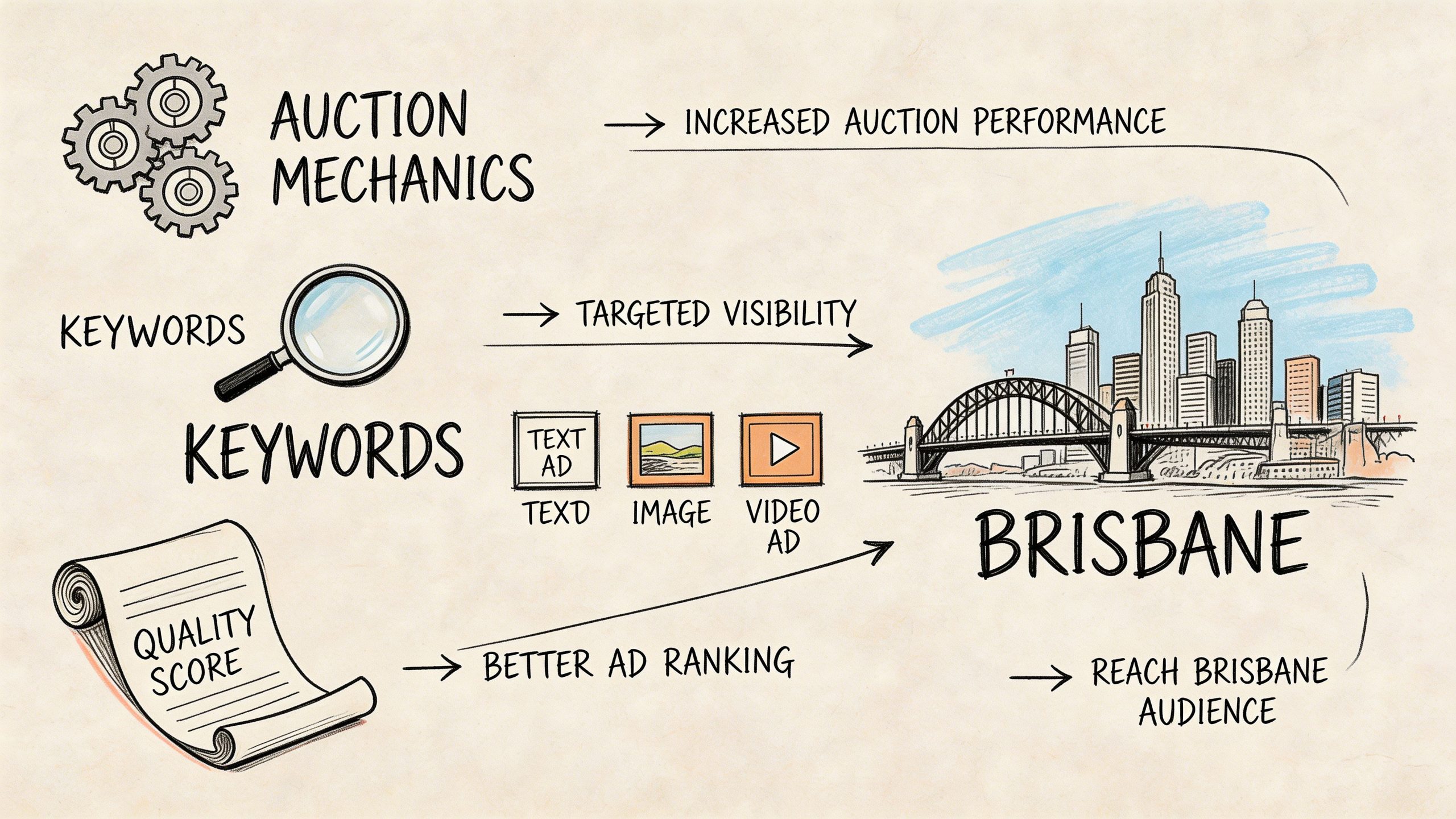
Most confusion starts because several moving parts affect performance at once. It helps to think of Google Ads like a local bidding market with quality control built in.
Keywords are the search terms you want to show for. If you’re a physiotherapy clinic, one set of keywords might reflect high intent service searches. Another set might be broad research queries that don’t lead anywhere.
A useful distinction is intent:
The closer a keyword sits to a real buying or booking decision, the more valuable it usually is.
Every time someone searches, Google runs an auction. New advertisers often think the highest bidder always wins. That’s not how it works in practice. Bid matters, but relevance matters too.
If your ad matches what the user searched for, and your landing page supports that message, you can compete more efficiently. That’s why a smaller Brisbane business can still outrank a larger competitor for specific local searches.
Google Ads isn’t one single ad type. Different formats do different jobs.
| Format | Best suited to | Typical local use |
|---|---|---|
| Search | Active intent | Quotes, calls, bookings |
| Display | Awareness and remarketing | Staying visible after a site visit |
| Maps and local | Physical presence | Directions, call clicks, store visibility |
| Performance Max | Cross-network automation | Broader conversion-focused campaigns |
A Brisbane restaurant, for example, may rely heavily on Maps and local intent. A commercial services firm may lean more on Search. An e-commerce brand may combine Search with broader campaign types.
Google rewards relevance because users reward relevance. If the search says one thing and the ad says another, people don’t click. If the ad promises one thing and the landing page shows something else, people bounce.
That’s where Quality Score becomes important. It’s based on three connected factors:
Those factors influence both cost efficiency and placement quality. For Brisbane businesses in expensive categories, that can have a major effect. According to Warren Digital’s explanation of Quality Score, a 10-15% improvement in Quality Score can reduce CPC by 25-40% depending on industry competitiveness.
That’s why ad copy and landing pages can’t be treated as afterthoughts.
Instead of abstract “marketing benefits”, it’s clearer to connect Google Ads to business outcomes.
SEO can be powerful, but it takes time. Google Ads can place you in front of buyers while your organic presence grows.
You can target where you operate. That matters for electricians, legal firms, clinics, showrooms, and any business with uneven service coverage.
You can track form fills, calls, bookings, and purchases. If something underperforms, you don’t have to guess where the issue sits.
You can test one headline against another, one offer against another, and one landing page against another. That feedback loop is one of the platform’s biggest advantages.
A strong campaign usually wins because it matches intent more closely than competitors do, not because it says more.
Take a Brisbane family law firm. If it targets broad legal terms, traffic may be expensive and mixed. If it groups campaigns by service, writes specific ad copy, and sends each click to the matching page, the campaign becomes easier to optimise. The keywords align with the ad. The ad aligns with the page. The page aligns with the enquiry form.
That’s the foundation of google ads brisbane. Not clever tricks. Alignment.
A campaign can be technically correct and still feel generic. That’s what happens when businesses target “Brisbane” as one flat market and ignore how people search by suburb, distance, and event timing.
Someone searching from Fortitude Valley during lunch behaves differently from someone searching in a residential suburb after work. A campaign should reflect that.
Three local targeting methods are especially useful:
A dental clinic might prioritise nearby searchers during booking hours. A restaurant may push harder around meal windows. A service business may focus on the times when staff can answer calls and convert intent into jobs.
Brisbane has a calendar that changes search behaviour. The mistake many campaigns make is treating all months and all weeks as equal.
According to RankingCo’s Brisbane agency guide, search volumes can spike 150-200% during Ekka and Riverfire, and ROI can improve by 30-50% with event-timed bidding. That’s a strong reminder that local demand isn’t static.
If you sell, serve, host, deliver, or book around those periods, event timing should shape your campaigns.
Examples include:
Practical rule: If Brisbane’s calendar changes how people search, your bids and ad copy should change too.
The goal isn’t to build dozens of tiny campaigns. It’s to shape your budget around local demand signals.
A workable approach looks like this:
Separate core services by intent
Keep always-on campaigns for your main revenue drivers.
Layer local modifiers where they matter
Add suburb names, service areas, and location-specific copy only where they improve clarity.
Create short event windows
Build temporary ad groups or campaigns around key seasonal moments.
Adjust bids by business reality
Push harder where your staff, stock, and capacity can handle the demand.
For businesses operating beyond Brisbane, local lessons often transfer well across South East Queensland. This broader regional page on Google Ads Gold Coast is a useful contrast because it shows how location strategy changes when the search context changes.
Many advertisers set one city target, one schedule, and one generic ad. That setup can still generate clicks, but it often misses the better opportunities hiding inside specific suburbs, event windows, and time-sensitive searches.
Local targeting works best when it reflects how Brisbane people behave, not how an account looks on a spreadsheet.
Choosing a campaign type is where many businesses drift into wasted spend. The platform offers several options, but each one solves a different problem. If you use the wrong one for the job, performance becomes hard to read and even harder to improve.
This comparison helps clarify what each campaign type is for.
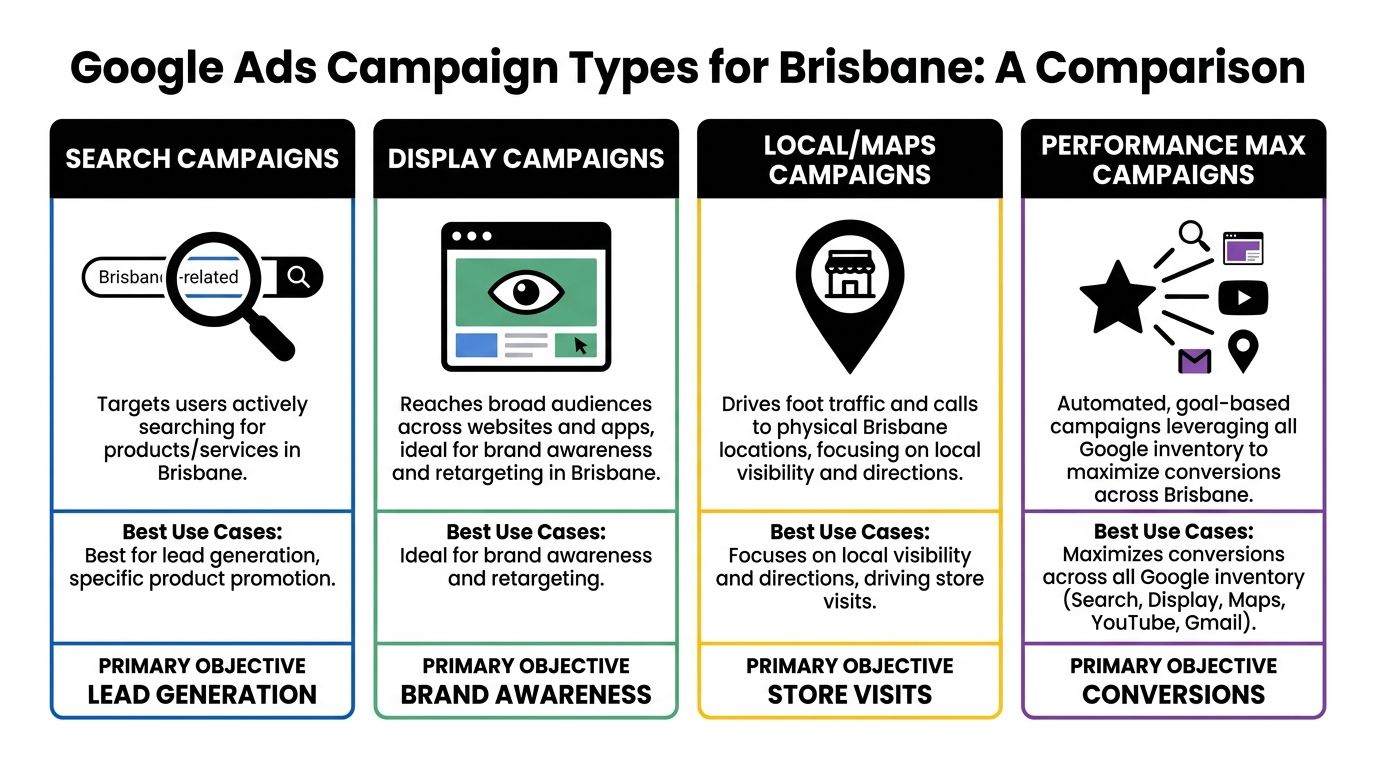
Search campaigns are the most direct option for lead generation. Your ads appear when people type in relevant queries.
That makes them useful for businesses where intent is already clear. Think “commercial cleaner Brisbane”, “accountant near me”, or “roof repair Brisbane northside”. The user has already raised their hand.
Best fit in Brisbane: service businesses, B2B enquiries, urgent local needs, quote-driven offers.
Main strength: high-intent traffic.
Main limitation: if keywords are too broad, you can pay for curiosity instead of commercial intent.
Display campaigns place visual ads across websites and apps. They’re less about capturing active searches and more about staying visible.
For Brisbane businesses, Display can support remarketing well. Someone visits your service page, leaves without enquiring, then sees your brand again later. That repeated visibility can help if the buying cycle isn’t immediate.
Best fit in Brisbane: remarketing, awareness, local brand recall.
Main strength: broad reach and repeated exposure.
Main limitation: weaker intent than Search, so message and audience quality matter a lot.
A local furniture retailer, for example, may use Search for “sofa store Brisbane” and Display to stay in front of site visitors who browsed products but didn’t visit the showroom.
A short explainer can help visual learners compare these formats in context.
Local visibility matters when physical presence affects the sale. Maps-focused placements can support calls, directions, and nearby discovery.
These are often strong for:
For businesses with a storefront, this campaign type supports people who are close to making an in-person decision.
Performance Max is Google’s cross-network automated campaign type. It distributes budget across Search, Display, YouTube, Gmail, and Maps using machine learning. According to RankingCo’s Google Ads specialist Brisbane page, Performance Max can reduce manual management by 60-70% and typically improve conversion efficiency by 15-25% when fed with 50-100 monthly conversions.
That sounds appealing, and often it is, but context matters.
Performance Max tends to work best when a business already has:
If those ingredients are missing, automation can become opaque rather than helpful.
Performance Max is usually strongest when you already know what a good conversion looks like and can feed that signal back into the system consistently.
| Campaign type | Primary objective | Strongest use case | Watch-out |
|---|---|---|---|
| Search | Leads and enquiries | Capturing active demand | Broad keywords can dilute intent |
| Display | Awareness and remarketing | Staying visible after a visit | Lower intent traffic |
| Local and Maps | Store visits and calls | Physical locations | Depends on location signals and local presence |
| Performance Max | Multi-channel conversions | Businesses with strong tracking and enough data | Can feel less transparent |
If you want a simpler way to choose, ask one question first.
What action do you want most?
For many Brisbane businesses, the right answer isn’t one campaign type. It’s a sequence. Search captures immediate intent. Local supports in-market discovery. Display brings back warm visitors. Performance Max becomes more useful once your data quality is strong enough.
Budgeting is where strategy becomes real. A business can agree with every Google Ads principle in theory, then still struggle because budget, bidding, and page quality aren’t working together.
Management fees vary by provider and scope. According to Peke’s Brisbane Google advertising page, freelance Google Ads specialists typically charge AUD $60 to $150 per hour, while agencies generally charge AUD $700 to $5,000 per month, with some setups also requiring minimum ad spend.
That range matters because many businesses confuse two separate costs:
Treating them separately makes budgeting clearer and helps prevent underfunding either side.
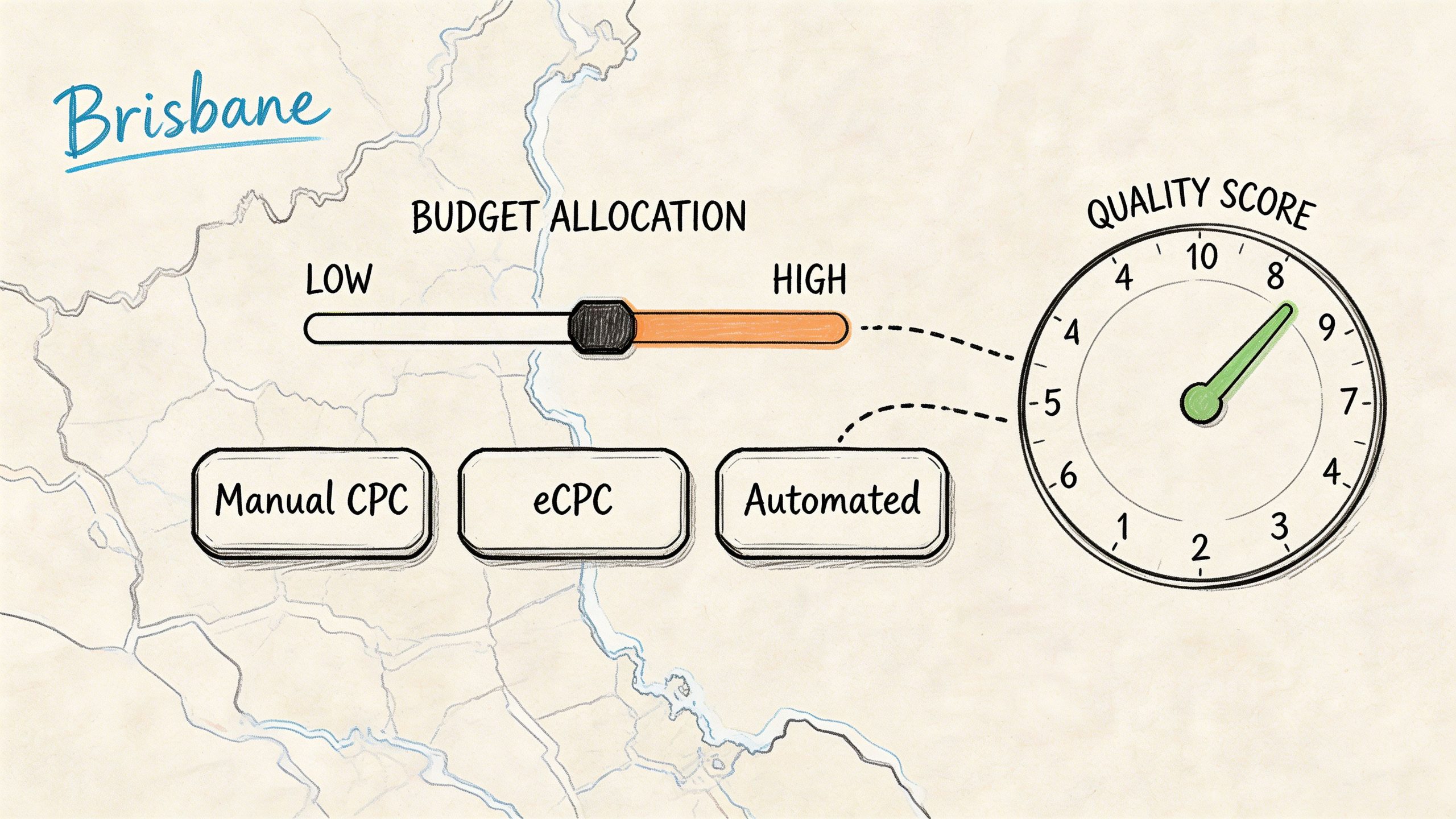
Many advertisers raise bids when results soften. Sometimes that helps. Sometimes it just pays more for the same weak traffic.
A better view is to see bidding and Quality Score as connected. Your bid influences competitiveness. Your Quality Score influences how efficiently that bid performs.
The three diagnostic inputs behind Quality Score are:
If those improve together, the same budget can work harder.
According to the Quality Score source cited earlier, a 10-15% improvement in Quality Score can reduce CPC by 25-40% depending on industry competitiveness. That’s especially relevant in high-cost Brisbane sectors where every inefficient click hurts.
A good budget doesn’t start with a random monthly figure. It starts with how campaigns will earn the right to keep spending.
If one ad group covers too many unrelated terms, relevance drops. Split campaigns by service line, intent, or location where needed.
Someone who searches for a specific service should land on a page about that service, not a generic homepage.
Manual and automated bidding both have a place. If tracking is immature, simpler control can be useful. If conversion data is reliable, automation often has more to work with.
Negative keywords, scheduling, and location controls often do more for efficiency than increasing spend.
Better bidding without better relevance often just makes waste more expensive.
Think in layers, not one total pot.
| Budget layer | Purpose |
|---|---|
| Core spend | Always-on campaigns for your main services |
| Test spend | New offers, new suburbs, new ad copy |
| Improvement spend | Landing page work, tracking fixes, creative updates |
If you need a plain-language walkthrough of how businesses usually approach PPC costs, this explainer on how much Google PPC costs gives a useful budgeting reference point.
The key is this. Don’t judge budget only by what you spend. Judge it by whether your campaign structure, bidding method, and page experience give that spend a fair chance to perform.
A campaign isn’t healthy because it’s getting clicks. It’s healthy when clicks turn into actions that matter to the business.
That sounds obvious, yet many accounts still track activity more carefully than outcomes. If you don’t measure form submissions, calls, booked appointments, purchases, or qualified leads, you can’t tell which parts of the account deserve more budget.
Before editing bids or rewriting ads, define what counts as success.
For most Brisbane businesses, conversions usually include:
A useful rule is to track actions that move the business forward, not just actions that make the dashboard look busy.
You don’t need a giant reporting deck. You need a shortlist that tells you where performance breaks.
This helps you judge whether the ad attracts the right attention.
This helps you judge whether the landing page and offer do their job after the click.
This helps you judge efficiency. If this drifts in the wrong direction, you need to inspect keywords, ad relevance, and landing pages together.
This matters most when you can connect ad spend to real revenue or lead value.
If you want a simple framework for working out cost efficiency properly, this guide on how to compute conversion costs is a useful companion because it breaks down the logic behind the metric.
Optimisation works best when it’s boring and consistent. Not dramatic.
A disciplined routine often includes:
Review search terms
Look for irrelevant intent, weak matches, and missed negatives.
Check device patterns
Some businesses convert well on mobile calls but poorly on mobile forms. Others show the reverse.
Compare landing pages
If one page gets clicks but not enquiries, the issue may sit after the ad.
Test ad copy
Clearer offers, tighter service wording, and stronger local relevance often improve response.
Pause or reduce weak segments
Not every keyword, suburb, or audience deserves equal budget.
The account usually tells you what’s wrong. The hard part is reading the signals in the right order.
The most common optimisation mistake is changing too many things at once. If you rewrite ads, shift bids, change landing pages, and alter targeting in one go, you won’t know what caused the result.
A better approach is controlled change. Test one major variable, monitor the outcome, then move to the next decision. That’s slower than random tinkering, but it produces cleaner learning and better long-term performance.
Brisbane businesses often ask two questions after learning the basics. First, what does good Google Ads management look like? Second, how do you choose the right partner without getting lost in jargon?
The answer to the first question is less glamorous than many sales pages suggest. Good management usually looks like tight local targeting, clear reporting, fast feedback, and campaigns that connect ad intent with landing page intent. It rarely looks like “set and forget”.
You don’t need an agency that says the most. You need one that answers practical questions directly.
Ask these in a discovery call:
How do you structure campaigns for local intent?
You want to hear about search intent, location strategy, and landing page alignment.
What do you report on regularly?
A useful report connects spend to conversions, lead quality, and actions taken.
How often do you optimise?
The account should not sit untouched for long stretches.
Who manages the account?**
Strategy quality depends on the person doing the work, not just the brand name on the proposal.
How do you handle landing page feedback?
Strong Google Ads work usually includes some attention to post-click experience.
For businesses comparing local providers, this page on PPC management Brisbane is one example of the kind of service detail worth reviewing when you assess fit and scope.
A lot of confusion disappears when pricing is laid out plainly.
| Agency Type | Pricing Model | Fee Range | Recommended Ad Spend |
|---|---|---|---|
| Freelancer | Hourly | AUD $60 to $150 per hour | Varies by provider |
| Agency | Monthly retainer | AUD $700 to $5,000 per month | Varies by provider |
| Agency with flat fee model | Monthly flat fee | Starting from AUD $1,000 per month | Some providers recommend minimum ad spend paid directly to Google |
The fee ranges above come from the Brisbane pricing data cited earlier from Peke.
The cheapest option can cost more if reporting is weak, strategy is generic, or no one is watching search terms closely. On the other hand, a higher fee only makes sense if the work is structured, transparent, and tied to commercial outcomes.
A sensible selection process usually weighs:
Many agency pages rely on dramatic growth stories. The problem is that not every published result gives enough context to judge whether it applies to your business.
Use case studies as conversation starters, not proof by themselves. Ask what changed in the campaign, what role the landing page played, how conversion tracking was set up, and how long optimisation took.
One documented example in the verified data comes from the Performance Max source already referenced earlier, which mentioned a Brisbane-based franchise campaign linked with website redesign and Google Ads optimisation. Rather than chasing isolated success stories, focus on whether an agency can explain the mechanics behind results in a way that makes sense for your market.
A good agency should make the account easier to understand over time, not more mysterious.
Google Ads works best in Brisbane when it reflects local reality. That means targeting real suburb demand, matching campaign type to business goals, improving Quality Score through relevance, and measuring outcomes that matter to the business.
The businesses that usually get the best results aren’t always the ones with the biggest budgets. They’re often the ones with tighter alignment. Better keywords. Better ad copy. Better landing pages. Better timing around local demand.
If you’re deciding what to do next, keep it simple.
google ads brisbane isn’t just about showing up in search. It’s about showing up with the right message when Brisbane customers are most likely to act. When that’s done well, paid search becomes a disciplined growth channel, not a gamble.
If you want help turning these ideas into a working campaign, Virtual Ad Agency can help with strategy, campaign management, and full-funnel support that connects Google Ads to better lead quality and clearer business results.

 previous