
So, what exactly is a consultant digital marketing expert? Think of them as a high-level strategist you bring in to diagnose, plan, and guide your company's entire online marketing game. They serve as an expert navigator for your business, charting a course to growth by looking at the data and market trends your own team might be too swamped to notice.
Imagine your business is a powerful ship. You know where you want to go—growth—but the digital seas are tricky and always changing. A consultant digital marketing specialist doesn't come on board to scrub the decks; they’re there to read the nautical charts, predict the weather, and steer you towards your destination as efficiently as possible. Their main job isn't the daily grind of execution, but the high-level strategic thinking that directs it.
They always start with a deep dive, a full diagnostic of your digital presence. This isn't just a quick look at your social media or website traffic. It’s a complete audit that inspects every single touchpoint a customer has with your brand, from the first time they hear about you right through to post-purchase loyalty.
Here’s the key difference: an in-house team is usually laser-focused on running campaigns day-to-day. A consultant, on the other hand, brings an objective, bird's-eye view. Their value is in spotting the critical inefficiencies and growth opportunities that are almost impossible to see from inside the bubble.
Having this strategic function is becoming more crucial than ever. Australia, for instance, is staring down a projected shortfall of over 370,000 digitally skilled workers by 2026, with a massive gap in senior 'digital expert' roles. This talent crunch makes it incredibly tough for businesses to find—and afford—the top-tier strategic minds they need to compete. This is where bringing in an external consultant makes a lot of sense. For more on this, you can explore the data on Australia's digital talent crisis.
A consultant’s real job is to ask the hard questions: "Are we putting our budget in the right channels? Is our customer journey truly seamless? Are we even tracking the metrics that actually drive revenue?" This outsider’s perspective is their greatest asset.
Ultimately, they’re the bridge between your big-picture business goals and your team’s daily marketing tasks. They provide the "why" behind the "what," making sure your efforts aren't just busywork but are actively building towards scalable growth and making a real impact in your market. For a deeper dive into this role, you can learn more about digital marketing consulting in our detailed guide.
A great consultant doesn't just hand you a menu of services; they build a custom toolkit designed to solve your specific business problems. It’s all about outcomes, not just checking boxes. A genuine digital marketing consultant moves beyond cookie-cutter packages to architect a cohesive engine for growth.
This means every single action is tied to a tangible business result. It's the difference between just "doing SEO" and launching a full-scale strategy to snatch market share from your competitors, driving qualified organic traffic that actually turns into customers.
Think of a consultant as a strategic navigator, steering your business through the complexities of the digital world towards real, measurable market growth.
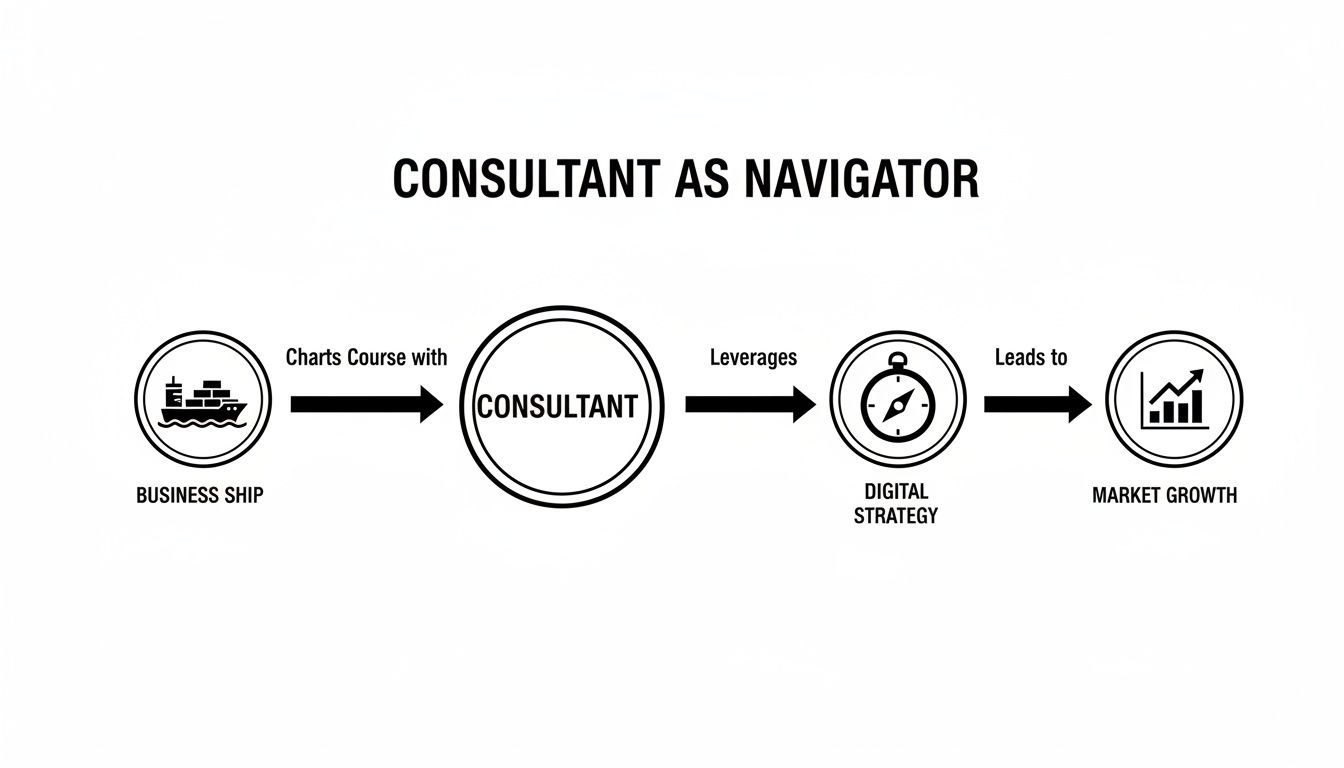
As the diagram shows, their job is to create a direct path from where you are now to where you want to be, with a rock-solid strategy as the map. Let's break down the key services that form this strategic foundation.
A consultant’s service list isn’t just a random assortment of tasks. Each area is chosen to work in concert with the others, creating a holistic strategy where the whole is greater than the sum of its parts. Here’s a look at the typical services you can expect and how they contribute to the bigger picture.
| Service Area | Primary Objective | Common KPIs |
|---|---|---|
| SEO Strategy | Increase organic visibility, attract high-intent traffic, and build long-term digital authority. | Organic Traffic, Keyword Rankings, Click-Through Rate (CTR), Conversion Rate, Backlink Profile Growth. |
| PPC Management | Generate immediate, qualified leads and sales while maximising return on ad spend (ROAS). | Cost Per Acquisition (CPA), Return on Ad Spend (ROAS), Conversion Rate, Quality Score, Click-Through Rate (CTR). |
| Social Media | Build brand awareness, foster community engagement, and drive traffic from social platforms. | Engagement Rate, Follower Growth, Reach & Impressions, Social-Referred Traffic, Conversions. |
| Customer Experience (CX) | Optimise the entire customer journey to improve satisfaction, loyalty, and lifetime value (LTV). | Customer Satisfaction (CSAT), Net Promoter Score (NPS), Customer Lifetime Value (LTV), Churn Rate. |
| Analytics & Reporting | Provide clear insights into marketing performance to enable data-driven decision-making. | Website Traffic, Conversion Rate, Lead-to-Customer Ratio, Channel-Specific ROI. |
Each of these services represents a crucial lever for growth. When pulled together by an experienced strategist, they create powerful momentum for your business.
Modern SEO is a world away from simply stuffing keywords onto a page. A consultant sees it as a complex discipline focused on cementing your digital authority, making sure your ideal customers find you the second they realise they have a problem you can solve.
It starts with a deep technical audit of your website to uncover and fix issues that are secretly holding back your rankings. Then comes a thorough competitive analysis—what are your rivals doing right, and more importantly, where are their blind spots?
From there, it’s all about crafting high-value content that genuinely answers your audience's questions and building authoritative backlinks that signal to Google that your site is the real deal. For many businesses, mastering SEO is the cornerstone of a sustainable lead generation engine, a topic we explore in our guide on finding the right lead generation service for your business.
Paid advertising, or Pay-Per-Click (PPC), gives you a direct, measurable path to get your brand in front of a hand-picked audience. The consultant’s job here is to squeeze every drop of value from your ad spend, moving far beyond just "turning on" the ads.
They do this with smart budget allocation, funnelling your money into the campaigns and channels that deliver the goods. This strategic oversight includes:
The aim is to build a paid media machine that doesn't just bring in leads today but also mines valuable data to make your entire marketing strategy smarter tomorrow.
A consultant's real value in PPC is turning ad spend from a simple expense into a predictable, scalable investment. They obsess over metrics like Customer Acquisition Cost (CAC) and Lifetime Value (LTV) to prove financial impact.
Social media isn't just a digital billboard for brand announcements anymore. It's a critical channel for building a real community, nurturing loyalty, and sparking meaningful conversations. A consultant crafts a strategy that aligns your social activities with your bottom-line business goals.
This isn’t about chasing the latest viral dance trend. It's about consistently creating valuable content that positions your brand as a leader in your field and builds genuine connections with your followers. A consultant will pinpoint the platforms where your target audience actually spends their time and create a content plan that speaks their language.
Finally, a top-tier digital marketing consultant knows that every channel needs to work in harmony. They focus on perfecting the entire customer experience (CX), from the very first ad someone sees to the follow-up email they receive after a purchase.
They use sophisticated analytics to map out the customer journey, identify any bumps in the road, and make data-backed improvements. This holistic view ensures you’re not just winning new customers but turning them into passionate advocates for your brand.
This seamless integration of data and strategy is what sets a true consultant apart from a simple service provider. They connect every marketing task back to the big picture, making sure your efforts are cohesive, efficient, and laser-focused on driving growth you can actually measure.
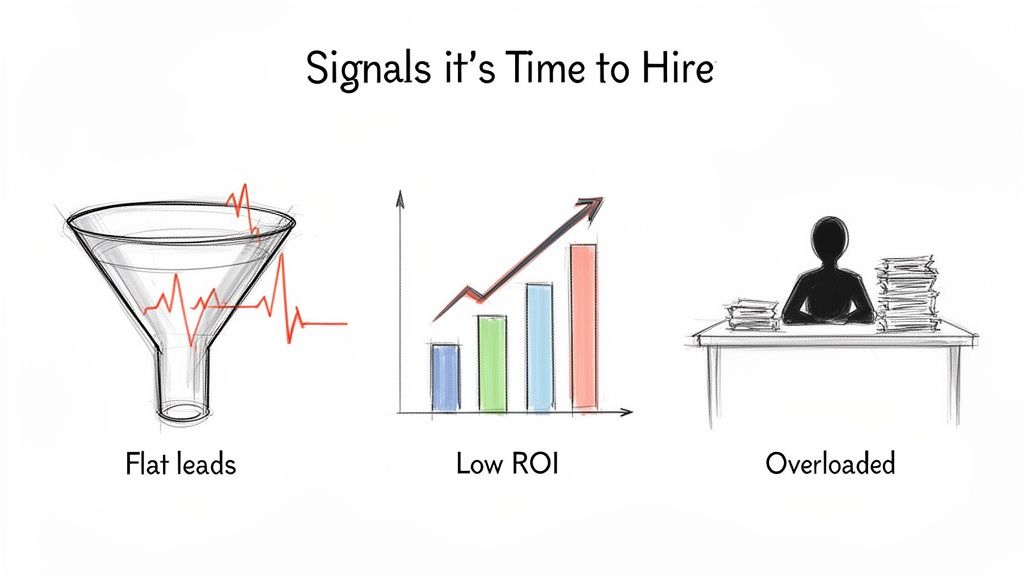
Deciding to bring in an external expert is often the single most important decision you can make to kickstart a new phase of growth. It's not a sign of failure; it's a strategic move to scale intelligently. The real challenge is knowing the right moment to make that call.
Think of it like a routine health check-up for your marketing. You'd see a specialist for a nagging issue your GP can't solve, right? A digital marketing consultant is the specialist for those persistent growth problems your team struggles to diagnose and treat on their own.
The most obvious sign is the dreaded plateau. Your lead pipeline, once a reliable engine for new business, has either flatlined or started to sputter. Your team is running the same plays that used to work, but the scoreboard isn't moving.
This kind of stagnation often happens when the market shifts, new competitors pop up, or your customers start behaving differently. An outside consultant brings a fresh set of eyes, unburdened by internal history or bias, to figure out what's changed and map out a new strategy to get things moving again.
Another clear indicator is when your key metrics start flashing red.
When you're too close to the problem, it's easy to mistake symptoms for the root cause. A consultant's real value is their ability to step back, analyse the whole system, and find an accurate diagnosis that leads to an effective cure.
Sometimes, the problem isn't performance but capacity. Your in-house marketers are talented and hardworking, but they're completely swamped with the day-to-day grind. They're so busy managing campaigns, creating content, and putting out fires that there's simply no time left for high-level strategic thinking.
This is a classic growth bottleneck. Your team is stuck working in the business, not on the business. A consultant steps into that strategic gap, providing the roadmap your team needs to ensure their daily hustle is actually pushing towards bigger, long-term goals.
Let's face it, the digital marketing world is incredibly complex and never sits still. Your team might be brilliant at content and social media but lack the deep, technical know-how for advanced SEO or data analytics. Or maybe you're gearing up to launch in a new market and don't have the experience to build a go-to-market strategy from scratch.
Hiring a digital marketing consultant gives you instant access to that niche expertise without the cost and long-term commitment of a senior full-time hire. They bring years of experience from working across different industries, letting you sidestep common mistakes and dramatically shorten your learning curve. This focused expertise is often the precise injection of knowledge needed to get you ahead of the game.
Choosing a digital marketing consultant isn’t like picking a vendor; it’s more like finding a strategic partner. The right one becomes an extension of your own team, genuinely invested in seeing you win. The trick is to see past the slick sales presentations and buzzwords to find a team that actually gets what your business is all about.
Getting this choice right is your first big test. You need a solid game plan for sizing up their proposals, checking their real-world skills, and asking the sharp questions that separate the talkers from the doers. Get it wrong, and you can burn through months of budget and miss out on huge opportunities. Get it right, and you can unlock some serious growth.
The very first thing to check is whether they understand your specific industry. A generic, one-size-fits-all strategy is a massive red flag. Your business has its own unique set of challenges, customer quirks, and competitors, and that calls for a plan built just for you.
In those first chats, listen for the details. Do they use the same language your industry does? Can they bring up specific trends or regulations that affect your market? A top-tier consultant digital marketing firm shows up to the first meeting having already done their homework, armed with ideas, not just a list of questions.
A consultant who asks, "So, tell me about your business," is starting from scratch. A true partner says, "We've analysed your top three competitors' backlink profiles and see a significant opportunity in X." That's the difference between a vendor and a strategist.
Their proposal should feel like it was made exclusively for you. Look for strategies that directly tackle the weaknesses and opportunities you talked about. If it reads like a template they could send to any business, it’s a pretty clear sign they haven’t put in the necessary brainpower.
Case studies are great, but you have to know how to read between the lines. Don't get distracted by flashy numbers alone. An impressive-sounding 300% increase in traffic doesn't mean much if it didn't lead to actual sales or qualified leads.
You need to dig deeper into their success stories:
After you've looked at their highlight reel, the most important step is to talk to their current or recent clients. This is non-negotiable. An agency that’s confident in their work will be happy to provide references. If they seem hesitant, take that as a serious warning. To find a great fit, you can also check out curated lists of the best digital marketing agencies to see how others are rated and reviewed.
To keep your evaluation structured, it helps to use a scorecard. This ensures you're comparing each potential partner on the same critical points, rather than just going on gut feeling.
| Evaluation Criterion | Consultant A Score (1-5) | Consultant B Score (1-5) | Notes |
|---|---|---|---|
| Industry Understanding | Do they grasp our market's specifics? | ||
| Customised Strategy | Is the proposal tailored or generic? | ||
| Relevant Case Studies | Are their examples similar to our goals? | ||
| Clear KPIs & Goals | Are the proposed metrics tied to revenue? | ||
| Transparency & Reporting | How clear is their communication plan? | ||
| Client References | Did their references provide positive feedback? | ||
| Team Expertise & Fit | Do they have the right skills and culture? | ||
| Overall Value for Cost | Does the price align with the expected impact? | ||
| Total Score |
Using a simple checklist like this helps you step back and make a more objective, data-driven decision about who will be the best long-term partner for your business.
At the end of the day, a great partnership comes down to clear alignment and open communication right from the start. The KPIs they propose have to link directly to your main business goals, whether that's boosting marketing qualified leads (MQLs), lowering customer acquisition cost (CAC), or increasing customer lifetime value (LTV).
You also need to set a clear rhythm for communication. How often will you meet? What will their reports look like, and how exactly will you measure performance together? The right partner is proactive, uses data to guide their decisions, and is focused on building a transparent relationship where everyone is accountable for hitting the same targets. They should feel less like someone you've hired to do tasks and more like a trusted advisor.
Let's get straight to it. Bringing on a marketing consultant is a serious investment. Like any business decision, you need to be crystal clear on what it's going to cost and, more importantly, what you'll get back. Getting your head around the common pricing structures and figuring out the potential return on investment (ROI) is the first step to building a solid business case and finding a partner who actually delivers the goods.
Most consultants in Australia will price their work in one of three ways. There’s no right or wrong model; it all comes down to what you need and for how long. Knowing the difference helps you pick the approach that fits your goals and your budget.
Before you sign on the dotted line, you need to understand how the billing works. The pricing structure is often a good clue about the type of engagement it will be, from a quick-fix project to a long-term strategic partnership.
Monthly Retainer: This is the go-to for ongoing, strategic work. You pay a set fee each month for an agreed-upon scope of services. It makes your costs predictable and gives you consistent access to their expertise. Think of it like having a senior strategist on your team, but not on your payroll. It’s perfect for the long game stuff like SEO and content marketing.
Project-Based Fees: Got a specific, one-off job? Maybe a website audit, a big campaign launch, or setting up your marketing automation. A project-based fee is what you're looking for. You agree on a fixed price for a very clearly defined outcome, which makes it incredibly simple to budget for.
Performance-Based Models: This one links the consultant’s pay directly to the results they generate. It might be a percentage of your ad spend or a fee for every lead they bring in. While it can feel like less risk upfront, just be aware that it can get expensive if they knock it out of the park (which is the whole point, right?).
Recent data shows the sweet spot for marketing consultant rates in Australia is around $777 per day. Of course, this varies. A specialist Digital Marketing Strategist might command $836 per day, while an SEO Specialist averages $814. When you compare that to the $80k to $95k salary for a full-time hire, you can see how bringing in a consultant offers a ton of flexibility and can be a much more cost-effective move.
Cost is only one side of the coin. The real question is, what's the financial return? A good consultant doesn't just drive traffic; they drive profit. Calculating your ROI is all about connecting their work to real, tangible business results.
To nail this, you need to obsess over two core numbers:
Customer Acquisition Cost (CAC): This is the total cost of everything you do in marketing and sales to land one new customer. Your consultant’s job is to make this number smaller by optimising your channels and making every dollar work harder.
Customer Lifetime Value (LTV): This is the total profit you can reasonably expect from a single customer over the entire time they do business with you. A great consultant helps you push this number higher by improving the customer experience and keeping them coming back.
The rule of thumb here is simple: your customer's LTV has to be significantly higher than their CAC. A healthy ratio to aim for is 3:1—meaning for every dollar you spend to get a customer, you make three dollars back over their lifetime.
For a consultant to truly prove their worth, they need to be all over advanced tracking, like using multi-touch attribution models to really understand what's working. This helps pinpoint which touchpoints actually led to a sale, allowing for smarter budget decisions and a much more accurate picture of your ROI. When you focus on these financial metrics, you can measure the real impact of your investment and be confident your consultant is delivering the growth you hired them for.
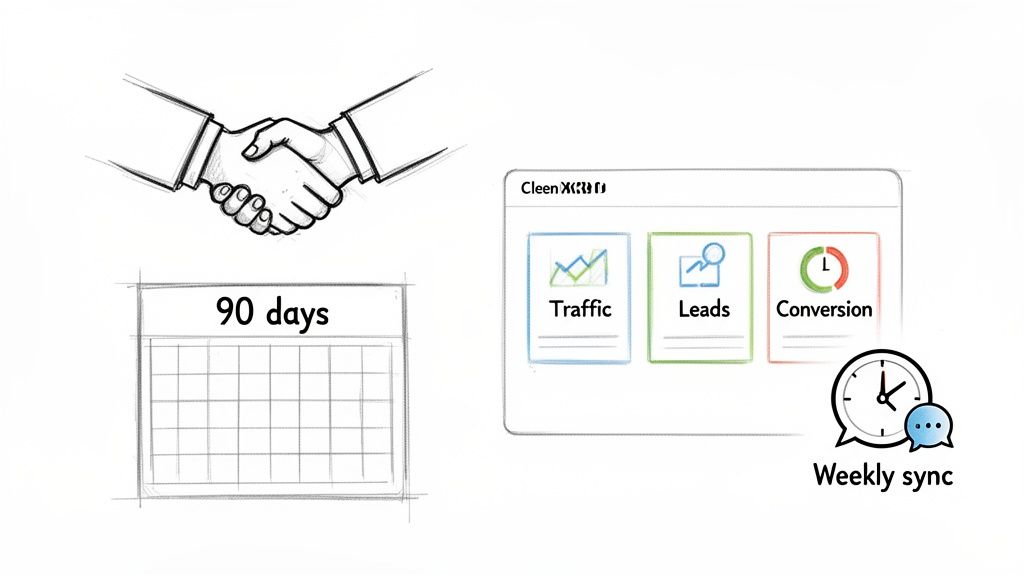
Any successful partnership with a digital marketing expert is forged in the first 90 days. Forget about seeing massive, immediate results. This initial period is all about laying the groundwork for a transparent, results-driven collaboration. It’s where you shift from a simple contract to a genuine partnership.
Think of it like building a house. If you rush the foundation, the whole structure is compromised. In the same way, a strong onboarding process makes sure your long-term goals are propped up by clear communication, shared expectations, and mutual accountability right from the get-go.
Those first few weeks are critical for getting everyone aligned. This shouldn't just be a series of introductions; it needs to be a structured effort to establish a shared rhythm of working together. A well-planned kickoff sets the tone for everything that follows.
A solid onboarding checklist will always include:
Once the foundation is set, it’s all about building and maintaining momentum through consistent communication. Setting up a clear schedule for check-ins is the best way to head off misunderstandings and keep the strategy nimble. This isn't about micromanagement; it's about fostering an open dialogue.
Regular communication should be baked right into your process. We’re talking weekly sync-ups to review progress and tackle any immediate roadblocks, plus more formal quarterly business reviews to see how things are tracking against the big-picture goals. A huge part of this is delivering clear, concise marketing agency reporting that clients actually read.
Your shared KPI dashboard becomes the single source of truth for the partnership. It should be a live, accessible report tracking the core metrics you both agreed upon, making sure everyone is aligned and accountable for the results.
This kind of structured approach transforms the relationship from a simple client-vendor deal into a powerful strategic alliance. When you have clear goals, open communication, and shared data, both you and your consultant are fully invested and positioned for long-term wins.
Given that 77.7% of Australians are on social media, having an expert-led strategy is non-negotiable. Consulting firms achieve a remarkable 47.67% social media engagement rate, which blows other sectors out of the water and proves that expert guidance is what turns a passive audience into active leads.
Stepping into a partnership with a digital marketing consultant can feel like new territory, and it's natural to have questions. We've put together some straightforward answers to the things businesses most often ask when they're thinking about bringing an expert on board. This should clear up the practical side of how it all works.
This really depends on the tools we're using for the job. Think of it like this: some marketing tactics are like launching a firework—big, bright, and immediate—while others are more like planting a tree, requiring patience to cultivate strong, lasting growth.
Any consultant worth their salt will lay out a realistic roadmap with clear milestones from the get-go. You’ll always know what’s happening and what to expect next.
The best results always come from a partnership, not a hand-off. While the consultant drives the strategy and does the heavy lifting, your team's insider knowledge of your brand, your customers, and your product is pure gold. When it works well, the consultant feels like a natural extension of your own team.
You’ll want to have a dedicated point of contact on your side to keep communication flowing smoothly. Beyond that, plan to join regular check-in meetings to go over progress, give feedback, and make sure we’re all pulling in the same direction. It’s this collaborative spirit that really makes things click.
A great way to think about it: the consultant is the expert chef, but you provide the amazing, locally-sourced ingredients (your business knowledge). It’s the combination of the two that creates something truly special.
Yes, absolutely. A seasoned consultant is tech-agnostic and should be comfortable working with a wide range of marketing tools and platforms. They’re not there to rip out your systems and start from scratch.
One of the very first steps in the onboarding process is a deep dive into your current tech stack. This means getting familiar with your CRM, analytics platforms, email marketing software—whatever you rely on day-to-day. The strategy will be integrated seamlessly into your existing workflows. The only time a good consultant will suggest new software is if there’s a glaring gap in your setup that's holding back growth, and they can make a clear business case for it.
Ready to see what a strategic partner can do for your business's bottom line? Virtual Ad Agency specialises in building data-driven digital marketing strategies that deliver real, measurable growth. Book a complimentary strategy session with us today!

 previous