
At its core, display advertising is like renting digital billboards on the websites, apps, and social media platforms your ideal customers visit every day. Unlike text-based search ads, it uses visually striking formats—like images, graphics, and videos—to grab attention and build brand familiarity. It’s all about putting your message in front of the right people, even when they aren't actively looking for you.
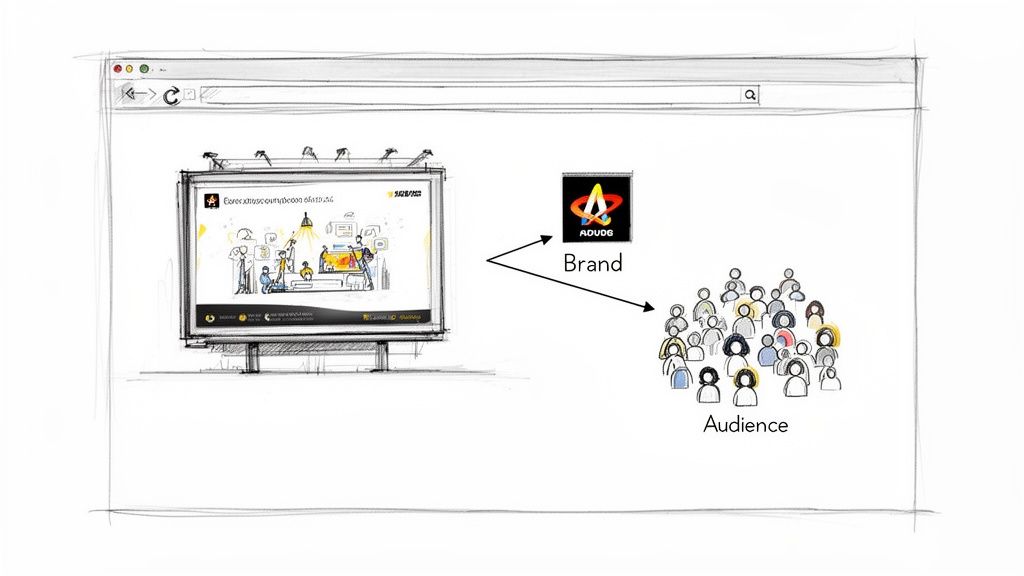
Think of the difference between search ads and display ads as ‘pull’ versus ‘push’ marketing. Search ads are a ‘pull’ strategy; they reel in users who are already on the hunt, typing keywords into Google looking for a solution right now.
Display advertising, on the other hand, is a ‘push’ strategy. It proactively shows your brand to a handpicked audience based on their interests, who they are, or where they’ve been online.
This approach lets you create demand where none existed a moment before. You can introduce your products to potential customers while they're catching up on the news, watching a YouTube clip, or scrolling through their favourite app. The goal is often less about an immediate sale and more about planting a seed—building that top-of-mind awareness so your brand is the first one they think of later.
So, how does an ad for a pair of shoes you just looked at suddenly pop up on a completely different website? It all happens through a complex, lightning-fast ecosystem that connects advertisers (that's you) with publishers (the website and app owners with ad space to sell).
This whole process is almost entirely automated. The moment someone lands on a publisher's site, an auction kicks off and finishes in milliseconds. Advertisers bid for that single ad view, and the winner’s ad is instantly served up to the user. This system, often powered by platforms like the Google Display Network, reaches a staggering number of internet users across the globe.
The real power of display advertising is its massive reach. It’s about being seen across millions of websites and apps, becoming a familiar presence in your audience's daily digital life, and building brand recall long before they’re ready to make a purchase.
To make sense of it all, here's a quick look at the core components that make the magic happen.
This table breaks down the key players in the display advertising ecosystem. Understanding these roles is the first step to seeing how the entire process fits together.
| Component | Description | Example |
|---|---|---|
| Advertiser | The business or brand wanting to promote a product or service. | An online shoe retailer wants to promote its new line of running shoes. |
| Publisher | The website, app, or platform owner that sells ad space to make money. | A popular Australian fitness blog that has designated banner ad spaces. |
| Ad Network | The tech platform connecting advertisers to a huge inventory of publishers. | The Google Display Network connects the shoe retailer to the fitness blog. |
| User | The target audience member who sees the ad while browsing the publisher's content. | A reader of the fitness blog who has previously searched for running gear. |
Each component plays a vital role, working together in a split second to deliver a relevant ad to the right person at the right time.
Knowing what display advertising is is a great start. But the real secret sauce? That’s about picking the right creative format to get the job done. It’s what separates a campaign that just runs from one that truly performs.
Not all display ads are created equal. Far from it. Each format has a specific job to do, designed to connect with people at different points in their journey. Nailing this choice is everything if you want to grab attention and hit your campaign goals, whether you’re building brand awareness, chasing website traffic, or nudging a potential customer over the finish line.
These are the formats you’ve seen a million times – the digital billboards of the internet. They’re the bread and butter of display advertising.
But here’s the thing: while these formats are foundational, relying on them alone is a risky move. The ground is shifting under our feet.
Recent Australian data from the September 2025 quarter shows that while total digital ad spend grew, standard display ads actually took a 6.8% dip. That’s a massive wake-up call. User preferences are evolving, and marketers who stick only to the old playbook are going to get left behind.
Video isn’t just a trend; it’s become a dominant force in the display ad world. It offers a rich, story-driven way to connect that static images just can’t replicate. We’re not talking about sticking a 30-second TV commercial online. These are short, snappy ads built specifically for digital platforms.
They’re brilliant for showing a product in action, telling a brand story, and tapping into emotions. The numbers don't lie.
Video ad spend has shot up by a huge 16.7% to reach $1,347 million. It now accounts for a staggering 73% of general display advertising. A lot of that growth is coming from connected TV and social video, proving that people want to see content that moves and speaks to them. If you're looking to jump in, knowing how to create video ads that genuinely connect with an audience is your first, most critical step.
Ever been reading an interesting article on a news site and only realised halfway through that it was sponsored content? That’s the magic of native advertising. These ads are cleverly designed to mimic the look, feel, and function of the website they’re on.
They don’t shout, “I’m an ad!” Instead, they blend right into the user experience, offering up relevant and valuable content. This soft-sell approach is the perfect antidote to “banner blindness,” that subconscious habit we all have of ignoring anything that looks like a traditional ad. Because they’re less disruptive, native ads often see much higher engagement and do a better job of building trust.
This is where display advertising gets incredibly personal and powerful. Dynamic retargeting shows previous website visitors ads that are tailored specifically to them, based on what they looked at.
Imagine someone browses a specific pair of boots on your online store but leaves without buying. A dynamic ad can then follow them around the web, showing them that exact pair of boots on other sites they visit. It’s a hyper-relevant tap on the shoulder, reminding them to come back and finish what they started. It’s an absolute killer strategy for closing sales and getting the most out of your ad spend. You can dig deeper into the growth of Australian digital advertising on Mediaweek to see just how these trends are shaping the market.
Have you ever been browsing one website, only to see an ad for a product you were looking at on a completely different site just moments earlier? It’s not a coincidence, and it’s certainly not magic. It’s the result of a lightning-fast, automated buying process that puts ads in front of the right eyeballs in milliseconds.
To really get your head around display advertising, you need to understand how this ad space is bought and sold. There are two main ways to go about it: programmatic advertising and direct buys. While they both get your ad onto a publisher’s website or app, they work in totally different ways. The right choice for you will come down to your campaign's size, budget, and what you’re trying to achieve.
Think of programmatic advertising like a massive, real-time stock exchange, but instead of trading company shares, it’s trading digital ad space. It’s a completely automated system where software buys and sells ad impressions through high-speed auctions.
This all happens in the blink of an eye. The second you land on a webpage, an auction kicks off for the available ad space on that page. Advertisers who want to reach someone like you automatically place their bids, and the highest bidder wins, their ad instantly appearing on your screen. This is called Real-Time Bidding (RTB), and it’s the engine driving most of the display ads we see today.
The real power of programmatic buying is its efficiency and laser-focused precision. You're not just buying space on a website; you're buying access to a specific audience, wherever they happen to be online.
This data-first approach lets you target users with incredible detail, making sure your budget is spent on people who are actually likely to be interested. This level of efficiency is why programmatic advertising is exploding in Australia. It's forecast to jump from US$441.74 million in 2024 to a staggering US$2,963.14 million by 2033, all thanks to brands wanting to deliver more personalised campaigns.
On the other end of the spectrum, we have the direct buy. This is a much more traditional, hands-on process. Picture it like negotiating directly with a landlord to rent a prime billboard on a busy highway. You speak with the publisher (the website owner), shake hands on a price, and lock in a guaranteed ad spot for a specific amount of time.
This method gives you a level of control and certainty that programmatic auctions can’t always match. You know exactly where and when your ads will show up, which is perfect for big-impact campaigns where guaranteed visibility on a top-tier website is a must.
A classic example would be a luxury car brand doing a direct buy to take over the homepage of a major financial news site for 24 hours to coincide with a new model launch. It guarantees maximum exposure to a highly relevant, premium audience.
Both methods have their strengths and are built for different jobs. Knowing the trade-offs is key to putting together a smart display advertising strategy.
| Feature | Programmatic Advertising | Direct Buys |
|---|---|---|
| Process | Automated, real-time auctions | Manual negotiation with publishers |
| Targeting | Audience-based (demographics, behaviour) | Placement-based (specific websites/pages) |
| Scale | Massive reach across millions of sites | Limited to negotiated publisher inventory |
| Cost-Efficiency | Highly efficient, pays market rate per impression | Often premium pricing for guaranteed spots |
| Best For | Performance, retargeting, broad reach | Brand awareness, high-impact takeovers |
At the end of the day, it's not about which one is "better" but which one is the right tool for the task at hand. Programmatic brings unbeatable scale and precision for performance-driven campaigns. Direct buys deliver the guaranteed visibility you need for those big brand-building moments. For a deeper dive, check out our guide on what is programmatic advertising.
The image below charts the simple evolution of display ads, from the humble banner to the rich, interactive experiences we see today.
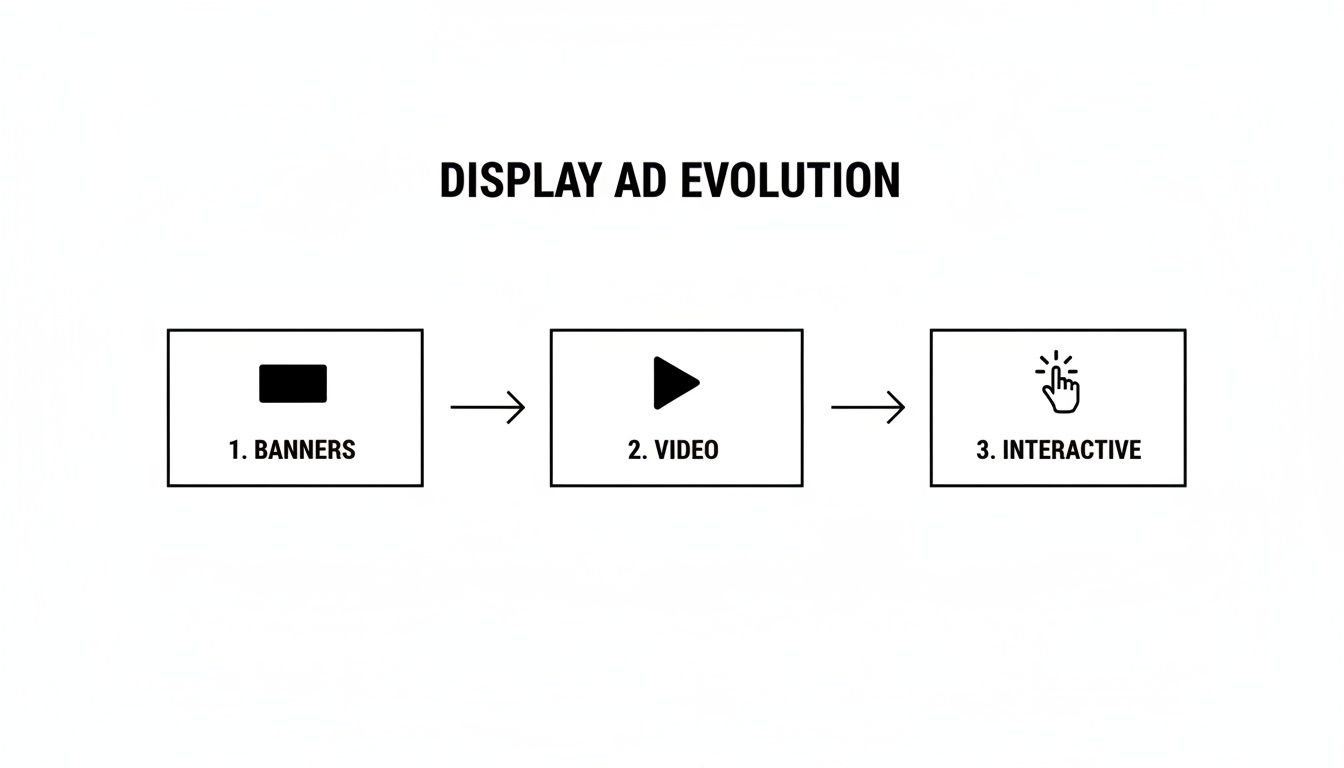
This journey really shows how technology has opened the door for more engaging and sophisticated ads, which are now delivered almost exclusively through advanced programmatic systems.
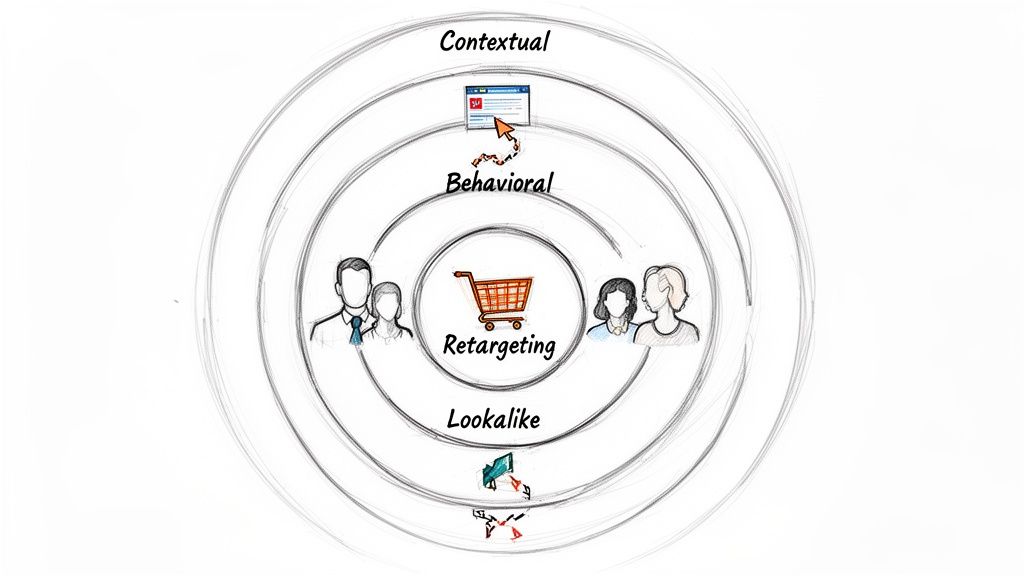
You can craft the most visually stunning display ad with the perfect message, but it’s completely wasted if it’s shown to the wrong person. This is where the real magic of display advertising happens — it's not just about what your ad says, but who it says it to.
Smart audience targeting is the difference between shouting into the void and starting a meaningful conversation with a future customer. It works by using data to build a picture of your ideal client and then finding them online, turning your ad spend from a hopeful guess into a calculated investment. Let's break down the most effective ways to make sure your message always hits the mark.
The simplest and most traditional method is contextual targeting. Think of it like placing an ad for premium hiking boots in a travel magazine that focuses on mountain trekking. The logic is simple: your ad appears alongside content that’s directly relevant to what you’re selling.
This method places your ads on websites and apps where the content aligns with specific keywords or topics you've chosen. If you sell kitchenware, your ads might pop up on recipe blogs or cooking tutorial sites. It’s a powerful starting point because it catches people when they're already in the right frame of mind.
Taking it a step further, behavioural targeting looks beyond the page's content and focuses on a user's past online actions. It works by anonymously tracking browsing history, clicks, and searches to build a profile of someone's genuine interests.
For instance, if someone has been frequently visiting websites about home renovation and searching for power tools, they can be grouped into an audience interested in DIY projects. Your ad for a new cordless drill can then be shown to them on a completely unrelated website, like a news site or weather app, because you know the interest is there.
This is where display advertising gets truly personal. You're no longer just targeting the content; you're targeting the person based on a clear pattern of interest they've shown over time, making your ad feel incredibly relevant.
One of the most powerful strategies in the entire advertising toolkit is retargeting (also known as remarketing). This tactic focuses exclusively on people who have already visited your website or used your app. Think of it as a friendly tap on the shoulder.
Imagine someone browses your online store, adds a pair of shoes to their cart, but gets distracted and leaves. Retargeting allows you to show them ads for those exact shoes as they browse other sites, gently reminding them to come back and finish their purchase. Because you're reaching a "warm" audience already familiar with your brand, retargeting campaigns almost always deliver fantastic conversion rates.
Once you have a solid base of loyal customers, lookalike audiences help you find more people just like them. Ad platforms like Google and Facebook can analyse the characteristics, interests, and behaviours of your best customers.
The platform then builds a new audience of people who share those same traits but haven't discovered your brand yet. This is a brilliant way to scale your campaigns and reach a much wider group of highly qualified potential customers. To see just how powerful this can be, it’s worth mastering Facebook Ads targeting options and how these tools work in practice. By combining these methods, you create a robust strategy that doesn't just find an audience but builds the right one.
Running a display campaign without tracking your numbers is a bit like driving a car with your eyes closed. Sure, you're moving, but you have no clue if you're heading in the right direction or about to hit a wall. To figure out if your ads are doing their job, you need to dive into the data.
These numbers are your Key Performance Indicators (KPIs). They're what turn a hopeful guess into a predictable, data-backed strategy. They show you what's clicking with your audience (literally) and what's falling flat, so you can make smart tweaks that get better results and make every dollar count.
Every campaign needs a dashboard of the essentials. Think of these as the vital signs that give you a quick, high-level view of how people are interacting with your ads, from the very first glance to the first flicker of interest.
Tracking these basic metrics gives you an immediate pulse-check on your campaign's visibility and initial appeal. They’re the first things to look at to see if your strategy is healthy or needs some urgent care.
Getting clicks and views is great, but the real test is whether your campaign is actually helping your business. Performance metrics are where the rubber meets the road, connecting your ad spend directly to tangible outcomes. They answer the all-important question: "Are we actually making money from this?"
Getting a handle on these deeper KPIs is crucial for making smart decisions. To see how a seemingly simple metric like CTR can have a huge impact, check out our detailed guide on what is click-through rate and its true role in a campaign.
To help you get started, we've put together a quick rundown of the most important display advertising metrics, what they mean, and how they tie back to real business goals.
This table breaks down the KPIs that truly measure the success and profitability of your display campaigns.
| Metric (KPI) | What It Measures | Business Goal Alignment |
|---|---|---|
| Cost Per Acquisition (CPA) | The average cost to generate one conversion (e.g., a sale or lead). | Measures the efficiency of your ad spend for lead generation and customer acquisition. |
| Conversion Rate | The percentage of clicks that result in a desired action, like a purchase. | Indicates how effectively your ads and landing page work together to drive sales. |
| Return On Ad Spend (ROAS) | The total revenue generated for every dollar spent on advertising. | The ultimate measure of profitability, showing the direct financial return from your campaign. |
| View-Through Conversions | Conversions from users who saw your ad but didn't click, converting later. | Proves the brand-building value of display ads by capturing their influence over time. |
By focusing on these metrics, you move beyond just counting clicks and start measuring the real impact your display advertising has on your bottom line.
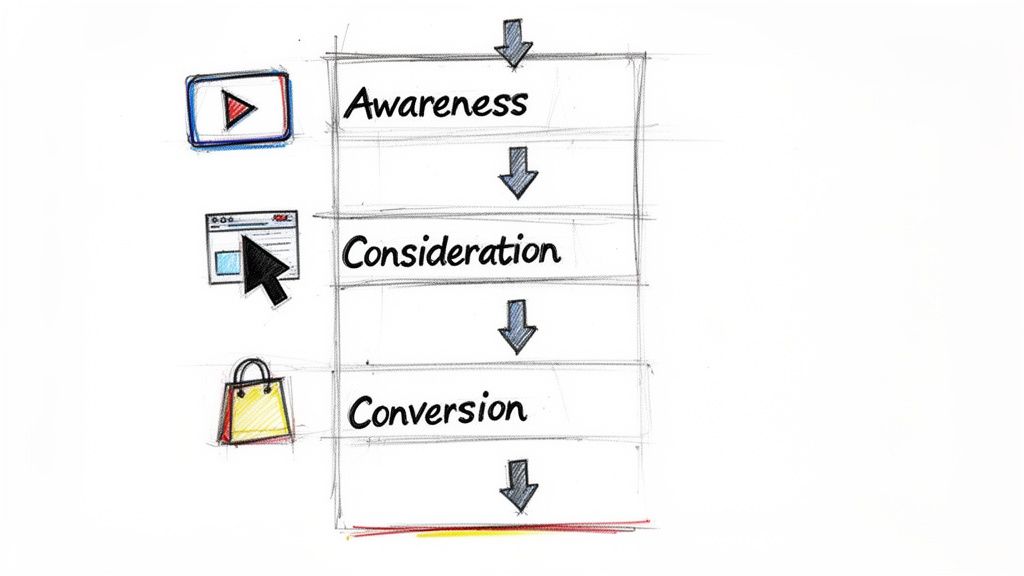
Knowing all the ad formats, buying methods, and metrics is one thing. The real magic happens when you weave them all together into a cohesive, full-funnel strategy. A display advertising campaign should never be a bunch of isolated tactics; think of it as a carefully guided journey for your customers, leading them from that first "hello" all the way to a final purchase.
At Virtual Ad Agency, we don't just run ads—we build pathways. It all kicks off with deep-dive media planning and audience discovery to figure out exactly who your ideal customers are and where they’re hanging out online. Getting this data-driven foundation right means every dollar you spend has a clear purpose.
This initial legwork shapes the entire strategy, allowing us to map different ad formats and targeting methods to specific stages of the marketing funnel. The whole point is to get the right message, in the right format, to the right person at just the right moment.
Let’s make this real. Imagine an Australian e-commerce brand that sells eco-friendly activewear. A full-funnel approach would look a little something like this:
Top of Funnel (Awareness): We’d start by launching snappy, short-form video ads across platforms like YouTube and relevant lifestyle apps. The goal here isn’t to make an immediate sale. It’s about grabbing attention and introducing the brand’s sustainable mission to a broad, new audience who are into fitness and ethical products.
Middle of Funnel (Consideration): Once someone has watched a video or popped over to the website, they’ve entered the consideration phase. Now, we serve them native ads and eye-catching static banners on popular health and wellness blogs, showcasing specific product lines and reinforcing what makes the brand special.
Bottom of Funnel (Conversion): For anyone who browsed a few products or added items to their cart but didn’t buy, we bring out the big guns: dynamic retargeting ads. These personalised ads show them the exact activewear they were looking at, serving as a powerful, persuasive nudge to complete their purchase.
By lining up the creative and targeting with the customer's mindset at each stage, we build momentum. Each touchpoint flows naturally into the next, creating a seamless journey that feels helpful, not pushy.
Layering your strategy like this ensures display advertising hits multiple business goals at once. You're building long-term brand equity at the top of the funnel while simultaneously driving immediate sales at the bottom. It’s a powerful combo that taps into the enormous potential of Australia’s online advertising market.
In FY2025, this market hit a massive $17.2 billion, with retail leading the pack. This shows there’s a huge opportunity for brands to grow. You can find more insights about Australian ad spend trends on IAB Australia. Our role as a display advertising agency is to turn this theory into tangible results, optimising every part of the campaign to deliver a strong return on your investment.
As we wrap up this guide, you’ve probably got a few questions buzzing around. It's totally normal. Getting started can feel like a big leap, so we’ve pulled together the most common queries we hear from Australian business owners to give you some clear, straight-up answers.
There’s no single price tag on display advertising – the costs can swing pretty wildly. It all comes down to things like how competitive your industry is, who exactly you’re trying to reach, and the types of ads you’re running.
Generally, you’ll pay one of two ways. There's Cost Per Mille (CPM), where you pay a set price for every thousand times your ad is shown. Or, you might go with a Cost Per Click (CPC) model, meaning you only pay when someone actually clicks on your ad.
A small campaign focused on a local suburb might only need a modest budget to get going. But if you’re planning a national blitz to a massive audience, you’ll naturally need a much bigger investment. The key thing to remember isn’t the upfront cost, but the return. The real goal is to squeeze the highest possible Return On Ad Spend (ROAS) from your budget, making every dollar work its socks off for you.
Absolutely. There's a persistent myth that display ads have had their day, but that couldn't be further from the truth. Sure, how people use the internet has changed, but display advertising has evolved right along with it, becoming smarter and more powerful than ever.
Today's display advertising uses incredibly precise targeting, engaging formats like video, and clever programmatic buying to get in front of the right people. It's still one of the best tools out there for building brand awareness at the top of the funnel—introducing your business to new audiences who don't even know you exist yet.
Plus, it's essential for bringing interested people back to your site through retargeting. This makes it a vital part of any solid digital strategy, working to both create new demand and capture the interest you’ve already generated.
The easiest way to get your head around this is to think about ‘push’ versus ‘pull’ marketing.
Search ads 'pull' people in. These are users who are already actively searching for a product or service. They have a problem, they've gone to Google, and they're typing in keywords to find a solution right now.
Display ads 'push' your brand's message out. They find a relevant audience while they're browsing other websites, reading articles, or watching videos. This strategy is all about creating demand and building brand familiarity before they even start searching.
A truly killer digital marketing strategy doesn't pick one over the other; it uses both. Search ads are there to capture existing intent, while display ads work to create future intent. Together, they cover the entire customer journey, making sure your brand shows up at every important moment.
Ready to build a display advertising strategy that gets real results for your business? The team at Virtual Ad Agency is here to guide you through every step, from planning and creative to optimisation and measurement. Get in touch with us today to start the conversation.

 previous