
Let's cut through the jargon. At its heart, programmatic advertising is simply about using smart technology to buy and sell digital ad space automatically and in real time.
Imagine a high-speed stock market, but for online ads. Instead of people haggling over prices, sophisticated software makes the buying decisions in the blink of an eye.
When you boil it down, programmatic advertising is a massive shift away from the old-school way of buying ads. Gone are the days of endless phone calls, lengthy negotiations, and manual paperwork between advertisers and website owners.
Instead, we now have a system of automated platforms that makes the whole process faster, way more efficient, and incredibly precise.
This automation lets businesses target specific groups of people with a level of detail that used to be pure science fiction. For instance, a local Melbourne retailer can choose to show their ads only to people who've visited their website, live within 10km of their shop, and have recently looked at a specific product. This entire decision, purchase, and ad placement happens in the time it takes for a webpage to load.
If you want to dig a bit deeper into the mechanics, this guide is a great starting point: What Is Programmatic Advertising? A Performance-First Guide.
To get your head around how it all works, it helps to know the main players involved. Think of them as the moving parts in a well-oiled machine, all working together to get the right ad in front of the right person.
Here’s a quick rundown of who’s who in the programmatic world:
| Player | Role in the Process |
|---|---|
| Advertiser | The business or brand wanting to place ads and reach customers. |
| Publisher | The website or app owner who has ad space to sell. |
| DSP (Demand-Side Platform) | The advertiser's toolkit for managing and buying ads across many sources. |
| SSP (Supply-Side Platform) | The publisher's toolkit for managing and selling their available ad space. |
| Ad Exchange | The digital marketplace where the DSPs and SSPs meet to trade ad inventory. |
This automated system connects all the dots, making it a perfect fit for a wider https://virtualadagency.com.au/integrated-marketing-communications-strategy/ by keeping your messaging consistent and efficient across the board.
The growth here in Australia has been nothing short of explosive. We saw programmatic ad spending jump from about AUD 337 million in 2015 to a staggering AUD 1.7 billion by 2019.
Fast forward to 2021, and these automated transactions made up around 70% of all digital media buying in Australia. It's no longer just a way to buy digital ads; for many, it's the way. This tells you everything you need to know about the industry's shift towards data-driven campaigns that deliver laser-focused precision and results you can actually measure.
Ever wondered how that perfectly timed ad seems to find you on a website, almost the second you arrive? It feels like magic, but it’s actually a high-speed, automated journey that happens in the blink of an eye. Literally.
Let's break down the split-second life of a programmatic ad, from the moment you click on a webpage to the ad appearing on your screen.
It all kicks off the instant you land on a publisher's website. That single action sends out a signal, basically announcing that an ad spot is now up for grabs.
Think of that signal as an auctioneer kicking things off: "We have an ad spot for sale!" This announcement is broadcast to an ad exchange, which is really just a digital marketplace where buyers (advertisers) and sellers (publishers) meet.
The ad exchange then sends out a bid request to a whole bunch of advertiser platforms, known as Demand-Side Platforms (DSPs). This request is packed with anonymous data about you—things like your general location, what you’ve been browsing, and basic demographics—plus details about the webpage and the ad space itself.
This infographic gives you a good look at how all these moving parts connect to get an ad delivered.
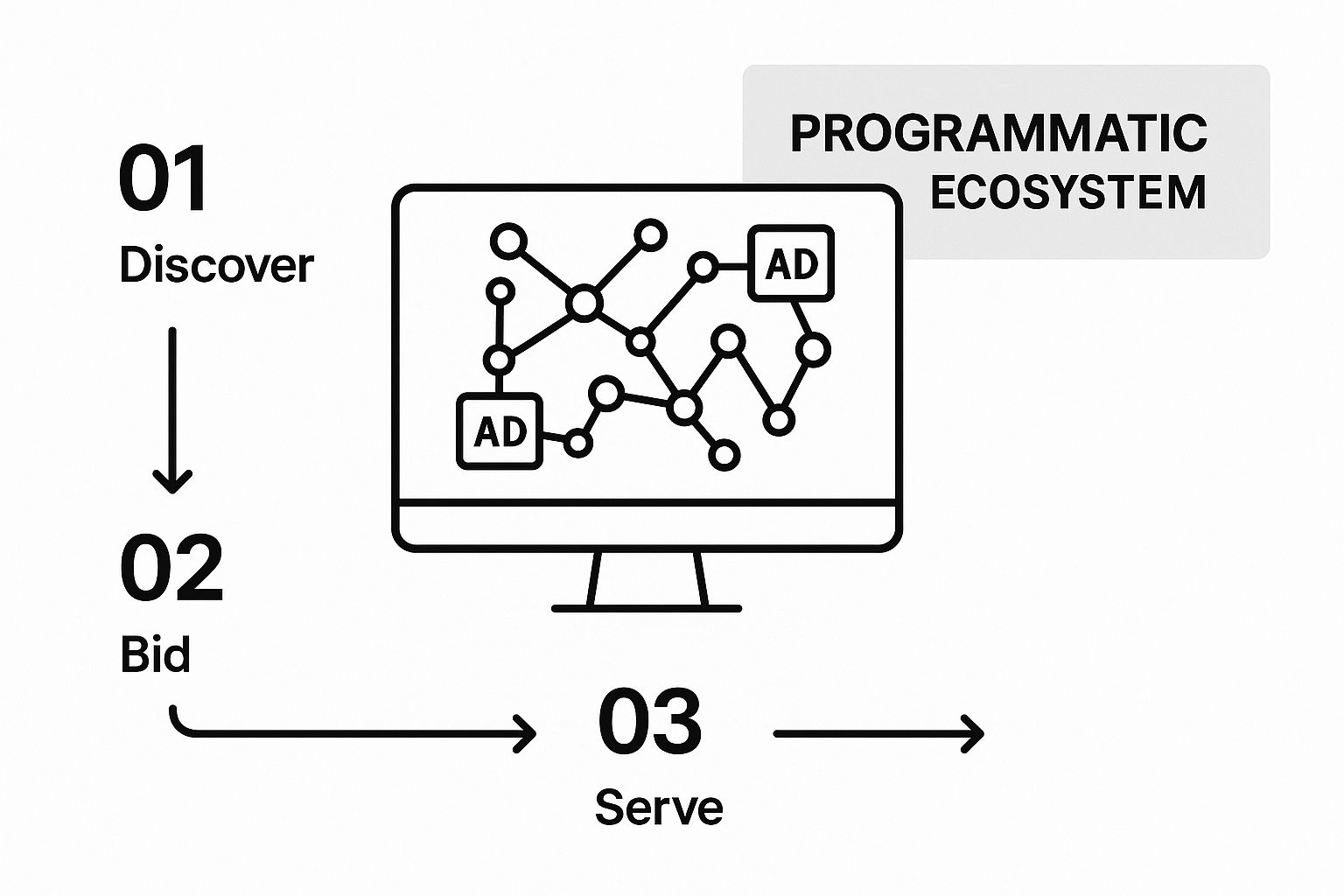
You can see the flow between advertisers, publishers, and the tech platforms that make the whole transaction happen in real time. It’s a completely automated ecosystem.
Once the DSPs get the bid request, their algorithms spring into action. Each DSP works for different advertisers, and its job is to analyse all the data and answer one crucial question: is this ad impression valuable to my client?
If the data lines up with an advertiser’s campaign goals—maybe you fit their target audience and have recently shown interest in what they sell—the DSP will place a bid.
This whole process happens in a real-time auction. Dozens, sometimes hundreds, of advertisers are all competing for that single ad spot, right there and then.
And it happens incredibly fast. We’re talking about bids being placed in about 100 milliseconds. To put that into perspective, it takes you around 300 to 400 milliseconds just to blink.
The ad exchange gathers up all the bids and finds the winner. The rule is simple: the highest bidder takes the prize. The winning DSP gets the notification, and we move to the final step.
Finally, the ad exchange sends the winning ad creative back to the publisher's website. The ad loads and pops up right there on your screen.
This entire sequence—from you visiting the site to the ad appearing—all happens behind the scenes, often finishing before the webpage has even finished loading for you. That’s programmatic advertising in a nutshell: a hyper-efficient, automated system making sure ads aren't just placed, but are also genuinely relevant to the person seeing them.
Now that you've seen just how quickly that ad auction happens, let's pull back the curtain and meet the tech that makes it all possible. The programmatic ecosystem isn't just one single thing; it's a collection of specialised platforms all working together in perfect sync. Think of it like a high-speed relay race, where each piece of technology flawlessly passes the baton to the next, ensuring your ad gets delivered in the blink of an eye.
Getting a handle on how these core components talk to each other is the key to truly understanding programmatic advertising. You have tech that serves the advertiser (the buyer), tech that serves the publisher (the seller), and the marketplaces that bring them together.
Over on the buy-side, advertisers have a Demand-Side Platform (DSP). This is their mission control.
Essentially, a DSP is the software that lets advertisers and agencies buy, manage, and fine-tune their ad placements across millions of websites, all from one dashboard. It's the engine that automates the decision to bid on an ad spot, based on the advertiser's campaign goals and exactly who they're trying to reach.
On the flip side, the publishers who own the websites and apps use a Supply-Side Platform (SSP). This is their own toolkit for managing all the ad space they have to sell.
The SSP’s main job is to help publishers get the best possible price for their ad inventory. It packages up their available ad slots and plugs them into a huge pool of potential buyers (via ad exchanges), all with the goal of maximising their revenue.
You can think of the DSP and SSP as representing the two sides of the deal. The DSP is the buyer's advocate, fighting to get the right ad space at the best price. The SSP, on the other hand, is working for the publisher, trying to get the highest price for their ad space.
Connecting these two sides are the digital marketplaces where the trading floor action happens.
Ad Exchanges: An ad exchange is the neutral ground, the open marketplace where the real-time bidding takes place. It's a bit like a stock exchange, but for digital ads. Here, SSPs list the available ad space, and DSPs place bids on behalf of their advertisers.
Data Management Platforms (DMPs): A DMP is the brains of the operation. It's a data warehouse that collects, sorts, and activates massive amounts of audience data. It gathers intel from all sorts of places—like website visits or a company's own customer lists—and uses it to build detailed, anonymous profiles of users.
This organised data then feeds into the DSP, allowing it to make much smarter bidding decisions. For example, a DMP might identify a group of users who are really into "outdoor gear," which lets an advertiser target that specific group with pinpoint accuracy. It's this seamless flow of information between the platforms that makes the whole automated process work.
Okay, understanding the tech is one thing, but what does programmatic advertising actually do for a business? Let's move beyond the how and get into the why – the real-world advantages that have made this the dominant force in digital marketing today.
At its heart, programmatic is all about incredible targeting precision. It gives you the power to reach the exact audience you want, right when they’re most likely to listen.
Think about it this way: a Melbourne-based shoe store can serve ads specifically to people who have recently searched for ‘running shoes’ and are currently within a 10km radius of their shop. That level of accuracy slashes wasted ad spend and makes sure your message actually lands with someone who cares.
The perks of programmatic advertising run parallel to the broader benefits of business process automation. When you stop doing manual tasks like haggling over ad prices and placements, your team is freed up to focus on what really matters: strategy.
This shift to automation delivers a few key wins:
You can see the power of these benefits reflected in the market's growth. Australia’s programmatic ad market is on a serious upward trajectory, projected to jump from around US$ 441.74 million in 2024 to an impressive US$ 2.96 billion by 2033. This explosion is happening because Aussie brands are doubling down on precise, measurable campaigns.
Ultimately, programmatic provides a direct line to your ideal customer. It enables strategies like remarketing, where you can re-engage users who have visited your site but didn't convert, keeping your brand top-of-mind.
This is especially powerful on social platforms. We dive deeper into how you can apply these principles in our guide on remarketing with Facebook. By mixing precision targeting with timely follow-ups, programmatic helps turn casual interest into actual business results.
When you hear “programmatic advertising,” you might picture a massive, free-for-all digital auction. And while that’s a big part of the picture, it’s not the whole picture. The reality is a lot more nuanced.
Advertisers actually have a few different ways to buy ad space, each with its own level of control, exclusivity, and pricing. Think of it like buying a house – you can go to an open auction, make a private offer, or even negotiate a deal before it even hits the market. Each approach suits a different goal.

Let’s break down the four key ways you can buy inventory programmatically. Understanding the differences is crucial to picking the right strategy for your campaign.
This is the one most people think of – a massive, public marketplace where publishers make their ad space available to any and all advertisers. The highest bidder wins the ad spot, and this all happens in the blink of an eye through Real-Time Bidding (RTB).
It’s completely open, meaning you can reach a huge audience at a potentially low cost. The trade-off? Less control over where your ads appear. It's fantastic for campaigns focused on maximum reach without breaking the bank.
Think of this as an exclusive, invitation-only auction. A select group of advertisers are invited by a publisher (or group of publishers) to bid on their premium ad inventory before it’s offered to the open auction.
You still bid in real-time, but you’re competing against fewer people for higher-quality placements. A PMP gives you a great balance of scale and quality control, ensuring your ads run on reputable sites alongside brand-safe content.
Here, you get to skip the auction queue entirely. With a preferred deal, an advertiser and a publisher agree on a fixed price for specific ad inventory. This gives the advertiser a ‘first look’ option to buy that space before it goes to any auction.
The key thing here is that it’s an option, not an obligation. You get priority access at a predictable price, but you don't have to commit to buying a certain volume. It's ideal when you want to secure placements on a specific, high-value site without a massive upfront commitment.
This is the programmatic version of a traditional, direct ad buy. Everything is negotiated and agreed upon upfront – the price, the amount of ad inventory, the flight dates, all of it. The inventory is then reserved specifically for you.
There’s no bidding involved; the transaction is automated through the programmatic platforms. This approach offers the most control and predictability, making it perfect for big brand-building campaigns where you need to guarantee your ad will be seen in a specific place at a specific time.
Choosing the right deal type really boils down to your campaign goals. Are you chasing widespread awareness, or are you after guaranteed spots on a handful of premium websites?
This table breaks down how each deal type stacks up, so you can see which one aligns best with what you’re trying to achieve.
| Deal Type | Pricing Model | Inventory Access | Best For |
|---|---|---|---|
| Open Auction (RTB) | Real-time bidding (variable) | Public and wide-reaching | Maximum scale and cost-effective reach |
| Private Marketplace (PMP) | Real-time bidding (variable) | Invite-only, premium inventory | High-quality placements with more control |
| Preferred Deals | Fixed price (pre-negotiated) | First look at specific inventory | Priority access without a volume commitment |
| Programmatic Guaranteed | Fixed price (pre-negotiated) | Reserved, guaranteed inventory | Brand-building and high-impact campaigns |
Ultimately, many of the most successful programmatic strategies use a mix of these deal types. You might use the open auction for broad reach, then layer on some PMPs and preferred deals to ensure your ads are hitting those all-important premium placements.
When most people first heard about programmatic advertising, it was all about the classic banner ad you’d see plastered across a website. Today, that picture is a whole lot bigger. The same smart, automated tech now powers campaigns across a mind-boggling variety of channels, meeting audiences wherever they happen to be.
Sure, display and mobile ads are still the bread and butter of programmatic, but the real excitement is happening in new spaces that are completely changing the game. Programmatic is no longer just stuck in your browser; it’s now in your living room, in your ears, and even on the street.
This push into new media is a huge deal for advertisers. It’s opening up fresh, immersive ways to connect with exactly the right people at the right time.
This shift towards more dynamic and engaging formats isn't just a fad; it’s a direct response to how people are consuming media. As programmatic advertising expands beyond traditional banner formats, understanding effective strategies for creating viral content becomes crucial for making an impact.
Here in Australia, you can see this trend reflected in the spending. In the first quarter of 2025, video advertising shot up by 23.3% to reach AUD 1.165 billion. That growth was a huge driver behind the market’s overall 11.6% year-on-year jump. You can dive into the numbers yourself in the full report on Australian internet advertising spend.
To help bring it all together, let’s run through a few common questions that pop up when people are first getting their heads around programmatic. These quick answers should help clear up any lingering confusion and make the whole picture a bit clearer.
This one trips a lot of people up, but it's simpler than it sounds. Think of programmatic advertising as the entire car, and Real-Time Bidding (RTB) as the engine.
Programmatic is the umbrella term for the whole automated process of buying ad space. RTB, on the other hand, is a specific method inside that process — the one where ad impressions are bought and sold in a live, lightning-fast auction.
While RTB is a huge part of programmatic, there are other ways to buy, like Programmatic Direct, that don't involve an auction at all. So, remember: all RTB is programmatic, but not all programmatic is RTB.
Not anymore. While the big brands with massive budgets were definitely the first to jump on board, the technology is now far more accessible. Today, it’s an incredibly valuable tool for small and medium-sized businesses (SMBs) right here in Australia.
The real magic for smaller companies is the efficiency and laser-focused targeting. You don't need a huge budget like you did with old-school media. Modern Demand-Side Platforms (DSPs) give you flexible budget controls, so you can reach very specific local audiences without a massive upfront investment. It’s levelled the playing field.
A common misconception is that programmatic advertising is too complex for a small team. In reality, modern platforms are designed to be user-friendly, and partnering with an agency can simplify the process even further, making it a powerful tool for businesses of any size.
The easiest way to dip your toes in is to team up with a media agency that lives and breathes programmatic advertising. The other route is to work directly with a self-serve DSP. For anyone just starting out, an agency is often the best bet, as they’ll handle the strategy, campaign setup, and ongoing tweaks.
If you’re keen to go the self-serve route, my advice is to start small. Have a crystal-clear goal for your first campaign, define your target audience meticulously, and set a small test budget to learn the ropes. A simple display campaign is a great way to get comfortable with the platform before you start exploring more advanced channels.
Ready to see how programmatic advertising can deliver real results for your business? The team at Virtual Ad Agency specialises in building and managing data-driven campaigns that connect you with your ideal customers. Find out more on our website.

 previous