
Picture this: your marketing machine is humming along 24/7, pulling in potential customers and nurturing leads, even while you’re asleep. That’s the real power behind marketing automation—using smart software to handle all those repetitive marketing jobs. It’s about getting personalised, timely messages to the right people, without lifting a finger every time.
The best way to think about marketing automation is like a smart irrigation system for your business. Instead of dragging a hose around to water every single plant (or manually contacting every lead), the system knows exactly what’s needed and delivers it at the perfect moment. It uses technology to run your marketing processes and handle complex campaigns across multiple channels, all on its own.
This is a game-changer. It gets your team away from the tedious, soul-crushing tasks like sending one-off emails or scheduling social media posts. Instead, they can pour their energy into what really matters: big-picture strategy, creative ideas, and digging into the results. By automating workflows, you’re essentially building a more efficient and scalable marketing engine that guides leads from their very first click all the way until they’re ready to buy.

At its heart, marketing automation technology zeroes in on a few key areas to make your efforts more effective and drive better outcomes:
One of the smartest things marketing automation does is score your leads based on how engaged they are. This lets your sales team focus their precious time on the people who are practically raising their hands to say, “I’m ready to talk,” which is a massive boost for both efficiency and conversion rates.
To give you a clearer picture, here’s a quick rundown of what marketing automation does and the direct benefits it brings to your business.
| Core Function | Key Business Benefit |
|---|---|
| Email Marketing | Delivers personalised, targeted email sequences automatically. |
| Lead Generation | Captures and organises leads from forms and landing pages. |
| Lead Nurturing & Scoring | Guides prospects through the sales funnel and identifies sales-ready leads. |
| Social Media Management | Schedules posts and tracks engagement across multiple platforms. |
| Analytics & Reporting | Provides detailed insights into campaign performance and customer behaviour. |
This table shows how each piece of the puzzle contributes to a more powerful, data-driven marketing strategy.
Ultimately, getting your head around what marketing automation is is the first step towards building a more strategic, results-focused marketing operation. It’s not about doing more; it’s about working smarter to achieve real, sustainable growth and build stronger relationships with your customers. With the right systems in place, you can finally make sure no potential customer ever slips through the cracks again.
So, how does this all work behind the scenes? To really get what marketing automation is, you need to lift the bonnet and look at the engine. The whole system runs on a simple but incredibly effective principle: triggers, workflows, and actions.
Think of it like setting up a series of digital dominoes. A user’s action—say, signing up for your newsletter—tips the first one over. This kicks off a pre-planned sequence of events that feels personal and perfectly timed to them, all without you lifting a finger.
A trigger is that first nudge. It’s the specific event that sets an automated process in motion. It could be anything from a new subscriber joining your list to a customer leaving items in their shopping cart. It’s the initial signal that tells your platform, “Right, let’s go.”
From there, the workflow takes the reins. This is the journey or sequence you’ve already mapped out. For example, a new signup trigger might launch a workflow that sends a welcome email straight away, a follow-up with some great content three days later, and a special offer after a week.
This flow, from grabbing a new lead to keeping them engaged and analysing what works, is laid out perfectly here.
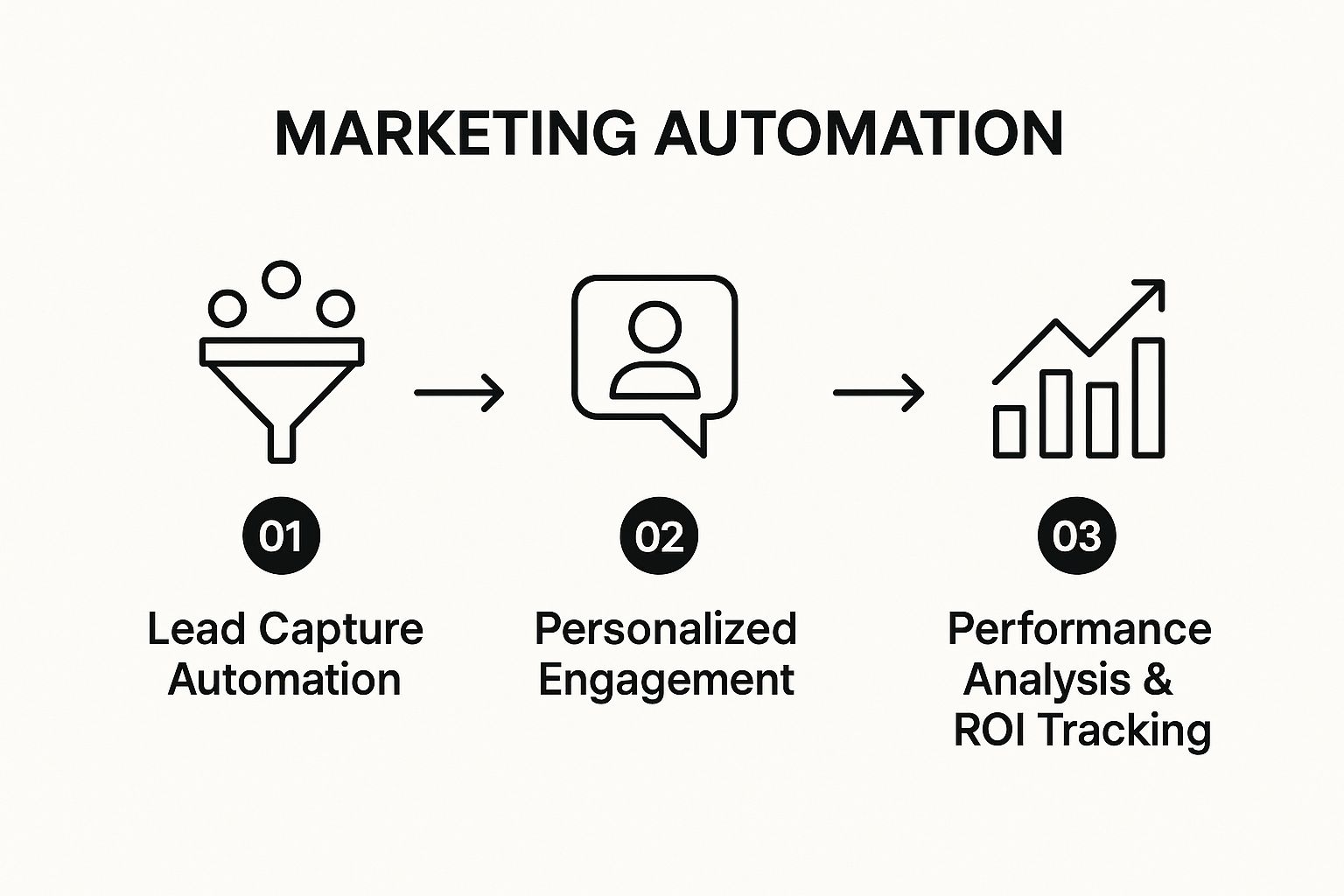
As you can see, automation isn’t just a one-off task. It’s a continuous cycle of attracting, engaging, and learning from your audience so you can keep refining your strategy.
What makes all this intelligent rather than just robotic? Two key components: customer segmentation and lead scoring. These are the features that ensure your messages don’t just get sent automatically, but get sent to the right people with the right level of priority.
Customer segmentation is simply the practice of dividing your audience into smaller, more manageable groups based on things they have in common. This could be based on:
This allows you to send super-relevant content that actually resonates with each specific group. If you want to go deeper on creating a cohesive plan for all your messaging, it’s worth looking into building an https://virtualadagency.com.au/integrated-marketing-communications-strategy/.
The other piece of the puzzle is lead scoring. This process automatically assigns points to your leads based on their profile information and the actions they take. Someone who visits your pricing page might get 10 points, while downloading an in-depth guide could add another 15 points.
This system is an absolute game-changer. It helps your sales team immediately spot the most engaged, sales-ready prospects. Instead of chasing down cold leads, they can focus their energy on people who are already showing serious interest, which massively boosts efficiency and conversion rates.
Figuring out how automation helps streamline this journey often involves optimizing your sales funnel to guide people smoothly from awareness to purchase.
By pulling together triggers, workflows, segmentation, and scoring, marketing automation builds personalised customer experiences at a scale that would be completely impossible to manage manually. It’s a system designed to deliver the right message to the right person at exactly the right time.
Here in Australia, the shift towards marketing automation is way more than just another flash-in-the-pan trend; it’s a fundamental change in how businesses operate. Companies are quickly figuring out that to stay competitive and actually grow, they need systems that work smarter, not just harder.
Automation gives you the power to scale up your marketing in ways that are flat-out impossible if you’re doing everything by hand. Think about it. Instead of your team being bogged down in repetitive tasks like sending follow-up emails or scheduling social media posts, they’re freed up to focus on the big picture: strategy, building real customer relationships, and coming up with the next great idea. This is why everyone’s getting on board – it lets even a small business punch well above its weight.
Beyond just getting more done, the real magic of marketing automation is its knack for building stronger, more personal connections with customers. It lets you send the right message, to the right person, at exactly the right moment, all based on what they’ve actually shown interest in. A generic email blast becomes a genuine conversation.
And this tailored approach leads to some pretty tangible results:
The core idea is simple: you move from shouting one message at everyone, to having thousands of one-on-one conversations, all at the same time. This is what turns a casual browser into a loyal fan who tells their mates about you.
The numbers don’t lie. The marketing automation market down under is already valued at around USD 190 million, but it’s not just growing—it’s exploding. Projections show it’s set to climb at an annual rate of 19.9% between 2025 and 2030, hitting a forecast of nearly USD 544.9 million. If you want to dig deeper into the stats, Grand View Research has some great insights on Australian market growth.
This isn’t just about buying new software. It’s a serious investment in building a business that’s more resilient, more customer-focused, and ultimately, more profitable. For Aussie companies, getting on board with automation isn’t really a choice anymore. It’s a crucial step towards getting ahead and achieving real, sustainable growth.
Theory is one thing, but seeing marketing automation work in the real world is where it all clicks. When you tie abstract ideas like ‘workflows’ and ‘triggers’ to actual business results, you start to see just how powerful this approach can be. Let’s look at a couple of classic scenarios that show automation driving real growth.
The pattern is always pretty simple: a customer does something (the trigger), which kicks off a pre-planned sequence of actions (the workflow). The whole point is to hit a specific business goal without anyone having to lift a finger. That’s the magic of it, really.
This is probably the most common—and most profitable—use of automation out there. We’ve all done it: you’re shopping online, you load up your cart, and then… life happens. A phone call, a notification, and you’ve wandered off without buying a thing. For online stores, this is a massive headache.
Instead of just letting that sale disappear, a smart automation workflow jumps into action:
This simple, automated sequence works 24/7 in the background. It claws back sales that would otherwise be gone for good, giving a store’s revenue a serious boost without any manual effort.
Now, let’s switch gears to a business-to-business (B2B) software company. Here, the sales cycle isn’t a quick impulse buy; it’s a long game of building relationships and proving your value.
Imagine someone visits your website and downloads a helpful guide, say, “10 Ways to Improve Project Management.” This is a clear signal of interest, and it’s the perfect trigger for a lead nurturing workflow.
The whole process is designed to build trust and position the company as an expert guide, not just a seller. The software quietly tracks which emails the person opens and what links they click, so the sales team only steps in when the lead is properly warmed up and ready for a real conversation.
The tech is getting smarter, too. For instance, around 41% of marketers have seen a noticeable jump in sales after bringing AI-driven tools into the mix. This kind of technology helps with more complex jobs like lead scoring and analysing customer behaviour, helping Australian businesses build more effective strategies. You can find more insights on the impact of AI-driven marketing automation on sitecentre.com.au.
To give you a better idea of the possibilities, here are a few common ways businesses put automation to work.
| Scenario | Triggering Action | Automated Workflow | Primary Goal |
|---|---|---|---|
| Welcome Series | New user subscribes to a newsletter or creates an account. | Send a series of 3-5 emails introducing the brand, key features, and best content. | Onboarding & Engagement |
| Customer Feedback | A customer makes a purchase and receives their product. | Wait 7 days, then send an email asking for a product review or service feedback. | Social Proof & Improvement |
| Re-engagement Campaign | A subscriber hasn’t opened an email in 90 days. | Send a “We miss you!” email with a special offer or a request to update preferences. | List Hygiene & Retention |
| Event Promotion | A user registers for a webinar or online event. | Send confirmation, reminders before the event, and a follow-up with the recording. | Attendance & Follow-up |
As you can see, the trigger-and-workflow model can be adapted to almost any part of the customer journey, from the first hello to winning back a customer who has gone quiet.
With so many marketing automation tools on the market, picking the right one can feel like a mammoth task. The secret is to look past the flashy sales pitches and get brutally honest about what your business actually needs to grow.
Think of it like buying a vehicle. A solo tradie doesn’t need a semi-trailer, and a national logistics company can’t run its operations with a scooter. It’s all about finding the right fit for the job at hand.
Your decision should start with a clear-eyed look at your own situation. A small business might get incredible results from a tool that nails email marketing, whereas a bigger enterprise will need an all-in-one platform to manage complex customer journeys across a dozen different channels. The last thing you want is to pay for features you’ll never touch.

Before you even book a single demo, sit down and make a list of your non-negotiables. This simple step will save you hours of wasted time, letting you filter out the unsuitable options and focus only on platforms that are a genuine match for how you operate.
So often, we see businesses make the mistake of choosing a platform that’s either way too powerful or far too simple for their needs. The goal isn’t to find the ‘best’ tool on the market, but the best tool for your specific business goals and existing tech.
Once you’ve narrowed down the field to a couple of top contenders, the next phase is all about implementation. A smooth rollout is just as important as picking the right software in the first place.
Your first move should be to get your contact data organised and cleaned up before you import it. Trust me, it’s a lifesaver. From there, it’s vital your team gets proper training so they actually feel confident using the new system.
Finally, start small. Launch a simple but effective first campaign, like a welcome email series for new subscribers, to build momentum and show some early wins. This first step into automation paves the way for much bigger and better things down the track.
To make sure those initial campaigns hit the mark, check out our guide on high-performance email marketing for some practical, battle-tested tips.
Marketing automation is a powerful tool, no doubt. But with great power comes great responsibility, especially when you’re handling someone’s personal data. Here in Australia, this isn’t just about being a good corporate citizen—it’s the law.
The Privacy Act 1988 is the big one here, and it means businesses have to put transparency and consent at the very top of their list for every single automated interaction. You can’t just scrape an email address and dump it into an automated sequence anymore. That ship has sailed.
The whole point is to use data to make the customer’s life better, not to be creepy or intrusive. Trust is everything, and that trust is built by being completely upfront about what data you’re collecting and how you plan on using it.
Thankfully, modern automation platforms get this. They’re built with these rules in mind, offering features that help you manage consent, handle unsubscribe requests instantly, and keep customer information locked down and secure.
Staying on the right side of the law is more than just ticking a box on a form. It’s about building privacy into the very DNA of your marketing strategy. The Australian Privacy Principles (APPs) give us a clear roadmap for how personal information needs to be treated.
Here’s what that looks like in practice:
When you make compliance a core part of your strategy, you’re not just dodging hefty legal fines. You’re building much stronger, more trusting relationships with your audience. People are far more willing to engage with a brand they know respects their privacy.
In Australia, data privacy is now a critical piece of the marketing automation puzzle. Many platforms now connect with Customer Data Platforms (CDPs) to pull together all the different customer data points into one unified, real-time profile. This is what lets businesses trigger super-relevant campaigns, like an abandoned cart reminder just moments after someone leaves your site. You can get more insights into what’s next by checking out the future of marketing automation on vandalist.com.au.
At the end of the day, handling data ethically is the bedrock of any successful automation strategy. Get that right, and you’re well on your way.
As businesses start digging into what marketing automation is all about, a few key questions almost always pop up. Getting your head around these practical concerns is a must if you want to understand how this tech can genuinely fit into your day-to-day, no matter how big or small your company is. Let’s clear the air on a few of the most common ones.
One of the biggest myths floating around is that marketing automation is just for massive corporations with bottomless budgets. That couldn’t be further from the truth. These days, plenty of platforms are built specifically for small to medium-sized businesses, offering affordable plans that focus on the essentials like email campaigns and lead management.
Another common worry is that automation will make your customer interactions feel cold and, well, robotic. But when you do it thoughtfully, the exact opposite happens. The whole point is to use data to send messages that are far more personalised and timely than any human could ever manage manually.
It lets you send the right message at the right moment, based entirely on what a customer has done or shown interest in. This actually creates an experience that feels more relevant and human, not less. For this to really work, you need a deep understanding of your audience. This is where tools like a customer journey mapping template become invaluable for getting a clear picture of their experience.
The real power of marketing automation lies in its ability to scale intimacy. It lets you have thousands of what feel like one-on-one conversations at the same time, ensuring no customer ever feels like just another number in a database.
Seeing a return on your investment is obviously a top priority. You can expect to see some quick wins, like saving a heap of time on repetitive tasks, within the first month of getting set up.
But the bigger payoff—the one that comes from slick lead nurturing and a shorter sales cycle—usually takes a bit longer. Most businesses start seeing a major impact on their bottom line within three to six months. That’s the point where you’ve built out more complex workflows and have enough data to start fine-tuning your strategy. It’s a marathon, not a sprint, but the payoff is absolutely worth the effort.
At Virtual Ad Agency, we specialise in creating marketing systems that drive real growth. If you’re ready to see how automation can transform your business, explore our services at https://www.virtualadagency.com.au.

 previous