
So, how much do Facebook ads really cost in Australia?So, how much do Facebook ads really cost in Australia? It’s the million-dollar question, isn’t it? While there’s no single price tag you can slap on a campaign, we can definitely give you a clear starting point.
You can expect an average Cost Per Click (CPC) to be around $2.10 AUD. If you’re chasing more specific results, like an e-commerce sale or a fresh lead for your sales team, you’re likely looking at a range of $10 to $50 AUD.
Thinking about Facebook ad costs isn’t like reading a fixed menu at your local cafe. It’s much more like a dynamic, real-time auction where prices shift constantly based on who’s bidding, who you’re trying to reach, and frankly, how good your ad is.
It’s a common myth that the advertiser with the deepest pockets always wins. The truth is, Facebook’s algorithm is smart—it rewards ads that are relevant and engaging.
A clever, well-targeted ad can often outperform a big-budget, sloppy one, and do it for less money. This is fantastic news for businesses of all sizes, because it means your ad spend isn’t just a fixed cost; it’s a variable you can actually control and optimise.
To set a realistic budget, you first need to get a feel for the local landscape. In Australia, Facebook advertising costs have some pretty clear patterns that can help guide your planning.
Before you jump in, it’s worth knowing what you can typically expect to pay for different results. This table gives you a quick snapshot of the usual cost ranges here in Australia.
| Metric or Goal | Average Cost Range (AUD) |
|---|---|
| Cost Per Click (CPC) | ~$2.10 |
| Cost Per 1,000 Impressions (CPM) | ~$11.04 |
| E-commerce Conversions (Sale) | $20 – $50 |
| Lead Generation (Per Lead) | $10 – $30 |
These numbers give you a solid foundation, showing what’s typical in our competitive market.
Recent data paints a clear picture for Aussie advertisers:
These figures show just how important a well-planned strategy is. For a deeper dive into these numbers, you can discover more insights about Australian ad costs.
Understanding these benchmarks is the first step. The next is learning how to influence them. Your goal isn’t just to spend money but to invest it wisely for the highest possible return.
Throughout this guide, we’ll break down exactly what drives these numbers up or down and give you some actionable strategies to squeeze the most value out of every dollar you put into your campaigns.
Ever looked at a competitor and wondered how they’re getting prime ad spots, even with what seems like a smaller budget? It’s a common head-scratcher. The secret isn’t just about throwing more money at the problem; it’s about mastering the Facebook ad auction.
And no, this isn’t your classic auction where the highest bidder walks away with the prize. It’s far more nuanced than that.
Think of it more like a talent competition. One contestant might have a booming voice (that’s your bid), but the judges are looking at the whole package. They want a stellar performance (your ad’s quality) that truly resonates with the audience (its relevance).
Facebook’s primary mission is to keep users on its platform. The best way to do that? Show them content they genuinely find interesting and engaging. This is why the algorithm is built to reward ads that deliver the most Total Value. An ad that sparks conversation and clicks is always more valuable to Facebook than a boring ad with a massive budget behind it.
This idea of “Total Value” isn’t just a fluffy marketing term; it’s a real calculation Meta uses to rank ads in the auction. While they keep the exact formula under lock and key, we know it boils down to three core ingredients.
The key takeaway is this: an ad with a lower bid but high relevance and action rates can—and frequently does—outperform a competitor with a much higher bid but mediocre quality. This is what levels the playing field for smaller businesses.
To even enter the auction, you need to tell Facebook how you want to spend your money by selecting a pricing model. This choice should line up directly with your campaign’s end goal, as it has a major impact on your overall advertising costs.
These models are the foundation of how most real-time bidding platforms work. If you’re keen to go deeper down the rabbit hole, you can learn more about the technology by exploring what programmatic advertising is and how it automates the whole ad buying process.
For most businesses starting out on Facebook, there are two main options you’ll come across:
So you’ve got your head around the Facebook ad auction. That’s step one. But what are the actual dials you can turn to push your costs up or down? There are a few key levers that directly control what you end up spending on Facebook ads. Getting a handle on these is the difference between a campaign that just burns cash and one that actually makes you money.
Think of it like mixing a song in a recording studio. Each factor is a separate channel on the mixing desk. By tweaking each one, you fine-tune the final track—in this case, your Return on Ad Spend (ROAS). Get the mix right, and your message cuts through the noise without costing a fortune.
Who you’re trying to talk to is probably the biggest single driver of your ad costs. It’s simple supply and demand. The more advertisers are fighting to get in front of the same group of people, the more you’re all going to pay.
Imagine you’re a real estate agent trying to reach first-home buyers in Sydney. You’re not just competing with other agents. You’re also up against every bank, mortgage broker, and conveyancer in the city, all chasing the same eyeballs. That intense competition sends bid prices through the roof.
On the flip side, if you’re selling something super niche, like custom-made miniature train sets, your audience is smaller and far less crowded. This usually translates to much lower ad costs.
As we touched on before, Facebook wants its users to have a good time. It actively rewards advertisers who contribute to that positive experience. The platform gives your ad a ‘quality score’ based on how relevant and engaging it is, and this has a huge say in what you pay.
An ad that gets plenty of likes, comments, and shares is basically sending a big thumbs-up to Facebook’s algorithm. It tells the system people actually find this useful or entertaining. In return, Facebook will often reward you with lower costs and better ad placements.
On the other hand, poor-quality ads that people hide or report get penalised. You’ll see your costs climb and your reach shrink. It’s Facebook’s built-in quality control.
Where your ad shows up across Meta’s apps also plays a part in the price tag. Not all real estate is created equal, and some ad placements are simply more valuable—and therefore more expensive—than others.
Honestly, using Automatic Placements is often the smartest play. It just lets Facebook’s algorithm do the heavy lifting, automatically finding the cheapest and most effective spots to show your specific ad.
Advertising costs aren’t static; they ebb and flow with the calendar. Certain times of the year are a feeding frenzy for advertisers, which naturally drives prices up for everyone.
The most obvious example is the massive cost spike during major retail events like Black Friday, Cyber Monday, and the entire Christmas shopping season. If you’re not in retail, you might find it’s cheaper to pull back a bit during these periods and advertise when things are quieter.
Even the time of day and day of the week can make a difference, all depending on when your particular audience is most likely to be scrolling.
Finally, the industry you’re in makes a big difference. Some fields are just naturally more competitive, often because a single customer is worth a lot more over their lifetime. This justifies a much higher ad spend. Industries like finance, insurance, and legal services consistently see some of the highest costs per click.
For Australian small to medium businesses, this all means monthly Facebook ad budgets can swing wildly, from AUD 1,000 to over AUD 10,000, purely based on these competitive factors. Even with a fairly average CPC of AUD 1.61, a campaign aiming for just 10 clicks a day will add up to nearly AUD 500 a month. You can get a better sense of the numbers by exploring some insights on Australian Facebook ad spending.
Your industry has a massive say in what you’ll end up paying for Facebook ads. It really boils down to simple supply and demand. If you’re in a fiercely competitive sector where a single new client is worth thousands, you can bet you’ll be paying a premium to get in front of them. The cost of a click is definitely not a one-size-fits-all deal.
Think about fields like finance, insurance, and legal services. These consistently see some of the highest CPCs in Australia. Why? Because you’ve got countless advertisers all bidding for the attention of the exact same, very valuable audience, which naturally drives up the auction prices. On the flip side, industries like retail, entertainment, and hospitality often get away with lower costs because their audiences are broader and there’s less of a dogfight for every single click.
Knowing where your business fits on this spectrum is crucial for setting a budget that makes sense and keeping your expectations in check. When you know the typical cost benchmarks for your sector, you have a solid yardstick to measure your own performance against and can avoid burning through your cash unnecessarily.
Let’s break it down with a practical example. A law firm might not blink at paying upwards of $3.50 AUD for one click, because the potential lifetime value of that lead is enormous. At the same time, an online clothing store could be paying just $0.70 AUD per click, banking on a much higher volume of sales to turn a profit.
This difference isn’t a sign that one industry is “better” for advertising than another. It’s just a reflection of the economic realities of different markets. Your strategy has to be built around the financial landscape of your specific field.
To give you a clearer picture, here’s a quick snapshot of what you might expect to pay across various sectors in Australia.
A comparative look at estimated CPC and CPM ranges across various Australian industry sectors.
| Industry | Average CPC Range | Average CPM Range |
|---|---|---|
| Finance & Insurance | $2.50 – $4.00 | $30.00 – $45.00 |
| Retail & E-commerce | $0.60 – $1.20 | $10.00 – $20.00 |
| Real Estate | $1.80 – $3.50 | $25.00 – $40.00 |
| Health & Wellness | $1.50 – $2.80 | $18.00 – $32.00 |
| Entertainment | $0.35 – $0.80 | $7.00 – $15.00 |
As you can see, the numbers can be worlds apart. This just reinforces the need to know your industry’s benchmarks before you dive in.
The entertainment sector in Australia is a particularly interesting case. While global CPCs in this space have often dropped, Australia’s entertainment industry has held onto a uniquely low average CPC of $0.36 AUD. Despite a few peaks mid-year and a sharp dip in July, the costs stayed remarkably stable, kicking off at $0.39 AUD in November and hovering around that mark for the next ten months. If you want to dig deeper into these numbers, you can read the full research on Australian entertainment ad costs.
The chart below shows how factors like your audience, ad placement, and even the season directly influence your ad spend.
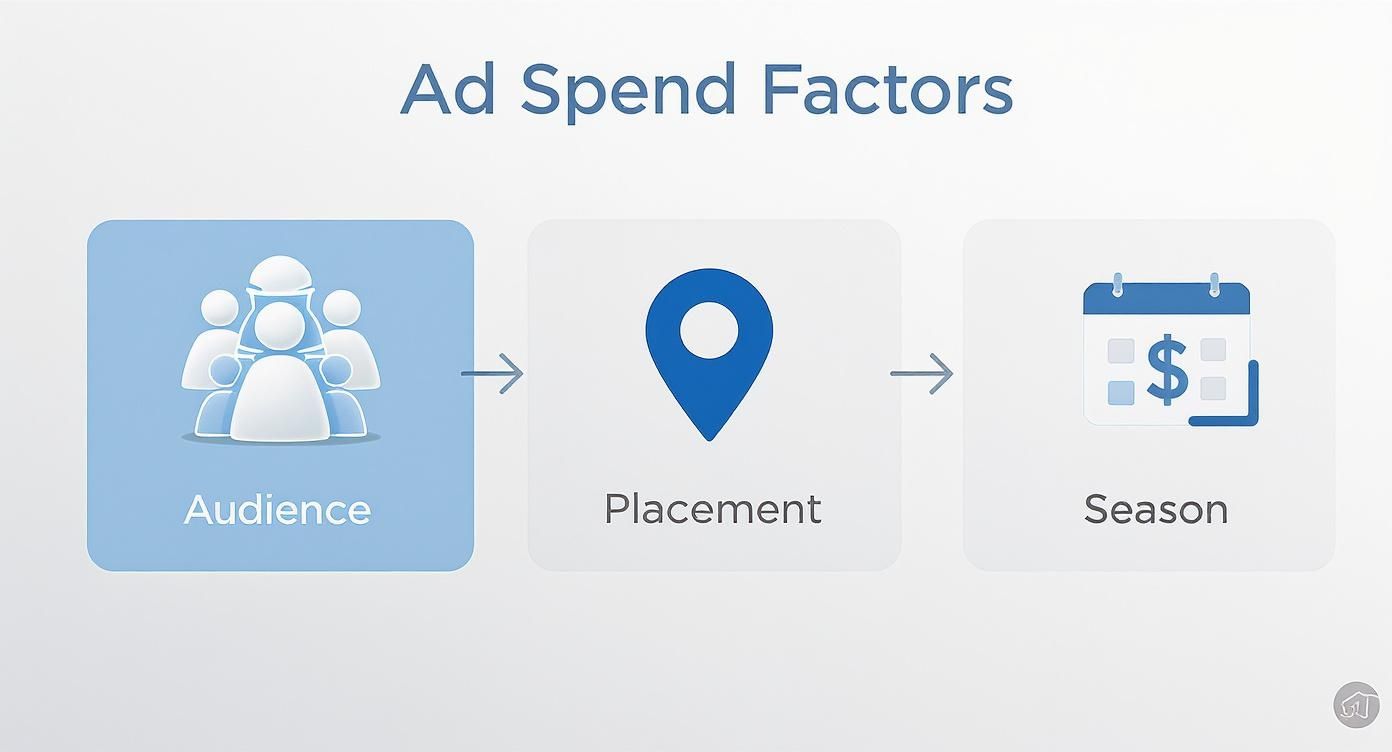
This visual really drives home the point that your final ad cost is a result of many interconnected moving parts, not just your industry alone.
Getting your head around the factors that push Facebook ad costs up and down is half the battle. The other half? Knowing exactly what to do about it.
The good news is you have a handful of powerful levers you can pull to make every dollar in your budget stretch further. Instead of just swallowing high costs as a “cost of doing business,” you can actively bring them down by making your campaigns better and more relevant.
Think of it as earning a discount from Facebook for being a good advertiser. These are the tried-and-true strategies we use to optimise ad spend, boost performance, and get a much better return.
It’s a simple truth: Facebook rewards ads that people actually like. Your ad’s Relevance Score (or the more recent ‘Quality Ranking’ metric) is basically Facebook’s report card on how engaging your creative is.
High-quality, relevant ads get preferential treatment in the ad auction, which almost always means lower costs and better placements for you. To improve your score, focus on creating thumb-stopping visuals and writing copy that hits on your audience’s real-world problems and desires.
Don’t be scared to test different formats, either. An ad that does okay as a static image might absolutely crush it as a short, punchy video or Reel.
The secret is to create ads that don’t feel like ads. The more your content blends in as something genuinely entertaining or valuable, the better it will perform—and the less you’ll pay for every click and conversion.
Guessing is expensive in the world of advertising. The only way to know for sure what clicks with your audience is to test it. This is where A/B testing, or split testing, comes in, allowing you to run different versions of your ads against each other to see what wins.
The golden rule of A/B testing is to only change one variable at a time. If you change the headline, the image, and the call-to-action all at once, you’ll have no clue which change actually made the difference.
Start by testing the big, impactful elements to find your winning formula:
By testing methodically, you start making data-driven decisions that consistently bring your costs down over time.
Targeting too broadly is one of the fastest ways to burn through your budget. The real magic of Facebook advertising is how deeply you can target specific groups of people. When you focus your spend on those most likely to convert, your efficiency can skyrocket.
Kick things off by creating Custom Audiences from your own data—these are your warmest leads. These are high-value groups made up of people who already have a relationship with your brand. For instance, you can target:
Once you have a solid Custom Audience, you can unleash one of Facebook’s most powerful tools: the Lookalike Audience. Facebook’s algorithm analyses the traits of your source audience and then goes out to find brand new people who share similar characteristics.
This is hands-down one of the most effective ways to find new customers at a lower cost. These audiences are the backbone of many successful campaigns. To dive deeper, check out our guide on remarketing with Facebook to see how you can use these audiences to re-engage people who’ve already shown interest.
A brilliant campaign strategy doesn’t mean much without smart financial planning and a clear way to track what’s actually working. Nailing down a realistic Facebook ads budget is your first step, whether you’re starting with a few hundred dollars or managing thousands.
Facebook gives you two main ways to control your spending: a daily budget and a lifetime budget. A daily budget tells Facebook the average amount you’re willing to spend each day, which is great for consistency. A lifetime budget, on the other hand, sets a total spend for the entire campaign, giving the algorithm more freedom to spend on days it spots the best opportunities.
To really get a grip on your campaign’s performance, you need to look past the vanity metrics like likes and shares. The number that truly matters is your Return on Ad Spend (ROAS). It tells you exactly how much money you’re making for every dollar you put into your ads.
The formula is refreshingly simple:
ROAS = Total Revenue from Ads / Total Ad Spend
So, let’s say you spent $500 on a campaign that brought in $2,000 in sales. Your ROAS would be 4. This means for every single $1 you invested, you got $4 back. This basic calculation shifts you from guessing to knowing, giving you the power to justify your ad spend and make decisions based on cold, hard data. To measure this accurately, using a tool like the official Facebook Insights analytics tool is essential for digging into the detailed performance analysis.
ROAS is a fantastic starting point, but it’s just one piece of the puzzle. Truly effective measurement involves tracking a whole range of indicators that paint a complete picture of your campaign’s health. Getting familiar with these wider digital marketing performance metrics helps you see the full impact of your advertising, from that first spark of brand awareness right through to the final sale. This approach ensures you’re not just profitable, but also building a solid growth engine for your business.
Ready to turn your ad spend into measurable growth? Virtual Ad Agency specialises in creating data-driven marketing strategies that deliver real results. Let us help you build a campaign that not only reaches your audience but also maximises your return on investment. Find out more at https://www.virtualadagency.com.au.

 previous