
So, how much should you budget for Facebook advertising in Australia? While there's no one-size-fits-all answer, we can certainly look at the benchmarks to get a clear starting point. On average, you can expect a Cost-Per-Click (CPC) of around AUD $2.10 and a Cost-Per-Thousand-Impressions (CPM) of about AUD $11.04.
Diving a little deeper, the price of your Facebook ads isn't a fixed menu item. It's much more like a dynamic marketplace where costs shift based on things like demand, who you're trying to reach, and how relevant your ad is to them.
The two most important metrics you’ll hear about are CPC and CPM.
Think of it this way: imagine you're handing out flyers for your new café. Paying per click (CPC) is like only paying when someone takes your flyer, reads it, and actually walks into your café. Paying per thousand impressions (CPM), on the other hand, is like paying a flat fee for someone to show your flyer to 1,000 passersby on a busy street, whether they come in or not.
The actual cost of your Facebook ads really hinges on your campaign goal. Are you trying to get leads for your service business, sell products directly from your website, or just get your brand name out there? Each of these objectives comes with a different price tag.
For businesses here in Australia, recent data shows that costs can swing quite a bit based on competition and how specific your audience is. For example, while that average CPC is around $2.10, the cost to get a conversion varies wildly by industry. An e-commerce business might pay anywhere from AUD $20 to $50 per sale, while generating a new lead could cost between AUD $10 and $30.
This kind of variability is completely normal. An ad that’s highly targeted to a small but valuable audience will often have a higher CPC, but it can deliver a much, much better return on your investment in the long run.
Key Takeaway: Don't get hung up on chasing the lowest possible click cost. The real goal is to find the most cost-effective way to achieve your specific business objective, whether that's a sale, a qualified lead, or a booking.
To give you a clearer picture of what you might be looking at, here’s a quick overview of typical costs for different goals.
| Metric/Goal | Average Cost (AUD) |
|---|---|
| Cost Per Click (CPC) | $2.10 |
| Cost Per 1,000 Impressions (CPM) | $11.04 |
| Cost Per App Install | $4.25 |
| Cost Per Like | $0.80 |
| Cost Per Lead (General) | $10 – $30 |
| Cost Per Sale (E-commerce) | $20 – $50 |
As you look at these numbers, think about how they line up with your own business goals and what a new customer is truly worth to you over their lifetime. For a more detailed breakdown of all the factors at play, check out our guide on the true cost of Facebook ads.
Lots of advertisers fall into the trap of thinking the Facebook ad auction is just a straight-up bidding war where the deepest pockets win. That couldn't be further from the truth. It’s actually a lot more sophisticated—think less like a simple auction and more like a contest for a primetime TV spot, where the network cares about how good your ad is, not just how much you’re willing to pay.
Getting your head around this process is essential because it’s the single biggest factor affecting your Facebook advertising costs. Instead of just handing the win to the biggest budget, Meta's algorithm is designed to create the best possible experience for both its users and its advertisers. To do this, it calculates a "total value" for every ad in the running. The ad with the highest total value gets the placement. Simple as that.
So, what exactly goes into this "total value" score? It really boils down to three critical signals from your campaign. If you can master these, you’ll be on your way to winning more auctions and bringing your ad spend down.
These three core components are:
This infographic breaks down how the auction's outcome directly translates into the cost metrics you see in your Ads Manager.
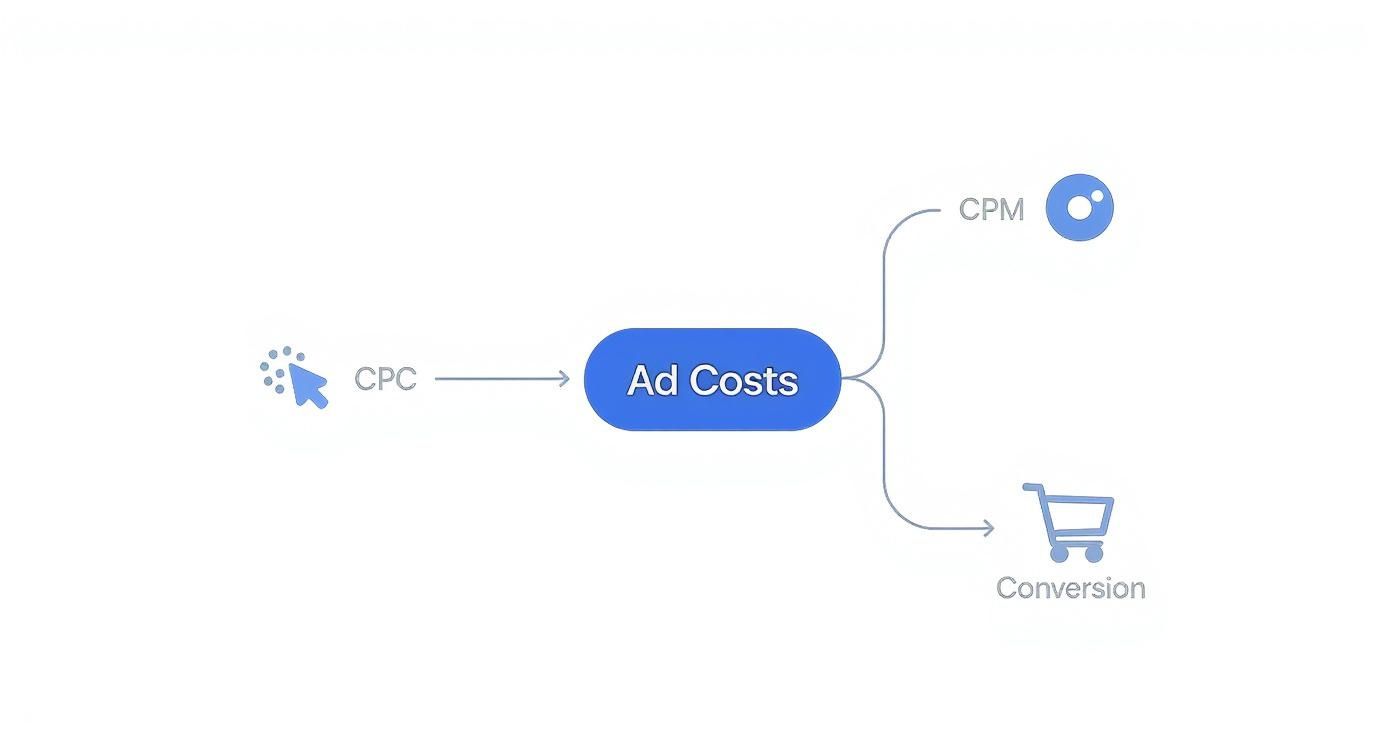
As you can see, the results of the auction ripple out to affect tangible costs like your CPC, CPM, and how much you pay for each conversion.
This system is precisely why a super-relevant ad with a smaller bid can consistently beat a competitor who’s throwing a much bigger budget at the wall. If your ad has a high estimated action rate and top-notch ad quality, Facebook knows that showing it is going to create a positive experience for its users.
Facebook's number one priority is keeping people on the platform. A relevant, engaging ad helps them do that, so the algorithm will often favour it—even if the monetary bid is lower.
What this means for you is that you don't always have to just pour more money into your campaigns. By focusing on creating genuinely high-quality, relevant ads that connect with your audience, you can seriously improve your total value score. A higher score leads to winning more auctions at a better price, which in turn lowers your overall Facebook advertising cost and gives your return on investment a healthy boost.
Ever stared at your Facebook ad reports, scratching your head? One campaign is humming along at $1 per click, while another—seemingly targeting a similar audience—is hitting you for $5 a pop. It's not random, I promise. It's all down to a handful of key factors that are constantly interacting behind the scenes.
Think of it like booking a flight. The price swings wildly depending on where you're going (your audience), the time of year (seasonality), and how many other people are trying to cram onto the same plane (your competition). Facebook’s ad auction is surprisingly similar.
Let's break down the variables that really move the needle on your ad spend.
Who you decide to show your ads to is, without a doubt, the biggest cost driver of them all.
Go for a broad, general audience, and it's a bit like buying a billboard on a major highway. You’ll get in front of a lot of eyeballs for a relatively low cost per impression, but a huge chunk of them will drive right past without a second glance.
On the other hand, if you get super specific—say, architects in Sydney who have shown an interest in sustainable building materials—that audience is far more valuable. Because this group is smaller and fiercely targeted by competitors, you'll naturally pay a premium. But while the cost-per-click might be higher, the quality of leads and conversion rates are usually in a different league entirely.
The industry you're in plays a massive role in what you'll end up paying. Some sectors are just more crowded and competitive than others, and that drives up the price of entry for everyone.
For instance, industries with a high customer lifetime value—think finance, insurance, and B2B services—consistently see some of the highest CPCs. A financial services company might pay an average of $3.77 per click, while an apparel brand could get away with paying just $0.45. It makes sense; the potential return from a single new finance client justifies a much higher cost to get them in the door.
Key Insight: Your Facebook advertising cost is a direct reflection of the market value of your target audience. The more valuable that audience is to other advertisers, the more you'll need to bid to win their attention.
Here in Australia, this gets even more layered. Ads targeting metro hubs like Sydney and Melbourne almost always cost more due to the sheer volume of competition. Seasonal trends also cause costs to spike—think major holidays or even end-of-quarter budget blowouts when everyone is trying to hit their targets. You can dig deeper by checking out the latest research on Facebook ad costs in Australia.
The table below breaks down how these different factors can either inflate or reduce what you end up paying.
| Influencing Factor | Impact on Cost | Reason |
|---|---|---|
| Broad Audience Targeting | Decreases | Less competition for a larger, less defined group of users. |
| Niche Audience Targeting | Increases | High competition from other advertisers trying to reach the same valuable, specific group. |
| High-Competition Industry | Increases | More advertisers are bidding for the same audience, driving auction prices up. |
| Low-Competition Industry | Decreases | Fewer advertisers mean lower bids are needed to win placements. |
| High Ad Quality/Relevance | Decreases | Facebook's algorithm rewards ads that provide a good user experience with lower costs. |
| Low Ad Quality/Relevance | Increases | Poorly performing ads are penalised with higher costs to discourage bad content. |
| Major Holidays/Events | Increases | A surge of advertisers entering the auction for seasonal shoppers creates more competition. |
Ultimately, a smart strategy involves finding the sweet spot between a precisely targeted audience and a cost you can sustain.
Finally, never underestimate the power of your ad creative. Facebook’s primary goal is to keep its users happy and scrolling, which means showing them content they actually find interesting. Because of this, the algorithm actively rewards high-quality, relevant ads with better placements and, you guessed it, lower costs.
This is where your Ad Quality ranking comes into play. If people are liking, commenting, and sharing your ad—and not hiding it—Facebook sees it as a positive user experience. As a reward, you'll often pay less to reach your audience than a competitor with a boring, uninspired ad.
This means investing in compelling copy and eye-catching visuals isn't just a fluffy creative task; it's a direct, powerful cost-saving strategy.
Think of picking a campaign objective on Facebook like punching a destination into your car's GPS. It doesn't just pick the final stop; it maps out the entire route, figures out the travel time, and ultimately, determines the cost of the journey. This one choice is one of the most powerful levers you can pull to control your Facebook advertising costs.
When you select an objective, you’re essentially telling Facebook’s algorithm what success looks like to you. It then goes to work, finding the people in your audience most likely to take that specific action. Naturally, you'll pay for that result. Getting this alignment right from the get-go is the key to making sure every dollar in your budget works as hard as possible.
Objectives at the top of the marketing funnel, like Brand Awareness or Reach, are all about introducing your business to a massive audience. Picture it as casting a wide, inexpensive net just to get a feel for who's swimming in your local waters.
Because the only goal is to get your ad seen by as many eyeballs as possible, the cost is relatively low. Facebook is optimising for impressions (views), which are much cheaper than actions like clicks or, heaven forbid, actual purchases. These campaigns are brilliant for building that initial name recognition, but don't bank on them driving immediate sales.
As you travel further down the funnel, your objectives get sharper, more valuable, and have a much bigger impact on your ad spend.
Aligning your campaign objective with your business goals is non-negotiable. If you need sales, optimising for 'Brand Awareness' is like bringing a fishing net to a car race—you’re using the wrong tool for the job, and your results will show it.
Here in the Australian market, this cost difference becomes even more obvious during peak shopping seasons. Ads optimised for conversions will see their prices soar around Black Friday and Christmas as competition for ready-to-buy customers gets fierce.
Understanding these dynamics is vital for smart budgeting, especially when your objective is directly tied to your customer acquisition cost. To get a better handle on this, check out our complete guide on how to calculate the customer acquisition cost formula. It will help you figure out if that higher ad spend for conversions is actually profitable for your business in the long run.
Getting your head around the mechanics of Facebook ad costs is one thing, but actively bringing those costs down is a whole different ball game. The good news? You have far more control over your ad spend than you might think. With a few smart, proven strategies, you can boost your campaign's efficiency and make every single dollar work harder for you.
This isn’t about discovering secret loopholes or gaming the system. It’s about methodically improving the core elements that Facebook’s algorithm loves to reward: razor-sharp audience targeting, high-quality ads, and relentless testing.
Let's dive into the practical tactics that will help you build a more cost-effective advertising machine.
Without a doubt, the single most effective way to lower your costs is to stop wasting money showing ads to the wrong people. It’s that simple. The more precisely you can target users who are genuinely interested in what you’re offering, the higher your engagement rates will climb—and Facebook rewards high engagement with lower costs.
It's time to move beyond basic interest targeting and start tapping into Facebook's more powerful tools:
Nailing your audience targeting is the bedrock of an efficient campaign. It ensures your message lands with maximum impact, which skyrockets your relevance and directly drives down your Facebook advertising cost.
As we’ve touched on, Facebook’s auction system gives priority to ads that create a positive experience for its users. A high-quality, engaging ad can actually win placements over a competitor with a much bigger budget. Your mission is to create ads people actually want to see in their feed.
Key Takeaway: Your ad creative isn't just a design task; it's a direct cost-control lever. Investing in compelling copy and eye-catching visuals will pay for itself by lowering your ad spend and increasing conversions.
Start by focusing on grabbing attention within the first three seconds. Use crisp, high-resolution images, clear and punchy copy, and a strong, unmissable call-to-action. One of the most effective ways to do this is with captivating video content that drives high engagement, which can lead to better results in the ad auction. You can discover some powerful strategies to boost Facebook engagement with video content to see just how well this can work.
Never, ever assume you know what will work best. A/B testing, or split testing, is your best friend here. It lets you pit different versions of your ads against each other to see which one comes out on top. This data-driven approach takes the guesswork out of the equation and allows you to systematically improve your results over time.
You can test almost any part of your ad, but it’s best to start with the elements that are likely to have the biggest impact:
By isolating just one variable at a time, you can pinpoint the winning combinations and start funnelling your budget into what's been proven to work. This is how you truly optimise your spend.
Another powerful tactic is to re-engage users who have already shown interest in your brand. To really master this, you can learn more about remarketing with Facebook in our detailed guide.
Diving into Facebook ads often kicks up a lot of questions, especially around cost. We get it. To help you budget with confidence, we’ve put together some straightforward answers to the queries we hear most often from Australian businesses.
If you’re a small business just testing the waters, a realistic starting point is usually somewhere between AUD $500 to $1,500 per month. This is the sweet spot—enough to gather some real performance data without having to commit to a massive upfront investment.
A good rule of thumb is to set a daily budget of about $20-$30 per campaign. Think of it as giving Facebook's algorithm enough fuel to figure out who’s responding to your ads and start optimising for better results.
Honestly, the initial dollar amount isn't the most critical part. What really matters is consistency and a willingness to test. Stick to one or two main goals, like driving website traffic or generating leads, and prove the model works before you even think about scaling up your spend.
Broadly speaking, yes, Facebook ads can have a lower cost-per-click (CPC), particularly if your goal is top-of-funnel stuff like building brand awareness. In Australia, you'll often see Facebook's average CPC hover between AUD $1.15 and $3.20. In contrast, competitive keywords on Google Ads can easily set you back $2 to $5 per click, and often much more.
But here’s the thing: "cheaper" really comes down to what you're trying to achieve.
The smartest approach? Use them together. They’re not competitors; they’re teammates. Google captures the demand that’s already out there, while Facebook goes out and creates new demand. A solid digital strategy uses both to cover the entire journey, from that first flicker of awareness to the final click to buy.
Key Insight: Stop getting hung up on CPC alone. The metric you should really care about is your cost per acquisition (CPA). A pricier click on Google might actually be more profitable if it converts into a high-value customer more often.
That heart-stopping moment when your ad costs spike is something most advertisers experience. It’s alarming, but it’s almost always traceable to a few usual suspects. Pinpointing the cause is the first step to getting things back on track.
The most common culprit is ad fatigue. This is what happens when your audience has seen your ad so many times they’ve started to tune it out. Engagement drops, and Facebook has to work harder (and charge you more) to get your ad seen.
Another big one is increased competition. This is a given during peak retail periods like Christmas, Black Friday, or the End of Financial Year sales. More businesses are bidding for the same eyeballs, which naturally drives up auction prices for everyone.
Finally, have you made any major changes to your campaign recently? Switching up your targeting, creative, or objective forces the algorithm into its "learning phase" all over again. Costs can temporarily rise while it re-optimises. To stay ahead of this, make sure you refresh your ad creative regularly, keep a close watch on your 'Frequency' metric, and be aware of big seasonal trends that might bring more competition to the table.
At Virtual Ad Agency, we help Australian businesses cut through the complexity of paid advertising to achieve real, measurable growth. If you're ready to build a cost-effective ad strategy that actually delivers, see how we can help at https://www.virtualadagency.com.au.

 previous