
When you hear “social media advertising services,” what comes to mind? For many, it’s just paying to “boost” a post on Facebook or Instagram. But that’s like thinking a Formula 1 team just puts petrol in the car and tells the driver to go fast. The reality is much, much deeper.
Think of it this way: you could try to build a high-performance race car with a basic toolkit from your garage. You might even get it to start. But putting it on the track against the pros? That’s a different story. Social media advertising services are your expert engineering crew—the specialists who design, build, and fine-tune your campaign for the win.
These services are a world away from just hitting the “promote” button and hoping for the best. It’s the difference between blindly guessing who might be interested in your offer and using sophisticated tools to pinpoint individuals with surgical precision, based on their behaviours, interests, and where they are in their buying journey.
It’s a common mistake to think that these services are just about placing ads. The real work is a continuous cycle of strategy, execution, learning, and refining. A professional agency or consultant isn’t just a button-pusher; they’re managing several critical parts of the machine to make sure your investment actually turns a profit.
The day-to-day work goes far beyond just creative design. It’s a full-stack operation that includes:
In a hyper-connected market like Australia, a professional approach isn’t just a nice-to-have—it’s essential. As of early 2025, there were around 20.9 million social media user identities in the country. That’s nearly 78% of the entire population!
This huge, active audience is a massive opportunity, but it also means the competition is fierce. Getting your message through the noise requires more than just a budget; it requires expertise.
At its core, social media advertising services give you the expertise and tools to cut through that clutter. They transform your ad spend from a hopeful gamble into a reliable engine for business growth, making sure your message doesn’t just reach more people, but resonates deeply with the right people.
To get a broader look at different types of paid campaigns, you can find more on Social Media Ads. Ultimately, this strategic management is what separates the campaigns that fizzle out from the ones that drive real, tangible results for a business.
A high-performing social media ad campaign is a bit like a finely tuned orchestra. Every single instrument plays a crucial part. When they all come together in perfect harmony, the result is powerful and moving. Just throwing a nice image and a clever line of text out there is like having a lone violinist—it might sound pleasant, but it won’t have the depth to really captivate an audience. Professional social media advertising services are the conductor, making sure every component works together to hit the right notes.
This coordinated effort kicks off long before any ad goes live. It starts with some deep strategic thinking, turning a vague idea into a sophisticated marketing asset that’s built for performance. It’s the difference between shouting into a crowded room and having a genuine, one-on-one chat with your ideal customer.
The foundation of any knockout campaign isn’t just raw creativity; it’s understanding. Before a single visual is designed or a word of copy is written, an agency dives deep into audience research. This goes way beyond basic demographics like age and location.
Instead, they build detailed buyer personas. Think of it as moving from a blurry photo to a high-definition portrait of your customer. For instance, a generic target like ‘fitness enthusiasts’ becomes a super-specific profile: ‘a 32-year-old female yoga practitioner in an urban Australian centre who follows sustainable activewear brands, reads wellness blogs, and shops online via her phone after 8 PM.’
This level of detail allows for hyper-targeted messaging that really connects on a personal level. The strategy also involves a good look at what the competition is up to. To truly stand out, thorough PPC competitor research can uncover what your rivals are doing right (and wrong), giving you the inside track.
Once there’s a deep understanding of the audience, the creative process can begin. This isn’t just about making something that looks good; it’s about making something that works. Every single element is chosen deliberately to get a specific response.
Key parts of the ad creative include:
The infographic below breaks down the core pillars that social media advertising services manage to deliver results.
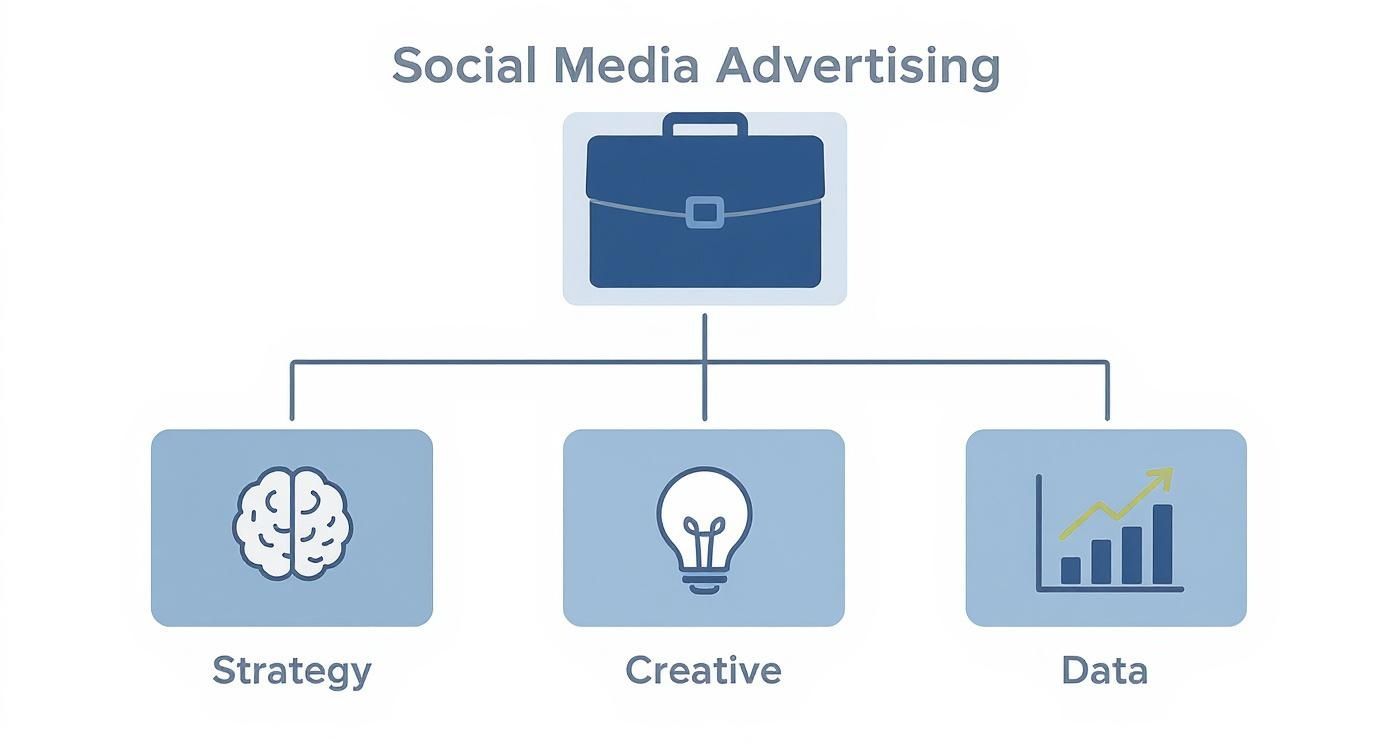
This shows how foundational strategy, creative execution, and data analysis are the essential supports for any successful service.
It’s a common myth that a bigger budget automatically means better results. The truth is, how you allocate that budget is far more important. A professional service knows how to make every dollar count by funnelling funds toward the most effective platforms and audiences.
This is where relentless testing comes in. A/B testing, or split testing, is simply running multiple versions of an ad at the same time to see which one performs best. An agency might test:
By constantly testing these variables, the campaign is always being optimised. It’s a data-driven process of evolution, where underperforming ads are cut and the winning combinations get more budget, ensuring the highest possible Return on Ad Spend (ROAS).
This methodical approach takes all the guesswork out of the equation. To see how these principles look in the real world, checking out a variety of https://virtualadagency.com.au/social-media-marketing-examples/ can give you some great insight into what makes campaigns tick across different industries. It’s this combination of deep research, compelling creative, smart budgeting, and tireless optimisation that truly defines a high-performing campaign.
Deciding where to spend your advertising dollars is a lot like picking a location for a new shop. You wouldn’t open a high-end jewellery store in a skate park, and a surf shop probably wouldn’t last long in the middle of the financial district. Each spot has its own vibe and attracts a certain crowd; social media is exactly the same.
Not all platforms are created equal, especially when it comes to your business. Each one is a unique world with its own audience, its own unspoken rules, and its own advertising strengths. A huge part of what professional social media advertising services bring to the table is picking these digital battlegrounds strategically. It’s about making sure your message doesn’t just get seen, but that it connects with people where they’re actually ready to listen.
This isn’t just about chasing the most popular platform. It’s a deeper dive into your ideal customer’s online habits and matching those with the specific ad tools each network offers.
First things first: what are you trying to achieve? Are you hunting for professional leads, driving online sales, or building a community around your brand? Each goal points you toward a different platform.
For example, a B2B software company trying to reach C-suite executives will find its best hunting ground on LinkedIn. Its power to target by job title, industry, and company size is second to none for connecting with decision-makers in a work mindset. You’d be throwing money away trying to do the same thing with a TikTok campaign.
On the flip side, a fashion brand that relies on stunning visuals and impulse buys will feel right at home on Instagram and Pinterest. These platforms are all about aesthetics and discovery, making them the perfect runway to showcase products and spark that “I need this now” feeling.
Beyond just who is on a platform, you have to think about why they’re there. People scroll through different apps for different reasons, and the best ads respect that.
Choosing the right platform means meeting your audience not just where they are online, but where they are mentally. It’s about joining the right conversation at the right time. That’s what turns your ad from an annoying interruption into a welcome suggestion.
A seasoned advertising service knows how to read this psychological context. They craft campaigns that feel less like a sales pitch and more like a helpful tip, perfectly suited to what the user is thinking about in that moment. That’s how you turn ad spend from a cost into a real investment.
To help you make a smart call, it’s useful to see a direct comparison. Each platform has unique perks depending on your business and what you’re trying to do. This table gives you a starting point for figuring out where to put your budget for the biggest impact in Australia.
| Platform | Primary Australian Audience | Best For (Business Objective) | Ad Format Strengths |
|---|---|---|---|
| Broad; strong in 25-55+ age groups across all demographics. A massive user base. | Community building, lead generation, local business awareness, e-commerce sales. | Video Ads, Carousel Ads (for products), Lead Forms, Messenger Ads. | |
| Younger demographic, strong in 18-39. Visually driven and mobile-first users. | Brand awareness, visual product showcases, influencer marketing, e-commerce. | Stories Ads, Reels Ads, Shopping Ads, high-quality image and video content. | |
| Professionals, B2B decision-makers, high-income earners. 25-55 career-focused individuals. | B2B lead generation, professional recruitment, thought leadership, corporate branding. | Sponsored Content, InMail, Document Ads (for whitepapers), Video Ads. | |
| TikTok | Primarily Gen Z and young millennials (16-30). High engagement and trend-focused. | Brand awareness with a younger audience, driving viral trends, user-generated content. | In-Feed Video Ads, Branded Hashtag Challenges, Spark Ads (promoting organic content). |
| Predominantly female (70%+), 25-49. Users actively planning purchases. | E-commerce (fashion, home, DIY), driving website traffic, visual product discovery. | Promoted Pins, Shopping Ads, Video Pins, Idea Pins. |
Ultimately, the goal is to focus your resources where your customers are most active and receptive. Spreading your budget thinly across every single platform is a classic mistake that just weakens your message. By zeroing in on the one or two channels that align best with your goals, you concentrate your firepower for a much bigger bang.
Bringing in a professional social media advertising agency can feel like a big step, and it’s only natural to want to get your head around the numbers first. It’s not just about what you’re spending; it’s about what you’re getting back. Let’s pull back the curtain on how agencies usually structure their fees and, more importantly, how to measure success so your investment actually fuels business growth.
Think of it like hiring a specialist tradesperson to renovate your kitchen. You’re not just paying for their time and materials; you’re paying for their expertise to add real, lasting value to your home. The same logic applies here. You’re investing in expertise to make your ad budget work much harder than you could on your own.
And businesses are certainly investing. In 2024, Australian brands are expected to pour a massive $4.26 billion into social media advertising. That’s a huge 12.1% jump from the previous year, with social now accounting for over 29% of all digital ad spending. It’s clear where the momentum is heading.
When you team up with an agency, you’ll find their fees typically fall into one of a few common models. Getting familiar with these helps you compare apples with apples and find a structure that suits your budget and your goals.
There’s no single “best” option—it all comes down to what you need.
The real measure of any ad campaign isn’t how many clicks or likes it gets. Those are just vanity metrics. A professional service zeroes in on the numbers that actually hit your bottom line, turning ad spend into tangible business results.
The question isn’t “How many people saw my ad?” It’s “How much revenue did my ad generate for every dollar I spent?” This is what separates a cost from a true investment.
Two of the most critical metrics for this are Return on Ad Spend (ROAS) and Cost Per Acquisition (CPA).
By focusing on metrics like ROAS and CPA, you get a clear, unfiltered view of how your investment is performing. It shifts the conversation from vague ideas like “brand awareness” to concrete discussions about revenue and growth. That’s how you turn social media advertising into a reliable engine for your business.

Choosing a partner to run your social media advertising is a big deal. Think of it like bringing on a co-pilot for your business’s growth engine; you need someone with the right skills, a clear flight plan, and a genuine commitment to getting you where you want to go. The wrong choice can burn through your ad budget and leave massive opportunities on the table, while the right one can unlock a whole new level of growth.
To find that perfect fit, you have to look past the slick sales pitches and focus on what really counts. That means digging into their track record, understanding their processes, and making sure their style lines up with your business goals. A great partner isn’t just another vendor—they feel like an extension of your own team.
The Aussie online ad industry is a tough space. With giants like Google Australia and Facebook Australia pulling in billions, you can see how important deep platform expertise is. Choosing a partner who lives and breathes these dominant ecosystems isn’t just a good idea; it’s essential for success. You can get more insights on the Australian online advertising market at IBISWorld.
To cut through all the noise, you need a clear way to size up potential agencies. It’s all about asking the right questions to figure out what they can really do for your brand. A solid vetting process will save you a world of headaches down the track.
Start by looking for proof, not just promises. The best agencies are proud of their results and are happy to show you how they get them.
Here are the key things to look into:
Once you’ve got a shortlist, it’s time to dig a bit deeper. These questions are designed to get you past the sales script and into the nuts and bolts of how they operate. Their answers will tell you a lot about their strategic thinking and whether they’re the right fit for the long haul.
Finding a true partner means looking for someone who is as invested in your business outcomes as you are. Their success should be directly tied to your growth, creating a collaborative and aligned relationship from day one.
Arm yourself with these questions for your next meeting:
By focusing on these areas, you can confidently pick a social media advertising services partner that’s geared for a proper growth-focused relationship. If you’re starting to look at your options, our guide on the top digital advertising agencies is a great place to start.
Firing off a social media advertising campaign is like firing the starting pistol in a race. It’s the beginning, not the end. The real work kicks off the second those ads go live. This is where professional social media advertising services really show their stripes, turning a simple launch into a living, breathing system that learns, adapts, and gets better over time.
This constant cycle of tweaking and improving is the engine that drives sustainable growth. It’s all about listening to what the data is telling you and making smart, calculated adjustments. Without it, even the most brilliant campaign will eventually run out of steam, fall victim to ad fatigue, and just stop working.
Performance data can look like a wall of numbers, but an expert knows exactly which signals to tune into. They look past the vanity metrics like likes and shares to focus on what actually moves the needle for the business. This means keeping a close eye on click-through rates, conversion costs, and how different audiences are responding to figure out what’s working and, more importantly, what’s not.
For instance, say a particular ad creative is getting a heap of clicks, but nobody’s converting on the landing page. That’s a classic sign of a mismatch between the ad’s promise and what the page is actually offering. An expert will spot that disconnect straight away and get to work realigning the message, stopping you from pouring money down the drain. This kind of constant vigilance turns raw numbers into a clear roadmap for what to do next.
Making data-driven adjustments is the secret sauce for long-term success. It’s a never-ending process of fine-tuning your approach and shifting resources around to make sure every single dollar is working as hard as it possibly can.
This optimisation loop usually involves a few key moves:
This is where the true value of a service really comes through. It’s not about just setting up a campaign and walking away; it’s about nurturing it. By constantly reading the tea leaves of performance data and making strategic adjustments, an agency ensures your marketing efforts evolve with your market, consistently driving better results over the long haul.
Diving into professional social media advertising services usually sparks a few questions. It’s a serious investment of both your time and money, so getting straight answers is a must before you commit to anything. Here, we’ll get into some of the most common queries we hear from business owners.
Think of it like the final check before a big road trip. You’ve mapped your route and checked the engine; now you just need to make sure you’ve got enough in the tank and know what to do if you hit a detour. These answers should give you that last piece of confidence.
This is the big one, but honestly, there’s no single magic number. A decent starting point for a small business in Australia is often between $1,000 to $5,000 per month in total ad spend, and that’s not including agency fees. But this figure can swing wildly depending on your industry, your goals, and just how aggressive you want to be.
A much better way to approach it is to work backwards from what you want to achieve.
Answering these questions first helps an agency recommend a budget that isn’t just a random figure, but a calculated investment designed to hit your specific business targets.
It’s easy to get these two mixed up, but they handle very different jobs. Think of it like a restaurant: you’ve got one person managing the dining room vibe and chatting with customers, while another is in the kitchen cooking the meals that brought people in.
Social media management is all about nurturing the community you already have. This means posting organic content, replying to comments, and shaping your brand’s personality. It’s the long game of building engagement.
Social media advertising services, on the other hand, are laser-focused on growth and getting new customers. This is the paid side of things—running targeted campaigns to reach new people, drive sales, and generate leads. While they work best together, advertising is a specialist skill centred on direct, measurable returns.
The simplest way to remember it is: management speaks to the audience you have, while advertising goes out and finds the audience you want. Both are vital, but they solve different business challenges.
Patience is a virtue, but in business, you need results. While you can see early data like clicks and engagement within a few days, a true return on your investment takes a bit longer to materialise. Generally, you should give it at least three months to see meaningful, stable results.
The first month is usually about gathering data and testing. The agency is learning what your audience responds to and what they ignore. The second month is for refining and optimising based on those early lessons. By the third month, the campaigns should be hitting their stride and delivering a much more predictable and positive return.
Ready to turn your social media presence into a powerful growth engine? The team at Virtual Ad Agency specialises in creating and managing high-performing ad campaigns that deliver measurable results. Find out how we can help your business grow.

 previous