
At its heart, the customer acquisition cost formula is pretty straightforward. You just take your total marketing and sales costs and divide that figure by the number of new customers you brought in over a specific period. It's the metric that tells you, on average, exactly how much you're spending to win over each new customer.
Think of your business as a car on a long road trip. Your marketing and sales efforts are the fuel, and your Customer Acquisition Cost (CAC) is the price you're paying per litre. You wouldn't set off on a big journey without knowing the price of petrol, would you? Ignoring it is a sure-fire way to run out of fuel halfway to your destination.
That's exactly what happens when businesses ignore their CAC. It's like driving blind. You might be pouring cash into advertising channels that look busy but are actually burning through your budget for minimal mileage. It’s how promising companies run out of money without ever making real progress.
Getting a handle on your CAC is the difference between guessing and strategising. Suddenly, you can make sharp, informed decisions about where your budget will have the biggest impact. When you know what it costs to land a customer from different channels, you can:
A deep understanding of CAC transforms your marketing from a simple expense line into a predictable growth engine. It’s the difference between merely hoping for new customers and building a reliable system to attract them profitably.
At the end of the day, mastering the customer acquisition cost formula is all about ensuring the long-term health of your business. It's what stops you from acquiring customers at a loss—a dangerous path that leads to failure, no matter how fast you seem to be growing.
By optimising your CAC, you make sure every dollar you spend on marketing is contributing to sustainable, profitable expansion. A big part of this involves streamlining your processes, which is where learning more about what is marketing automation can give you a serious edge.
Knowing the customer acquisition cost formula is one thing, but applying it correctly is where the real magic happens. At its heart, the formula is beautifully simple. It cuts through the noise to give you one clear number: how much you’re spending to land each new customer.
This isn't just about your ad spend, though. A classic mistake is to only count the most obvious marketing expenses. To get a true picture, you need to bundle up all the costs tied to winning new customers over a set period, like a month or a quarter.
Customer Acquisition Cost (CAC) = Total Acquisition Costs / New Customers Acquired
Think of "Total Acquisition Costs" as the complete budget for your growth engine. This goes way beyond advertising dollars. It includes the salaries of your sales and marketing teams, software subscriptions for your CRM or email platform, and even the cost of creating your ads.
To use the customer acquisition cost formula properly, you need to be honest and thorough when adding up your expenses. Here’s what should be in your "Total Acquisition Costs" bucket:
Of course, a big piece of this puzzle is knowing how well your campaigns are actually performing. For a deeper look into measuring this, it’s worth exploring the conversion rate formula.
Let's say an online store here in Australia wants to figure out its CAC for the last quarter.
First, they tally up all their costs. They spent $10,000 on Google Ads, $5,000 on social media marketing, and paid $15,000 in salaries for their marketing team. That brings their total acquisition cost to a neat $30,000. Over that same period, they successfully brought in 500 new customers.
Using the simple calculator below, we can see how this works out.
The calculation shows that for every $60 they spent, they acquired one new customer. In Australia, CAC is a critical metric for business sustainability. The formula CAC = Total Acquisition Costs ÷ Number of New Customers Acquired is used everywhere, with total costs covering everything from marketing spend and sales team expenses to marketing tools and overheads. With this $60 figure, the business now has a solid benchmark to measure its future performance against.
A blended Customer Acquisition Cost gives you a solid starting point, but the real power comes from digging deeper into the numbers. Calculating your CAC for individual marketing channels is like switching from a blurry, old-fashioned map to a high-definition GPS. It shows you exactly which routes are leading to profitable customers and which ones are just expensive dead ends.
To do this, you have to get granular. It means meticulously tracking your spending and attributing every new customer to their specific source. You need to isolate the costs for each channel—like Google Ads, content marketing, or your social media campaigns—and then connect the dots to see which customers came from where. It’s the same customer acquisition cost formula, just applied with more precision.
Let's break it down with an example for a paid social media campaign you might be running.
For instance, social media advertising is a huge piece of the puzzle for many Australian businesses. It's projected to command around 29% of total digital ad spend, or about AUD 7.5 billion, in 2025. With that kind of money on the table, you can see why knowing your channel-specific CAC is absolutely critical.
This simple but powerful formula is at the heart of all these calculations.
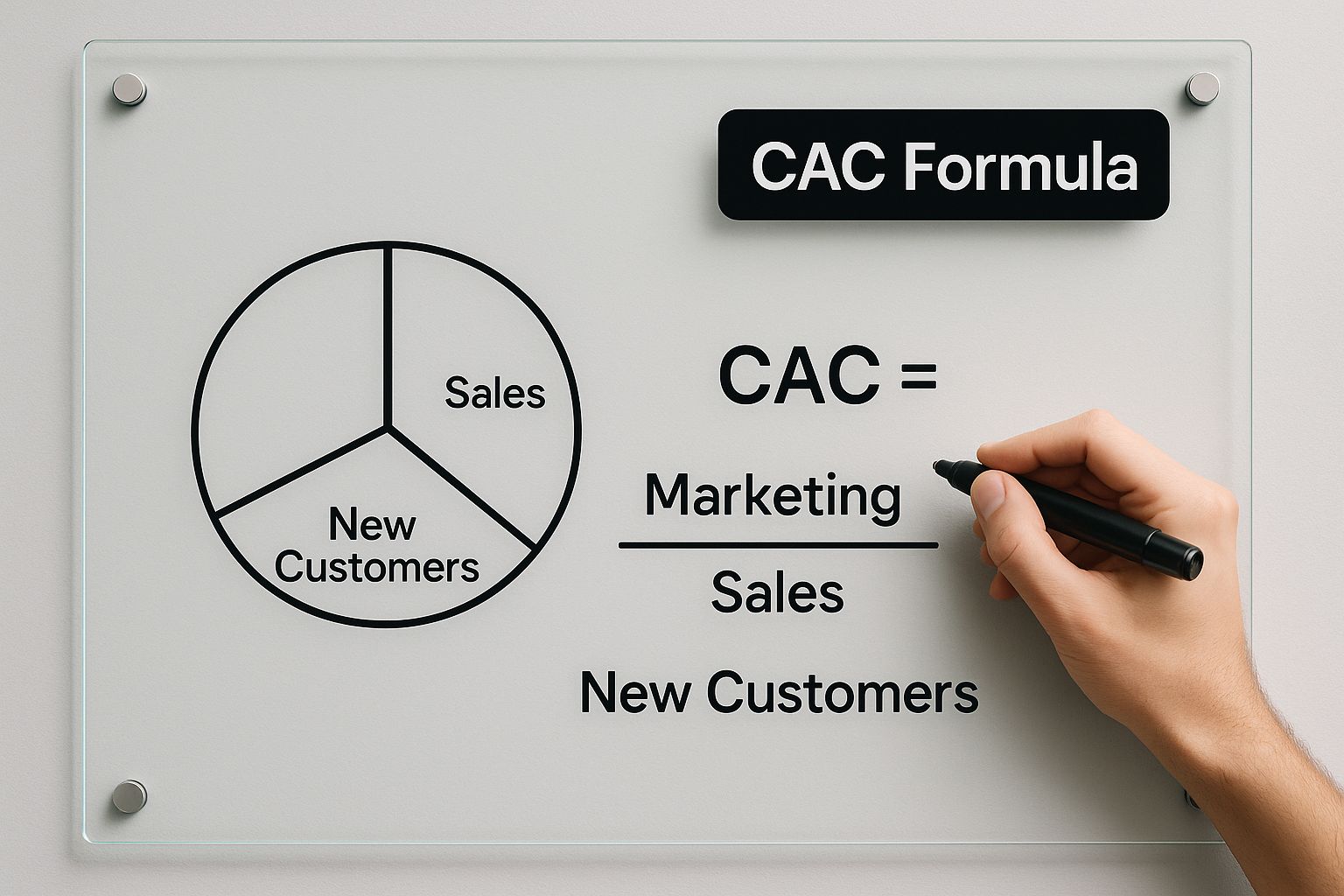
As the image shows, CAC is simply your total costs divided by the new customers you've brought in. When you're trying to figure this out for specific platforms like Facebook, tools such as a Facebook Advertising Cost Calculator can be a massive help for estimating your potential spend before you even commit.
To give you a clearer picture of how this looks in practice, here's a sample breakdown of CAC across a few common channels for a fictional business over one month.
| Marketing Channel | Total Spend (AUD) | New Customers Acquired | CAC (AUD) |
|---|---|---|---|
| Google Ads | $5,000 | 100 | $50.00 |
| Facebook Ads | $3,500 | 50 | $70.00 |
| Content Marketing | $2,000 | 25 | $80.00 |
| Email Marketing | $500 | 40 | $12.50 |
Looking at the table, it's immediately obvious that Email Marketing is the most efficient channel, while Content Marketing is the most expensive for acquiring a single customer in this period. This is the kind of insight that lets you make smart, data-driven decisions.
By analysing each channel, you stop making decisions based on vague averages and start optimising based on actual performance. This granular view allows you to confidently reallocate your budget, pouring more resources into your winners and refining or cutting your underperforming channels.
So, you've calculated your Customer Acquisition Cost. You have a number. Now what?
On its own, that number doesn't tell you much. It’s a bit like knowing your car's speed without knowing the speed limit – there's no context. The real magic happens when you stack your CAC up against what each customer is actually worth to your business over the long haul.
This is where another crucial number enters the picture: Customer Lifetime Value (LTV). Simply put, LTV is the total revenue you can expect to earn from a single customer throughout their entire relationship with your business. When you put these two metrics side-by-side, you start to see the real story of your business's health.
The relationship between what you spend to get a customer and what you earn from them is perfectly captured in the LTV:CAC ratio. This simple comparison is one of the most powerful signs of whether your business is built to last. It answers the one question that really matters: is each new customer bringing in more value than they cost to acquire?
For most businesses, a healthy ratio is generally considered to be 3:1 or higher. This means for every dollar you spend bringing a customer in the door, you’re getting three dollars back over their lifetime.
A ratio below 1:1 means you're actively losing money on every new customer. On the flip side, a really high ratio (say, 10:1) might sound great, but it could be a sign that you're not investing enough in marketing and are missing out on some serious growth opportunities.
In the Australian B2B world, companies really aim for an LTV to CAC ratio of at least 3:1 to stay profitable and make their marketing spend worthwhile. This benchmark ensures that for every dollar spent getting a customer, they expect to earn at least three dollars back. For some interesting stats on this, check out the B2B marketing benchmarks at First Page Sage.
There's one more piece to this puzzle: the CAC payback period. This metric tells you exactly how long it takes to earn back the money you spent acquiring a customer.
The faster you can do this, the better. A shorter payback period means you become profitable on each customer sooner, which frees up cash flow to pour back into finding even more customers. It's the engine of sustainable growth.
Getting a handle on these relationships lets you move way beyond the basic customer acquisition cost formula and start making genuinely strategic financial decisions. Of course, to get this right, you first need to have your LTV nailed down. We can help you there – check out our guide on how to calculate customer lifetime value.
Getting a handle on your Customer Acquisition Cost is a brilliant first step, but the real game is figuring out how to push that number down. Lowering your CAC isn't about frantically slashing your marketing budget; it’s about making every single dollar you spend work smarter and harder.
When you dial in your marketing efficiency, you directly boost your profitability without needing to find a single extra lead. It all comes down to refining the processes you already have in place to coax more prospects over the line into becoming paying customers.
One of the quickest wins for lowering your CAC is to improve the conversion rates on your website and landing pages. This whole practice, known as Conversion Rate Optimisation (CRO), is focused on turning more of your existing traffic into customers.
Think about it this way: if you can double your conversion rate, you've effectively cut your CAC in half without spending another cent on ads. Start by digging into how users are behaving on your key pages. From there, you can run A/B tests on things like headlines, calls-to-action (CTAs), and even page layouts to see what really clicks with your audience.
Paid ads get you results fast, sure, but it’s a tap that runs dry the second you stop paying. On the other hand, investing in long-term organic channels like content marketing and Search Engine Optimisation (SEO) builds a sustainable asset that brings in customers for 'free' over time.
While these strategies take a bit more patience to get going, they consistently lower your blended CAC as your organic traffic snowballs. Creating valuable blog content or optimising your site can attract high-intent customers for months, or even years, to come. If you're just starting out, you can learn more about how to raise your Google SEO ranking and build that solid foundation.
Investing in SEO is like planting a tree. It requires patience at first, but it eventually provides shade—or in this case, a steady stream of low-cost customers—for years to come.
Your happiest customers are your most powerful—and most cost-effective—marketers. A well-thought-out referral program gives them a little nudge to spread the word, bringing you new customers at a fraction of the usual cost.
A great program offers a compelling reward for both the person referring and the new customer, creating a genuine win-win. This doesn't just lower your CAC; it also brings in highly qualified leads who already trust your brand thanks to that personal recommendation. For a deeper look at what this involves, it's worth exploring the proven methods on how to reduce customer acquisition cost.
Even after you've got the formula down pat, a few questions always seem to pop up when you start applying customer acquisition cost to your own business. It's a metric with a lot of moving parts, and it’s easy to get tripped up by a few common sticking points.
Let's clear the air. We'll tackle some of the most frequent queries so you can start calculating and using your CAC with a lot more confidence.
This is the big one, and the honest-to-goodness answer is: it depends. There’s no magic number. A "good" CAC is completely relative to your industry, your business model, and most critically, your Customer Lifetime Value (LTV).
Think about it. A $200 CAC would be a disaster for a business selling $50 t-shirts. But for a software company whose customers pay $1,000 a year for the next five years? That's a fantastic result. The real secret is comparing it against your LTV. A healthy business usually has an LTV:CAC ratio of 3:1 or higher. In simple terms, for every dollar you spend getting a customer, you should be making at least three dollars back over their lifetime.
You'll want to calculate your CAC regularly, but the perfect timing depends on your business rhythm.
Seeing a high CAC can be a bit alarming, but it’s usually a symptom of a few specific, fixable issues. The usual suspects are things like targeting the wrong audience, using ad creative that just doesn't connect, or having a clunky website experience that kills your conversion rates.
Don't panic if your CAC seems high. Instead, treat it like a diagnostic tool. It's pointing you to an inefficiency in your sales and marketing funnel. Use it to start asking questions and testing improvements, from tweaking your ad targeting to optimising your landing page copy.
At Virtual Ad Agency, we help businesses dive deep into their marketing funnel to analyse and optimise every step, driving down acquisition costs and boosting profitability. Discover how our strategic approach can work for you.

 previous