
So, what on earth is omnichannel marketing, anyway?
Put simply, it's a way of creating a single, seamless customer experience across every single place a customer might interact with your business, whether that's online or in the real world. Every touchpoint—from seeing your ad on social media to walking into your physical store—should feel like one continuous, easy conversation.
Let's walk through a pretty common customer journey. A shopper spots an ad on their Instagram feed for a new pair of shoes. They click through, browse your website on their laptop for a bit, and pop the shoes into their cart.
Later that day, they pull out their phone and use your mobile app to see if a local store has their size in stock. And what do you know, it does! So they head to the store, try the shoes on, and make the purchase right then and there.
This smooth, interconnected flow is what omnichannel marketing is all about. It’s not just about showing up on different channels; it’s about making them all work together like a well-oiled machine. The real goal is to get rid of any friction a customer might feel moving from one touchpoint to the next, making their whole journey feel natural and effortless.
At its core, omnichannel marketing is a customer-first mindset. It forces you to organise your entire business around the consumer, which is a big shift from older models where every channel—the website team, the retail staff, the social media crew—operated in its own little bubble.
An omnichannel approach gets one crucial thing right: the modern customer doesn't see channels; they just see your brand. Whether they're on your app or in your store, they expect a consistent experience that remembers who they are and what they've done before.
For any Australian business that wants to build real, lasting customer loyalty, this isn't just a nice-to-have anymore; it's essential. By tying every touchpoint together, you build a powerful, cohesive brand experience that doesn't just meet customer needs but actually starts to anticipate them. And that leads to some serious benefits:
It's a classic mistake. A lot of businesses think that because they have a website, a few social media profiles, and a physical store, they're automatically running an omnichannel operation. But that's a crucial misunderstanding.
The real difference isn't about how many channels you use. It's about how deeply they're connected from the customer's point of view.
Think of multichannel marketing like a brand shouting the same message from several separate, unconnected rooms. The social media team is doing their thing, the email team is sending out a campaign, and the in-store staff are running a promotion. They're all working for the same company, sure, but they operate in silos, completely unaware of what the others are doing.
Omnichannel marketing, on the other hand, is one seamless conversation that follows the customer from room to room. It remembers everything that was discussed before. The whole experience is built around the customer, not the company's internal departments.
The fundamental split between these two approaches boils down to one thing: focus. A multichannel strategy is company-focused. It's about blasting a message out through as many channels as possible to get maximum reach. Each channel is treated like its own little empire with its own goals and metrics.
In contrast, an omnichannel strategy is entirely customer-focused. It puts the individual right at the centre and orchestrates all the channels around their unique journey. The goal isn't just to be present everywhere, but to make jumping between touchpoints feel completely invisible and natural. For a deeper look into this integrated approach, this guide does a great job of clarifying the distinction between omnichannel and multichannel.
An omnichannel approach recognises that a customer who adds an item to their cart on a mobile app is the same person who later walks into the physical store. It ensures the experience is continuous, not reset at every new touchpoint.
This is what that seamless journey looks like in practice, with a customer effortlessly moving between their phone, laptop, and an in-store visit without a single hitch.
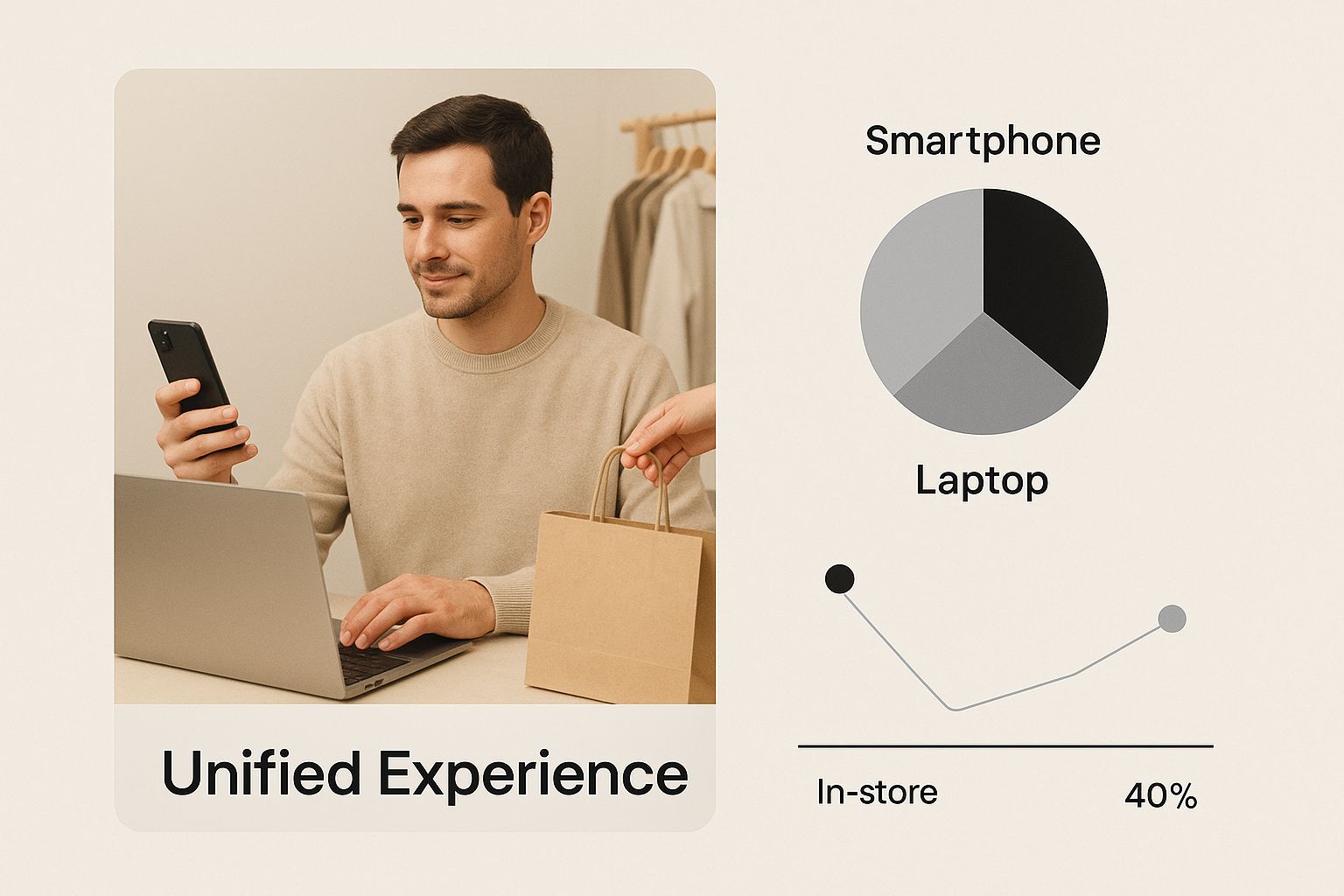
As the visual shows, it’s about building a single, cohesive journey rather than just stringing together a series of separate interactions. This connected approach is absolutely vital in Australia, where shoppers fluidly move between the online and offline worlds.
To put it into perspective, a whopping 58% of Australian holiday shoppers now begin their search for a product online. This shows just how critical those digital entry points are to the modern shopping journey.
To really hammer home the difference, let's break down the two strategies side-by-side. The table below highlights how they diverge in their core philosophy, from the way they treat data to the ultimate goal they're trying to achieve.
| Feature | Multichannel Marketing | Omnichannel Marketing |
|---|---|---|
| Primary Focus | Company-centric (broadcasting a message) | Customer-centric (building a relationship) |
| Channel Integration | Channels operate independently in silos | Channels are fully integrated and share data |
| Customer Experience | Inconsistent and fragmented across channels | Consistent, seamless, and personalised |
| Data Usage | Data is siloed within each channel | Data is centralised for a single view of the customer |
| Goal | Maximise reach and engagement per channel | Enhance customer lifetime value and loyalty |
| Measurement | Success is measured by individual channel metrics | Success is measured by overall customer journey metrics |
While both strategies use more than one channel to reach customers, it's the underlying philosophy that sets them worlds apart.
Ultimately, multichannel is about giving customers options, while omnichannel is about unifying those options into a single, superior experience.

A genuine omnichannel experience doesn't just happen by magic; it's carefully built on a solid foundation. Think of it like a house – without strong supports, the whole thing comes crashing down. Your omnichannel marketing strategy is no different, relying on a few core pillars to work properly. Without them, even your best ideas can result in a confusing and broken customer journey.
Understanding these foundational pieces gives you a clear blueprint. It's the key for Australian businesses wanting to move beyond just having a presence on multiple channels. It’s about building a framework where every channel works together seamlessly, making the customer’s experience feel natural and intuitive.
Let's break down the three essential pillars that hold this entire structure up.
The absolute bedrock of any omnichannel strategy is unified customer data. Imagine trying to have a continuous conversation with someone who forgets everything you’ve said each time you meet. That’s exactly what it feels like for customers when your channels don’t talk to each other.
This pillar is all about creating a single, reliable source of information for every customer interaction. Whether they browse your website, open an email, or chat with a support agent, every little bit of data should feed into one central hub. This is often done using a Customer Data Platform (CDP), which connects all your touchpoints into one cohesive view.
A unified data profile means you know that the person who abandoned their cart on your website is the same person who just walked into your Melbourne store. This knowledge unlocks true personalisation.
Once your data is connected, the next pillar is making sure every interaction feels like it's coming from the same brand. Consistency in branding and messaging is absolutely vital for building trust and reinforcing who you are. The tone of your emails has to match the language your in-store staff use, and the look of your mobile app should feel just like your website.
This consistency creates a feeling of familiarity and reliability. It tells customers that no matter how they choose to connect with you, they’ll get the same great experience. A strong omnichannel strategy is built on various elements, including powerful customer engagement strategies that ensure every single interaction is cohesive and on-brand.
The final pillar is the integrated technology stack that makes it all happen. This is the technical plumbing that lets your systems communicate without a hitch. It's the magic behind the scenes connecting your e-commerce platform to your inventory management system, which enables popular features like "buy online, pick up in-store."
An integrated stack ensures data flows freely and that an action in one channel can trigger a reaction in another. This is where you can really see the benefits of what is marketing automation by creating automated, real-time responses based on what your customers are doing.
Your technology stack should support:
Together, these three pillars—unified data, consistent messaging, and integrated technology—form the unshakeable foundation of a truly successful omnichannel strategy.
Knowing the theory behind omnichannel marketing is one thing, but seeing the impact it has in the real world is where it really clicks. For Aussie businesses, this isn't just another trend to jump on. It's a fundamental shift in how you connect with your customers, and it delivers tangible, bottom-line results.
The biggest win? A massive boost in customer retention. Think about it. When a customer's journey feels seamless and personalised, it creates a powerful sense of being seen and understood. They stick with brands that remember what they like and make shopping feel easy, not like a series of disconnected hurdles. That loyalty directly pumps up their customer lifetime value (LTV) because happy customers come back more often and spend more over time.
Beyond keeping customers happy, an omnichannel approach gives you something incredibly valuable: a single, unified view of your customer data. By connecting every single touchpoint—from a click on your website to a chat with your sales team or a visit to your store—you start to build a complete picture of how people interact with your brand.
This rich pool of data is gold. It lets you create marketing campaigns that are ridiculously effective because they’re targeted with precision and are genuinely relevant.
And this integrated strategy really pays off. Recent data from the Australian market shows that omnichannel campaigns blow their single-channel counterparts out of the water. In fact, they are 1.4 times more attention-grabbing, 1.5 times more persuasive, and an incredible 1.7 times more memorable. You can dig into the numbers yourself in The Tradedesk's Australian Omnichannel Edge Report.
An omnichannel strategy transforms marketing from a series of disconnected guesses into a cohesive, data-driven conversation that resonates with customers and drives measurable business growth.
Ultimately, switching to an omnichannel model is about more than just a slicker customer experience. It’s about building a stronger, more profitable business. By focusing on the entire customer journey, Aussie businesses can:
So, what’s the greatest benefit of omnichannel marketing? It’s the ability to forge stronger, more profitable relationships with your customers—the kind that last.
Theory is one thing, but seeing omnichannel marketing in the wild is where it all clicks. Across Australia, some seriously clever brands are blurring the lines between the digital world and the real one, creating shopping experiences that just flow.
It's not just about flashy tech. It’s about a genuine obsession with understanding how their customers actually live and shop. These brands have woven their websites, mobile apps, loyalty programs, and physical stores into a single, cohesive experience. The result? Every interaction feels personal, timely, and genuinely helpful. That's how you build real loyalty.
Online fashion retailer The Iconic is a perfect example of omnichannel done right. Their entire strategy is built around one simple idea: make the customer's life easier, no matter where they are.
Imagine this: you're browsing for a dress on your laptop and add it to your wishlist. A week later, a notification pops up on your phone via The Iconic's app—it's on sale. You buy it right there and, because you're in a metro area, you select their three-hour delivery. Just like that, a digital browse becomes a physical product in your hands.
The core principle is simple but powerful: the experience must adapt to the customer's context, not the other way around. Every channel works in concert to remove friction and add value at every step.
This seamless loop even includes returns. Instead of the usual trek to the post office, you can book a pickup from home through the app. The whole journey, from first glance to final decision, is incredibly smooth.
Beauty giant Mecca has cultivated an incredible community by brilliantly mixing content, loyalty, and the in-store experience. Their Beauty Loop program is a masterclass in making customers feel seen and valued across every single touchpoint.
A customer might see a makeup tutorial on Mecca's Instagram, click through to the product on their site, and then use the store locator to find a nearby shop to try it out. Once in-store, a beauty advisor can pull up that customer’s purchase history and wish list, offering tailored advice that feels truly personal. It’s a perfect example of a powerful integrated marketing communications strategy, where the message and the service are spot-on everywhere.
It's a beautifully connected system where every piece of the puzzle talks to the others:
By looking at how these brands operate, you start to see a practical playbook emerge for any business wanting to put their customers at the absolute centre of everything they do.
Switching to an omnichannel approach can feel like a massive job, but it doesn't have to be overwhelming. You don't need to boil the ocean all at once. The trick is to start with a clear, practical roadmap and build it out one step at a time. It's less about flipping a switch overnight and more about laying a solid foundation.
The most important first step? Taking an honest look at where you are right now. Before you can design that perfect, seamless experience, you need to properly understand the one your customers are currently having.
Start by meticulously mapping out every single way a customer can interact with your brand. Think about their entire journey, from the moment they first hear about you, right through to their post-purchase experience and what comes after.
The goal here is to pinpoint two critical things:
When you walk in your customer's shoes, you stop guessing and start seeing the real gaps and opportunities. This map becomes the blueprint for your entire omnichannel strategy, showing you exactly where to focus your energy first.
Once this map is in your hands, you can spot the most jarring disconnects that need immediate attention. This data-first approach ensures your initial efforts will make the biggest difference to the customer experience.
With your friction points identified, the next step is to choose the right tech to bridge those gaps. A true omnichannel experience is built on your systems being able to talk to each other. Your website, point-of-sale system, customer service software, and marketing platforms all need to share data freely.
This is where a Customer Data Platform (CDP) often enters the picture, creating a single, reliable source of truth for every customer. In Australia, where total ad spend has hit $19.9 billion and digital makes up $14.5 billion of that, getting your channels aligned is non-negotiable. With 62.5% of Aussies using search and 33.6% using social media to research brands, a unified framework isn't just a nice-to-have. You can find more insights into Australian digital habits over at Meltwater.com.
At the end of the day, the biggest hurdle is often organisational, not technical. You have to break down the internal silos that keep your marketing, sales, and customer service teams working in their own little worlds. Success demands a shared vision and workflows that actually encourage collaboration.
But don't try to change everything at once. Kick things off with a small, manageable pilot project. For instance, focus all your energy on creating a flawless "buy online, pick up in-store" process. By proving the return on investment (ROI) with one focused initiative, you'll get the momentum and internal support you need to scale your efforts across the entire business.
As businesses start wrapping their heads around what omnichannel marketing could mean for them, a few practical questions almost always pop up. Let's tackle these head-on to clear up any confusion and make the path forward feel a lot less daunting.
One of the first things on everyone's mind is the budget.
Honestly, the cost can swing wildly. A small local business might just need to link up its e-commerce site with its social media and email marketing. That's a pretty modest investment.
On the flip side, a large enterprise might need to spend big on a sophisticated Customer Data Platform (CDP) to pull together massive amounts of customer information.
The smartest way to go about it is to start small. Kick off a focused pilot project, prove it delivers a solid return, and then you can justify scaling up. It's about making decisions based on results, not guesswork.
This one’s simple: the most important channels are the ones your customers actually use. It’s not about being everywhere; it’s about being everywhere they are.
For a retailer, that might be their physical shop, website, mobile app, and Instagram. For a B2B service, the focus could be LinkedIn, the company website, and good old-fashioned email.
Your customer's behaviour should always dictate your channel strategy, not the sheer number of platforms available. This customer-centric view is the heart of a successful omnichannel approach.
This laser focus also helps you measure what really matters, like getting a handle on how to calculate customer lifetime value across the channels they love most.
You might be surprised to hear that the biggest hurdle usually isn't the tech—it's the people. Getting omnichannel right means tearing down the walls between your marketing, sales, customer service, and IT departments.
These teams have to work together seamlessly, sharing data and insights to build a single, complete picture of the customer's journey. If that internal alignment isn't there, even the flashiest technology won't deliver the connected experience your audience expects.
Ready to build a seamless customer journey that drives real results? The team at Virtual Ad Agency specialises in creating powerful, integrated marketing strategies that connect with your audience at every touchpoint. Discover how our full-funnel approach can help your business grow.

 previous