
Calculating Customer Lifetime Value, or CLV, is all about predicting the total revenue your business can expect from a single customer over time. It’s a powerful metric, shifting your focus from chasing one-off sales to building long-term, profitable relationships.
Honestly, it helps you figure out which customers are actually worth investing in.

Think of Customer Lifetime Value as more than just another number to track on a spreadsheet. It’s your strategic guide for sustainable growth. It represents the total net profit you'll make from one customer throughout their entire journey with your brand.
Once you get a handle on this figure, you stop just chasing new leads and start building a more resilient, profitable business. Knowing how to calculate CLV allows you to make smarter, data-driven decisions across your whole organisation. It fundamentally changes how you view your marketing spend, sales priorities, and even your product roadmap.
Let’s be real: not all customers are created equal. Some buy once and vanish, while others become loyal fans who buy again and again. CLV is the tool that helps you spot that high-value group.
Once you know who your best customers are, you can dig into their behaviour, what they like, and where they came from. The goal? To find more people just like them.
For instance, you might discover that customers you found through a specific social media campaign have a 3x higher CLV than those from other channels. That's a huge insight. It tells you exactly where to double down on your budget for the best possible return.
One of the most immediate uses for CLV is figuring out your Customer Acquisition Cost (CAC). It's simple, really. If you know the average customer is worth $1,500 to your business over their lifetime, you can confidently spend a chunk of that to get them in the door. It sets a clear benchmark for what a successful campaign looks like.
Without CLV, marketing spend can feel like a shot in the dark. With it, you can answer critical questions:
Focusing on increasing CLV often leads to profitability skyrocketing. It’s not just a hunch; research shows that improving customer retention by just 5% can boost profits by anywhere from 25% to 95%.
Finally, CLV gives you incredibly valuable feedback on your products and services. If you notice that customers who use a particular feature have a much higher lifetime value, that’s a massive signal. It’s telling you that this feature is a key driver of loyalty and happiness.
This kind of data can justify putting more resources into developing similar features or just making the user experience even better around what people already love. It turns customer behaviour into a clear roadmap, ensuring your development efforts are directly tied to what creates genuine, long-term value.
Diving into the numbers behind Customer Lifetime Value (CLV) isn't as intimidating as it sounds. At its heart, you're trying to answer a pretty simple question: "how much is a customer actually worth to us over time?" There are a couple of popular ways to get to this answer, each with its own level of detail.
The most straightforward approach is often called the Simple CLV formula. It’s perfect when you’re just starting out or need a fast calculation, giving you a quick, high-level snapshot of customer value. This method sticks to historical revenue and doesn't get bogged down in profit margins or complex predictions.
Then there's the Traditional CLV formula. This one adds another layer by bringing your gross margin into the mix, giving you a much clearer picture of profitability. It does require one extra data point, but the insight it gives you into the actual profit from each customer is well worth the little bit of extra effort.
Let's start with the most common and accessible way to calculate CLV. This model is ideal for getting a baseline understanding of your customer value without needing complex financial data. It’s all about multiplying how much your customers spend, how often they spend it, and how long they stick around.
The calculation itself is pretty direct. For Australian businesses looking to get more from their marketing spend, the standard formula is a great starting point: (Average Purchase Value × Purchase Frequency) × Average Customer Lifespan.
Think about it this way: if a typical Aussie grocery shopper spends $80 AUD per visit, shops 10 times a year, and stays loyal for 3 years, their CLV is $2,400 AUD. This lines up with what we see in Australian retail, where purchase frequency often drives over 60% of lifetime revenue. For a deeper dive into this, you can explore some great insights on how to boost customer value.
Let's see this formula in action with a real-world scenario.
Imagine you run an online store based in Melbourne that sells sustainable home goods. To work out your simple CLV, you'd just need three key bits of info from your sales data:
With these numbers handy, the calculation is a breeze:
CLV = $75 (APV) x 4 (APF) x 3 (ACL) = $1,200 AUD
So, on average, a customer is worth $1,200 in revenue to your business over their entire relationship with your brand. That's a powerful number to know.
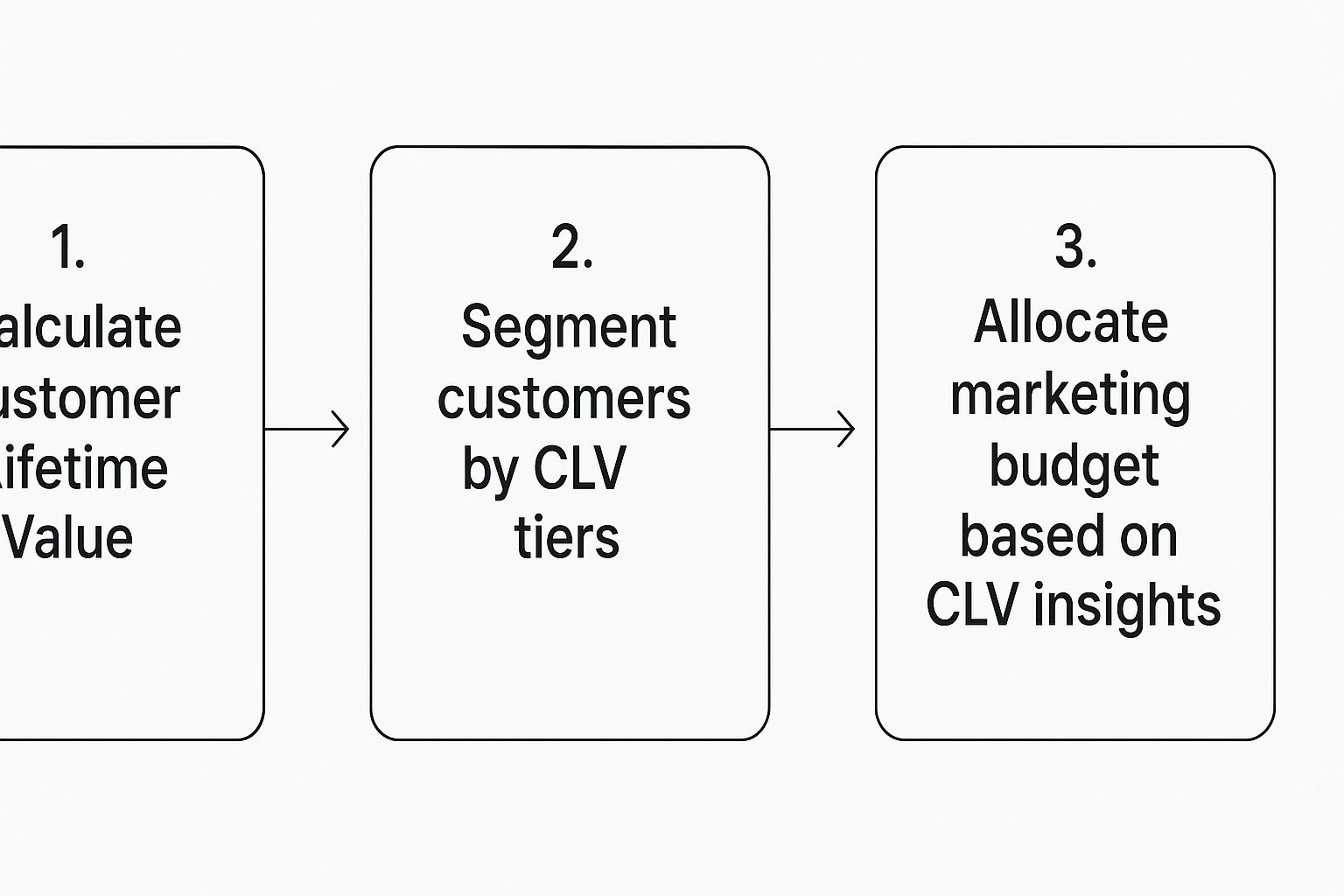
This image really highlights that calculating CLV is the first step in a smarter process. It’s not just a metric to track; it’s a foundational insight for segmenting your audience and making much better financial decisions.
While the simple formula is a great start, the Traditional CLV formula gives you a more accurate view by focusing on profit, not just revenue. It helps you understand how much actual profit a customer generates, which is a much stronger indicator of business health.
The key difference here is the inclusion of your Gross Margin.
To use this formula, you first need to calculate your Customer Value and then multiply it by the Average Customer Lifespan. Here’s how the components break down:
Let's go back to our Melbourne e-commerce store and add one more variable:
First, we find the annual customer value, but this time we'll factor in profit:
Customer Value = ($75 x 4) x 0.25 = $75 AUD per year
Now, just multiply that by the customer's lifespan:
Traditional CLV = $75 x 3 = $225 AUD
This $225 figure represents the total profit you can expect from an average customer. It’s a much more conservative number than the $1,200 revenue figure, but it gives you a far more realistic foundation for making decisions about your marketing spend and customer acquisition costs.
To make it easier to decide which formula is right for you, here’s a quick breakdown of the two methods we've covered.
| Calculation Method | Formula Components | Best For | Complexity |
|---|---|---|---|
| Simple CLV | Average Purchase Value, Purchase Frequency, Average Customer Lifespan | Quick estimations, revenue-focused analysis, businesses new to CLV. | Low |
| Traditional CLV | All Simple CLV components + Gross Margin | Profit-focused decisions, setting marketing budgets, deeper financial analysis. | Moderate |
Ultimately, the simple formula is fantastic for getting a quick read on the situation, while the traditional formula provides the kind of profit-based insight you need to make truly strategic decisions.

The formulas we've covered are powerful, but their output is only as good as the data you feed them. It's a classic case of 'garbage in, garbage out'. Even a slightly off metric can throw your final CLV figure into a completely different ballpark, so sourcing clean, accurate information is mission-critical. Think of it like cooking – you need quality ingredients before you even think about the recipe.
The good news? Your business is likely already sitting on a goldmine of this data. It's just a matter of knowing where to look and what to pull out. Your main sources will almost always be your Customer Relationship Management (CRM) system, your e-commerce platform, and your payment processor.
These platforms are treasure troves for the metrics that form the backbone of your CLV calculation.
To get this rolling, you’ll need to pull some specific pieces of information. It's best practice to look at data from a consistent period, like the last 12 months, to make sure your averages are a true reflection of current business trends.
Here’s where to find what you need:
A common mistake I see is people pulling data from different timeframes. Using this month's purchase value with last year's purchase frequency, for example, gives you a completely warped picture of customer behaviour and makes your CLV number pretty meaningless.
What happens if your data isn't perfect? First off, don't stress. It's completely normal. You might have duplicate customer entries, missing order dates, or records that just don't line up across different systems. The goal here isn't absolute perfection; it's about getting to a reasonable and trustworthy estimate.
If you're staring down incomplete records, start by cleaning up what you can. Merge those duplicate customer profiles in your CRM and standardise your data formats where possible. If you have gaps, you can use averages from the data you do have to fill them in – just be sure to make a note of the assumptions you've made.
Understanding how these data points fit into the wider customer experience can also provide crucial context. A great way to visualise this is by mapping out the entire lifecycle. You can explore a customer journey mapping template to see how different interactions connect and where key data is generated along the way.
Ultimately, starting with an imperfect CLV calculation is so much better than not calculating it at all. It gives you a baseline that you can refine and improve over time as your data quality gets better, letting you start making more informed decisions right now.
https://www.youtube.com/embed/lytQxBNDC3Y
Figuring out how to calculate customer lifetime value is the diagnosis; improving it is the cure. Once you’ve got your baseline CLV, the focus shifts from maths to marketing. It’s all about creating experiences so valuable that customers not only stick around but also spend more over time.
This isn’t about fluffy, generic advice. It's about putting targeted tactics into play that directly bump up the numbers in your CLV formula. You’d be surprised how small, consistent improvements in customer retention and satisfaction can lead to massive gains in lifetime value.
The moments right after a customer hits 'buy' are some of the most crucial in their entire journey with you. Instead of a generic "thank you" email, think about how you can add immediate value and make them feel great about their decision.
For example, if you're a clothing store, why not send styling tips for the specific items they just bought? A software company could send a quick video tutorial on a key feature they'll want to use first. This kind of proactive, personalised engagement shows you get their needs beyond just the initial transaction. You can learn more about this approach by understanding the customer experience love language and the currency of care.
These small actions build a solid foundation of trust and usefulness, giving customers a real reason to come back.
A classic mistake is to pour a huge effort into winning a customer and then immediately pivot to chasing the next one. The post-purchase experience is where real loyalty is built, which directly impacts customer retention and, you guessed it, your CLV.
Let's be honest, modern loyalty programs are less about transactional points and more about building a genuine community. People want to feel like they belong to something bigger than just a mailing list. It's about creating a sense of shared identity and connection.
Consider creating exclusive content, giving early access to new products, or even setting up online forums for your most loyal customers. These initiatives foster a much deeper connection than a simple discount ever could. When people feel like they're part of an inner circle, they stick around.
Customer feedback is gold. It’s a powerful tool for cutting down churn and extending your average customer lifespan. When a customer takes the time to share their thoughts—good or bad—they’re handing you a roadmap for improvement. Ignoring it is a surefire way to watch your CLV flatline.
You need a system to actively collect and analyse feedback. Try using:
Use this intel to pinpoint common pain points and tackle them head-on. Fixing the issues that cause frustration doesn't just save existing customers; it also improves the experience for all your future ones. This creates a positive loop that consistently boosts your CLV. For a deeper dive, check out these 14 Proven Strategies to Increase Customer Lifetime Value (CLV).

Knowing how to calculate customer lifetime value is only half the battle. The real magic happens when you start weaving that number into your day-to-day business strategy.
CLV shouldn't just be a figure that lives in a spreadsheet. Think of it as a guiding light for your marketing, sales, and even product development teams. It turns abstract data into a powerful tool for making confident decisions that fuel real, sustainable growth.
Essentially, it bridges the gap between what a customer is worth over the long haul and what you're willing to spend to get them through the door. This keeps your entire business aligned and, most importantly, profitable.
One of the most immediate ways to put CLV to work is by figuring out an acceptable customer acquisition cost (CAC). If you know the average customer is going to generate, say, $900 in lifetime value, you can decide with far more confidence how much you should invest to acquire them.
This clarity is gold. It helps your marketing team answer crucial questions with data, not just guesswork:
CLV provides the financial guardrails to ensure your marketing spend is a true investment, not just another expense. This data-driven approach is an absolute cornerstone of any high-performance email marketing strategy, where understanding your audience's value is the key to incredible ROI.
Your sales team's time is one of your most precious resources. CLV helps them focus that time where it’s going to have the biggest impact. By analysing the characteristics of your high-CLV customers, you can build a detailed profile of your ideal client.
Do your most profitable customers come from a specific industry? Are they a certain business size? Do they tend to find you through a particular marketing channel?
Answering these questions lets your sales team qualify and prioritise leads far more effectively. Instead of treating every lead as equal, they can dedicate more energy to prospects who mirror the traits of your most valuable existing customers. The result? A dramatic improvement in efficiency and conversion rates.
CLV turns your sales efforts from a wide net into a spear. It’s all about precision—focusing on the leads that are most likely to become long-term, profitable partners for your business.
How do you decide which new features to build or which parts of your service to improve? CLV gives you a clear business case for making investments that boost customer retention and satisfaction. It connects your product development roadmap directly to the bottom line.
For example, if you notice that customers who actively use a specific feature have a 30% higher CLV, that’s a powerful signal. It justifies dedicating more resources to enhancing that feature or improving its onboarding process to get more people using it.
In Australia's competitive market, this is incredibly important. We're seeing local companies that actively improve their customer experience getting their customers to spend up to 140% more. This spending uplift is directly tied to a higher CLV, because improving customer retention by just 5% can boost profits by a staggering 25% to 95%. It's a clear demonstration of how small improvements driven by data can have a massive financial impact.
Even once you get the hang of calculating customer lifetime value, a few practical questions almost always come up. Let's tackle some of the most common ones I hear.
Getting these details right can be the difference between CLV being just a number on a spreadsheet and a genuinely useful tool for growing your business.
There isn't a single magic number here, but a solid rule of thumb is to run the numbers at least quarterly. This hits a nice sweet spot. It’s frequent enough to spot meaningful shifts in customer behaviour or see the impact of a new marketing campaign, without getting you bogged down in constant analysis.
Of course, if your business is in a heavy growth phase or you've just launched a major new product, you might want to switch to a monthly calculation. This will give you much faster feedback on how your strategies are actually landing with customers.
This is a tricky one, because "good" is completely relative. A healthy CLV for a high-end software subscription is going to look wildly different from that of your local cafe.
Instead of chasing a specific number, a much more useful benchmark is the CLV to Customer Acquisition Cost (CAC) ratio.
A healthy CLV:CAC ratio is generally seen as 3:1 or higher. What this means is for every dollar you spend bringing a new customer in the door, you're getting at least three dollars back over their lifetime. If your ratio is dipping below this, it might be time to take a hard look at your acquisition strategy or your efforts to build customer loyalty.
This is the absolute core of a sustainable business. You have to balance what you're willing to pay for a customer (CAC) with what they're ultimately worth to you (CLV). The two metrics are two sides of the same coin and you should never look at one without the other.
Think of your CLV as the ceiling for what you can afford to spend on CAC while still turning a profit.
The real danger zone is having a low CLV paired with a high CAC. That's a clear signal your business model just isn't sustainable. When you use your CLV calculation to inform your CAC budget, you make sure your growth efforts aren't just bringing in any customers, but profitable ones.
At Virtual Ad Agency, we help businesses turn CLV insights into profitable growth strategies that connect with high-value customers. Discover how we can help your business grow.

 previous