
Figuring out the true cost of Facebook ads isn't as simple as looking up a price list. It's more of a moving target, shaped by your specific industry and what you're trying to achieve. As a starting point for Australian businesses, you can expect to pay somewhere around AUD 2.10 per click and AUD 11.04 per 1,000 views on average.
Think of advertising on Facebook less like buying a product off the shelf and more like taking part in a super-fast, real-time auction. Every single time there’s a spot to show an ad to someone on their feed, an auction happens in the blink of an eye. The price you end up paying is decided by a mix of things, like your industry, the exact audience you're trying to reach, and how much people are actually engaging with your ad.
To get a real grip on it, you first need to understand the core metrics that define your spending. These are the key numbers you'll see popping up in all your ad reports. For anyone wanting to brush up on the basics of the platform to better understand the context of ad spending, you can find some great general information about Facebook Ads.
Recent data gives us a solid baseline to work from. The average Cost-Per-Click (CPC) – that’s what you pay each time a person clicks on your ad – hovers around AUD 2.10. At the same time, the Cost-Per-Thousand-Impressions (CPM), which is the price for getting your ad seen 1,000 times, averages AUD 11.04.
But here’s where it gets interesting. The cost of getting a customer to take a specific action, like buying something or filling out a contact form, can vary wildly.
An e-commerce business might pay between AUD 20 to 50 for a sale, whereas a local business might only pay AUD 5 to 20 for a phone call or booking.
This huge difference really drives home why it's so important to understand the "why" behind these numbers. It's the key to building a profitable ad strategy and keeping your budget in check.
To give you a clearer picture, let's break down the typical costs you might see for different goals here in Australia.
This table offers a quick snapshot of what you can generally expect to pay for different outcomes in the Australian market. It's a handy reference point when you're planning your next campaign.
| Metric | Average Australian Cost |
|---|---|
| Cost Per Click (CPC) | $0.80 – $3.50 AUD |
| Cost Per 1,000 Impressions (CPM) | $9.00 – $15.00 AUD |
| Cost Per Lead (CPL) | $10.00 – $60.00 AUD |
| Cost Per App Install (CPI) | $2.50 – $7.00 AUD |
| Cost Per Engagement (CPE) | $0.15 – $0.50 AUD |
Remember, these are just averages. Your actual costs will swing based on the factors we'll dive into next, like your industry, audience, and the quality of your ads.
To get a handle on the cost of Facebook ads, you first need to speak the language of the ad auction. Think of it like buying ad space on a busy highway billboard. You’ve got a few different ways to pay, and each one makes sense for a different goal. These payment options are measured by a few key metrics.
The three big ones you'll bump into are CPC, CPM, and CPA. Getting your head around these is the first step to controlling your ad spend and actually hitting your campaign goals. Without this knowledge, you’re basically flying blind.
CPC stands for Cost Per Click. It’s as straightforward as it sounds: you pay Meta every single time someone clicks on your ad. This is the perfect choice for campaigns where your main goal is driving traffic to your website, a special landing page, or a product listing.
So, if your CPC is $1.50 AUD and your ad gets 100 clicks, you’ll be charged $150. Simple. This model directly connects what you spend to how many people are actively engaging, making it a no-brainer when you just need to get eyeballs on your digital turf.
Next up is CPM, or Cost Per Mille. 'Mille' is Latin for a thousand, so this is your cost per 1,000 impressions. With a CPM model, you pay a flat rate every time your ad is shown 1,000 times, whether anyone clicks on it or not.
This approach is tailor-made for brand awareness campaigns. Let's go back to our billboard analogy. CPM is like paying for every 1,000 cars that drive past. You're not necessarily looking for them to pull over and buy something right away; you just want your brand name lodged in their brain.
Key Takeaway: Choose CPC when you want direct traffic, like website visits or product views. Go for CPM when your main mission is to get your brand in front of as many relevant people as possible.
Finally, we have CPA, which means Cost Per Action (you might also see it called Cost Per Acquisition). This is often where the real magic happens, because you only pay when someone does exactly what you want them to do. That action could be anything from making a purchase to signing up for a newsletter or filling out a contact form.
CPA gives you a direct measurement of how much it costs to get a new customer or lead, making it the king of metrics for sales-focused campaigns. It might look more expensive on the surface than CPC or CPM, but a well-tuned CPA ensures your budget is only spent on things that actually grow your business.
Figuring out how to balance these metrics is a core skill, and it's what any good social media marketing firm focuses on to deliver a killer return on investment.
Ever wondered why a law firm in Sydney might pay ten times more for a click than a local bakery in Adelaide? The answer is all about the fierce, behind-the-scenes auction that sets the cost of Facebook ads. On this platform, different industries are essentially playing in separate economic leagues, shaped by intense competition and what a potential customer is actually worth to them.
Think of it like this: two completely different businesses are bidding for the same person's attention. One is a real estate agency trying to sell a million-dollar home, where a single lead could be worth tens of thousands. The other is a cafe promoting a $5 coffee special. It's obvious the real estate agency can afford to bid much, much higher for that click because their potential return is massive.
This exact dynamic is at play across every single sector, and it's what creates the huge gap you see in advertising costs.
Industries with a high customer lifetime value (CLV)—think finance, legal services, and real estate—almost always face steeper ad costs. It just makes sense for them to spend hundreds to acquire one client, because that single client will likely generate thousands in revenue over time.
On the other hand, industries like retail or hospitality are all about volume. Their business model relies on acquiring a high number of customers at a very low cost to stay profitable, which naturally keeps their average ad spend down.
To give you a clearer picture, this chart visualises the average cost across the key metrics we've discussed.
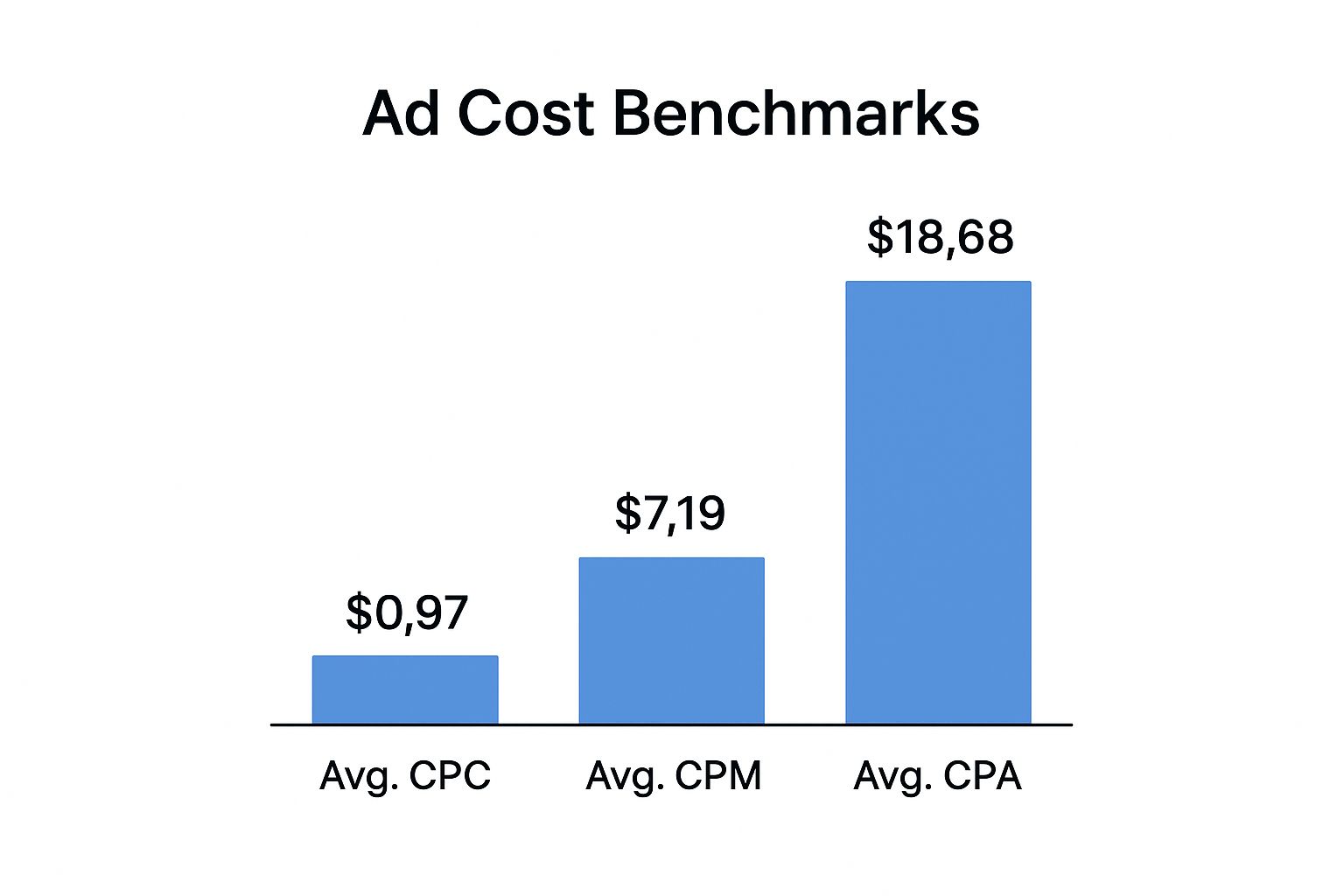
As you can see, each metric really does tell a different part of the story, from what it costs to get a simple click to the price of a finalised, valuable action.
In Australia, these industry variations are especially pronounced. The cost of Facebook ads can swing wildly, with CPMs (cost per 1,000 impressions) often landing somewhere between AUD $10 and over AUD $20 for good quality traffic.
But in hyper-competitive sectors, things get expensive fast. Skincare brands might see CPMs soar to AUD $60-$80, while businesses in the financial industry can face even higher prices. Knowing the baseline for your industry is absolutely crucial if you want to set a realistic budget. You can learn more about Australian Facebook ad cost variations to get a better feel for the local market.
We've put together a table to show you just how much CPMs can differ across various sectors in Australia.
A comparative look at how much advertisers in different Australian industries can expect to pay per 1,000 ad impressions, highlighting the cost variance.
| Industry | Estimated CPM Range (AUD) |
|---|---|
| Retail & E-commerce | $12 – $35 |
| Beauty & Skincare | $40 – $80 |
| Health & Fitness | $25 – $50 |
| Real Estate | $30 – $70 |
| Finance & Insurance | $50 – $90+ |
| Legal Services | $60 – $100+ |
| Travel & Hospitality | $15 – $45 |
| Education & Training | $35 – $65 |
This comparison really highlights why a one-size-fits-all budget just doesn't work. The cost of reaching your audience is directly tied to the commercial realities of your sector.
Ultimately, understanding this landscape is the first step toward smart budgeting. It stops you from comparing your results to a completely unrelated industry and helps you focus on what really matters: optimising your campaigns within your own competitive reality.
While industry benchmarks give you a decent starting point, the real levers controlling the cost of Facebook ads are often hidden away in your campaign setup. Getting a handle on these is the key to turning a good budget into a seriously profitable one. It’s not just about what you spend, but how you spend it.
Think of the Facebook auction as a complex ecosystem where every choice you make has a direct impact on the price you pay. Your audience targeting, for example, plays a huge role. It might seem smart to narrow your audience right down, but getting too specific can sometimes backfire, increasing competition for a smaller pool of users and driving your costs up.
On the flip side, a really high-quality ad can actually earn you a discount. Facebook rewards ads that people find engaging with a better Ad Relevance Score. When an ad gets a lot of interaction, it signals to the platform that it’s creating a good user experience, which can bring down your cost per click.
Seasonality is another massive influence. If you’re advertising during peak retail periods like the pre-Christmas rush or Black Friday, you can expect your ad spend to spike dramatically. Way more advertisers are competing for the same eyeballs, which naturally inflates auction prices for everyone.
Where you choose to place your ad also has a big say in your budget. The cost to appear in an Instagram Story is totally different from the cost of a spot in the main Facebook Feed. Each placement has its own auction dynamics and its own unique user behaviour.
Here are four key factors you can directly control:
By understanding these levers, you can start making strategic adjustments. A smarter creative, a more refined audience, or even a simple shift in timing can lead to substantial savings and much better overall performance for your campaigns.
Knowing how to navigate these variables is what separates the pros from the amateurs. For instance, you can create tailored ads for specific audience segments—a core principle you can learn more about in our guide to remarketing with Facebook. It's also vital to keep an eye on future shifts in regulations, as the upcoming data privacy changes will almost certainly alter targeting capabilities and, in turn, your ad spend efficiency.
Taking control of the cost of Facebook ads means you stop guessing and start making calculated investments. This all begins with getting a handle on your budget and bidding options, which are the instructions you give Facebook on how to spend your money in the ad auction. It’s the difference between saying, "Here's some money, find me results," and, "Here's my money, but only spend it if you can hit my specific cost goals."
Your first decision is between a daily and a lifetime budget. A daily budget sets a steady, average spend each day, which is perfect for your ongoing, always-on campaigns. On the other hand, a lifetime budget gives Facebook the flexibility to spend more on high-opportunity days, making it ideal for short-term promotions with a clear end date.
Think of bidding as your game plan for the auction. The most common choice is 'Lowest Cost,' where you essentially let Facebook’s algorithm do its thing and get you the most results possible within your budget. This works really well when your main goal is sheer volume.
Alternatively, you could use a 'Cost Cap'. This tells Facebook not to bid over a certain amount for any single action. It’s a great way to protect your profit margins, but be warned – if you set your cap too low, you might limit your ad's reach.
For instance, if you know you can't afford to pay more than $25 to acquire a customer profitably, setting a Cost Cap at that amount is a smart move. It ensures your ad spend stays efficient.
Here in Australia, with the average CPM for Facebook ads hovering around AUD 10 to 20, having a sharp strategy is vital. Many local businesses dip their toes in the water with a monthly spend between AUD 1,000 and 10,000, testing the waters to see what works before they scale up. You can discover more insights about Australian ad spend benchmarks.
Ultimately, a winning strategy is about more than just the numbers on a spreadsheet; it's about tying your budget directly to clear performance goals. Understanding what drives performance beyond what you spend is key. It’s worth diving deeper into the crucial social media engagement metrics that have a real impact on your costs. For personalised advice, working with a digital marketing consultant can help tailor these strategies to your unique business needs.
Even with all the data in the world, getting your head around Facebook ad costs throws up some common questions. We get it. Here are some straightforward answers to the queries we hear most often from Australian business owners, designed to help you run your campaigns with a bit more confidence.
Think of this as a quick-fire round to tackle those practical, "what if" scenarios that pop up when you're in the trenches with your ad account.
There's no one-size-fits-all answer here, but a great starting point for most small Aussie businesses is somewhere between AUD 500 and AUD 1,500 per month. This isn't a random number; it's the sweet spot for gathering enough meaningful data to see what’s actually working.
This kind of budget lets you test the waters—different audiences, various ad creatives, and a few offers—without betting the farm. The real strategy is to start small, obsess over the initial results, and then confidently scale up your spending on the campaigns that are hitting your goals.
Seeing your ad costs shoot up overnight can be alarming, but there's usually a logical reason behind it. The most common culprit is ad fatigue. This happens when your audience has seen your ad so many times they’ve started to tune it out completely, tanking your engagement.
Another big factor is competition. During peak retail seasons like Christmas or Black Friday, the ad auction gets crowded, and costs go up for everyone. It's also worth checking if any recent tweaks to your targeting or creative have lowered your relevance score—Facebook will make you pay more for ads it deems less relevant. A good rule of thumb? Keep an eye on your ad frequency and aim to refresh your creative every few weeks to keep things interesting.
Not at all. While a high Cost Per Click (CPC) or Cost Per Mille (CPM) might make you wince, it’s crucial to see the bigger picture: your return on investment (ROI).
A high CPC in the luxury goods market or for a high-value B2B service can be totally fine if that single click leads to a massive sale. The metrics that truly matter are your Cost Per Acquisition (CPA) and Return On Ad Spend (ROAS). If your campaigns are profitable, they're working, regardless of how much the initial clicks cost.
At Virtual Ad Agency, our specialty is building data-driven Facebook ad strategies that produce real, measurable results. Let's work together to make sense of your ad costs and seriously boost your return on investment. Contact us today to optimise your campaigns.

 previous