
Think of a digital marketing consultant as a specialist doctor for your business's online health. They're the expert you call in when things just aren't working—maybe your website traffic has flatlined, your ad spend is spiralling with no return, or your social media feels like shouting into the void. They diagnose the underlying issues and prescribe a clear, custom plan for growth.
A digital marketing consultant is an external partner, which gives them a massive advantage: a fresh, objective perspective on your business. Unlike an in-house team member deep in the daily grind, or an agency focused on executing set tasks, a consultant lives in the world of high-level strategy and problem-solving.
Their job is to get to the bottom of why you’re stuck. They step in to answer the big questions: "Why are our ads failing?" and "What's the smartest, most effective way to fix this now?"
The real value of a consultant comes from their specialised knowledge and unbiased viewpoint. They aren't bogged down by internal politics or chained to "the way we've always done it." Instead, they bring a wealth of experience from working with all sorts of businesses across different industries, allowing them to see patterns and apply proven solutions to your unique challenges.
Typically, their process looks something like this:
A great consultant doesn’t just hand you a plan and walk away. They build a sustainable framework for growth and, just as importantly, they transfer that knowledge to your team, making your business stronger long after their contract ends.
This kind of strategic thinking is essential. The digital marketing sector in Australia is a massive AUD 19 billion industry and it's only getting bigger. To get ahead—and stay there—you need an expert in your corner.
The image below shows perfectly how a consultant sits at the top, directing the strategy that guides all the other moving parts.
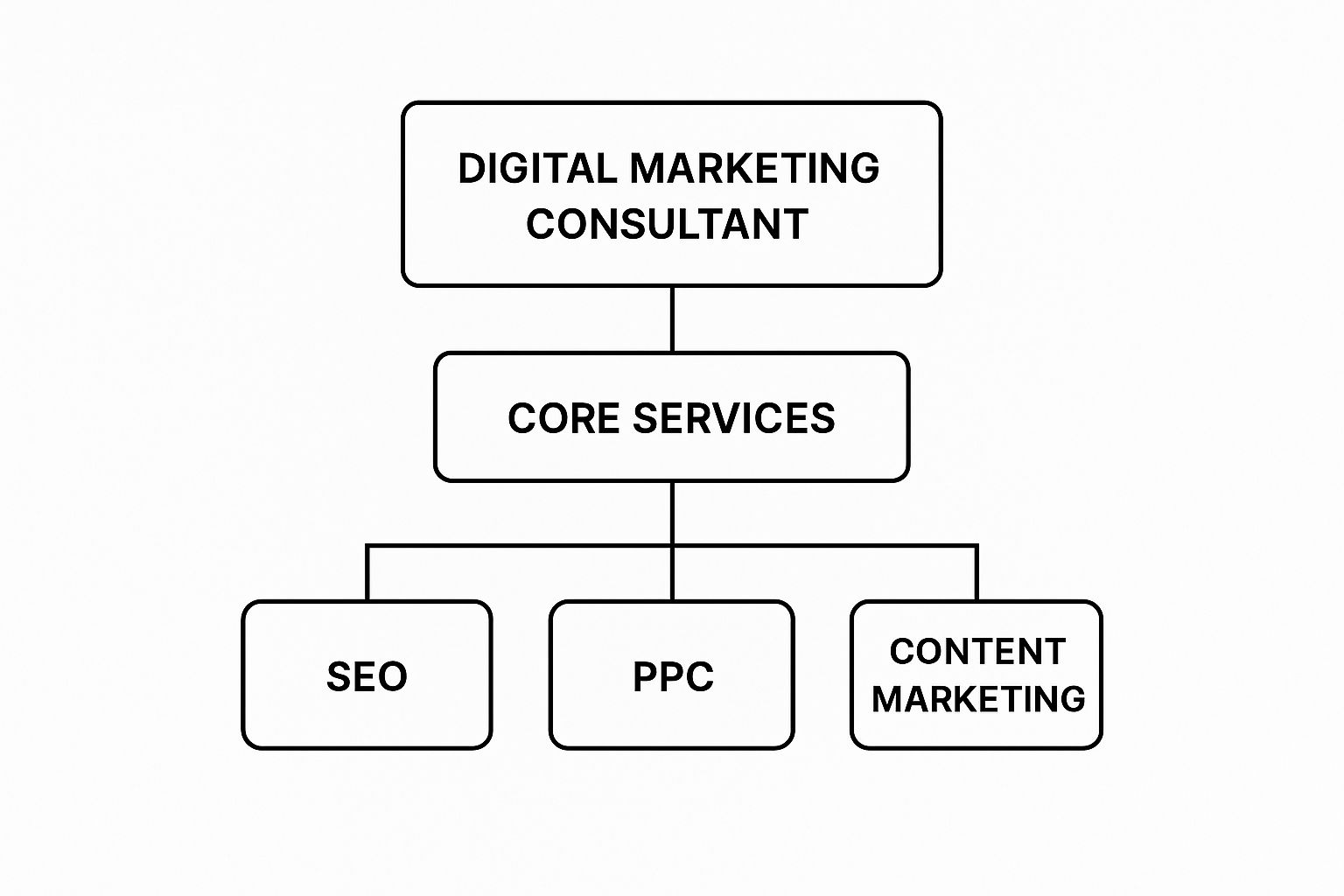
This shows how their strategic direction flows down into the execution of specific channels like SEO and social media. A consultant connects the high-level business goals with the on-the-ground execution, ensuring everything works together for maximum impact. Understanding the essential SEO best practices they champion, for example, is just one piece of the puzzle they help you solve.
A good digital marketing consultant doesn't just throw a random assortment of services at your business and hope something sticks. Instead, they act more like a master chef, carefully selecting and combining different elements into a cohesive strategy. Each service supports the others, creating a result that’s far more powerful than the sum of its parts.
It all starts with a strategic roadmap—the blueprint for your growth. This isn't about jumping on the latest trend. It’s about figuring out the most direct path to hitting your specific business goals, whether that's boosting sales, generating high-quality leads, or becoming the go-to name in your industry. This initial planning is critical; it ensures every dollar you spend and every action you take has a clear purpose.

Before you can sell anything, people need to be able to find you. That’s where Search Engine Optimisation (SEO) comes in. Think of SEO as the art and science of making your website irresistible to search engines like Google.
A consultant’s work goes much deeper than just stuffing a few keywords onto a page. They’ll perform a thorough technical audit to fix any backend errors holding your site back, fine-tune your content to perfectly match what your ideal customers are searching for, and build a strong backlink profile to signal your authority to Google.
Imagine a local cafe in Melbourne struggling to stand out. A consultant might optimise their Google Business Profile, create content around local search terms like ‘best coffee near Federation Square’, and make sure their website is lightning-fast on mobile. The goal? To be the very first result someone sees when they’re looking for a great coffee nearby, driving real foot traffic through the door. You can learn more about how a strategic approach to SEO ranking can put you on the path to the top page.
Once people find you, you need to give them a reason to stick around, trust what you have to say, and eventually become a customer. Content marketing is the engine that builds that trust and authority. It’s all about creating genuinely helpful and relevant articles, videos, and guides that solve your audience's problems.
A consultant will develop a content strategy that lines up with the customer’s journey. They'll help you create content designed to:
This means you’re not just randomly publishing blog posts. You’re building a strategic library of assets that systematically positions your brand as the expert in your field.
SEO and content marketing are fantastic for long-term, organic growth. But sometimes, you just need to get results now. Pay-Per-Click (PPC) advertising, on platforms like Google Ads and social media, lets you put your message directly in front of a hyper-targeted audience almost instantly.
This is where a consultant's expertise is vital. It’s shockingly easy to burn through a lot of money with poorly managed ad campaigns. A consultant will handle the deep audience research, write ad copy that grabs attention, and constantly A/B test every element to squeeze the maximum Return On Ad Spend (ROAS) out of your budget.
The real value of a consultant in PPC isn't just in setting up the campaigns. It's in their relentless, data-driven optimisation. They dig into the numbers to see what’s working, cut what isn’t, and make sure every single dollar of your ad budget is pulling its weight.
One of the main ways they drive these results is by developing a comprehensive SaaS marketing plan that makes sure both your organic and paid efforts work together for maximum impact.
At the end of the day, none of this matters if you can't measure its impact on your bottom line. A digital marketing consultant lives and breathes data. They set up sophisticated tracking and analytics to monitor Key Performance Indicators (KPIs), turning confusing spreadsheets into clear, actionable advice.
They look past the vanity metrics like 'likes' or 'impressions' and focus on the numbers that actually drive business growth:
By transforming raw data into genuine insights, a consultant ensures your strategy is constantly evolving and improving. This data-driven approach takes the guesswork out of marketing, allowing you to make smart decisions that lead to consistently better results.
Bringing a digital marketing consultant on board is about so much more than just getting an extra pair of hands. Think of it as introducing a powerful catalyst for growth into your business, one that can unlock potential you didn't even know was there. Often, the biggest win is simply gaining that objective, outside perspective that can spot the ingrained habits holding you back.
It's easy for in-house teams to get comfortable with certain ways of doing things or become blind to subtle shifts in the market. A consultant, however, walks in with fresh eyes and a wealth of experience from different industries. They can pinpoint inefficiencies and missed opportunities that have become part of the background noise, providing the honest, data-backed feedback needed to get things back on track.

Another huge advantage is getting immediate access to top-tier expertise without the hefty long-term cost of a senior, full-time employee. True specialists in fields like technical SEO, marketing automation, or advanced data analytics come with significant salary expectations. Hiring a consultant lets you tap into those exact skills right when you need them, and only for as long as you need them.
This on-demand expertise gives you incredible flexibility. Instead of being locked into one person's skillset, you get a dynamic resource who can help you pivot strategies quickly when the market or your competitors make a move. This kind of agility is what keeps you ahead of the pack, ensuring your marketing is always sharp and relevant.
Just imagine a small e-commerce brand watching its ad spend climb month after month while sales stayed stubbornly flat. Frustrated, they brought in a consultant. Within days, she identified a critical targeting error in their social media campaigns—their ads were hitting a broad, completely uninterested audience, burning through their budget.
By simply refining the audience targeting and tweaking the ad copy to speak directly to a specific niche, she helped them achieve a massive turnaround. The result? They slashed their ad spend by 50% and doubled their monthly revenue at the same time. This is a perfect example of how an expert’s focused insight delivers a direct, measurable return. If you're keen to nail this part of your strategy, learning how to get social media working for your business is a fantastic place to start.
At their core, digital marketing consultants are wired for results. Their success is tied directly to yours, which creates a powerful sense of accountability. From day one, they'll work with you to set clear, measurable Key Performance Indicators (KPIs), making sure every single activity is aligned with real business outcomes.
The core function of a consultant is to cut through the noise and focus on what truly moves the needle. They translate complex data into a clear story, identify the 20% of efforts that will generate 80% of the results, and hold the entire strategy accountable to the bottom line.
This focus brings incredible efficiency to your entire marketing operation. They'll introduce proven systems, streamline workflows, and get your team focused on high-impact tasks instead of being bogged down in busywork that doesn’t produce results.
This structured approach delivers some key benefits:
Ultimately, engaging a digital marketing consultant is an investment in strategic clarity, operational efficiency, and sustainable growth. They provide the expert guidance needed to not just navigate the complexities of modern marketing but to turn them into a real competitive advantage.
One of the first questions on anyone's mind when thinking about hiring a digital marketing consultant is, "So, what's this actually going to cost me?" It helps to frame this as an investment in your business’s growth, not just another expense on the books. Getting your head around the different ways consultants structure their fees is the key to finding a model that fits your budget, your goals, and how you like to work.
The pricing structure isn't just picked out of a hat; it’s a direct reflection of the kind of help you need. Are you after a quick fix for a single nagging problem? A complete strategic overhaul for a big launch? Or maybe you need someone in your corner long-term, keeping your marketing sharp month after month. Each scenario calls for a different approach to pricing.

Most consultants in Australia will lean towards one of three main models. Each has its pros and cons, and they’re suited to different types of projects and business needs.
Hourly or Daily Rates: This is as straightforward as it gets. You pay for the exact time the consultant spends on your business. It's a great fit for short-term tasks, one-off consultations, or when the scope of work isn't totally clear from the outset. You get flexibility, but the downside is that costs can creep up if the project ends up being bigger than you first thought.
Project-Based Fees: With this model, you agree on a fixed price for a project with a very clear end goal and set deliverables. Think of a complete website SEO audit or mapping out a six-month content strategy. This gives you fantastic cost certainty, which makes budgeting a breeze. The catch? You need a rock-solid, detailed project scope from day one to avoid "scope creep."
Monthly Retainer: A monthly retainer means you pay a fixed fee each month for ongoing access to the consultant's brain and services. This is perfect for long-term strategic guidance, continuous campaign optimisation, and regular performance check-ins. It builds a really deep, collaborative partnership, almost like having an expert as a permanent part of your team.
The right pricing model isn’t about what’s cheapest—it’s about what creates the most value. A project fee gives you budget clarity for a specific outcome, while a retainer is an investment in a continuous strategic partnership that can adapt and grow right alongside your business.
You’ll quickly notice that not all consultants charge the same, and there are a few good reasons for that. A consultant with deep expertise in a high-demand area like technical SEO or marketing automation will naturally command a higher fee than a generalist. It’s the same for experience—a consultant with a decade of proven results and a killer portfolio will have higher rates than someone just starting out.
The size and complexity of your project are also huge factors. A simple social media audit is going to cost a lot less than creating and managing a full-funnel marketing strategy for a national product launch.
Here in Australia, the average daily rate for a marketing consultant hovers around AUD 760, but this can swing wildly depending on their expertise. A fractional Chief Marketing Officer (CMO), for example, can average AUD 1,477 per day, with top-tier talent reaching as high as AUD 2,550. You can dive into a full breakdown of these numbers and learn more about Australian marketing consultant rates here.
To help you get a clearer picture of what you might be paying for, here’s a look at the common pricing models side-by-side.
A breakdown of common consultant pricing structures to help you understand what you are paying for.
| Model | Best For | Pros | Cons |
|---|---|---|---|
| Hourly/Daily Rate | Short-term tasks, specific advice, or projects with an uncertain scope. | High flexibility; pay only for time used. | Unpredictable final cost; can be harder to budget for. |
| Project-Based Fee | Clearly defined projects with specific start and end points (e.g., website redesign). | Cost certainty; clear deliverables and deadlines. | Less flexible; requires a very detailed scope upfront. |
| Monthly Retainer | Long-term, ongoing support, strategic guidance, and continuous optimisation. | Builds a strong partnership; predictable monthly expense. | Can be a higher initial commitment; unused hours may not roll over. |
Ultimately, the best model depends entirely on your situation. Don't be afraid to discuss these options to find the one that feels right.
To make sure there are no nasty surprises down the track, it’s vital to ask the right questions before you sign on the dotted line.
Questions to Ask About Pricing:
Getting these questions answered upfront sets the stage for a transparent financial relationship. It ensures both you and your new digital marketing consultant are on the same page from day one.
Finding the right digital marketing consultant can feel a bit like searching for a needle in a haystack. But with a bit of a plan, it becomes a much clearer, more manageable process. Instead of getting bogged down in endless profiles and proposals, you can zero in on a genuine strategic partner who’s right for your business.
The real key? It's knowing exactly what you’re looking for before you even start the search. This isn’t just about hiring someone to “do the marketing.” It’s about finding an expert to solve a very specific business problem—whether that’s a crippling lack of leads, a brand message that isn’t landing, or an ad budget that seems to evaporate with nothing to show for it. Think of your problem as a compass; it’ll guide every decision you make from here.
Before you even think about talking to a consultant, you need to get crystal clear on what success actually looks like. Are you trying to boost online sales by 30% in the next six months? Do you need to generate 50 solid, qualified leads every month for your sales team? Maybe your goal is to be the number one result on Google for a specific service in your city.
Whatever it is, get specific and write it down. This simple act is more powerful than you think, as it instantly allows you to filter out the noise. It’s the difference between asking for a “doctor” and asking for a “cardiologist” when you’re having heart trouble.
Once you’ve got your goals locked in, spell out the main obstacle standing in your way. For example:
Having this level of clarity empowers you to ask much better questions and quickly spot the consultants who are a perfect match, separating them from the generalists.
Experience is one thing, but relevant experience is everything. A consultant who achieved fantastic results for a B2B software company might not be the best person to help your local retail shop. You’re looking for someone with a track record of success in your industry, or at least with businesses that have faced the same hurdles you’re facing now.
And don't just take their word for it. Ask for detailed case studies or to be walked through examples of their past work. A truly great consultant will be excited to show you their process—the initial problem, the strategy they built, and the real-world results they delivered.
A portfolio full of impressive brand logos is nice, but what you really need is the story behind the success. Ask them to explain the 'how' and the 'why' of a past project, not just the final numbers. This is where you’ll see their strategic thinking shine through.
This is also a great time to check their expertise in the specific channels that matter to your business. In Australia, for instance, social media and influencer marketing are massive. With social media ad spend expected to hit around AUD 7.5 billion, a consultant has to know how to navigate this space. You can get a feel for the latest trends by exploring some of the key social media statistics for Australia.
The most valuable consultants are strategists first, tacticians second. They’re the ones who constantly ask "why" before they even start thinking about "what" or "how." As you have your initial chats, pay close attention to the kinds of questions they ask you.
Are they jumping straight to solutions and rattling off a list of tools? Or are they digging deeper to properly understand your business model, your customers, your competitors, and where you want to be in five years? A real partner wants the full picture before they even think about prescribing a fix.
Key Questions to Ask a Potential Consultant:
Their answers will tell you everything you need to know about their approach. You're looking for someone who thinks like a business owner, not just a marketer. A good strategist, for example, will know when to connect different channels, like running a PPC campaign that funnels leads into a targeted email nurture sequence. For a better sense of how those channels can work together, have a look at our guide on high-performance email marketing.
At the end of the day, trust your gut. This person will be a close collaborator, so you need to feel confident that your communication styles click. Are they clear, direct, and transparent? Do they break down complex ideas in a way that’s easy to follow? A consultant who can’t communicate their own value clearly is going to have a hard time communicating your brand’s value to customers.
Before you make the final call, do a bit of homework. Check their LinkedIn profile for recommendations, look for online reviews, and don’t be shy about asking for references you can actually speak to. Hearing from past clients is one of the best ways to get an honest, unfiltered look at what it’s really like to work with them. This final check confirms you’re not just hiring a skilled marketer, but a reliable and professional partner.
The role of a digital marketing consultant is changing, and fast. It's no longer just about running ad campaigns or chasing search rankings. The job is evolving into something much closer to a core business advisor, someone who deeply understands how technology and culture shape a company's future growth. We're seeing a shift away from single-channel specialists toward strategic thinkers who can tie every marketing dollar directly to real business outcomes.
So, what's driving this change? It really boils down to two things: smarter technology and a massive shift in what consumers expect from brands. Three major trends are setting the stage for the next era of consultancy: the clever use of artificial intelligence, the unavoidable move to privacy-first marketing, and a growing demand for sustainability and genuine brand ethics.
Artificial intelligence is quickly becoming a non-negotiable part of any serious marketing toolkit. For a digital marketing consultant, this isn’t about letting robots take over. It’s about supercharging human strategy. AI tools are brilliant at sifting through enormous piles of data to spot trends, predict what customers will do next, and handle the repetitive grunt work, freeing up the consultant to focus on the big picture.
Instead of just looking back at last month's performance report, a consultant who's skilled with AI can start building predictive models. This means they can anticipate what customers will need before they even know it themselves, letting them craft campaigns that feel incredibly personal and perfectly timed.
The real power of AI isn't just about doing things faster; it's about foresight. A consultant using these tools can stop asking "What happened?" and start asking, "What's likely to happen next quarter, and how do we get ready for it?" This transforms them from a marketing expert into a strategic business forecaster.
Using AI to create these hyper-personalised experiences is also incredibly efficient. In fact, getting this level of personalisation right has the potential to slice customer acquisition costs by nearly 50%. For any business trying to get ahead, that makes an AI-driven strategy a seriously compelling proposition. You can explore more insights on the Australian digital marketing market to see just how big its impact is becoming.
For years, marketers had a free-for-all with third-party cookies and extensive data tracking. That party is well and truly over. With tougher privacy laws and customers demanding more control over their data, the future is all about building trust through marketing that's transparent and based on consent.
This is a new and complex challenge, and it's where a top-tier consultant really earns their stripes. They’re the ones who will guide businesses in building their own robust, first-party data strategies. This means earning customer data the old-fashioned way: by offering genuinely valuable content, great loyalty programs, and an exceptional user experience that makes people want to stay in touch.
A forward-thinking consultant will help businesses put the right tools in place, such as:
It’s a shift that demands a much more creative and customer-focused way of thinking about marketing.
Today's consumers, especially the younger generations, care deeply about a brand's values. They're actively choosing to spend their money with businesses that show a real commitment to doing good in the world, whether that's socially or environmentally. "Sustainable marketing" isn't a niche idea anymore—it's becoming a core part of a brand's reputation and long-term survival.
The consultant of the future needs to be an expert in weaving purpose into a brand's story. They’ll be advising on how to talk about ethical practices authentically, without it sounding like a cynical marketing ploy. This could cover anything from being transparent about supply chains to supporting local community projects, turning a company's values into a genuine competitive edge. The consultant's role here expands to that of a brand guardian, ensuring every marketing move helps build a positive, lasting legacy.
Even with a solid plan in place, bringing a digital marketing consultant on board can raise a few practical questions. It’s completely normal. Let’s tackle some of the most common queries business owners have, so you can feel confident moving forward.
This is the big one, and the honest answer is: it depends. The timeline for results is always a mix of quick wins and long-term, sustainable growth.
For instance, a sharp PPC or social media advertising campaign can start pulling in traffic and leads almost straight away—sometimes within days. But organic growth from SEO? That’s a marathon, not a sprint. You’re building authority and trust with search engines, and that typically takes a good 6-12 months to deliver the kind of results that really stick.
A good consultant will manage your expectations from day one, laying out a clear roadmap with short-term milestones and long-term goals.
It's easy to get these two mixed up, but their roles are fundamentally different. A digital marketing consultant is your hands-on problem solver. They’re the expert you hire to diagnose what’s wrong, create the strategic plan, and often get directly involved in making it happen. Think of them as the expert hired to do and manage.
A marketing coach, on the other hand, is all about empowerment and education. Their job is to teach you or your team how to build and run your own marketing. They guide and advise, helping you build skills in-house rather than executing the strategy for you.
This really comes down to what you need most right now.
The best consultants are often described as "T-shaped." They have a broad understanding across many marketing disciplines (the horizontal bar of the T) but also possess deep, expert knowledge in one or two key areas (the vertical stem). This blend gives you the best of both worlds: strategic oversight and specialised skill.
To get the most out of that first chat, a little prep work goes a long way. The more you bring to the table, the faster a consultant can get up to speed and start offering real insights.
Try to have these things ready:
This prep turns your first meeting from a simple info-gathering session into a proper strategic discussion.
At Virtual Ad Agency, we provide the strategic expertise to turn your marketing challenges into growth opportunities. Contact us today to discuss how we can build a winning strategy for your business.
Article created using Outrank

 previous