
Most of the advice you’ll find on agency lead generation is pretty generic, and frankly, it misses the point. Following it usually leads to a swamp of low-quality contacts, creating more busywork than actual business. The real secret is to build a system that delivers a steady flow of ideal clients, not just a long list of random names.
Think of old-school lead generation like cracking open a fire hydrant. Sure, you get a massive, uncontrollable gush of water, but almost all of it disappears straight down the drain. An effective agency lead generation strategy is completely different. It’s more like building a custom water filtration system—one designed to capture, purify, and deliver a manageable stream of exactly what you need: high-quality opportunities.
The fundamental problem with outdated methods is their obsession with quantity over quality. Chasing down every possible contact, no matter how poor the fit, just burns through time, energy, and money. Your team ends up wasting hours trying to nurture leads who were never going to sign on, simply because they don't see the value in your expertise or can't afford your services in the first place.
A pipeline jam-packed with unqualified leads is a recipe for disaster. It gives you a false sense of progress while burning out your sales team and bleeding your marketing budget dry. This whole approach ignores what makes agency services unique; they’re built on expertise, relationships, and trust—not mass-market, pile-it-high appeal.
The goal isn’t a flood of leads; it's a consistent flow of purified opportunities. A well-crafted strategy attracts clients who already respect your expertise and are prepared to invest in premium services.
Grasping this simple distinction changes your entire approach. Instead of asking, "How many leads can we possibly get?", the real question becomes, "How can we attract the right leads?". Answering that question shifts your focus from broad, generic tactics to precise, value-driven strategies.
A smart system is all about attracting, not chasing. It’s about creating a client acquisition engine that does the heavy lifting for you, automatically filtering out the prospects who aren’t a good fit. If you're looking to build a steady stream of high-quality leads and drive real growth, it pays to explore proven approaches. For a deeper dive into effective strategies, check out these 7 winning tips for lead generation for marketing agencies.
Ultimately, a successful lead generation framework for any agency has to nail three key things:
By putting these elements first, you can finally move away from the chaotic fire hydrant model and start building a sustainable engine for growth. This reframes lead generation from just another sales tactic into the foundational process for building a truly thriving, profitable agency.
Winning new agency clients isn't about throwing spaghetti at the wall and hoping something sticks. A proper lead generation strategy is a carefully structured process. The best way to think about it is as a guided journey you create for your ideal clients, moving them smoothly from that first "hello" all the way to a signed contract.
This journey is your client acquisition funnel.
It’s a roadmap that breaks down the messy business of turning strangers into partners into clear, manageable stages. Understanding each stage means you can use the right tactics at the right time, building trust every step of the way. This stops you from going in for the hard sell too early or, just as bad, letting a warm prospect go cold.
The client acquisition funnel is broken down into three core stages. Each one has a different goal and needs a different approach. Getting all three right is the key to creating a steady stream of high-quality leads for your agency.
The ToFu stage is all about casting a wide, yet targeted, net. You're focused on driving traffic and getting your agency's name in front of businesses that fit your ideal client profile. This is your first impression, so it’s vital to lead with value, not a sales pitch.
Content marketing is your workhorse here. In Australia, it’s proven to be an incredibly efficient way for agencies to generate leads. In fact, content marketing generates three times as many leads as old-school marketing while costing 62% less. For Aussie B2B marketers, LinkedIn is the undisputed champion, responsible for a whopping 80% of all B2B leads coming from social media. You can dig into these numbers by reviewing the full marketing statistics for Australia.
Effective ToFu tactics include:
This infographic shows the foundational process for targeting your audience accurately before launching any campaign.
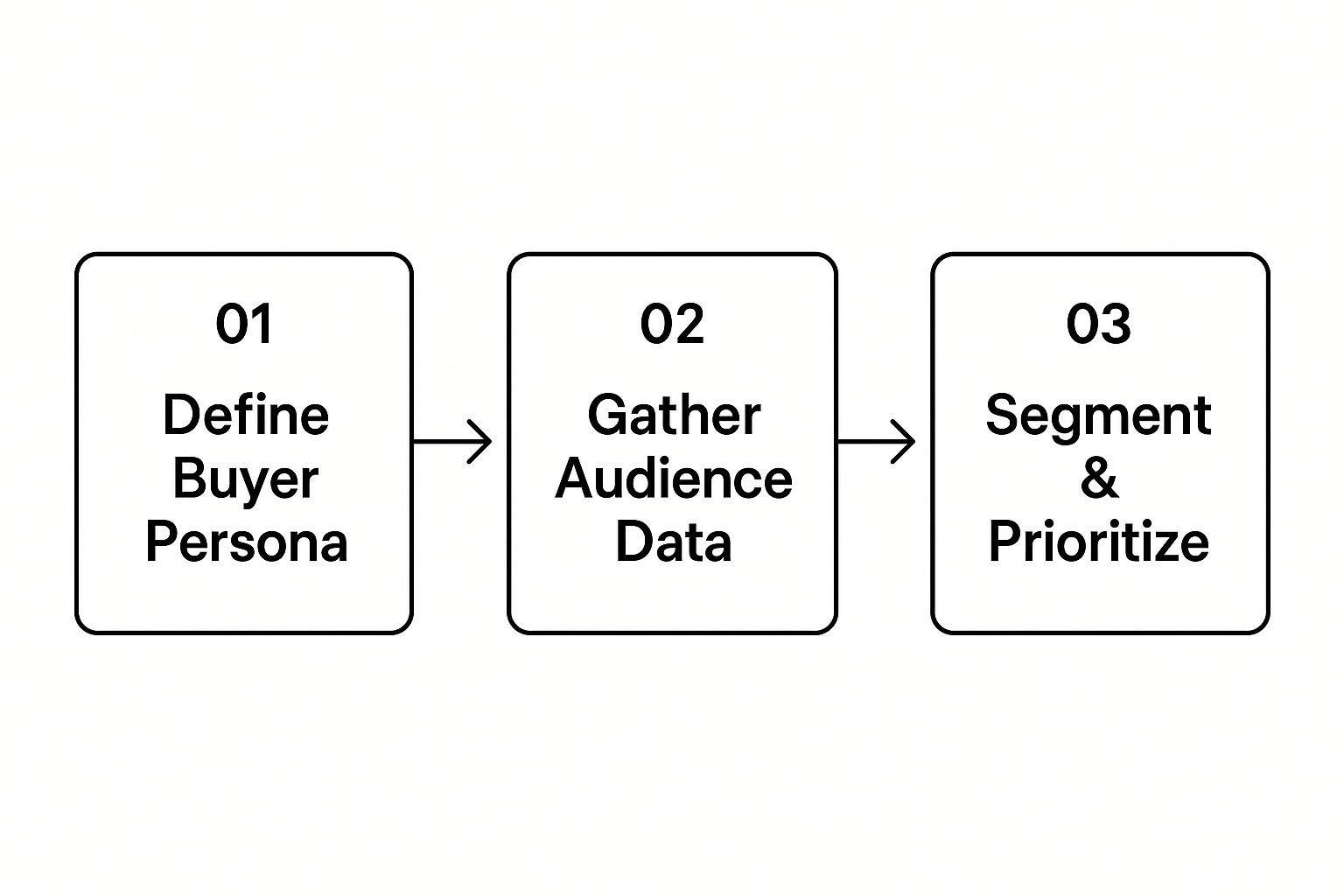
As the flow shows, real success starts with a deep understanding of who you're actually trying to reach.
Once you have someone’s attention, the MoFu stage is all about building a real relationship. The aim is to turn those anonymous website visitors into known leads by offering them something so valuable they're happy to trade their contact details for it. We call this a lead magnet.
This is the critical transition point. The value you provide here directly influences a prospect's decision to move forward with you. It's where you prove you know your stuff.
Your content needs to get more specific here, tackling deeper challenges. Great MoFu strategies include:
By the BoFu stage, your leads are highly qualified and giving your services serious thought. The conversation switches from education to demonstration. You need to show them exactly how your agency will solve their specific problems and deliver real, tangible results. The communication has to be personal and direct.
Your goal is to make it incredibly easy for them to say "yes." This means removing any friction and giving them a clear call to action that nudges them towards a final decision.
High-impact BoFu tactics include:
A strong agency lead generation plan isn't about shouting into every corner of the internet. It’s about speaking clearly in the rooms where your ideal clients are already listening. Spreading yourself too thin across dozens of channels is a fast track to burnout and mediocre results. The real key is to pick and master a select few channels that consistently bring in quality leads.
Think of it like fishing. You wouldn't just drop a line in the middle of the ocean and hope for the best. You'd find out where the specific fish you want to catch gather, what bait they prefer, and the best time to cast your line. That same focused approach is exactly what you need to build a resilient, multi-channel system that fuels growth without being dangerously reliant on a single source of new business.
Search Engine Optimisation (SEO) is the ultimate long game for agency lead generation. When a potential client has a problem, their first move is almost always to search for a solution online. Being the top result for that search immediately positions your agency as an authority and a trusted resource.
Unlike paid ads, which disappear the second you stop paying, a strong SEO presence is an asset that builds value over time. Every piece of content you create and every backlink you earn contributes to a powerful, lead-generating machine that works for you around the clock.
Effective SEO for agencies involves:
While SEO builds momentum slowly, paid advertising delivers immediate visibility and traffic. For agencies, the two heavy-hitters are typically Google Ads and LinkedIn Ads, and each serves a very different purpose in your lead gen efforts.
Google Ads lets you capture prospects at the exact moment they’re searching for the services you offer. This is high-intent marketing at its absolute best—you're meeting a direct and immediate need.
LinkedIn Ads, on the other hand, are perfect for reaching specific decision-makers within your target industries. You can zero in on job titles, company sizes, and sectors with incredible precision, making sure your message lands in front of the right people, even if they aren't actively searching.
The real magic of paid ads is in their specificity. You're not just buying traffic; you're buying access to a highly curated audience that perfectly matches your ideal client profile.
Content marketing is the connective tissue that makes all your other channels stronger. It fuels your SEO, gives you valuable assets for paid campaigns, and provides something meaningful to share on social media. More importantly, it demonstrates your expertise and builds trust long before a sales call ever happens.
By consistently putting out valuable content, you educate your audience, address their pain points, and subtly guide them toward your solutions. It’s a strategy that shifts the dynamic from "selling" to "helping," which is far more effective for attracting high-calibre clients. For many agencies, social media is a powerful—yet often underused—way to find new clients. To really get the most from these platforms, you need to master lead generation on social media.
While inbound methods like SEO and content marketing attract leads to you, outbound outreach lets you proactively target your dream clients. This isn't about spamming a generic list. Modern outbound is highly personalised, research-driven, and focused on starting genuine conversations.
Successful outbound strategies often include:
Finally, don't overlook the power of real-world connections. Building strategic partnerships with complementary businesses (like a web design agency partnering with a copywriting firm) can create a powerful referral network. Both parties can send qualified, high-trust leads to each other, creating a true win-win scenario.
Industry events, both online and in-person, also remain a fantastic channel. Attending or speaking at conferences positions you as an expert and puts you in a room filled with potential clients and partners. The goal is to build relationships and become a recognised face in your industry, which naturally leads to new business opportunities.
With so many options, choosing where to focus your energy can feel overwhelming. The key is to understand the trade-offs between cost, effort, and the type of leads each channel typically produces.
| Channel | Typical Cost | Time & Effort | Lead Quality Potential | Best For |
|---|---|---|---|---|
| SEO | Low to Medium | High (Long-term) | Very High | Agencies looking for sustainable, long-term growth and authority. |
| Paid Ads | Medium to High | Medium | High | Agencies needing immediate, high-intent leads and predictable results. |
| Content Marketing | Low to Medium | High (Consistent) | Very High | Building brand trust, supporting SEO, and nurturing leads over time. |
| Outreach | Low | High (Personalised) | High | Targeting specific, high-value "dream" clients with a direct approach. |
| Partnerships | Low | Medium | Very High | Generating warm, high-trust referrals through a network. |
| Events | Medium to High | Medium | High | Building relationships and establishing personal brand authority in a niche. |
Ultimately, the best channels are the ones that align with your agency's strengths, budget, and ideal client profile. Most successful agencies don't just rely on one; they build a blended strategy, often starting with one or two channels and expanding as they gain momentum.

A killer agency lead generation strategy is more than a collection of good ideas. It needs the right tools to bring those ideas to life with precision and efficiency. Having the right technology is like upgrading from a hand saw to a full suite of power tools—sure, both can cut wood, but one does it faster, cleaner, and on a completely different scale.
Building your tech stack isn't about collecting every shiny new tool that hits the market. It’s about building a connected ecosystem where every piece of software talks to the others. This gives you a seamless, birds-eye view of your entire client acquisition journey and is often the key difference between agencies that scale and those stuck spinning their wheels with manual follow-ups.
Think of your Customer Relationship Management (CRM) system as the central nervous system for your whole lead gen operation. It’s your single source of truth, the one place where every interaction, conversation, and detail about your leads and clients lives. Without a solid CRM, you're basically running your agency from memory and a messy collection of spreadsheets.
A good CRM helps you:
Popular choices like HubSpot or Salesforce are much more than just digital address books; they’re the bedrock of your entire sales and marketing machine.
The right CRM doesn’t just store data; it makes that data actionable. It turns a long list of contacts into a clear roadmap for nurturing relationships and closing deals.
Marketing automation platforms are the engines that power your lead nurturing. These are the tools that handle all the crucial but repetitive tasks that are impossible to manage by hand once you're dealing with more than a few leads. They plug straight into your CRM and trigger actions based on what a lead actually does.
For instance, when someone downloads a case study from your site, an automation tool can instantly pop them into a specific email sequence. This sequence then drips out helpful, relevant emails over a few weeks, building trust and keeping your agency top-of-mind. This systematic approach ensures every lead gets a consistent, personalised experience that gently guides them down the funnel. If you want to dive deeper into building these automated sequences, our guide on high-performance email marketing provides a direct approach.
For any agency that's serious about organic growth, a dedicated SEO platform is completely non-negotiable. Tools like Semrush or Ahrefs deliver the critical intelligence you need to win at search. They shift you from guessing what content might work to making data-backed decisions that pull targeted traffic straight to your website.
These platforms are essential for:
Using these insights, you can create content that attracts highly qualified prospects who are already looking for the solutions you offer. It’s the most reliable way to fill the top of your funnel with a steady flow of organic leads.
Finally, for your outbound sales efforts, sales intelligence tools are an absolute game-changer. Platforms like Apollo.io or LinkedIn Sales Navigator give your team a key to vast databases of company and contact info, complete with powerful filters. This lets you build hyper-targeted lists based on industry, company size, job titles, or even the specific tech a company is using.
This level of precision takes all the guesswork out of prospecting. Instead of blasting a generic list, your team can engage with the right decision-makers at companies that perfectly fit your ideal client profile. They walk into the conversation armed with relevant information, which dramatically increases the success rate of your outbound agency lead generation campaigns.
Running a lead generation campaign that feels successful is one thing, but feelings don’t pay the bills. If you really want to fine-tune your client acquisition engine, you have to look past the vanity metrics. Things like website traffic or social media likes might feel good, but they don't tell the whole story.
The real goal is to track the key performance indicators (KPIs) that draw a straight line between your marketing efforts and your agency's bank account. When you track the right numbers, you can make decisions based on hard data, prove your return on investment (ROI), and spot any leaks in your pipeline. You can’t improve what you don’t measure, and believe me, these are the numbers that truly matter.
Before we dive in, it’s useful to see these metrics side-by-side to understand how they work together to paint a complete picture of your lead generation health.
| Metric (KPI) | What It Measures | Why It's Important |
|---|---|---|
| Cost Per Lead (CPL) | The average cost to generate one new lead. | Helps you understand the cost-efficiency of individual marketing channels (e.g., Google Ads vs. SEO). |
| Customer Acquisition Cost (CAC) | The total cost to acquire one new paying client. | This is the bottom-line metric for the profitability of your entire marketing and sales funnel. |
| Lead-to-Client Conversion Rate | The percentage of leads that become clients. | A direct measure of lead quality and the effectiveness of your sales process. |
| Customer Lifetime Value (LTV) | The total revenue a client brings in over their entire relationship with your agency. | Puts your CAC into context and ensures your growth is profitable and sustainable long-term. |
Tracking these KPIs isn't just about crunching numbers; it's about gaining the clarity needed to build a predictable and profitable client acquisition machine. Now, let's break down each one.
First up is Cost Per Lead (CPL). This number tells you exactly how much you’re spending, on average, to get a single new prospect into your pipeline. It’s your go-to metric for figuring out which of your marketing channels are actually efficient.
Calculating it is dead simple:
Total Marketing Spend on a Campaign ÷ Total New Leads Generated = Cost Per Lead (CPL)
Let's say you drop $2,000 on a LinkedIn Ads campaign this month and it brings in 40 new leads. Your CPL for that channel is $50. Now you have a hard number you can use to compare its performance against your content marketing or SEO efforts, helping you decide where to put your budget next month.
While CPL is about getting a potential customer, Customer Acquisition Cost (CAC) is about the total cost to land an actual paying client. Honestly, this is probably the most critical metric for understanding if your growth is actually profitable.
The calculation is a bit broader because it includes your sales costs too:
(Total Marketing Costs + Total Sales Costs) ÷ Number of New Clients Acquired = Customer Acquisition Cost (CAC)
This formula needs to cover everything—ad spend, software tools, and even the portion of your marketing and sales team's salaries dedicated to winning new business. A sky-high CAC is a red flag that something is broken in your funnel, while a low CAC is the hallmark of a healthy, scalable agency.
This metric is the bridge between your marketing team's work and your sales team's results. The Lead-to-Client Conversion Rate shows you what percentage of the leads you generate actually sign on the dotted line. It's a direct reflection of your lead quality and how effective your sales process is.
Here’s the formula:
(Number of New Clients ÷ Total Number of Leads) x 100 = Lead-to-Client Conversion Rate (%)
Imagine your agency generated 100 leads last quarter and closed 5 of them. Your conversion rate is 5%. If that number feels low, it could point to a problem with your lead qualification, or perhaps your proposals and closing techniques need a bit of a polish.
Finally, we have Customer Lifetime Value (LTV). This one gives you the long-term view, projecting the total amount of revenue you can expect from a client over the entire time you work together.
A simple way to calculate it is:
Average Monthly Retainer x Average Client Lifespan (in months) = Customer Lifetime Value (LTV)
Understanding LTV is what puts your CAC into perspective. A healthy rule of thumb is to aim for an LTV-to-CAC ratio of at least 3:1. This means for every dollar you spend to get a client, you should expect to make at least three dollars back. This ratio is the ultimate test of whether your agency is just growing, or growing profitably.

For agencies ready to really scale, outsourcing agency lead generation can be a game-changer. This isn't about throwing in the towel; it's a savvy, strategic move to bring in specialists. It frees up your own gun team to do what they do best: closing deals and knocking client work out of the park.
But choosing a partner isn't something to rush into. The wrong choice can burn through your budget and flood your pipeline with duds. The right partner, though? They act like a true extension of your own team, fuelling your growth with a reliable stream of genuinely qualified opportunities.
Before you sign on any dotted lines, you've got to do your homework. A quality partner will be completely transparent and keen to show you their worth. The Australian market has a pretty diverse scene of specialists, with over 150 companies offering B2B lead generation services fine-tuned for local industries. If you know what to look for, you can navigate these options with confidence and land a partner that delivers real ROI.
Your vetting process should zero in on a few key areas:
A true partnership is built on alignment. The right lead generation partner doesn’t just send you contacts; they understand your business goals and deliver opportunities that directly contribute to them.
Finding this kind of alignment can sometimes benefit from an outside perspective. For deeper insights into defining your needs before you outsource, you might consider working with a digital marketing consultant. They can help clarify your objectives and make sure you pick a partner who is genuinely set up for your success.
When you're trying to build a solid pipeline, a few key questions always pop up. Things like timelines, common traps, and whether to go inbound or outbound are always on an agency owner's mind. Getting straight answers is the first step to building a system that actually works and brings in clients consistently.
Let's break down some of the most common ones we hear.
This is the big one, isn't it? The honest answer is it really depends on the channels you're using. Some tactics give you almost instant feedback, while others are more of a slow burn that pays off big down the track.
Without a doubt, the single biggest pitfall is not qualifying leads properly. So many agencies fall into the trap of chasing volume, thinking that a full pipeline is a healthy pipeline. This just clogs up your sales process with prospects who aren't the right fit, can't afford you, or just aren't ready to buy.
The best lead generation systems are built on a simple principle: quality over quantity. They have a rock-solid, automated process for filtering and scoring leads early, so the sales team only ever talks to people who have a genuine chance of becoming great clients.
Nail down your ideal client profile first. Then, build everything around attracting and identifying only those people.
The whole "inbound versus outbound" debate is a bit of a red herring. The agencies that scale successfully don't choose one over the other; they blend both. Inbound, through things like SEO and content, is brilliant for building a long-term asset that brings clients to your door.
Outbound, on the other hand, puts you in the driver's seat. It gives you the control and predictability to go out and target your absolute dream clients directly. A healthy mix means you're not putting all your eggs in one basket, which creates a much more stable and robust way to win new business.
Ready to build a client acquisition engine that delivers predictable growth? The team at Virtual Ad Agency specialises in full-funnel marketing strategies that turn strangers into loyal clients. Learn how we can help your agency thrive.

 previous