
For any marketing agency, email is the unsung hero. It's a powerful, direct line to your clients' customers that delivers real, measurable results and helps you lock in those long-term retainers. It’s how you build an audience your clients actually own, a stable asset that isn't at the mercy of some new social media algorithm or ballooning ad costs. Get this right, and you stop being just another service provider. You become an indispensable growth partner.
In a world of rented audiences on social platforms and pay-to-play search rankings, email marketing gives you something that’s becoming incredibly rare: an owned, direct line of communication.
Think of it this way: social media is like renting a megaphone in a noisy, crowded public square. An email list? That’s a private hotline straight to your client's best customers. Social platforms can (and do) change their rules overnight, but an email list is a durable asset that your agency builds and controls for your client.
This is where predictable, sustainable growth comes from. It lets your agency move past chasing fleeting trends and focus on building genuine relationships. Every single email you send is a chance to provide value, build trust, and guide customers along their journey, from their first look to becoming loyal fans.
Getting email marketing right isn't just about sending out a weekly newsletter; it's about engineering real financial outcomes for your clients. Being able to directly trace revenue back to a specific campaign is undeniable proof of your agency’s value. Suddenly, you're not just reporting on clicks and open rates; you're showing them clear, tangible ROI. To see how the best in the business do it, it's worth checking out the insights from top email marketing agencies that are consistently knocking it out of the park.
This single capability completely changes the client-agency dynamic. You go from being a replaceable vendor who just ticks boxes to a strategic partner who is essential to their success. When you can confidently walk into a meeting and say, "Our email strategy generated an extra $50,000 in sales last quarter," you cement your role as a core part of their growth engine.
When your agency can directly connect its activities to a client's bottom line, conversations shift from cost to investment. Email marketing provides the clearest and most compelling way to draw that line, making client retention and upselling far more natural.
At the end of the day, this focus on tangible results creates stickier client relationships built on shared success. It’s this strategic edge that makes email marketing a true secret weapon for agencies looking for lasting growth and a reputation for getting things done.
A killer email marketing strategy isn't just about clever subject lines or flashy templates. Far from it. It's built on a solid foundation, a bit like building a house. Before you even think about the paint colours or interior design, you’ve got to get the framework right, the blueprints clear, and all the legal paperwork sorted. For agencies, this foundational stage is where you prove your strategic chops long before anyone clicks 'send'.
The process kicks off by sitting down with your client and setting clear, measurable goals. What does success actually look like for them? It’s almost never just about "sending a newsletter." Is the real aim to warm up cold leads until they're ready for a sales call? Or is it about driving direct online sales and bumping up the average order value? Maybe the focus is on building fierce customer loyalty and stopping people from leaving.
Without that clarity, you're just firing emails into the void and hoping something sticks.
Once you know where you're going, you need to understand who you're taking along for the ride. This is about digging deeper than basic demographics. It means doing some proper audience research to build out detailed customer personas. These aren't just make-believe character sheets; they are crucial strategic tools that will guide every single piece of content you create.
A well-crafted persona needs to answer some key questions:
Nailing these questions lets you craft messages that connect on a much more personal level. Suddenly, your client's emails feel less like an ad and more like a genuinely helpful conversation. This is the very heart of creating a high-performance email marketing approach that delivers the goods, time and time again.
One of the most critical parts of this foundation is locking down legal compliance. Building trust is everything, and nothing shatters it faster than being seen as a spammer. In Australia, the Spam Act 2003 governs all commercial electronic messages, and as an agency, it’s your job to make sure every client is playing by the rules.
The Act is pretty straightforward and boils down to three core principles that are absolutely non-negotiable:
Following the Spam Act isn't just about dodging massive fines; it's about basic respect for the inbox. It shows you’re a professional outfit committed to building a genuine, permission-based relationship with your client's audience—and that's the real secret to long-term success.
By methodically working through these pillars—goals, audience, and compliance—you create a reliable and repeatable framework for every new client you bring on. This structured approach ensures every email strategy you launch is built for stability, growth, and most importantly, results you can actually measure from day one.
Sending a generic, one-size-fits-all email blast today is like a tailor offering only one-size suits. Sure, it technically covers the basics, but it won’t fit anyone perfectly and it definitely won't impress. For agencies to really deliver client value, you have to move beyond mass communication and become masters of bespoke messaging. This is where advanced segmentation and personalisation come in, transforming a simple email list into a dynamic, responsive audience.

The idea at its core is simple: talk to different groups of people differently, based on what you know about them. When a message feels relevant and timely, it cuts through all the other noise in the inbox. This tailored approach is proven to work, with segmented campaigns driving a massive 760% increase in revenue for some businesses. It's the difference between shouting into a crowd and having a meaningful, one-on-one conversation.
This shift is fundamental for any agency looking to provide top-tier email marketing for agencies services. It moves the focus from sheer volume to targeted impact, creating campaigns that truly resonate and drive measurable results.
Segmentation isn't some abstract theory; it's a practical toolkit for organising your client's audience into meaningful groups. Instead of looking at the list as one giant blob, you break it down into smaller, more focused segments based on shared characteristics or behaviours. This lets you craft highly relevant offers, content, and messages for each little group.
Here are some of the most effective segmentation strategies your agency can start using right away:
By mixing and matching these tactics, you can create incredibly specific audience groups. For example, you could target "first-time female buyers aged 25-34 in Sydney who haven't purchased in 90 days." That level of precision is what separates good email marketing from great email marketing.
Real personalisation is so much more than just dropping {{first_name}} into a subject line. While it's a nice touch, modern email platforms allow for a much deeper, more dynamic level of customisation that can make each email feel like it was crafted just for the recipient. The goal is to create that one-to-one experience, but at scale.
This is where your agency can truly shine. Instead of just personalising a greeting, focus on customising the actual content of the email to match what you know about a subscriber's interests and past behaviour.
The future of email marketing for agencies isn't about sending more emails; it's about sending smarter ones. Dynamic content and triggered automations are the tools that let you create individualised experiences that feel personal, relevant, and genuinely helpful.
Imagine sending out a single weekly newsletter campaign, but different subscribers see entirely different blocks of content.
An Example of Dynamic Content in Action
A client in the travel industry could send one email campaign where different sections appear for different segments:
This is all done within a single campaign send, using rules you set up in the email platform. You’re not building three separate emails; you’re building one smart email that adapts its content for each reader. This approach massively increases relevance, engagement, and ultimately, the revenue your campaigns generate for your clients.
Picking the right tech platform is one of the most critical calls an agency can make. Think of it like a master chef choosing their knives; the right Email Service Provider (ESP) doesn't just get the job done, it makes the entire process smoother, faster, and ultimately, more profitable. This platform is the engine driving every single campaign, from basic segmentation to complex automation. Get it right, and it directly impacts the results you deliver.
The wrong platform, on the other hand, is just a source of constant friction. It’ll hamstring your creative team, turn multi-client management into a headache, and make reporting a total nightmare. A smart choice empowers your team to execute brilliant strategies without fighting clunky interfaces or wishing for features that aren't there. For any agency taking email marketing seriously, this decision is foundational.
Your mission is to find a platform that can grow alongside both your agency and your clients. It needs to be flexible enough for a startup’s first welcome series and robust enough for an enterprise client’s intricate, multi-layered campaigns.
The ESP market is crowded and noisy, and it's easy to get overwhelmed. The best way to cut through the marketing fluff is to focus on a few core capabilities. These are the absolute non-negotiables, the features that form the backbone of any effective email marketing operation.
Before you get distracted by shiny objects, make sure any platform you're considering nails these three key areas:
Here's the thing: not all clients are the same, and neither are email platforms. The real skill is matching the right level of technology to your client's business model, budget, and ambitions. There's no point forcing a small startup onto a massive enterprise-level platform—it's expensive overkill. At the same time, trying to run a complex e-commerce business on a basic tool will only lead to frustration.
For agencies juggling multiple clients with different branding, a simple, intuitive visual editor is often a make-or-break feature. Here’s a peek at the editor inside MailerLite, a platform well-known for being user-friendly.

As you can see, the clean, drag-and-drop interface makes building campaigns quick and efficient—a huge plus when you're managing several accounts at once.
Let's break down the typical tiers you'll encounter:
The best platform isn't the one with the longest feature list; it's the one that aligns perfectly with your client's current needs and future goals. Your role as an agency is to be the expert guide, recommending a tool that will be a catalyst for growth, not a technical roadblock. This strategic guidance is a massive part of the value you bring to the table.
Once you've got your client's email platform sorted and their audience nicely segmented, the fun really begins. This is where your agency shifts gears from planning to doing, creating campaigns that actively get results. Success here is built on two things working together: clean, compelling design and smart automation. Get this combination right, and every email won't just look professional—it'll work tirelessly to nurture leads and bring in revenue, 24/7.
Good design is more than just making things look pretty; it’s all about clarity and purpose. In a world where over half of all emails are opened on a mobile device, a mobile-first approach isn't just a good idea—it's essential. Emails need to be clean and easy to scan, guiding the reader's eye straight to the main call-to-action (CTA). That means short paragraphs, clear headings, and plenty of white space are your best friends.
Before anyone even sees your brilliant design, they see one thing: the subject line. This is your single best shot at getting them to open the email. The best subject lines are usually short, create a bit of urgency or curiosity, and give a hint of the value waiting inside. Ditch the generic stuff and focus on what makes the email genuinely worth their time.
Once they’re in, the CTA is the star of the show. It has to be impossible to miss and use clear, action-focused language. Vague instructions like "Click Here" just don't cut it anymore. Instead, use compelling commands that set clear expectations, like "Shop the New Collection" or "Download Your Free Guide". Every single piece, from the subject line to that final button, has to work in harmony to guide the subscriber to the next step.
Automation is the engine that powers modern email marketing. It’s what allows your agency to deliver perfectly timed, highly relevant messages at scale, transforming a static email list into a dynamic system that nurtures relationships and drives conversions automatically.
This automated process makes sure no lead ever slips through the cracks and that every customer interaction is an opportunity to build a bit more loyalty. The infographic below gives you a look at a simple but seriously powerful automation flow.
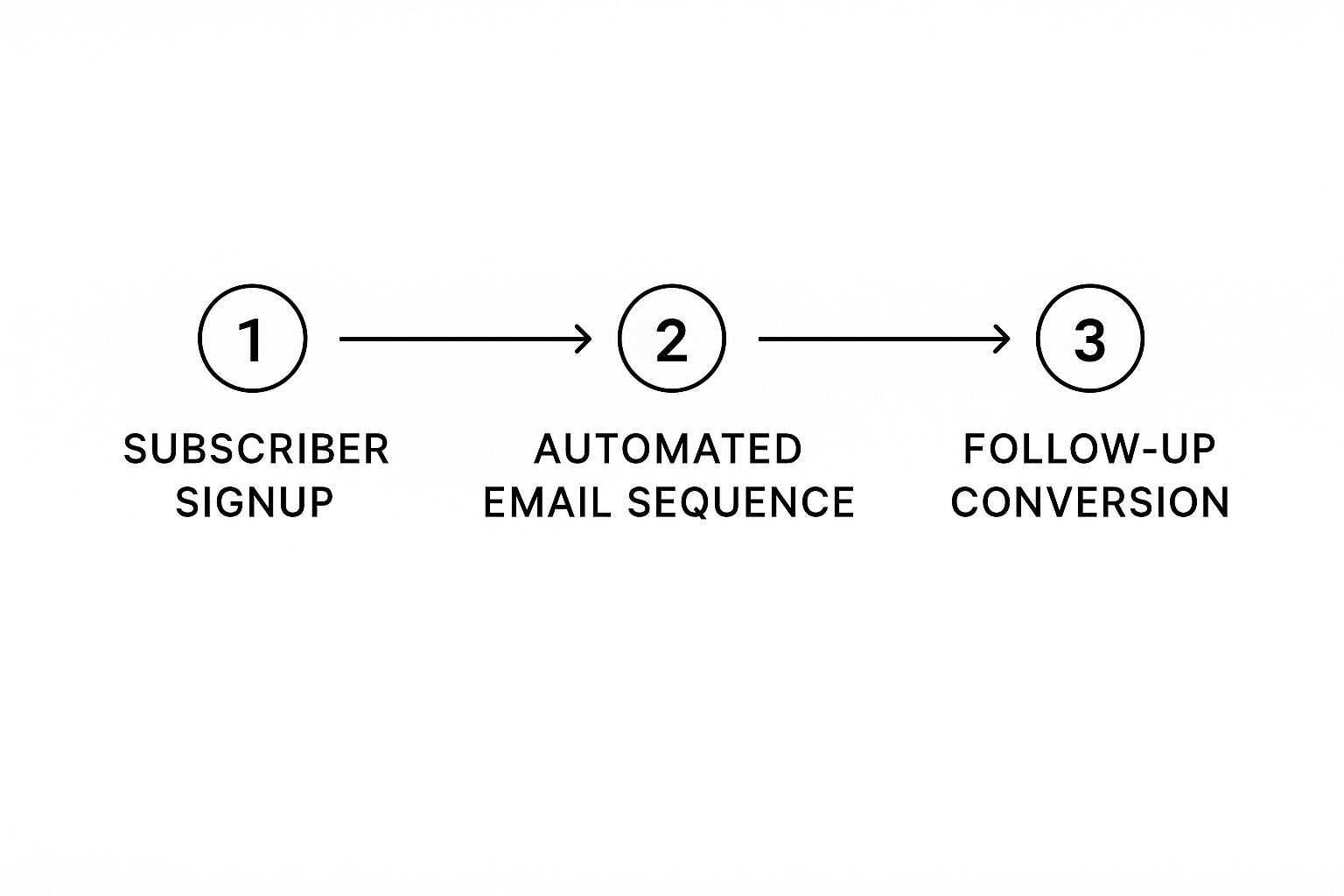
This flow shows how a single action, like a new signup, can kick off a whole series of targeted messages designed to nudge a subscriber towards a specific goal—all without you having to lift a finger.
While you can automate almost anything, there are a few core workflows that deliver the biggest bang for your buck for most clients. Nailing these foundational sequences is a crucial part of any solid email marketing for agencies service. Think of them as your automated sales and retention team, working around the clock.
Here are three essential automation sequences every agency should have in its toolkit:
Putting these automations in place frees up your agency's time to focus on the big picture—strategy and client relationships. Instead of manually blasting out one-off campaigns, you’re building systems that deliver consistent results. This systematic approach is also a powerful part of effective agency lead generation, as it shows you have a scalable and repeatable process for getting clients what they want. By building these automated journeys, you’re creating a powerful, always-on marketing machine for every single client.
Running flawless campaigns is only half the job. If you want to keep your clients for the long haul, you’ve got to prove your value in a language they understand: dollars and cents.
To truly become an indispensable partner, you have to move beyond vanity metrics like open rates and report on what actually matters to their business.
Let’s be honest, clients don’t ultimately care how many people opened an email. What they care about is how many of those people took a profitable action. Your reporting needs to tell a compelling story about how your email marketing efforts are directly feeding their bottom line.
It's time to shift the conversation from opens and clicks to revenue and growth. While an open rate can give you a hint about whether your subject line worked, it doesn't pay your client's bills. Your focus should be squarely on tracking and reporting metrics with a direct financial impact.
Here are the key performance indicators (KPIs) that should be front and centre in every client report:
To really nail your reporting, you have to be tracking the right things from the start. Digging deeper into the essential email marketing KPIs for agencies will sharpen your skills and make your reports impossible to ignore.
Your report needs to be more than just a data dump; it should be a success story. Kick it off with a high-level executive summary that highlights the key wins in plain English. Use charts and graphs to make the complex stuff easy to digest at a glance.
A powerful report connects your activities directly to your client’s outcomes. So, instead of saying, "The campaign had a 25% open rate," you frame it like this: "The 'Winter Sale' campaign generated $15,000 in direct revenue, which is a 3,500% return on your investment with us this month." This simple shift reframes your agency's work from a cost into a high-performing investment.
Here in Australia, email marketing consistently punches above its weight. Local businesses often see returns of up to $42 for every $1 spent—an incredible 4200% ROI. This is powered by fantastic local engagement, with Australian open rates hitting 46.34%, which is well above the global average. Dropping these benchmarks into your reports helps contextualise your client's success and shows them they’re performing well in a profitable market.
At the end of the day, every report should answer one simple question for your client: "Was this a good investment?" By focusing on ROI, revenue, and business growth, you make the answer an undeniable "yes," securing your partnership for the long term.
Communicating this value effectively is a specialised skill. For agencies looking to sharpen their client strategies and reporting, bringing in an experienced digital marketing consultant can provide the expert guidance needed to turn good results into unbreakable client relationships.

As you start weaving email marketing into your agency's services, a few common questions always pop up. Let's tackle them head-on with some straight-up answers to help you map out your strategy.
There’s no one-size-fits-all price tag here, as it really depends on the scope of work you're taking on. Most agencies work with a few common models.
You might opt for a flat monthly retainer, which could be anywhere from $3,000 to $10,000+ depending on the client's needs. Another route is charging project-based fees for one-off jobs, like setting up a complex automation sequence. Some agencies even go for a performance-based model, where you take a slice of the revenue your email campaigns directly generate.
A great way to get started with a new client is to kick things off with a single project. Once you've proven your value, it's a much easier conversation to transition them to an ongoing retainer. This approach builds trust and gives your agency that sweet, predictable revenue.
Think of it as having a secret weapon. A white-label service is when your agency brings in another expert company to do the email marketing grunt work, but you present all the results and reports to your client under your own brand.
It’s a brilliant way to expand what you offer and scale up your services without the massive overhead of hiring a huge in-house team.
When it's time to show your client the results, you need to speak their language. That means focusing on the numbers that actually matter to their bottom line—things like conversion rates, revenue per email sent, and the overall customer lifetime value.
To really nail this and show the true impact of your campaigns, you'll need the right tools. Having reliable client reporting tools for agencies is non-negotiable, as they give you those clear, hard-hitting insights into performance and ROI.
At Virtual Ad Agency, we don't just send emails; we build data-driven strategies that deliver real, measurable growth for our clients. Check out how our full-funnel approach can transform your client retention and drive serious results at https://www.virtualadagency.com.au.

 previous