
Think of an integrated marketing communications strategy as the art and science of getting all your marketing messages to sing from the same song sheet. Instead of your social media, ads, and PR teams all doing their own thing, this approach pulls them together to tell one clear, consistent, and compelling brand story.
Picture your marketing efforts as a skilled orchestra. Each instrument—your social media posts, email newsletters, digital ads, and PR stories—has its own part to play. An integrated marketing communications (IMC) strategy is the conductor, making sure every instrument works in perfect harmony. The result is a powerful, unified symphony, not just a jumble of random noises.
This approach breaks down the traditional walls that often spring up between marketing departments. When your advertising team launches a campaign, your social media team is right there backing it up with complementary content. Your PR team is pitching stories that echo the central theme. This creates a seamless experience for your customers, no matter how or where they connect with you. That consistency is gold when it comes to building credibility and trust.
In a world overflowing with digital chatter, people crave clarity. A jumbled marketing message just adds to the noise, creating confusion and chipping away at the trust you've built. An IMC strategy cuts right through the clutter by hammering home the same core message at every single touchpoint.
This kind of synergy delivers some serious wins:
At its heart, an integrated marketing communications strategy ensures the sum of your marketing efforts is far greater than its individual parts. It turns scattered tactics into a powerful, cohesive brand conversation.
Ultimately, this isn't just about blasting the same message everywhere. It’s about creating a holistic brand experience that truly connects with your audience, building loyalty and driving real, sustainable growth. It makes sure every dollar you spend is working as hard as it can, all pulling toward a single, focused goal.

A truly powerful integrated marketing communications strategy isn't just one brilliant tactic. Think of it more like a finely tuned engine, where multiple parts work in perfect sync. These parts are the core pillars of your marketing, each with its own job, but all driving towards the same destination. When they're organised properly, they don't just add up—they multiply each other's impact, creating a force that's much greater than the sum of its parts.
It's a bit like building a house. You need a solid foundation (that's your core brand message), sturdy walls (your key marketing channels), and a roof to tie it all together (your overarching strategy). Each pillar supports the others, making sure the whole structure is stable and can handle whatever the market throws at it.
Advertising is often the most visible part of the machine, the megaphone for your brand. This covers everything from old-school print and TV ads to the highly targeted digital campaigns you see on Google and social media. Its main job is to cast a wide net, building broad awareness and getting your core message out to a large audience.
Then you have sales promotions. These are the catalysts that turn a flicker of interest into a definite purchase. We're talking about short-term incentives like discounts, special offers, contests, or "buy now" deals designed to get people off the fence. When integrated, your advertising campaign creates the buzz, and a timely sales promotion gives customers the perfect nudge to act now.
Public Relations (PR) is the art of shaping how the public sees your brand and building up its credibility. Unlike advertising, where you pay for space, PR is all about earned media—getting positive mentions in the news, industry articles, or through influencers. A solid PR push gives your brand a third-party seal of approval, which people often trust far more than a direct ad.
Content marketing is PR's closest ally. This involves creating and sharing valuable, relevant content to attract and keep your target audience engaged. This isn't just fluff; it's about providing genuine value through:
Imagine you get a great feature in a major publication. That single PR win can be sliced and diced into a month's worth of content. You could write a blog post expanding on the story, create social media snippets quoting the article, and send out an email newsletter to share the good news.
An integrated marketing communications strategy ensures every piece of content, every ad, and every press mention reinforces the others. It's about creating a web of communication where each thread makes the entire structure stronger.
Digital marketing is the sprawling ecosystem where most customer interactions happen these days. It covers everything from your website and Search Engine Optimisation (SEO) to email campaigns and social media. This is the pillar that opens the door for direct, two-way conversations with your audience.
Social media is a huge piece of this puzzle. It’s not just a broadcast channel; it's a place for building communities, offering customer support, and engaging in real-time conversations. A smart integrated marketing communications strategy uses social media to listen just as much as it talks.
To really get a handle on how these pillars work together, it helps to see the main channels laid out. Each has a specific role, but their real power comes from how they connect and pass the baton to one another.
| Channel | Primary Role in IMC | Key Integration Point (Example) |
|---|---|---|
| Content Marketing | Build authority, educate, and capture leads with valuable information. | A blog post (content) is promoted via social media ads and includes a call-to-action to sign up for an email list. |
| SEO | Increase organic visibility and attract high-intent traffic from search engines. | SEO research informs content topics, ensuring blog posts and articles rank for terms your audience is searching for. |
| Social Media | Foster community, drive engagement, and provide real-time customer service. | A positive customer review on social media is repurposed into a testimonial for your website and email campaigns. |
| Email Marketing | Nurture leads, drive repeat purchases, and build direct customer relationships. | An email sequence is triggered after a user downloads an ebook (content), offering them a special discount (sales promo). |
| Paid Advertising | Generate immediate traffic, build brand awareness, and retarget interested users. | A PR feature story is amplified through paid ads, targeting audiences similar to the publication's readership. |
| Public Relations | Build credibility and trust through third-party endorsements and media coverage. | A press release announcing a new product is coordinated with a full launch campaign across social media and email. |
This table just scratches the surface, but it illustrates the core idea: no channel should operate in a silo. The magic happens when they are all speaking the same language and working towards the same goal.
The true power of IMC emerges when these pillars connect seamlessly. A social media campaign might drive traffic to a new blog post (content marketing), which then captures email sign-ups for a direct marketing sequence. That sequence then promotes a special offer (sales promotion) that's also being highlighted in your digital ads. Each pillar hands the customer off to the next, creating a journey that feels smooth and persuasive. This synergy is what turns individual marketing tasks into a cohesive growth engine for your business.
Let's move past the theory. The real magic of an integrated marketing communications strategy isn't just in the neatness of it all; it's in the tangible results it delivers to your bottom line. Thinking this way is more than just tidying up your messaging—it's a calculated business move that pays serious dividends in brand equity, customer loyalty, and ultimately, sales.
It’s the difference between having a bunch of individual marketing tactics running around doing their own thing, and a single, unified engine driving your growth.
When every channel works in concert, the synergy is incredibly powerful. Instead of running disconnected campaigns that end up fighting each other for budget and attention, IMC pulls everything together to amplify one another. This alignment makes sure every dollar you spend contributes to a bigger, cohesive goal, preventing wasted resources and squeezing the most out of your investment.
Consistency is the absolute bedrock of trust. When a customer bumps into your brand—whether it's on their social feed, in an email, or on a billboard—a consistent message reinforces your promise and professionalism. This kind of predictability makes your brand feel reliable and authentic, which is crucial for building relationships that last.
An integrated marketing communications strategy ensures this consistency is locked in at every single touchpoint. This unified front stops you from sending the kind of mixed signals that confuse customers and water down your brand’s identity. The result? A stronger, more recognisable brand that people feel connected to and are far more likely to choose over the competition.
Plain and simple, integrated campaigns are just more effective than siloed ones. When your different channels support and reinforce each other, the message cuts through the noise far more effectively. Think about it: a PR story can be boosted with paid social ads, which then drive traffic to a blog post, which in turn captures email leads for a follow-up promotion. Each step strengthens the next.
This creates a powerful multiplier effect. In fact, research shows that campaigns running across four or more digital channels can outperform single or dual-channel campaigns by over 300%. That synergy translates directly to a healthier return on investment, because every piece of the campaign is working harder and smarter.
A well-executed IMC strategy transforms marketing from a series of isolated expenses into a cohesive and profitable investment. It ensures the whole is always greater than the sum of its parts.
At first glance, you might think coordinating multiple channels sounds expensive. In reality, an integrated approach is often far more cost-effective. You eliminate redundant work, share creative assets across different platforms, and can even negotiate media buys in bulk. It’s all about making your marketing budget stretch further.
Despite these clear upsides, a surprising number of businesses haven't fully embraced a structured approach. A recent analysis found that nearly 47% of Australian companies still operate without a formal marketing strategy, which points to a massive opportunity.
For those that do have a plan, combining digital advertising with content marketing and personalisation delivers much higher returns. Digital ads within an IMC framework can boost brand awareness by up to 80%, and almost 9 out of 10 marketers see a positive ROI from personalising their campaigns. You can explore more 2025 digital marketing statistics and insights from RGC Digital Marketing to get the full picture.
Ultimately, an integrated marketing communications strategy gives you a powerful strategic advantage. It builds a resilient brand, deepens customer relationships, and makes sure every marketing dollar is spent with purpose and for maximum impact.
Putting together an effective integrated marketing communications strategy can feel like a massive job, but it really just boils down to a clear, step-by-step process. By breaking it down, you can shift from a bunch of disconnected tactics to a unified marketing machine that actually delivers.
Think of it like building a high-performance engine. You wouldn’t just throw parts together and hope for the best. Instead, you'd follow a precise blueprint, making sure every single component fits perfectly to create something powerful and efficient. Your IMC strategy needs that same level of careful construction.
This visual guide gives you a look at the basic flow, from the initial research right through to getting it all done.
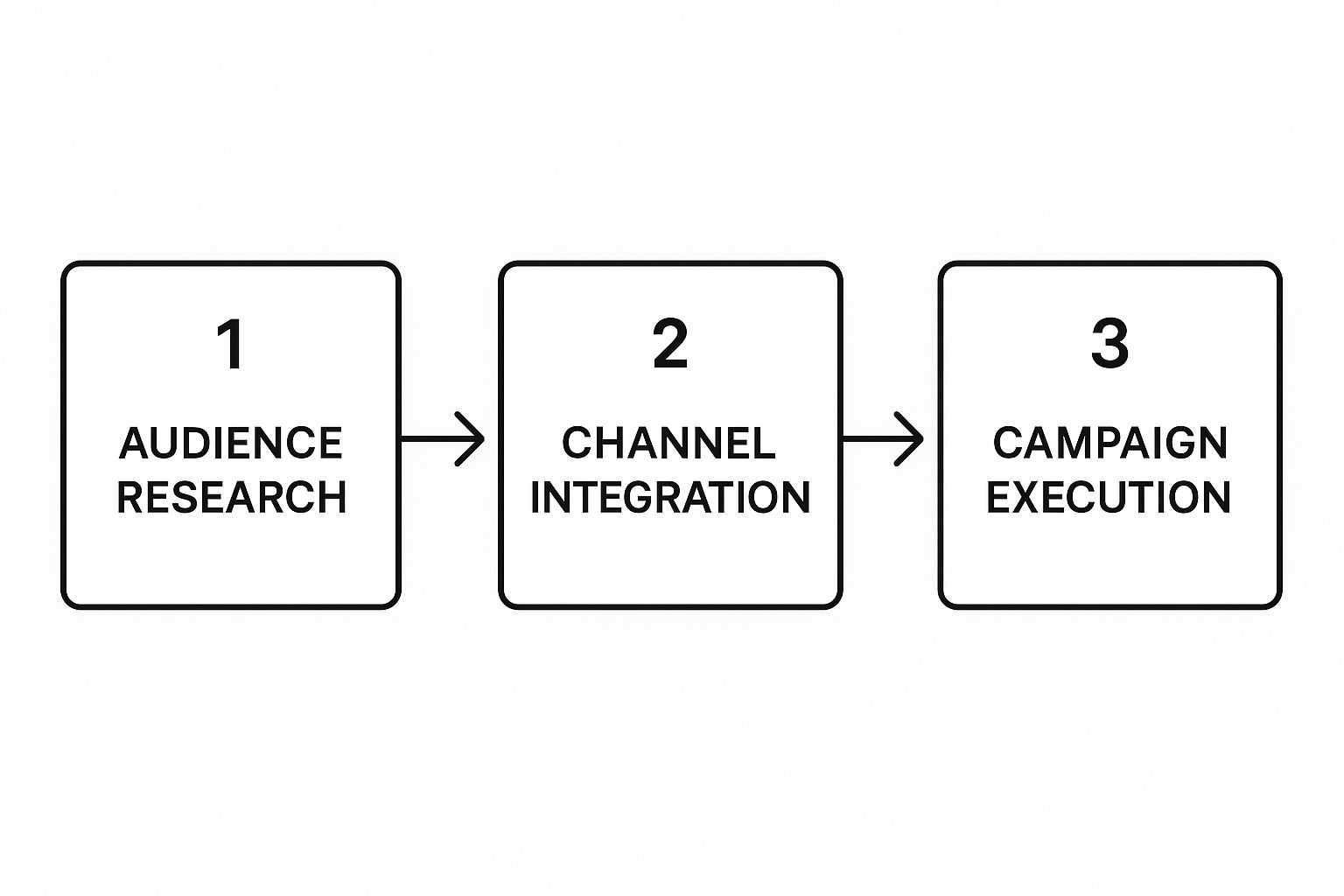
As you can see, a winning strategy always starts with getting to know your audience, moves on to choosing the right channels, and finishes with a coordinated campaign that brings it all together.
Before you write a single word of copy or design a graphic, you need to know exactly who you're talking to and what you want to achieve. Without this foundation, your whole strategy is just guesswork. Start by creating detailed buyer personas based on real data and solid market research.
Get a handle on their demographics, what keeps them up at night, their motivations, and where they get their information. Where do they hang out online? What sort of content do they actually trust? This deep dive is non-negotiable if you want to craft messages that genuinely connect.
Next up, set some SMART objectives for your strategy:
Clear objectives give you a roadmap for your entire campaign and the benchmarks you’ll use to measure success down the track.
With your audience and goals sorted, it's time to get to the creative heart of your strategy. This is where you nail down a single, powerful core message that will be the consistent thread woven through every single channel. This message needs to be simple, memorable, and speak directly to a key need or desire of your audience.
This "big idea" becomes the anchor for all your creative work. It sets the tone of voice, the visual style, and the overall vibe of your campaign.
Your core message is your brand's promise, delivered consistently. It’s the unifying idea that makes a customer’s experience with your paid ad feel connected to their interaction with your social media and your website.
Every piece of creative, whether it’s a quick tweet or a full-blown TV commercial, should feel like it’s coming from the same brand and telling the same story. That consistency is what builds recognition and, ultimately, trust.
Now, you get to decide which channels are going to be the most effective for getting your message in front of your target audience. This isn't about being everywhere; it's about being in the right places. Let your persona research be your guide here.
A successful integrated marketing communications strategy is all about synergy. You need to plan how your channels will work together:
When you're mapping this out, a solid content distribution strategy is crucial to make sure your message lands in all the right spots. Each channel should hand off seamlessly to the next, creating a smooth and persuasive journey for your customer.
Finally, you need to put your money where your mouth is by allocating your budget across your chosen channels and setting up a system to measure performance. Your budget should reflect your objectives and the channels you’ve decided are most important. It’s not about spending equally everywhere, but spending smartly based on expected impact.
To measure success, establish key performance indicators (KPIs) that link directly back to your SMART goals. These could be metrics like website traffic, conversion rates, customer acquisition cost, or even brand sentiment.
Use analytics tools to keep an eye on performance across all your channels in real-time. This data is gold. A great IMC strategy is never set in stone; it’s a living plan that you constantly tweak and refine based on what the numbers are telling you. This ensures your marketing efforts stay sharp and deliver the best possible return on your investment.

Any modern integrated marketing strategy has to live and breathe online. But let's be clear: just having a profile on Instagram, TikTok, and YouTube isn't enough. Not even close.
True integration is about turning those separate channels from standalone megaphones into a connected web. Each platform should work together to tell one single, powerful brand story.
The trick is to adapt your core message to fit the unique language of each platform without losing an ounce of consistency. Think of your brand's core message as a central melody. On YouTube, that melody might be a polished, long-form video. On Instagram Stories, it becomes a raw, behind-the-scenes snapshot. On TikTok, it’s a creative, trend-driven short clip. The tune is the same, but the arrangement changes to suit the venue.
This tailored approach makes your content feel native to each platform. You avoid that jarring experience of seeing a stuffy corporate video awkwardly dropped into a casual TikTok feed. It’s about respecting the user's context, which makes your message feel more welcome and far more effective.
Nailing your digital integration means getting a feel for what makes each channel tick. A one-size-fits-all approach will just fall flat. Instead, focus on the platform-specific nuances to create a brand experience that feels cohesive yet dynamic.
YouTube: This is your home for storytelling and going deep. Use it for tutorials, product deep-dives, and brand documentaries that really flesh out your core value proposition in a detailed, engaging way.
Instagram: It's all about visual appeal and authenticity here. Use high-quality images and Reels for your polished brand messaging, but save Stories for that spontaneous, behind-the-scenes stuff that builds a personal connection.
TikTok: Success on TikTok is built on creativity, authenticity, and jumping on trends. The best brand content doesn't feel like an ad at all; it feels like a natural part of someone's "For You" page, subtly weaving your message into entertaining formats.
Trying to juggle this complex, multi-platform world can be a real headache. It's why many businesses look into how to hire a social media marketing firm to manage their digital presence properly.
Digital platforms are a two-way street. They aren't just for shouting your message into the void; they're goldmines of real-time data and analytics. Paying close attention to these insights is absolutely fundamental to a successful integrated marketing communications strategy.
Think of your platform analytics as a compass. They don't just tell you what content is performing well, but why it's resonating. This allows you to fine-tune your messaging and double down on what truly works.
This constant feedback loop is priceless. Metrics like engagement rates, click-throughs, and audience demographics give you the intel you need to optimise your creative, adjust your channel mix, and make sure your message isn't just being seen—it's actively driving results. To better weave various online channels into your overarching strategy, check out these essential digital marketing tips for small business.
Here in Australia, the focus on digital integration is particularly intense. Social media advertising plays a massive role, with projections showing Aussie ad spend is set to hit around AU$7.5 billion, with steady annual growth. This huge investment highlights why a cohesive strategy across top platforms like Facebook, Instagram, and YouTube is no longer a "nice-to-have" for brands wanting to maximise their audience engagement.
Even the best-laid integrated marketing plans hit a few bumps in the road. It’s how you navigate these roadblocks that separates a good strategy from a truly great one. Interestingly, the biggest issues often aren't huge market shifts, but internal friction points that can derail your efforts before they ever really get going.
One of the most common hurdles is the classic internal silo. Your social media team, content creators, and sales department are all brilliant at what they do, but if they’re operating in their own little bubbles, your unified message shatters into a million pieces. This lack of coordination leads to inconsistent branding, wasted effort, and a jarring experience for the customer. Customers don't see your org chart; they see one brand, and mixed signals chip away at their trust.
Then there's the tricky business of measuring return on investment (ROI) across all your channels. It's pretty straightforward to see how many sales a single ad generated. But what about the combined effect of a blog post that led to an email sign-up, which then nudged a customer toward a purchase three weeks later? Without the right way to attribute success, justifying the value of a fully integrated approach can feel like an uphill battle.
Getting this right isn't about finding a magic bullet. It’s about making a deliberate shift in both your company culture and your processes to build a framework that supports collaboration and clarity.
In today's market, transparency isn't just a buzzword; it's a non-negotiable, especially when you're bringing external partners like influencers into the mix. Influencer marketing is a massive part of many IMC strategies here in Australia, but it’s loaded with regulatory risks if you’re not careful. A recent review by the Australian Consumer & Competition Commission (ACCC) found a staggering 81% of influencer posts were potentially misleading because of poor disclosure.
An effective integrated marketing communications strategy must include strict compliance rules and prioritise transparent communication to maintain audience trust and ensure ethical promotion.
This means your IMC framework has to enforce crystal-clear guidelines for disclosing paid partnerships across every single channel. Dropping the ball on this doesn't just put you in legal hot water; it completely undermines the authentic connection you’ve worked so hard to build with your audience. By baking these practices directly into your strategy, you safeguard your brand's reputation and strengthen the confidence your customers have in you.
Diving into integrated marketing communications for the first time usually sparks a few questions. That's a good thing. Getting these common queries sorted out is the best way to build the confidence you need to create and run a strategy that actually works. Let’s tackle some of the most frequent ones.
Measuring the return on investment (ROI) for an integrated marketing communications strategy means you have to think a bit differently. You can't just look at how one channel is performing all by itself. The whole point is to see how they all work together to influence the big picture.
This means ditching old-school ideas like last-click attribution, which gives all the credit to the final touchpoint before a sale. To get a true sense of ROI, you need to blend different approaches to see how all the pieces of your marketing puzzle—social media, email, in-store ads, content—guide a customer along their journey.
Key things to keep an eye on include:
These two terms get thrown around a lot, and people often use them interchangeably. But they describe two very different ways of thinking, and getting the distinction right is crucial. Frankly, omnichannel thinking is the real heart of a solid IMC strategy.
Multichannel is about using a bunch of different channels to talk at the customer. Omnichannel is about making sure those channels all talk to each other to create one smooth, unified experience for the customer.
Think of it like this: a multichannel retailer might have a physical store and a website, but they operate like separate businesses. In an omnichannel world, that same customer can browse a product on your website, check your phone to see if it's in stock at the local shop, and then buy it online for click-and-collect, all in one seamless flow. That's integration in action.
Absolutely. An integrated marketing communications strategy isn't just for big corporations with eye-watering budgets. The core ideas of consistency and making your channels work together scale down beautifully for small businesses.
You just need to be smart and focused. Instead of trying to be on every single platform, a small business can pick two or three channels where its customers actually hang out and integrate them perfectly. A local café, for example, could make sure its Instagram specials, email newsletter deals, and the A-frame sign out front all carry the same message, look, and feel.
This creates a really strong, cohesive brand experience without needing a massive marketing department. The focus is on the quality of the integration, not the number of channels you use.
Ready to build a powerful, cohesive marketing strategy that delivers real results? The team at Virtual Ad Agency specialises in creating and executing full-funnel marketing plans that drive growth. Discover how we can unify your marketing efforts by visiting us at https://www.virtualadagency.com.au.

 previous