
Click Through Rate (CTR) is one of those core marketing metrics you hear about all the time. Put simply, it measures the percentage of people who actually click on your ad, link, or call-to-action after seeing it.
It's calculated by dividing the total number of clicks by the total number of impressions, then multiplying by 100 to get a percentage. But more than just a number, it tells you how compelling your content really is to your target audience.
Let's ditch the technical jargon for a moment. Imagine your advertisement is a window display in a busy shopping centre. Every single person who walks past and glances at your display is an impression.
Now, think about every person who is so intrigued by that display that they stop, turn, and step right inside your store. That's a click.

Click Through Rate is just the simple percentage that links those two actions. If 1,000 people walk past your display (impressions) and 50 of them enter your shop (clicks), your window display has a 5% CTR. It’s a direct measure of how well your initial message grabs the attention of passersby.
To really get a handle on CTR, you need to understand its two fundamental parts: clicks and impressions. They seem simple on the surface, but each one tells a distinct story about how your campaign is performing.
The formula that ties these together couldn't be more straightforward:
(Total Clicks / Total Impressions) x 100 = Click Through Rate (%)
This simple calculation is one of the most important vital signs for your digital marketing health. It directly measures how well you're turning viewers into visitors and is often the very first indicator of a campaign's success or failure.
To make things even clearer, here's a quick reference table breaking down the essentials of CTR.
This table summarises the core components of Click Through Rate and what they signify for your marketing efforts.
| Component | What It Means | Why It Matters |
|---|---|---|
| Impressions | The number of times your ad or link was shown to an audience. | Indicates your reach and visibility. You can't get clicks without impressions. |
| Clicks | The number of times people acted by clicking on your ad or link. | Measures immediate engagement and shows that your message sparked interest. |
| CTR (%) | The percentage of impressions that resulted in a click. | Acts as a key performance indicator for relevance, ad copy, and targeting. |
Essentially, this table helps you see how the different parts of the CTR puzzle fit together to give you a clear picture of your campaign's appeal.
So, what is click through rate really telling you? At its heart, it's a measure of relevance and appeal.
A high CTR is a great sign. It suggests your ad copy, headline, or creative is hitting the mark with the audience seeing it. It shows you’ve successfully matched your message to the user's intent. For instance, a strong CTR on a Google Ad shows your keywords and ad copy align perfectly with what people are actually searching for.
On the other hand, a low CTR signals a disconnect. Your message might be getting in front of the wrong people, or the ad itself just isn't compelling enough to earn a click. This makes CTR an indispensable diagnostic tool for tweaking campaigns and making sure your marketing budget is being spent effectively.
Getting your head around what click-through rate is is the easy part. The real trick is knowing that a "good" CTR is never a one-size-fits-all number. A figure that signals massive success on one platform could be a sign of total failure on another. It all comes down to context.
Think of it like this: you wouldn't judge a food truck at a music festival by the same standards as a fancy fine-dining restaurant. Both can be wildly successful, but their customers have completely different expectations and are in totally different mindsets. The same goes for your marketing channels.
Someone actively typing a problem into Google is on a mission. They're hunting for a solution. Compare that to someone casually scrolling through their Instagram feed, and you can see why the CTR benchmarks are worlds apart. Nailing this distinction is the key to setting realistic goals and creating strategies that actually connect with people where they are.
When it comes to organic search results, your CTR is a direct reflection of how well your page title and meta description grab someone's attention on a crowded results page. When a user searches on Google, they’re actively looking for an answer. Your listing is sitting there, side-by-side with nine others, all fighting for that one click.
A high organic CTR is a great sign. It tells you that your little snippet of text is hitting the mark and feels relevant to what the searcher is looking for. Several things play into this:
A strong organic CTR doesn't just bring in more traffic; it can also send a positive signal back to Google, which can help your rankings over time.
In the world of Pay-Per-Click (PPC), CTR is even more critical. It’s not just a vanity metric—it directly affects how much you pay and how often your ads are shown. Google's Ad Rank system looks at your bid, but it also heavily weighs your Quality Score, and CTR is the biggest piece of that puzzle.
A higher CTR tells Google that your ads are relevant and helpful to users. As a reward, Google will often give you a better ad position at a lower cost-per-click (CPC). This means improving your ad's click through rate is one of the most effective ways to lower your advertising spend.
Unlike organic search, PPC advertising often targets users who are ready to buy, which can lead to higher average CTRs. Success here comes down to razor-sharp keyword targeting and ad copy that speaks directly to a person's immediate need.
Social media is a completely different ball game. People on Facebook, Instagram, or LinkedIn are usually in a passive, "discovery" mindset. They aren't actively looking for your product; your ad is an interruption to their scrolling. Earning a click here demands a different strategy entirely.
The creative is everything. A stunning image, a thumb-stopping video, or a clever carousel ad can make someone pause. The ad copy needs to be short and punchy, leading with a hook that piques curiosity or hits on a pain point. Because the user's intent is lower, social media CTRs are generally lower than search ads. This is where the platform excels at building brand awareness, and where understanding the difference between clicks and impressions, like in the cost per impression formula, is crucial for measuring your campaign's true reach.
Finally, we have email marketing. Here, CTR measures how many subscribers clicked on a link inside your email after opening it. It's a vital sign of how engaging your content is. Your open rate tells you if the subject line worked, but the CTR tells you if the stuff inside the email was compelling enough to get them to take the next step.
Things like a strong call-to-action (CTA), relevant content, and a clean, mobile-friendly design are everything. A low CTR could mean your email content didn't live up to the promise of your subject line, or maybe the offer just wasn't tempting enough. Segmenting your email list to send super-targeted messages is one of the best ways to lift this number, making sure the right content always lands in front of the right person.
Knowing your own Click Through Rate is one thing, but the real question is always: "Is my CTR any good?" Without context, your data is just a number. To really figure out how well your campaigns are doing, you need to see how they stack up against the competition, especially here in the Australian market.
Benchmarks aren’t about chasing vanity metrics; they give you a realistic baseline. A CTR that looks a bit low in one sector might actually be fantastic in another. This context helps you set achievable goals, spot genuine opportunities to improve, and avoid wasting time and money chasing a target that was never realistic in the first place.
The industry you're in has a massive impact on what you can consider an average or high-performing CTR. This all comes down to things like how ready your audience is to buy, how long they take to make a decision, and how much emotion is involved in the purchase.
Think about it: someone planning a holiday is often in a dreamy, visual state of mind. They’re far more likely to click on an exciting travel ad than someone doing their homework on a complex B2B software package. This difference in user behaviour shows up directly in the numbers.
Research into the Australian market shows just how much CTRs can vary. For instance, the average CTR for Google Ads in the Travel and Hospitality sector was a healthy 4.68%, while the Technology sector was much lower at 2.09%. Other key industries like Education saw a CTR of 3.78%, and Finance and Insurance averaged 2.91%. You can dig into more of these numbers and find more details in this breakdown of Australian ad performance benchmarks.
This data makes it crystal clear why a one-size-fits-all approach to CTR goals just doesn't work. A travel agency aiming for a 2% CTR would be seriously underperforming, but a tech company hitting that same 2% might be right on the money.
To give you a clearer picture, here’s a quick look at the average Click Through Rates for Google Ads across some of Australia's key industry sectors.
| Industry Sector | Average CTR (%) |
|---|---|
| Travel & Hospitality | 4.68 |
| Education | 3.78 |
| Finance & Insurance | 2.91 |
| Technology | 2.09 |
As you can see, the difference is significant. Use these figures as a starting point to gauge where you stand, but remember they are just averages. Your own performance will depend on the specifics of your campaign and audience.
The chart below gives you a visual comparison of how CTRs typically look across different marketing channels, showing how user engagement shifts from one platform to another.
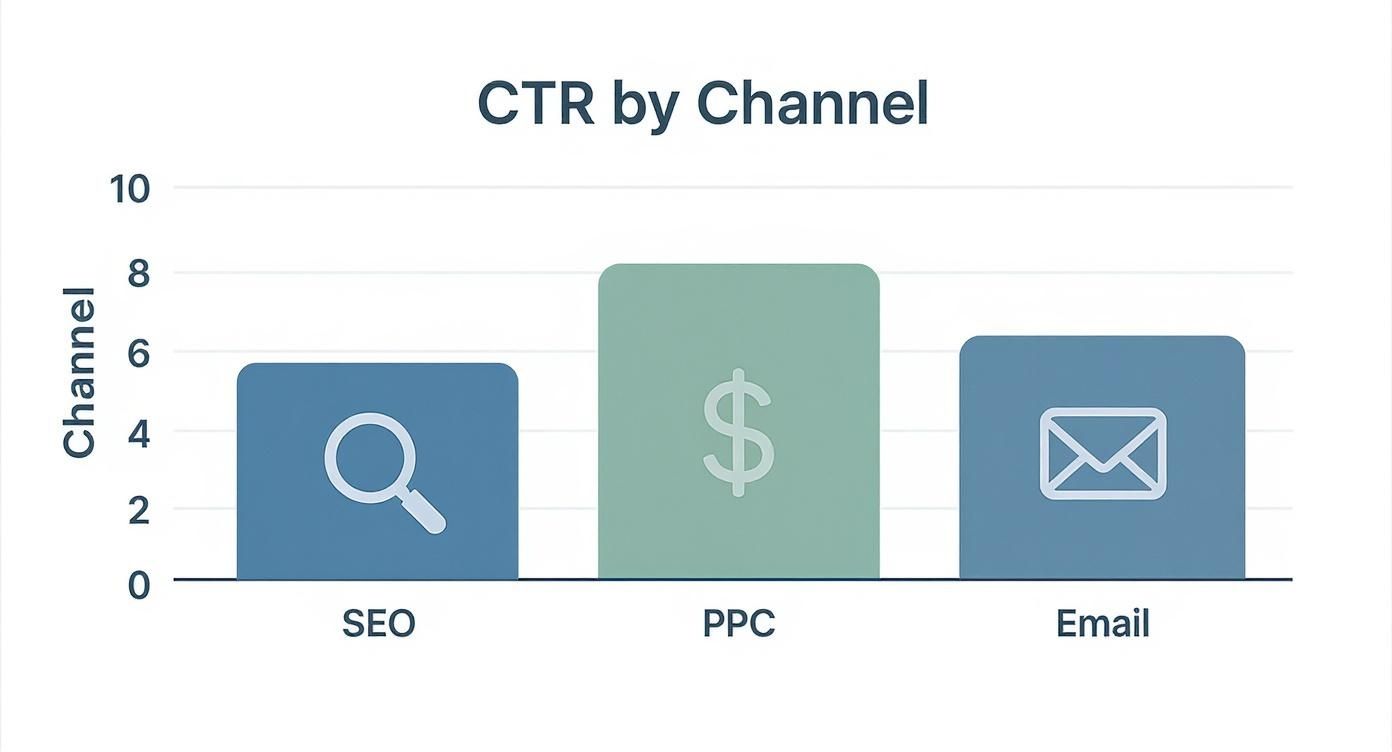
It’s pretty clear that channels where people have a higher intent to find something, like SEO and PPC, generally pull in stronger CTRs. Channels like email, where the audience might not be actively looking to buy right at that moment, tend to see lower rates.
Understanding why these benchmarks are so different is just as important as knowing the numbers. There are a few core factors that explain the massive variation you see between industries.
The bottom line is this: CTR variance comes down to how well your offer aligns with the user's intent at that exact moment. High-intent, emotionally driven, or urgent needs will almost always get more clicks than low-intent, research-heavy, or everyday products.
Here’s a breakdown of what’s driving these differences:
Once you get your head around these nuances, you can start setting smarter, industry-aware targets for your own campaigns. It lets you properly measure your performance and focus your energy on the tweaks that will actually make a difference.
Figuring out what a "good" Click Through Rate looks like is one thing. But understanding why your CTR is sitting where it is? That requires a closer look under the bonnet. Several elements all work together, either convincing someone to click or prompting them to scroll right on by.
Think of them like ingredients in a recipe. Get the mix right, and you create something compelling. Get it wrong, and the whole thing falls flat.

Once you get a handle on these factors, you move from just watching your CTR to actively controlling it. By pulling each part to pieces, you can spot the weak links in your campaigns, turn them into strengths, and systematically lift your performance, one click at a time. This is where the real work begins.
At the absolute heart of a strong CTR is relevance. Your ad copy, page title, or email subject line has to be a perfect match for what the user is actually looking for. When someone searches for "women's running shoes," they expect to see results that speak directly to that query, not some generic ad for "sportswear."
This connection between a user's intent (what they want) and your message (what you've got) is non-negotiable. The closer your keywords and ad copy mirror their search, the more relevant you appear, and the better your chances of earning their click. It's about creating that seamless "you asked, we've got it" moment.
A high CTR is often a direct reflection of how well you've answered a user's silent question. If your ad feels like the perfect solution to their problem at that precise moment, the click becomes an almost instinctive reaction.
Your Call to Action (CTA) is the clear, direct instruction telling people what to do next. Vague, passive language just doesn't cut it. A strong CTA creates clarity and a bit of urgency, taking all the guesswork out of the equation for the user.
Just think about the difference between a button that says "Learn More" versus one that screams "Get Your Free Quote Now." The second one is specific, action-focused, and hints at immediate value. The best CTAs often use powerful verbs and dangle a benefit, like:
Without a punchy CTA, even the most relevant ad can fall flat, leaving people interested but unsure of the next step. It's that final nudge that turns passive interest into direct action.
It probably comes as no surprise that where your ad or link shows up has a massive impact on its visibility and, by extension, its CTR. On a Google search results page, that top spot naturally grabs the most eyeballs and clicks. In fact, the #1 organic result typically gets 10 times more clicks than the one languishing down in the #10 spot.
Of course, this is always changing as search engine layouts evolve. Click-through rates in Australia have seen a general decline in recent years, for both desktop and mobile. This is partly because Google keeps adding SERP features like featured snippets and knowledge panels that answer a query directly on the results page, removing the need to click through at all. You can dive deeper into this in an in-depth analysis of Australian SEO and marketing trends.
Beyond just position, visuals are absolutely critical, especially on social media and display ad networks. An eye-catching image, a punchy video, or a sharp graphic can be the difference that stops a user mid-scroll. We're visual creatures, and a strong image can get a message across much faster and with more emotional punch than text ever could, making it a key lever for driving up engagement and clicks.
Knowing the theory behind what moves your Click Through Rate is one thing; putting that knowledge into practice is where the real results happen. Boosting your CTR isn't about throwing things at the wall to see what sticks. It's about making specific, deliberate changes to your campaigns. Think of this section as your toolkit, packed with proven tactics you can use today to make your ads, emails, and search listings impossible to ignore.
It’s a bit like a chef perfecting a recipe. A tiny tweak to an ingredient or a small change in cooking time can completely transform the final dish. In the same way, small adjustments to your copy, targeting, or visuals can lead to massive improvements in your CTR and, ultimately, your campaign's success.

We're going to skip the generic advice and dive into specific strategies for each major channel, complete with real-world examples to show you what works.
Whether it's for organic search results or a paid ad, your headline is your first—and sometimes only—impression. It’s the first thing a user sees and often the only thing they’ll read before deciding whether to click. The goal here is to craft titles that aren’t just relevant but are genuinely magnetic.
A powerful way to do this is by A/B testing different headline formulas. This just means running two versions of an ad or title tag to see which one gets more clicks. Here are a few proven approaches to test:
Example:
- Before: Melbourne Web Design Services
- After: Award-Winning Melbourne Web Design (Get a Free Quote)
The second version is far more compelling. It's more specific, adds a trust signal ("Award-Winning"), and includes a clear call to action, making it much more likely to earn that click.
Just below the headline, your meta description (for SEO) or ad copy (for PPC) is your chance to really sell the click. It needs to build on the promise of the headline and give users a clear reason why your link is the best one on the page.
Don't just stuff it with keywords. Instead, focus on the user's problem or goal. What pain point will your content solve for them? What benefit will they get from clicking through to your site?
Always finish with a strong, active call to action. Don't just hope they'll click; tell them what you want them to do. Phrases like "Discover how," "Shop now and save," or "Download your free guide" create a clear next step. That clarity is absolutely crucial for turning an impression into a website visitor.
In the world of email marketing, the subject line is your entire pitch. If it doesn’t grab someone's attention in a chaotic inbox, your email won't even get opened, let alone clicked. The same A/B testing principles we talked about for headlines are vital here. Test different lengths, tones of voice, and the use of personalisation or even emojis.
Recent data shows the average CTR for email marketing campaigns in Australia was 2.00%, with the click-to-open rate sitting around 5.63%. While these numbers show how important it is to have great content inside the email, it all starts with an irresistible subject line.
For some hands-on advice on writing better emails from start to finish, have a look at our guide on email marketing best practices. Many modern email platforms also come with built-in email campaign optimization features that help you run A/B tests, segment your audience, and use personalisation to get those numbers up.
Ad extensions are one of the most powerful—and surprisingly underused—tools for boosting PPC CTR. They let you add extra, valuable information to your ads, like your location, phone number, or links to specific pages on your website, all at no extra cost.
Why are they so effective?
By using sitelink extensions, callout extensions, and structured snippets, you can build a more helpful and robust ad that stands out from the crowd and gives people multiple relevant ways to get to your site.
Knowing your Click Through Rate is one thing, but that number is pretty meaningless if you can't measure it properly and understand its real-world impact. Chasing a higher CTR just for the sake of it isn't the goal. The real prize is figuring out what that number tells you about your audience and your campaign's health. You have to dig into the data to see the story behind the clicks.
To get started, you need to know where to find this crucial data. Different platforms house their CTR metrics in their own analytics dashboards, and each one gives you a unique angle on your performance.
Your most important sources for CTR data will almost always be the platforms where you're running your campaigns. Getting comfortable navigating these tools is the first real step toward doing any meaningful analysis.
Once you've got your CTR, the real work begins. A single percentage point doesn't tell you much on its own. The trick is to analyse it in context, look for patterns, and connect it to other important business goals.
A high CTR is only valuable when it leads to meaningful business outcomes. Analyzing your performance means correlating clicks with conversions, not just celebrating a high click count.
First up, start tracking your CTR over time to spot trends. Is a new campaign lifting your average, or is a once-successful ad starting to lose its shine? This historical view helps you understand what’s working and what isn’t.
Next, you need to segment your data. Don't just settle for looking at the overall account CTR. Break it down by:
This kind of segmented approach helps you pinpoint your most effective strategies. For a deeper understanding of how CTR fits into the bigger picture, explore our overview of essential digital marketing performance metrics.
Finally, and most importantly, correlate your CTR with bottom-line metrics like conversion rate and cost per acquisition (CPA). A campaign with a massive CTR but a terrible conversion rate points to a serious disconnect between your ad's promise and your landing page's delivery. True performance analysis connects that initial click to the final, profitable action, ensuring your efforts are actually driving real growth.
As you get more comfortable with CTR, a few common questions will inevitably pop up. Getting your head around these is the key to moving from just knowing the definition to actually using it to make smart decisions in your marketing. Let’s tackle some of the big ones.
Look, there’s no single magic number for a “good” CTR. The honest answer is: it’s entirely relative. A strong CTR for you will hinge on your industry, the channel you’re using (think Google Ads vs. email), and what you’re trying to achieve with that specific campaign.
The best way to set a realistic target is to check out the industry benchmarks for your specific context. As we've covered, what’s considered fantastic for a travel company might be just okay for a B2B tech firm.
Absolutely. It sounds counterintuitive, but a sky-high CTR can sometimes be a red flag, especially if your conversion rate is flatlining. This mismatch usually points to a disconnect between what your ad promises and what your landing page delivers.
Essentially, you're getting plenty of people in the door but failing to give them what they came for. It could mean your ad copy is a bit misleading, you're pulling in the wrong crowd, or in some cases, it might even point to click fraud. Always, always look at your CTR next to your conversion metrics.
It helps to think of these two as different stops on the customer's journey. They measure separate, but closely related, actions.
Ready to stop guessing and start getting real results from your marketing efforts? The team at Virtual Ad Agency specialises in full-funnel strategies that turn clicks into customers. Learn how we can optimise your campaigns for maximum impact.

 previous