
Right, let's talk about what brand positioning really is. Forget the textbook definitions for a moment. At its heart, brand positioning is about deliberately carving out a specific, memorable space in your customer's mind. It's the art and science of making your brand distinct from the competition, giving your ideal audience a crystal-clear reason to choose you over everyone else.
In short, it’s about owning one single, powerful idea in the marketplace.
Picture the market as a massive, noisy party. Hundreds of brands are shouting, trying to get noticed. Brand positioning is your unique story, your distinct personality that makes you unforgettable to the right people, while all the other noise just fades into the background.
This isn't just a fluffy marketing exercise. It's the absolute foundation of your entire business strategy. It guides everything from the products you develop to the ads you run.
When you nail your positioning, it becomes a compass for your whole organisation. You know exactly what you stand for and who you're for. Suddenly, your messaging gets sharper, your product development becomes more focused, and your marketing budget works a whole lot harder. You stop trying to be everything to everyone and start becoming the perfect choice for a specific group of people.
Without a strong position, a brand is just another commodity, left to fight it out on price. That's a race to the bottom. With clear positioning, you build real brand equity and create a loyal tribe of customers who value what makes you different. The benefits are tangible and they ripple through the entire business:
Brand positioning is essentially the art of association. It's about connecting something your buyers deeply want with the one thing your firm provides better than anyone else. This mental link must be simple, relevant, and different.
Of course, before you can claim your space, you have to know exactly who you're talking to. It’s essential to establish a clear Ideal Customer Profile. Using an Ideal Customer Profile template can be a massive help in guiding your understanding of who you are trying to reach.
Ultimately, getting your head around brand positioning is the first real step toward building a business that's resilient, memorable, and profitable. It’s what turns your brand from just a name into a meaningful presence in the lives of your customers.
A knockout brand position doesn't just happen by accident. It's carefully built on four strategic pillars that lock together to give your brand a rock-solid foundation. Getting these right is the key to cutting through the noise in your market.
Think of each pillar as answering a crucial question about your brand. When you nail all four, they create a clear, cohesive structure that guides every single marketing decision you make. This consistency is what delivers real impact.
This infographic breaks down how brand positioning acts as that vital bridge, connecting your high-level business strategy with your day-to-day marketing execution.

As you can see, your positioning has to flow from your core business goals and, in turn, steer all your marketing activities. It's a two-way street.
First up, and arguably the most important, is your target audience. Here’s the deal: you can’t be everything to everyone. A strong position starts with a laser-focused understanding of exactly who you’re for—and, just as critically, who you’re not for.
This isn’t just about basic demographics like age or location. You need to get into their heads and understand their psychographics: their values, their hopes, what keeps them up at night, and what drives their buying habits.
When you can answer those questions, you can build a brand that connects on a much deeper, emotional level. You become the obvious choice for a select group of people who genuinely feel like you get them.
Next, you need to clearly define your market category. This is the box you put yourself in so customers can instantly understand what you do. Are you a high-performance running shoe, a sustainable fashion brand, or a dead-simple accounting software for freelancers?
This context gives customers a frame of reference, making it easier for them to compare you to the right alternatives. Sometimes it’s straightforward. But for really innovative brands, it might mean creating a whole new category or reframing an existing one to properly showcase their unique value. Choosing the right playground sets the rules of the game.
This is where you make your stand. Your brand differentiator is the single, most powerful benefit that sets you apart from every other player in your market. It's the one big reason your target audience should choose you, hands down.
A weak differentiator sounds like "great service" or "innovative solutions"—claims that every one of your competitors is probably making too. A strong one is specific, tangible, and damn hard for anyone else to copy.
Your differentiator isn’t just about being different; it’s about being different in a way that your specific target audience genuinely cares about. It has to be a unique solution to a problem that matters to them.
Effective brand positioning leans on a solid brand strategy that spells out how your unique idea gets turned into compelling communication. Getting this right is central to translating brand strategy into effective communication that actually connects with people.
Finally, you need your reasons to believe. These are your proof points. They’re the evidence that makes your unique promise credible. Without proof, your differentiator is just an empty slogan.
These can take plenty of different forms, and the more you have, the better:
Pulled together, these four pillars—Target Audience, Market Category, Brand Differentiator, and Reasons to Believe—form the essential framework for a brand position that customers will want and competitors will envy.
This is where the rubber hits the road—turning all that strategic thinking into a single, powerful statement. Your brand positioning statement isn't a catchy tagline for the public. Think of it as an internal North Star, the guiding light for every single marketing decision, piece of ad copy, and campaign your team pulls together. It’s what ensures everyone is telling the same story, consistently.
The process of writing it forces you to boil down your entire strategy—your audience, your market, your unique promise—into one focused paragraph. The goal here is clarity, not cleverness. It needs to be sharp, believable, and ready for your team to put into action straight away.
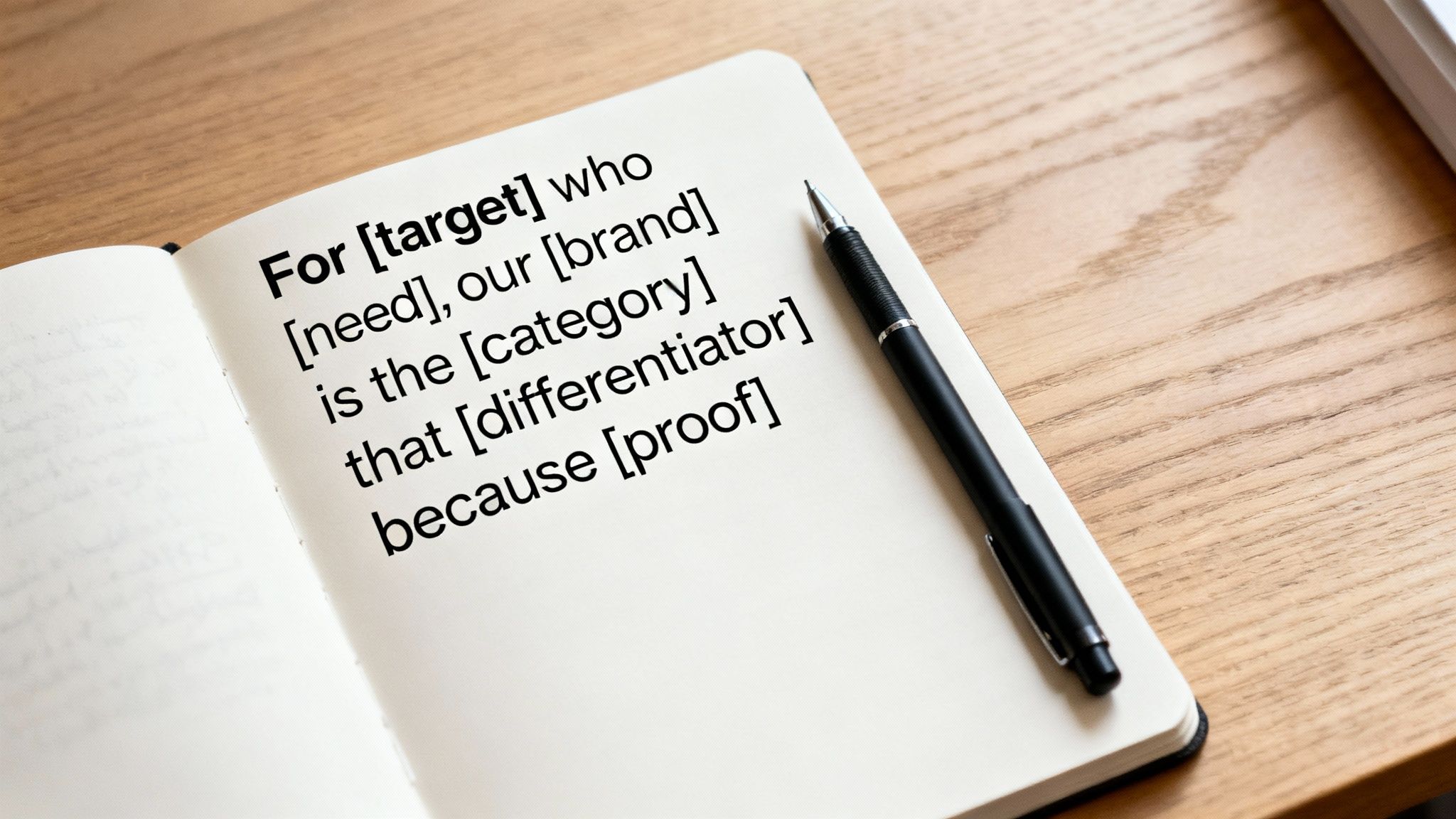
You could always free-form your statement, but starting with a proven template is a much better way to make sure you’ve covered all the critical bases. This simple structure forces you to answer the most important questions about your brand’s place in the world.
A classic, effective template that we often start with looks like this:
For [Your Target Audience], who [State the Audience's Need or Problem], [Your Brand Name] is the [Your Market Category] that [State Your Key Differentiator/Benefit]. Unlike [Your Main Competitor(s)], we [List Your Reasons to Believe/Proof].
It might look simple, but filling it out with real substance is the tricky part. Every single piece of this template connects directly back to the four pillars of brand positioning we’ve already discussed, transforming abstract ideas into a concrete, usable guide.
Let’s pull this template apart, piece by piece, so you know how to fill in the blanks with meaning, not just marketing fluff.
Your Target Audience: Get specific. Really specific. "Small businesses" is way too broad. "Australian-based ecommerce startups struggling with inventory management"? Now we're talking. The more tightly you define your audience, the sharper your entire statement will be.
Audience's Need or Problem: What's the core frustration or desire that keeps them up at night? This should be a pain point that you are uniquely wired to solve. For example, maybe they "need a simple, all-in-one marketing solution that won't blow their budget."
Your Market Category: This just sets the context for your customers. It tells them which mental box to put you in. Are you a "CRM platform," a "boutique accounting firm," or a "sustainable coffee supplier"?
Key Differentiator/Benefit: This is your knockout punch. It’s the single most compelling benefit you deliver that no one else can. It's not a boring list of features; it's the ultimate outcome for the customer, something like "delivers qualified leads, not just useless clicks."
Main Competitor(s): Naming your main rival helps to frame your value. This could be a direct competitor, or it could be an old way of doing things (think "spreadsheets and manual data entry") or even the choice to do nothing at all.
Reasons to Believe: These are your proof points. Why should anyone actually believe your promise? This is where you can mention your proprietary technology, award-winning service, a unique process, or powerful customer testimonials.
When you put it all together, you create a powerful internal document. It becomes the reference point for your whole team, making sure that from sales to customer support, everyone understands and communicates the core value of your brand in the exact same way. That kind of clarity is what brings a brand positioning strategy to life.
Understanding the theory behind brand positioning is one thing. Seeing it come to life in the real world is where the real lessons sink in.
Let’s pull apart how some of Australia's most recognisable brands have managed to claim their own unique patch of real estate in the customer's mind. These examples show just how a sharp strategy can translate into market dominance. By working backwards from their success, you can see how the core ingredients—target audience, market category, and differentiation—all blend together to create a brand that’s impossible to forget.
Before Canva came along, graphic design felt like a closed-off world, reserved for professionals armed with complex and pricey software. The market was split between the experts and everyone else. Canva spotted a huge, overlooked crowd: students, marketers, small business owners, and everyday people who just needed to create something that looked good, fast.
Their entire brand position is anchored in the promise of accessibility and simplicity.
This laser-focused positioning touches every part of their product and marketing. The platform is famously easy to get the hang of, and their messaging consistently hammers home speed, ease, and empowerment. They turned a daunting task into something fun.
Remember what buying a mattress used to be like? Overwhelming showrooms, confusing jargon, and pushy salespeople. It was a notoriously frustrating experience. Koala stormed into this stale industry with a completely different game plan, positioning themselves as the simple, convenient, and personality-packed alternative.
Their brand is built on convenience and a cheeky, relatable personality. They weren't just selling a mattress; they were selling a better way to buy one.
Koala’s success is proof that positioning isn’t just about what you sell, but how you sell it. They turned a tired industry on its head by obsessing over the customer experience, making the whole journey from click to delivery ridiculously simple and even enjoyable.
You can see this strategy in their "mattress-in-a-box" delivery, their fast and free shipping, and the game-changing 120-night trial that takes all the risk out of the purchase. Their marketing uses a distinctly Aussie, humorous tone of voice, which makes them stand out from the bland, corporate feel of their older competitors. By mastering these different types of brand positioning strategies, they built a cult following almost overnight.
The modern consumer thinks differently. Today, brand positioning has moved beyond just product features to something far more meaningful: values. Nearly half of all consumers (46%) say a brand's commitment to sustainability now directly shapes their buying choices—a massive shift from how things used to be.
No brand embodies this better than Patagonia. Sure, they operate in the "outdoor apparel" category, but their real position is much deeper. They are positioned as an activist company that happens to sell high-quality gear. Their legendary "Don't Buy This Jacket" campaign was a masterstroke, perfectly capturing their mission to encourage thoughtful consumption over mindless buying.
This purpose-driven approach attracts a very specific type of customer—one who shares their worldview. And they back it up with real action. Their proof points are baked right into their business, from using recycled materials and running the "Worn Wear" program to repair old gear, to their famous 1% for the Planet pledge. This isn't just clever marketing; it's who they are, and it builds a level of trust and loyalty most brands can only dream of.
Let's be honest. A brilliant brand positioning strategy is completely useless if it just sits in a presentation deck or a shared document. Its real power is only unlocked when you bring it to life—when you activate it.
This is all about turning that strategic statement into a consistent, compelling, and tangible customer experience at every single touchpoint. It’s the moment your brand stops being an abstract idea on a whiteboard and starts building real connections with actual people.
Activation means translating your position into action. It’s making sure that the carefully chosen space you want to own in your customer's mind is reinforced by everything your company says and does. Every piece of communication, from the top of the funnel right down to the bottom, must tell the same cohesive story.
Think of your brand position as the creative brief for every single stage of the customer journey. It dictates not just what you say, but how and where you say it, making sure the experience feels seamless.
Awareness Stage: Right at the top, your ads, social media content, and PR efforts need to introduce your core differentiator. The goal isn't just to get noticed, but to be noticed for the right reasons—the ones that line up with your unique promise.
Consideration Stage: As potential customers start weighing up their options, your website, blog content, and product demos have to provide the "reasons to believe." This is where you back up your claims with case studies, testimonials, and detailed explanations that prove your value.
Conversion Stage: When it's time to buy, your pricing, sales conversations, and checkout process must reflect your position. If you’re positioned as a premium brand, a clunky, discount-focused checkout experience creates a jarring disconnect.
Loyalty and Advocacy Stage: After the sale, your customer service, email follow-ups, and community engagement are where your positioning truly solidifies. A brand built on exceptional service has to deliver it in every single support ticket and interaction. No excuses.
Consistency is everything when it comes to effective activation. Your brand's voice, tone, and visual identity are the most direct ways you express your position.
A brand positioned as a bold disruptor shouldn't use a reserved, corporate tone in its emails. It just doesn't fit. Likewise, a brand built on simplicity needs a clean, uncluttered website design to match.
Activating your brand positioning means creating a unified sensory experience. The colours, fonts, imagery, and language should all work together to evoke the specific feeling you want to own in your customer's mind.
The Australian digital advertising landscape shows just how crucial this is. With social media ad spending tipped to hit US$4.73 billion in 2025, brands have to pick platforms and partners that actually reflect their position.
For instance, influencer marketing is set to command up to AU$943.8 million, and many brands are now partnering with micro-influencers (10K-100K followers). Why? Because their authentic, tight-knit communities are a perfect match for brands positioned on trust and relatability. You can find more insights like this on Australian marketing statistics at Eloquent.com.au.
Ultimately, bringing your brand position to life is an all-in commitment. It requires every department—from marketing and sales to product development and customer support—to understand and champion the brand's core promise. This ensures every single customer interaction strengthens the space you aim to own.
Nailing your brand positioning strategy is a huge win, but let's be honest, it's only half the job. The real question is this: is it actually making a difference? Figuring out how to measure your positioning is crucial for justifying marketing spend, showing a clear return on investment, and making smart tweaks to your strategy over time.
This isn’t about chasing fluffy metrics that look good in a report. It's about drawing a straight line from your strategic efforts to real, tangible business results. To do it right, you need a healthy mix of quantitative data (the hard numbers) and qualitative insights (what people are actually thinking and feeling).
To get the full story, you need to track a blend of metrics that reveal how your audience thinks, feels, and acts towards your brand. A solid measurement plan will tell you whether you’re successfully carving out that unique space in your customers' minds.
Here are some of the most telling KPIs to focus on:
While the data is essential, it doesn't paint the whole picture. You also need to understand the why behind the numbers. This is where qualitative measurement comes in, helping you get a read on perception, sentiment, and whether your message is landing as intended.
Measuring brand positioning isn't just about tracking clicks and conversions. It’s about understanding if your intended message is the one being received and if it’s building the long-term value that defines strong brand equity.
To gather these vital human insights, try these methods:
By blending these hard numbers with genuine human insights, you create a powerful feedback loop that constantly informs and refines your strategy. This data-backed approach not only proves the value of your efforts but also shines a light on where you need to adapt. Ultimately, this ongoing measurement process is what turns brand positioning from a one-off project into a dynamic engine for growth and helps you understand more about what is brand equity and how to build it.
Once you start digging into brand positioning, a few questions always seem to surface. Nailing down the answers is the key to moving from just 'getting' the concept to actually using it with confidence. Let’s clear up a few of the most common ones.
These questions usually get into the subtle but crucial differences between marketing ideas, helping clarify where positioning fits into the bigger picture of building a brand that lasts.
This is a big one, and it’s easy to see why they get jumbled up. The simplest way to put it is that positioning is the strategy, while branding is the execution.
Think of brand positioning as the deep strategic work that happens behind the scenes. It answers one vital question: "What specific, unique space do we want to own in our customer's mind?" It’s the game plan for how you want people to see you, especially when they stack you up against the competition.
Branding, on the other hand, is all the tangible stuff you create to bring that position to life. It’s the collection of recognisable elements that people see, hear, and feel:
In short, your positioning is the blueprint that guides every branding decision. It makes sure every single thing you put out there is consistent, aligned, and screams your unique value. One is the architect's plan; the other is the finished building.
While a strong position should have some serious staying power, it’s definitely not a "set and forget" job. Markets don’t stand still, and neither should your positioning.
A good rule of thumb is to give your brand positioning a formal review every three to five years. But sometimes, things happen that force your hand a bit earlier.
You should immediately reassess your positioning when there's a significant market shift. This could be a disruptive new competitor crashing the party, a major change in how your customers behave, new technology shaking things up, or even your own business pushing into new territories.
The goal isn't to chop and change constantly—that just confuses everyone. It’s about making sure your position stays sharp, compelling, and true in a world that’s always on the move.
Absolutely. In fact, for a small business, strong positioning isn't just a nice-to-have; it's a survival tool. When you can’t outspend the big guys, you have to outsmart them, and this is how you do it.
Sharp positioning allows a small business to compete on focus and relevance, not just on price or ad budget. By zeroing in on a specific niche and dedicating all your energy to serving that small group better than anyone else, you can build a fiercely loyal customer base that the big players can only dream of.
It’s about being the perfect, specialised choice for a select few, rather than a bland, generic option for the masses. This is exactly how small businesses carve out their space, attract the right kind of customers, and build an advantage that can stand up to much larger competitors.
At Virtual Ad Agency, we help businesses of all sizes craft and implement a powerful brand position that drives results across the entire marketing funnel. If you're ready to define your space and connect with your ideal customers, explore how our strategic services can help at https://www.virtualadagency.com.au.

 previous