
Let's be honest, "brand equity" sounds like something straight out of a marketing textbook. But cut through the corporate jargon, and you're left with a concept that's actually pretty simple: your reputation.
Think of it as the invisible value your brand name holds in a customer's mind. It’s the reason someone will happily pay more for a Starbucks coffee over a generic one, even if the beans are basically the same. It’s not about the coffee itself, but the entire feeling, experience, and trust wrapped up in the Starbucks name.
This isn't just fluffy, feel-good stuff; it's a genuine business asset. Strong brand equity translates directly to a healthier bottom line. You get more loyal customers, you're less rattled by a competitor's flashy new campaign, and you can command better profit margins. It's the gut feeling that makes you grab your usual brand of toothpaste without even glancing at the price of the one sitting next to it.
So, how do you build this powerful asset? It doesn’t just appear out of thin air. It rests on four key pillars that all work together. Get these right, and you're well on your way.
To really nail down what we're talking about, let's break down the core ideas. This isn't just about a logo or a catchy jingle; it's much deeper than that.
| Concept | What It Is | What It Is Not |
|---|---|---|
| Brand Equity | The intangible value and perception a brand holds in the customer's mind. | A company's book value or physical assets. |
| Brand Awareness | How familiar people are with your brand's existence. | Customers understanding every detail about your products. |
| Brand Associations | The feelings, ideas, and qualities people connect with your brand (e.g., "safety" for Volvo). | A list of your product features. |
| Brand Loyalty | The ultimate goal: customers who repeatedly choose you and become advocates. | One-off purchases driven by a discount or promotion. |
Understanding these distinctions is the first step to building a brand that doesn't just sell products, but earns a permanent place in your customers' minds.
This is square one. It’s all about how familiar your target audience is with your brand. After all, if people don’t know you exist, they can’t possibly develop any feelings about you, good or bad.
Strong awareness is the foundation everything else is built on. For a deeper dive, you can learn more about how to increase brand awareness in our detailed guide.
These are the mental shortcuts and connections customers make with your brand. When you think of Nike, you think of athletic achievement. When you think of Volvo, you think of safety.
These aren't accidental; they're the result of consistent messaging and experiences that actively shape how people perceive you.
Interestingly, this is less about the technical specs of your product and more about the customer’s opinion of its quality. It’s their belief that what you offer delivers superior value, whether that's in durability, performance, or overall experience.
This is the holy grail. Loyalty is what happens when customers stick with you, making repeat purchases and even recommending you to friends and family. They choose you time and time again, not because you’re the cheapest, but because they trust you.
Brand equity isn't just a marketing buzzword; it's a measurable force that drives your bottom line. It represents the sum of all customer experiences and perceptions, creating a lasting asset that can insulate a business from market fluctuations.
To really get a handle on how these pieces fit together, understanding the importance of online reputation management is key. Every glowing review, every consistent brand message, and every memorable interaction with a customer is like a deposit into your brand equity bank.
To really get what brand equity is all about, we need to look past a simple definition and check out what it’s built on. Strong, lasting equity isn’t just one thing; it’s a structure resting on four interconnected pillars. When these elements all work together, they create a brand that isn't just known, but is respected, chosen over others, and ultimately, far more valuable.
Each pillar holds up the others, contributing to a brand's overall strength and ability to bounce back. Think of it like building a house: without a solid foundation and sturdy walls, the roof is going to cave in. In the same way, a brand can't achieve real loyalty without first building awareness and a reputation for quality.
Let's break down each of these four essential pillars.
Brand awareness is the absolute foundation. Put simply, it’s about how well your brand is recognised by potential customers. If people don’t know you exist, they can’t form opinions, buy your stuff, or become loyal fans. It's the critical first handshake on the customer journey.
This is more than just having a logo people have seen before. True awareness is when someone thinks of a product category, and your brand pops into their head first. For instance, when an Aussie needs supplies for a weekend DIY project, "Bunnings Warehouse" is often the immediate thought. That top-of-mind recall is the gold standard of brand awareness.
Once customers know who you are, they start forming associations. These are all the mental and emotional connections—the thoughts, feelings, and images—that your brand brings to mind. Are you seen as innovative, reliable, luxurious, or a bargain? These associations shape your brand's personality and its place in the market.
Volvo, for example, has spent decades carefully building an association with safety. This was no accident; it was the result of consistent engineering, messaging, and marketing all hammering home one powerful idea.
Brand associations are the stories customers tell themselves about you. They are the sum of every interaction, advertisement, and product experience, shaping the perception that ultimately defines your brand's meaning.
These mental shortcuts are incredibly powerful because they steer purchase decisions, often without us even realising it.
Perceived quality is what a customer thinks about your product or service's superiority compared to the alternatives. And here's the interesting part: this perception can be more influential than the actual, technical quality. It’s all about the customer’s faith in your ability to deliver on your promise, again and again.
This perception is shaped by everything from your packaging and customer service to your brand reputation and price. A brand like R.M. Williams commands a premium price not just because of the quality of the leather, but because customers perceive a higher value in its craftsmanship, heritage, and durability. This belief makes the cost worthwhile and cements the brand's premium status.
In crowded markets, perceived quality is a huge differentiator. It gives customers a solid reason to choose you over a competitor, even if the specs on paper look almost identical.
Brand loyalty is the ultimate prize and the pay-off from the other three pillars. It’s a customer's commitment to keep buying from your brand, tuning out the noise from competitors. Loyal customers are the most valuable asset you can have—they provide a steady stream of revenue and become powerful advocates for your brand.
This loyalty isn't just about repeat business; it’s an emotional connection. Qantas, for instance, has built a loyal following through its Frequent Flyer program and a reputation for reliability, making it the default choice for many Australians. These customers trust the brand and aren't as swayed by price changes.
This infographic shows how these four pillars—awareness, associations, quality, and loyalty—come together to form the core of brand equity.
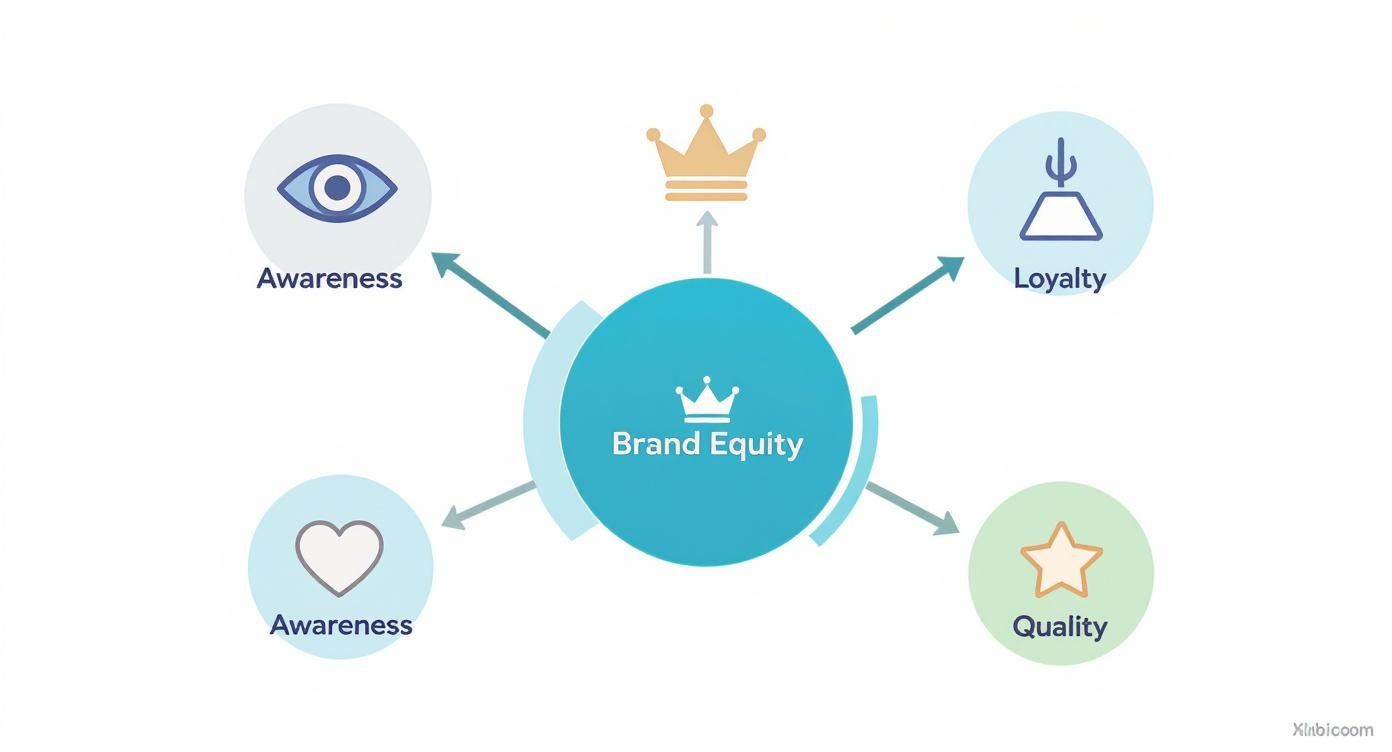
As you can see, each element is a crucial spoke supporting the central hub of brand equity, showing just how much they depend on each other. These pillars aren't just marketing fluff; they are measurable business assets.
In Australia, the focus on building these components has delivered big financial results. Brand equity is now seen as a core business asset, with the Kantar BrandZ Top 40 Most Valuable Australian Brands reaching a collective valuation of US$156 billion, a staggering 25% increase since the last measurement. This shows a clear shift where Australian companies now treat their brand as a strategic investment. You can discover more about these Australian brand valuations on Kantar.com.
By methodically strengthening each of these four pillars, a business can build a formidable brand that not only wins customers over but keeps them for life.

It’s one thing to understand the theory behind brand equity, but seeing it come to life is where the real lessons are. Top brands don’t just luck into a great reputation; they build it, deliberately and patiently, over years of consistent work. By looking at a couple of iconic Australian companies, we can see exactly how these concepts translate into real-world market dominance.
These businesses are masters at weaving together awareness, associations, quality, and loyalty. The result is something much bigger and more valuable than the products they sell. They manage to become a genuine part of their customers' lives. Let's dig into how two very different Aussie brands pulled this off.
For countless Australians, Bunnings is more than a hardware store—it's a weekend ritual. This didn’t happen by accident or through flashy sales. It was built on a foundation of powerful brand associations and a fierce sense of brand loyalty, all stemming from a customer-first mindset.
Their whole approach is a masterclass in building equity:
Through this relentless consistency, Bunnings has cultivated a bond that competitors find almost impossible to break. People don't just go there for a hammer; they go for the experience, the advice, and that classic sausage sizzle. That’s brand equity in action.
At the premium end of the scale, RM Williams shows us how perceived quality and heritage-based brand associations can command a high price tag and create an intensely loyal following. The brand's equity is tangled up in its story of Australian craftsmanship, and they tell that story brilliantly.
When you buy a pair of RM Williams boots, you're buying more than just shoes. You're buying into a story of rugged Aussie authenticity, something timeless and built to last. This is the direct result of a strategic focus on the pillars of brand equity.
A brand's value is created through meaning. Managing brands requires being a meaning-maker, a story-crafter, and a storyteller—finding and telling the stories that consumers need to hear to make their lives more fulfilling.
This sums up the RM Williams playbook perfectly. They don't just sell boots; they sell a piece of Australian heritage. That "Handcrafted in Australia" tag isn't just a manufacturing detail—it’s the anchor for their perceived quality. It’s what allows them to charge a price that reflects not just the leather and labour, but the decades of intangible value they've built.
The result is a customer who sees their purchase as an investment, not an expense. This deep-seated belief in superior quality fosters incredible brand loyalty, with many customers becoming lifelong advocates. They’ve successfully turned a product into a legacy.
Knowing the theory behind brand equity is one thing, but actually putting it into practice is where the real value gets built. Turning concepts into reality isn’t about grand, one-off gestures. It’s a focused, deliberate effort to shape every single interaction a customer has with your business through countless small, consistent actions.
Think of this as your playbook for turning those abstract ideas into tangible results. The strategies here are organised around three core themes that deliver real, measurable growth in your brand's standing. Get these right, and any business can start to build a more resilient and valuable brand.
Consistency is the absolute bedrock of trust. When your customers know exactly what to expect every time they interact with you—whether on your website, in-store, or scrolling through social media—they start to feel a sense of security. This predictability builds familiarity and cements your brand’s identity in their minds.
Picture a café famous for its friendly baristas and amazing coffee. If you visit on a Monday and get incredible service, but come back on Wednesday to a grumpy staff member and a lukewarm latte, the experience is broken. That single inconsistency chips away at trust and weakens the brand.
To stop this from happening, you have to make sure every touchpoint reflects your core brand values.
A cohesive approach presents a unified front, making your brand instantly recognisable and dependable. It’s a vital step in defining your place in the market. For more on this, exploring resources on effective brand positioning offers some fantastic insights.
Beyond just being consistent, the strongest brands build positive emotional connections. This means actively creating associations that reflect your brand's values and hit home with your target audience. It’s about making your brand stand for something more than just the products you sell.
A powerful way to do this is through smart partnerships and marketing that’s driven by your values. By teaming up with other respected brands or influencers who share your ethos, you can borrow some of their credibility and get your brand in front of a new, highly relevant audience.
A brand's value is created through meaning. Managing brands requires being a meaning-maker and a storyteller—finding and telling the stories that consumers need to hear to make their lives more fulfilling.
This is where your marketing becomes more than just advertising; it turns into a way to communicate what you stand for. A skincare brand, for instance, might partner with an environmental charity. This single act reinforces its commitment to sustainability and creates a positive link in the customer's mind, building a connection that goes far deeper than a simple transaction.
Ultimately, the goal of building brand equity is to cultivate fierce loyalty. Your loyal customers are your most valuable asset. They come back again and again, are less sensitive to price changes, and become powerful advocates who spread positive word-of-mouth.
You earn this level of devotion through exceptional service and genuine community-building.
Exceptional service isn’t just about solving problems. It’s about anticipating needs, personalising interactions, and making people feel truly cared for. It transforms a functional relationship into an emotional one.
On top of that, building a community gives your customers a sense of belonging. You can achieve this through:
These efforts make customers feel like insiders, part of a tribe, strengthening their emotional investment in your brand. In Australia, the line between trust and brand equity is crystal clear. Recent research from Roy Morgan found that 69% of Australians nominated at least one distrusted brand over a 12-month period, while only 44% named a trusted one. That gap shows that avoiding distrust is just as critical as building trust.
By mastering these elements, you can elevate your business from being just another option to a preferred partner in your customers' lives. For those looking to carve out a distinct identity in the market, our guide on brand positioning strategies offers more detailed approaches to get you there.

Brand equity can feel a bit like catching smoke – you know it’s there, but how do you grab hold of it? The thing is, its impact on your bottom line is very, very real. To grow this invisible asset, you first need to be able to measure it.
Without the right metrics, you’re basically flying blind. Are your marketing efforts building a brand people love, or are they just falling flat? Fortunately, measuring brand equity isn’t the guessing game it used to be.
By combining different methods, you get a complete picture of your brand's health. It’s about blending hard numbers with genuine customer sentiment, turning brand equity from a vague idea into a tangible, trackable asset you can actively improve.
A solid measurement strategy never relies on just one type of data. The smartest approach is to merge qualitative insights (the why behind what your customers do) with quantitative data (the what and how many). This balanced view tells the full story of how your brand is really performing.
Quantitative metrics are the concrete numbers – think market share, sales figures, and repeat purchase rates. They’re straightforward to track and compare over time.
On the other hand, qualitative insights dive into customer feelings, perceptions, and attitudes. This is where you get the juicy context that explains the numbers, gathered through surveys, focus groups, and listening to online conversations.
Using both, you won’t just see that your market share is growing; you’ll understand why customers are choosing you over the competition.
To get started, it’s best to focus on a few core metrics that give you a reliable snapshot of where your brand stands. These tools are popular for a reason: they offer clear, actionable insights into everything from customer loyalty to public perception.
Net Promoter Score (NPS)
Want a direct line into customer loyalty? Look no further than the Net Promoter Score (NPS). It’s all based on one powerful question: "On a scale of 0-10, how likely are you to recommend our brand to a friend or colleague?"
Based on their answers, customers fall into three camps:
Your NPS is calculated by subtracting the percentage of Detractors from the percentage of Promoters. A high NPS is a fantastic indicator of positive brand equity and a strong signal of future growth.
Sentiment Analysis
In a world overflowing with online reviews and social media chatter, you absolutely have to know what people are saying about you. Sentiment analysis uses technology to scan mentions of your brand online – across social media, forums, and review sites – and sorts them into positive, negative, or neutral buckets.
This gives you a real-time pulse check on public feeling. A sudden spike in negative sentiment, for example, can tip you off to a product flaw or a customer service breakdown before it snowballs into a major problem.
The importance of these tools is growing rapidly. Measures like Net Promoter Score and sentiment analysis are now being integrated into board-level reporting, shifting brand equity from a marketing-specific KPI into a core business metric that informs high-level strategy.
Financial Analysis
Finally, you can get a read on brand equity by looking at its direct financial impact. One of the most effective ways to do this is with a price premium analysis.
It’s simple: compare the price of your product to a generic or competitor’s equivalent. That extra amount people are willing to fork out for your brand? That’s a direct, monetary measure of your brand equity. It’s the value of your name, right there in dollars and cents.
To get a deeper understanding of how these figures fit into your broader marketing efforts, explore our detailed guide on essential digital marketing performance metrics. Combining brand-specific measurements with overall performance data creates a powerful toolkit for driving sustainable growth.
Once you start getting your head around brand equity, a few common questions always seem to pop up. Think of this as a quick FAQ session, designed to nail the most frequent queries we hear from business owners and marketers. Getting these details straight is what turns a fuzzy concept into solid, practical knowledge you can actually use.
These are the real-world, "what if" and "how do I" questions that come up when you stop theorising and start applying. Let's clear up any lingering confusion so you can move forward with confidence.
This is easily the most common point of confusion we see, but the distinction is actually pretty simple once you frame it correctly. They're two sides of the same coin, but they measure completely different things.
Think of it this way: brand equity is all about customer perception. It’s the sum of every feeling, thought, and experience they have with your brand. It's the trust you've earned, the loyalty you've built, and all the positive gut feelings people have when they see your logo. It’s a powerful but intangible asset that lives in the minds of your audience.
On the other hand, brand value is the cold, hard financial figure attached to that equity. It's the specific monetary worth of your brand if you were to slap a price tag on it. This is a concrete number that goes on a balance sheet, usually calculated during a merger, acquisition, or financial valuation.
In short, brand equity is the cause (the customer goodwill), and brand value is the effect (the dollar figure that goodwill is worth). You simply can't have a high brand value without first building strong brand equity.
If you’re looking for a magic number, you won’t find one. Building powerful brand equity is a marathon, not a sprint. It’s the result of delivering on your brand promise again, and again, and again. We’re talking years of consistency, not just a few killer marketing campaigns.
A brand doesn't earn genuine trust overnight. That kind of reputation comes from hundreds, even thousands, of positive interactions, a consistently great product, and customer service that people can rely on. Trying to rush it often leads to inauthentic messaging that customers can spot from a mile away. The key is patience and a relentless focus on quality across every single touchpoint.
Absolutely. In fact, small businesses often have a secret weapon. They might not have the eye-watering advertising budgets of global corporations, but what they can do is build deep, authentic connections with customers on a much more personal level.
Small businesses can build incredible equity by nailing a few key areas:
Powerful brand equity isn't about the size of your budget; it’s about the strength of your customer relationships. A small business that creates a tribe of loyal, passionate customers can build brand equity that is just as formidable—if not more so—than a much larger competitor.
At Virtual Ad Agency, we specialise in crafting strategies that build and measure brand equity, turning your reputation into your most valuable asset. Discover how our full-funnel marketing solutions can elevate your brand today.

 previous