
So, what is media buying, exactly? Put simply, it’s the process of buying advertising space. Think social media feeds, television ad breaks, website banners—anywhere you can place an ad to get your message in front of the right eyeballs.
The best way to think of a media buyer is as a personal shopper for your ads. They're out there finding the best spots and negotiating the best prices to make sure your campaign hits the mark.
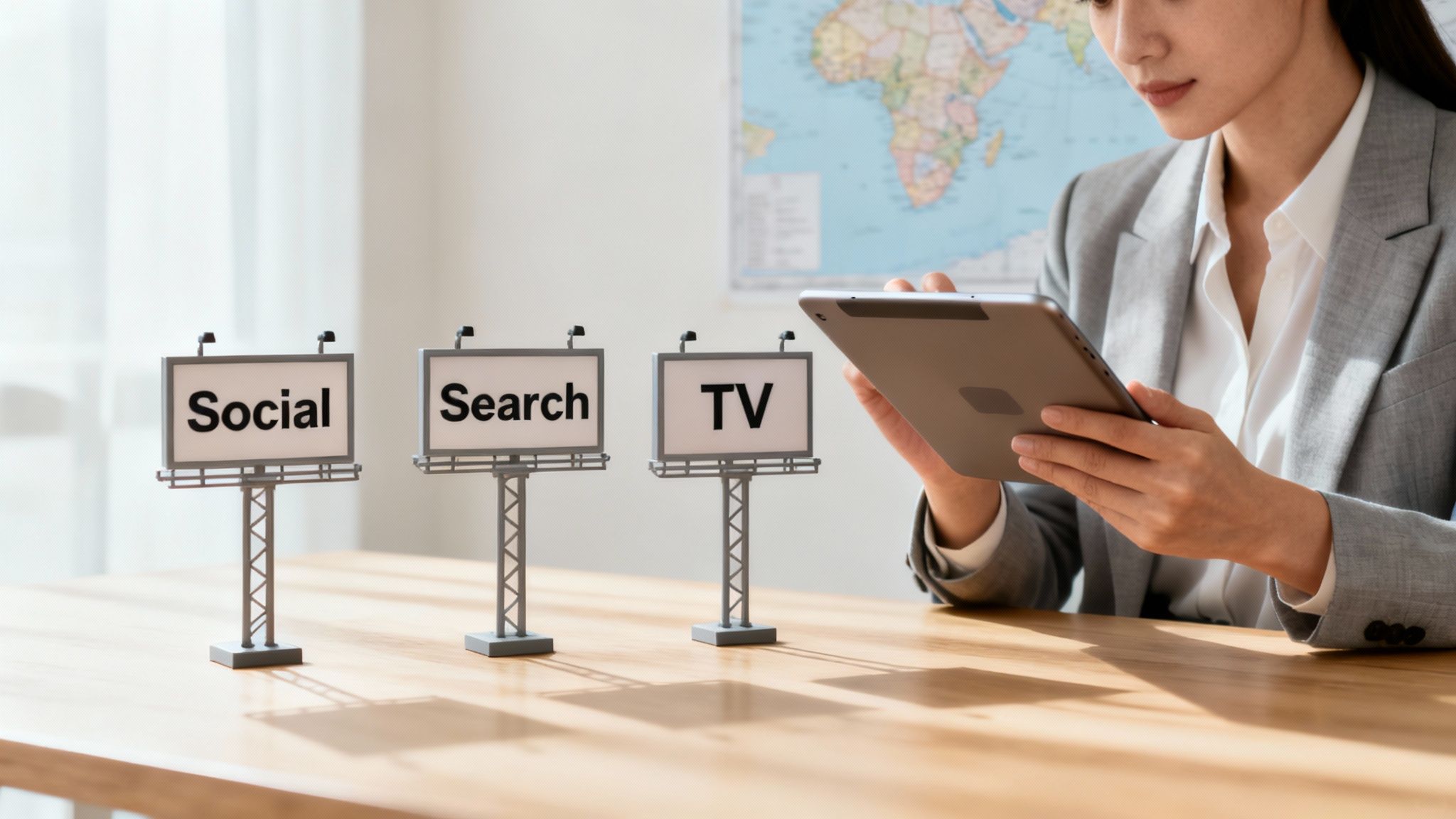
Let's say you want to put up a giant billboard to promote your business. Where do you stick it? On a quiet suburban street or slapped alongside a major city highway during peak hour? The choice feels obvious.
But what if that "highway" is actually an Instagram feed, a spot on a popular podcast, or a prime-time TV ad slot? This is the kind of puzzle media buyers solve every single day.
Media buying is really the execution part of a wider advertising strategy. It's the practical, hands-on work of locking in the ad space that will get your campaign in front of the right people, at the right time, and for the right price. It's the crucial step that turns a marketing plan into something real.
A media buyer’s job is much more than just shopping for ads. They’re juggling a whole range of critical tasks to make sure every dollar of an ad budget is pulling its weight.
Key activities usually include:
The advertising world in Australia has changed a lot, with new tech and shifting consumer habits completely reshaping the industry. The Media Buying Agencies sector in Australia is currently a $1.7 billion industry, although it has seen a slight dip as ad spending continues to move from traditional channels to digital ones. You can get a better sense of these industry trends on IBISWorld.
A great media buyer is part negotiator, part analyst, and part strategist, all rolled into one. Their goal isn't just to buy ad space; it's to buy the smartest ad space that delivers real, measurable growth for the business.
A successful media buying campaign isn't a one-off event; it's a strategic journey from start to finish. You can't just throw money at ads and hope for the best.
The whole process breaks down neatly into three distinct, yet totally connected, phases: pre-launch, launch, and post-launch. Each stage has its own job to do, making sure every dollar you spend is deliberate, closely watched, and ultimately, effective.
Think of it like building a house. The pre-launch is the blueprint phase—all the critical planning happens here. The launch is when construction kicks off and the plans come to life. Finally, the post-launch is like the final inspection and renovation, where you check the results and figure out how to build even better next time.
The pre-launch phase is where you lay the foundation for a brilliant campaign. It’s a classic rookie mistake to rush this part, and it almost always leads to wasted ad spend and disappointing results. This stage is all about research, strategy, and getting everything organised before a single ad goes live.
During this critical time, media buyers are focused on a few key things:
This prep work ensures that when your campaign launches, it isn’t just a shot in the dark. It’s a calculated move, aimed squarely at a well-defined audience with crystal-clear objectives.
With the blueprint finalised, it's time to launch. This is the active, hands-on stage where the media buying plan gets put into action. The main game here is getting the ads out there and monitoring their performance in real-time.
This phase is fast-paced and needs constant attention. A media buyer will oversee the ad rollout, making sure creatives are delivered correctly and appearing where they should. More importantly, they'll be watching the incoming data like a hawk. Are certain ads knocking it out of the park? Is one channel delivering a much cheaper cost-per-click?
Watching the early data allows for quick pivots. If an ad isn't landing with the audience, you can swap it out. If a particular channel is a dud, the budget can be shifted over to one that's performing well.
The campaign isn't over just because the ads have stopped running. In fact, the post-launch phase is arguably the most important for your long-term success. This is where you sift through all the data you collected to pull out valuable insights and lessons.
The big question you're trying to answer is: "What worked, what didn't, and why?" Media buyers compile detailed reports, comparing the real-world results against the KPIs you set way back in the pre-launch phase.
To get a clearer picture, let's break down the key activities that happen in each of these stages.
| Phase | Primary Objective | Key Activities |
|---|---|---|
| Pre-Launch | Plan and prepare for a successful campaign. | Audience research, channel selection, budget allocation, goal setting (KPIs), creative development. |
| Launch | Execute the campaign and monitor real-time performance. | Ad deployment, performance tracking, A/B testing, in-flight budget adjustments, initial data collection. |
| Post-Launch | Analyse results and gather insights for future campaigns. | Performance reporting, ROI analysis, audience insights, identifying top-performing channels and creatives. |
This analysis is pure gold for future campaign optimisation. Did you discover that a specific ad creative generated 52% more engagement? That's a massive clue for your next round of creative. By understanding the complete performance picture, businesses can refine their strategies, making every media buy smarter, more efficient, and more profitable than the last.
Today's media world is a sprawling, noisy place. It’s a mix of dozens of channels, each giving you a unique way to connect with the people you want to reach. Understanding what is media buying in this environment means going way beyond just picking platforms. It’s about being a matchmaker, strategically pairing the right channel with your specific business goals.
You've got a lot of options. Social media platforms like Facebook, Instagram, and TikTok are buzzing communities where you can tap into highly engaged audiences. Then there are the powerhouses like Google, where you can connect with people who have a problem and are actively searching for a solution right now. That's high-intent traffic, right there.
Display networks cast a wider net, splashing your visual ads across thousands of websites to build familiarity. And don't forget Connected TV (CTV), a fast-growing channel that brings the laser-focused targeting of digital advertising right into the living room. Each one has a different job to do, from building brand buzz to ringing the sales bell.
The secret to smart media buying isn't about being everywhere. It’s about being in the right places. Success comes from deeply understanding who your audience is and, just as importantly, where they hang out online.
For instance, if you're trying to reach Gen Z, you’d be wise to put your energy into short-form video on platforms like TikTok and Snapchat. But if you’re a B2B company? You'll likely get far more bang for your buck on professional networks like LinkedIn or through highly targeted search engine campaigns.
The whole process generally follows three clear stages, as you can see below.
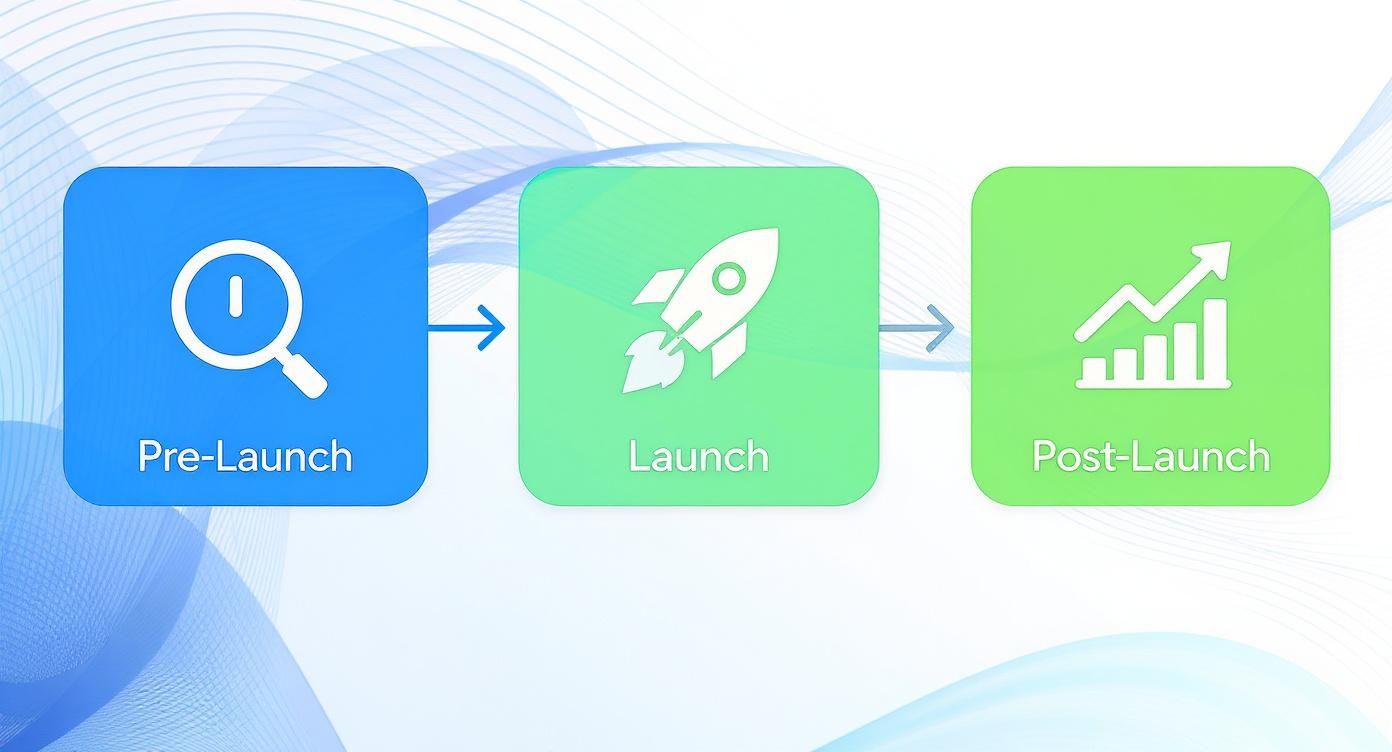
This flow shows how a campaign moves from planning and research to the live launch, and then into the crucial analysis and tweaking phase. It’s a structured approach that helps you make sense of all the channel options out there.
The shift to digital channels is impossible to ignore, especially here in Australia. The local media buying scene has been completely reshaped by social media and online video. In fact, social media advertising spend in Australia is expected to hit a massive AU$7.5 billion, which is 29% of the total digital ad spend. That tells you everything you need to know about how critical these platforms are for reaching Aussies.
This explosion in spending highlights just how important it is to get good at using the specific ad formats for each platform. As media buying gets more sophisticated, knowing the ins and outs of things like Facebook Video Ads isn't just a bonus—it's essential for running campaigns that actually work.
The goal isn't just to purchase ad space; it's to invest in the right ad space. A successful strategy aligns your message, audience, and channel to ensure every dollar spent contributes directly to your business objectives, turning your ad budget into a powerful growth engine.
When you're ready to buy digital ad space, you'll find there are two main ways to go about it: programmatic and direct. Getting your head around the difference is a big part of understanding what is media buying in today's world, as each path offers its own set of advantages for your campaigns.
Let's try an analogy. Think about buying shares on the stock market. You could jump onto a high-speed, automated trading platform that whips through thousands of transactions a second, all driven by data. That's pretty much programmatic buying in a nutshell – it's technology automating the purchase of ad inventory in the blink of an eye.
Now, imagine you want to secure a flagship retail store right in the middle of Martin Place. You wouldn't use an automated system for that, would you? You'd be on the phone, negotiating directly with the property owner to lock in that specific, high-value spot. This is direct media buying. It's a hands-on process, involving real conversations with publishers to secure guaranteed, premium ad placements.
Programmatic advertising leans on algorithms and lightning-fast bidding to place ads. This makes the whole process incredibly efficient and laser-focused on data. Instead of buying a big block of ad space on a single website, you're usually buying access to individual users as they move across a huge network of sites, based on their online behaviour and who they are. The focus here is squarely on the audience, not just the placement.
This automated method has become a real powerhouse in the Australian advertising scene. In fact, the Australia Programmatic Advertising Market is forecast to explode, growing from US$441.74 million to a massive US$2,963.14 million by 2033. It’s a clear signal that Aussie businesses are hungry for the efficiency and precision that automation delivers. You can get the full story by exploring the programmatic advertising market research from Renub Research.
If you want to get into the nuts and bolts of how this tech really works, our detailed guide on what is programmatic advertising is a great place to start.
While programmatic brings speed and scale to the table, direct buying offers something different: guaranteed placement and premium context. When you absolutely need your ad to be on the homepage of a major news site or right next to a specific, high-quality piece of content, a direct deal is the only way to make it happen.
This approach is all about building relationships with publishers and locking in that high-impact inventory that you just won't find on the open exchanges. It gives you total control over where your brand shows up, ensuring it's seen in trusted, top-tier environments.
Programmatic buying is like fishing with a high-tech net that catches specific types of fish across the entire ocean. Direct buying is like reserving a specific, prime fishing spot where you know the big fish always gather.
To help you figure out which method makes the most sense for what you're trying to achieve, let's put them side-by-side.
The choice between programmatic and direct isn't about which one is "better" but which one is the right tool for the job. This table breaks down the key differences to help you decide.
| Feature | Programmatic Buying | Direct Buying |
|---|---|---|
| Process | Automated, real-time bidding for ad space across many publishers. | Manual negotiation with specific publishers for guaranteed placements. |
| Targeting | Highly precise audience targeting based on data and behaviour. | Broader targeting based on the publisher's audience and content. |
| Control | Less control over exact ad placement, more control over audience. | Full control over ad placement and the content it appears next to. |
| Cost | Often more cost-effective for reaching niche audiences at scale. | Typically higher cost for premium, guaranteed inventory. |
| Best For | Performance-based campaigns, retargeting, and large-scale audience reach. | Brand awareness campaigns, high-impact launches, and premium brand association. |
Ultimately, many of the most effective strategies use a blend of both. You might use programmatic to drive performance and reach specific customer segments, while using direct buys to build brand credibility and make a big splash during key moments.
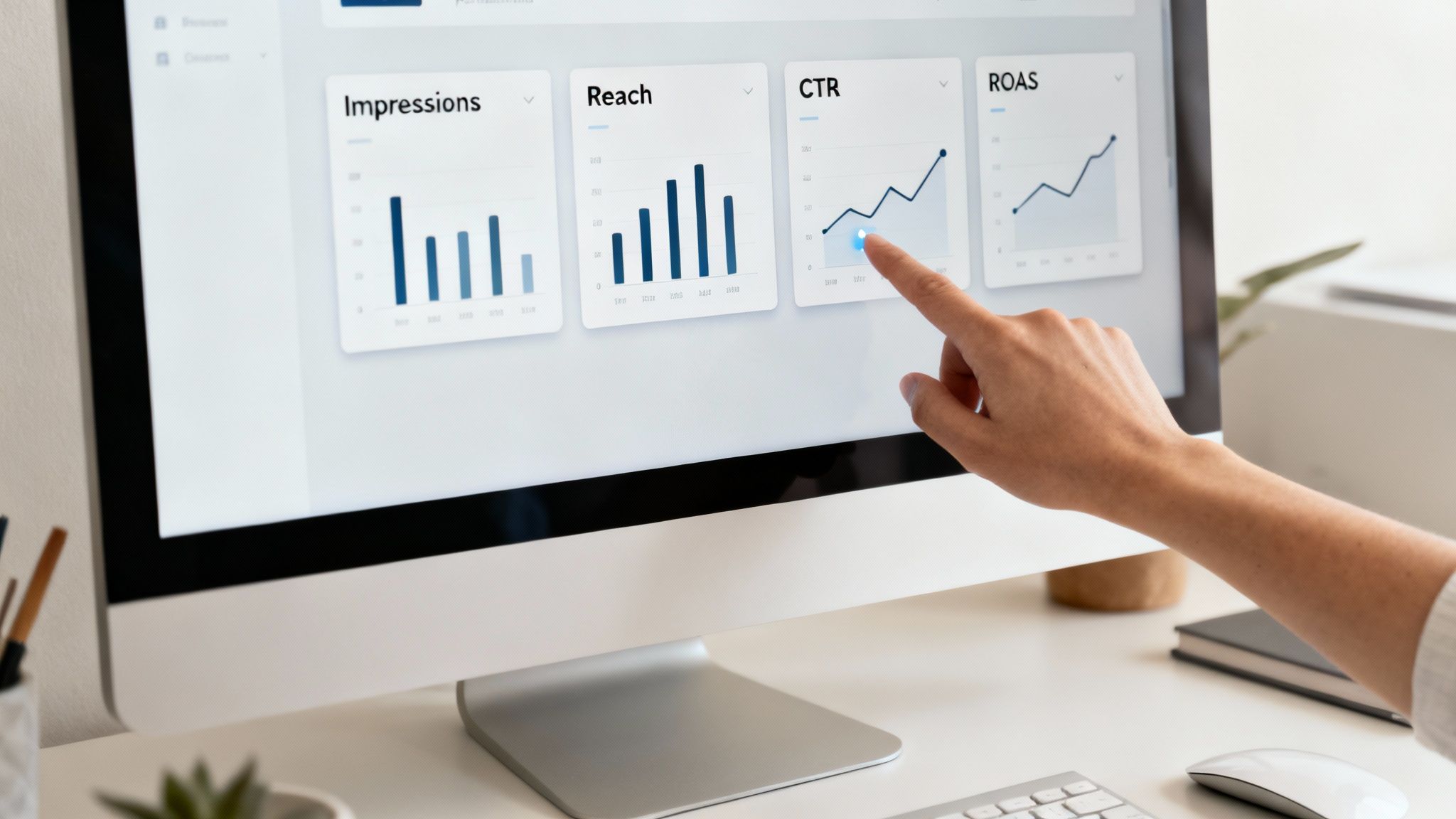
Pouring money into ad spend without tracking the results is like driving with your eyes closed. To figure out if your investment is actually working, you need to measure your success with the right metrics, connecting raw data to real business goals.
It's easy to get lost in a sea of acronyms. The trick is to focus on the key performance indicators (KPIs) that actually line up with what you're trying to achieve. Not every metric matters for every campaign; you need to choose the ones that tell the story of your success.
When your goal is simply to get your brand name out there, you're not necessarily focused on immediate sales. The aim is to maximise visibility and become a familiar face to your target audience.
For these campaigns, you should prioritise:
If you want to capture your audience's interest and get them to interact, your focus shifts from passive views to active participation. You want to know if people are actually paying attention.
The most important metric here is Click-Through Rate (CTR). This percentage shows how many people who saw your ad were interested enough to actually click on it. A high CTR is a huge signal that your creative and messaging are hitting the mark. A critical part of this involves carefully measuring creative test performance in Facebook Ads reporting to see which visuals and copy drive the most clicks.
Success isn't just about spending your budget; it's about proving that every dollar spent generated a tangible, valuable outcome for your business.
For campaigns laser-focused on driving direct business outcomes like sales or leads, the metrics become much more about the money. This is where you connect your ad spend directly to revenue.
Here, the essential KPIs are:
Tracking these goal-oriented KPIs turns your data from a confusing spreadsheet into a powerful decision-making tool. To dive deeper, you should explore these essential digital marketing performance metrics to get a complete picture of your campaign's health.
Even once you get your head around the basics of media buying, a few practical questions always seem to pop up. Let's tackle some of the most common queries we hear from Australian businesses, so you can feel confident about your next steps.
There's no magic number, unfortunately. The right budget really depends on your industry, what you're trying to achieve, and where you're placing your ads.
As a starting point, a small Australian business could look at earmarking 10-20% of its total marketing spend for media buying. More importantly, though, start small. Pick one or two channels and run a test campaign. Keep a close eye on your Cost Per Acquisition (CPA) – how much it actually costs you to get a new customer. Once you know that number, you can scale up your budget with real data, not guesswork.
Think of it as the difference between strategy and execution. One comes before the other, but they're completely intertwined.
Media planning is the 'before' phase. It's the blueprint. This is where you dig into audience research, figure out the best channels to reach them, set clear goals for your campaign, and decide how to slice up the budget.
Media buying is the 'during' phase. This is the hands-on work of bringing that plan to life. It involves negotiating with ad platforms, purchasing the ad space, hitting 'go' on the campaign, and then obsessively monitoring and tweaking it for the best results.
The planner draws the map and sets the destination; the buyer is the one behind the wheel, navigating the traffic to get there as efficiently as possible.
You can absolutely do it yourself. Platforms like Google Ads or Facebook Ads are designed to be user-friendly enough for business owners to jump in. Going DIY gives you total control and can be a great way to start if your budget is tight.
But here’s the catch: doing it well takes a serious amount of time and a knack for numbers. That's where an agency comes in. It makes sense to hire one when you’re ready to grow, want to tackle more complex platforms, or simply don’t have the hours in the day. An agency brings specialised tools, industry connections, and experience from countless other campaigns, which usually means they can make your ad dollars work much harder.
Ready to turn your advertising strategy into measurable results? The team at Virtual Ad Agency has the expertise to manage your entire media buying process, from planning to optimisation. Contact us today to see how we can maximise your ad spend.

 previous