
When it comes to growing an Aussie small business, SEO is a seriously powerful combo. Nailing your SEO is like setting up shop on the busiest digital high street in the country. It puts you right in front of customers who are actively looking for what you sell. This isn't just about having a website; it's about turning that website from a static online brochure into a machine that brings in leads.
Look, just having a website isn’t enough anymore. Imagine you’ve printed thousands of beautiful, glossy flyers for your business, but then you just leave them piled up in a locked storeroom. That's a website without SEO. Search Engine Optimisation (SEO) is really just the process of making your website more appealing to search engines like Google. Get it right, and you build a bridge connecting your business to potential customers at the exact moment they need you.
This isn't just another line item on your marketing budget; it's a long-term investment in a valuable business asset. Think about it: paid ads work wonders, but they stop the second you stop paying. A solid SEO foundation, on the other hand, builds sustainable, organic traffic that can keep delivering qualified leads for years to come. Aussie businesses are catching on, with the average monthly SEO spend now sitting at $1,350. The whole market is tipped to hit $1.5 billion by 2025. It’s clear your competitors are already investing, and it's time to get in the game.
To build a strong digital presence, you need to get your head around the core parts that work together to make the magic happen. SEO isn't a one-and-done task; it's a mix of ongoing efforts across a few key areas. For a great deep dive, check out this guide on a Practical Small Business SEO Strategy.
The infographic below breaks down the four essential pillars that every successful SEO framework is built on.
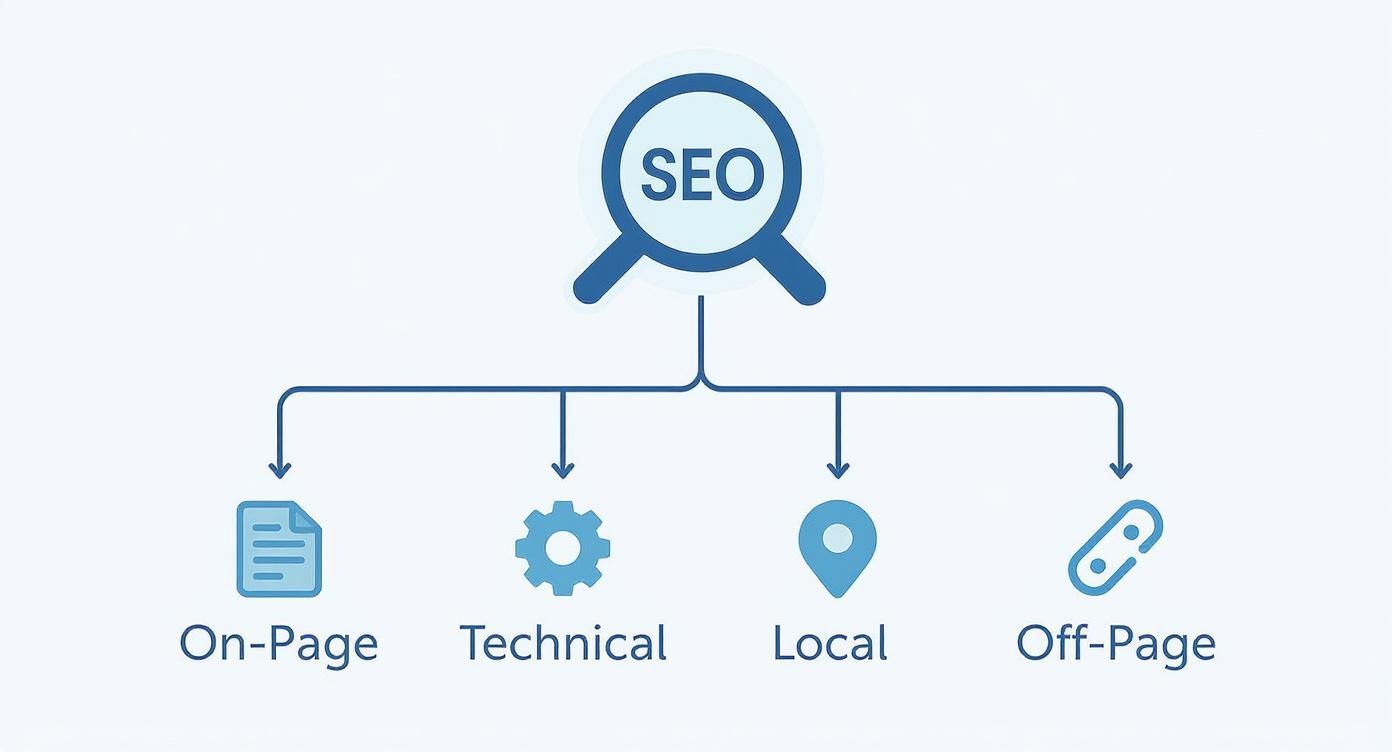
As you can see, on-page, technical, local, and off-page SEO all have to work in harmony. If you neglect one pillar, the whole structure gets wobbly. A balanced approach is absolutely crucial for getting the results you want.
SEO gives you the power to be the answer to your customers' questions. By appearing at the top of search results, you establish authority, build trust, and become the go-to solution in your industry.
In this guide, we'll walk you through each of these pillars with practical, actionable advice that’s specifically for Australian small businesses. You'll learn not just the "what" but the "how," giving you the tools to turn online searches into actual sales. Of course, a crucial first step is figuring out where you stand against the competition. Our guide on how to conduct competitor analysis is the perfect place to start. Let's get to it.

Think of your website as your digital storefront. On-page SEO is everything you do to organise that store so customers—and just as importantly, search engines—can easily find what they’re looking for. It’s about making your shop clean, logical, and inviting. This is your first and best chance to tell Google exactly what your pages are about, and it forms the bedrock of any solid SEO and small business plan.
Get this part right, and everything else you do will be that much more effective. It's the practical first step to getting your digital house in order and making sure your message is crystal clear.
Before you can start organising, you need to speak your customers' language. This is where keyword research comes in. It’s not a guessing game; it’s about digging in to find the exact words and phrases people are typing into Google when they need what you offer.
For an Aussie small business, that means getting local. A broad term like "plumber" is just too big a pond to fish in. You need to zero in on what your specific audience is looking for. Think things like:
Tools like Google Trends are a great free starting point, while paid options can give you even deeper insights. This research hands you a blueprint for the content your website needs, ensuring you’re creating pages that perfectly match what potential customers are trying to find.
Once you have your keywords, it’s time to put them to work in your digital "shop window"—your title tags and meta descriptions. These are the first things a potential customer sees on the Google search results page.
Title Tags: This is the clickable blue headline in the search result. It needs to be short, sharp, and include your main keyword. A good example would be: "Expert Perth Plumbers | Fast 24/7 Emergency Service." It tells the user and Google precisely what the page is about.
Meta Descriptions: This is the short blurb of text underneath the title. While it doesn't directly influence your ranking, it’s your sales pitch. A good one makes people want to click. For instance: "Need a reliable Perth plumber? We offer fast, affordable service for blocked drains, hot water systems, and more. Call us for a free quote!"
Think of your title tag as the sign above your shop door and the meta description as the enticing window display. Both need to be compelling enough to make someone want to step inside.
A well-written title and description can seriously boost the number of people who click on your link, even if you’re not in that coveted number one spot.
At its heart, great on-page SEO is about creating high-quality, relevant content that genuinely helps people. Every blog post, service page, and product description should aim to be the absolute best answer to a customer's question. And when you consider that 77% of internet users regularly read blogs, you have a massive opportunity to connect.
Instead of just listing what you do, think about the problems you solve. A landscaper in Sydney could write a guide titled, "5 Drought-Resistant Plants Perfect for Sydney Gardens." This kind of content does more than just sell; it shows you know your stuff and builds trust.
Here’s a simple way to approach it:
This approach transforms your website from a simple brochure into a go-to resource. When you consistently provide useful information, you send a powerful signal to Google that your site is an authority in its field—and that’s a ranking factor that drives real, sustainable growth.
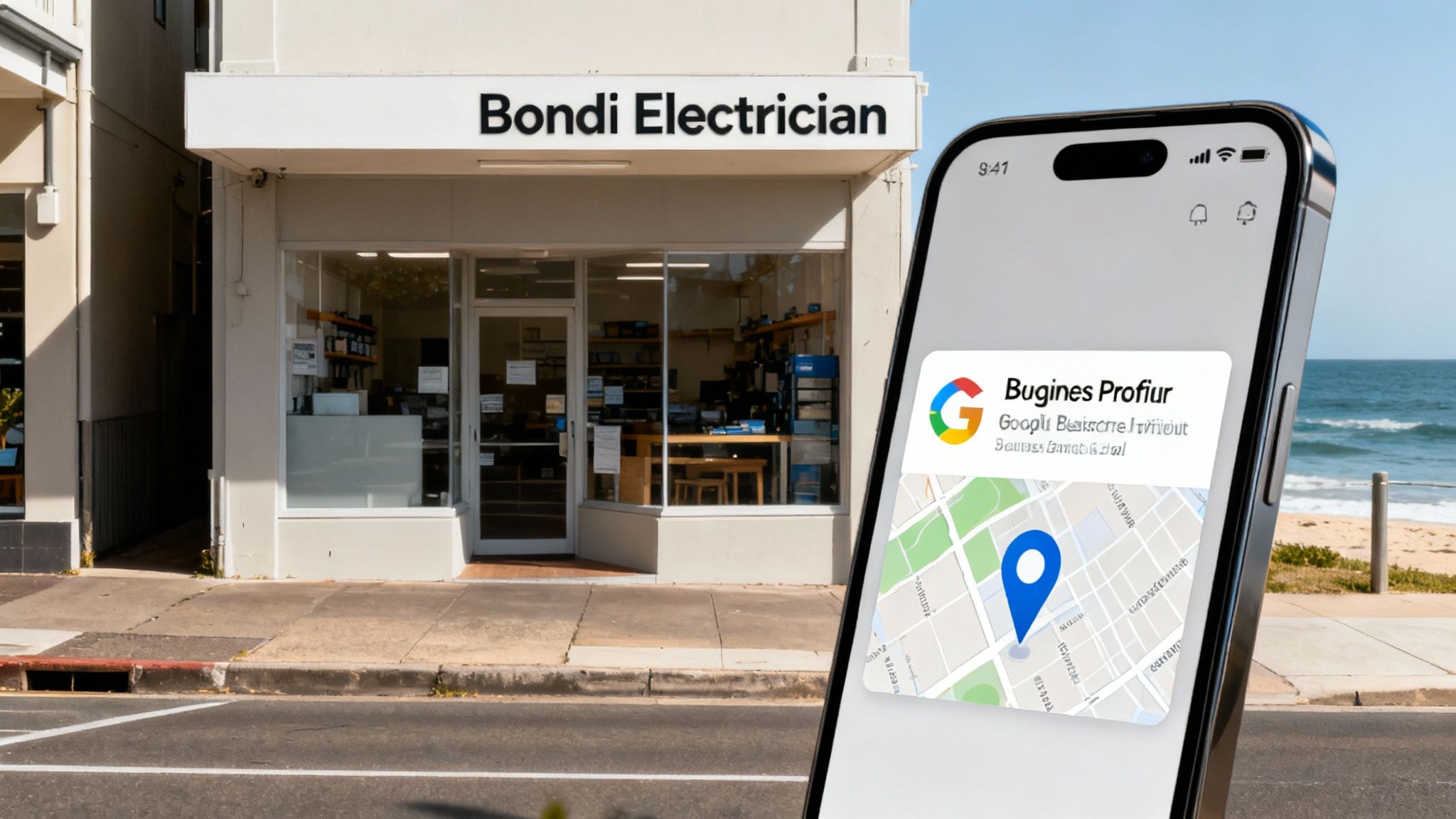
For an Aussie small business with a physical address or a set service area, winning the local battle isn't just a part of the game—it's everything. Local SEO is your secret weapon for showing up right when local customers need you most.
Think about it. When someone in your suburb searches for "cafe near me" or "electrician in Bondi," you want to be the first name they see. This isn't about taking on the national giants; it's about being the obvious, go-to choice for the people just around the corner. It all comes down to proving to Google that you're a trusted and relevant local operator.
Your most powerful tool in the local SEO arsenal is your Google Business Profile (GBP). Seriously. Think of it as your modern-day shop window, the first impression a customer gets before they even think about visiting your website or walking through your door. Best of all, it's completely free.
Leaving your profile half-finished is a massive missed opportunity. A well-managed GBP gives potential customers all the crucial info they need at a glance, right there on the search results page.
To turn your profile into a customer magnet, you absolutely must:
Beyond your GBP, Google is like a detective, looking for clues across the web that confirm your business details are legit. This is where your NAP (Name, Address, Phone number) information comes in.
If your NAP details are different across online directories like TrueLocal or other industry sites, it confuses search engines and can really hurt your local rankings. It's like having multiple, slightly different addresses listed for your house; the postie isn't going to know where to deliver the mail. Make sure your business info is identical everywhere.
Customer reviews are the digital version of word-of-mouth. They are a massive trust signal, not just for potential customers, but for Google's algorithm as well.
Actively encourage your happy customers to leave you a review. Even more importantly, respond to all of them—the good and the bad. A thoughtful, professional response to a negative review can sometimes build more trust than a dozen glowing ones. For small businesses, learning effective local SEO strategies for small businesses is the key to capturing nearby customers and building a rock-solid local reputation.
Ready to take your local strategy a step further? Create dedicated pages on your website for each specific location or service area you cover. If you're a plumber who works across multiple suburbs, a generic "Plumbing Services" page just won't cut it.
You need to get specific. Create targeted pages like "Plumber in Parramatta" or "Blocked Drains in Adelaide." This allows you to speak directly to customers in that area, using local landmarks and language they recognise. This hyper-local approach makes your content incredibly relevant, which is exactly what search engines love.
If you're based in South Australia, for example, working with someone who knows the local market inside and out can be a game-changer. You can get tailored advice from an expert SEO consultant in Adelaide to really nail your local strategy. This targeted method signals to Google that you are the authority for that service in that neighbourhood.
To help you get started, here’s a straightforward checklist covering the essentials for boosting your local search presence.
This table breaks down the key actions you need to take to get your local SEO in shape. Follow these steps to ensure you're visible to the customers right in your backyard.
| Action Item | Why It Matters | Quick Tip |
|---|---|---|
| Claim & Optimise Google Business Profile | This is your digital front door. It's often the first interaction a customer has with your business online. | Fill out every section completely. Use high-quality photos and encourage customer reviews and Q&As. |
| Ensure Consistent NAP | Inconsistent Name, Address, and Phone number details across the web confuse Google and hurt your rankings. | Use a tool to audit your online citations or manually check major directories like TrueLocal and Yelp. |
| Generate Local Customer Reviews | Reviews are a massive trust signal for both customers and search engines. More positive reviews = higher rankings. | Ask happy customers for a review via email or a simple link. Always respond to both good and bad feedback. |
| Create Location-Specific Pages | Dedicated pages for each service area or location make you highly relevant for "near me" searches. | Include local keywords, landmarks, and testimonials from local clients on each page. |
| Build Local Links | Links from other local businesses, community groups, or local news sites signal local authority to Google. | Sponsor a local sports team or charity event in exchange for a link back to your website. |
| Optimise for Mobile | Over half of all local searches happen on a mobile device. A poor mobile experience will cost you customers. | Use Google's Mobile-Friendly Test to check your site and ensure it's easy to navigate on a small screen. |
Working through this checklist is a fantastic starting point. Local SEO isn't a "set and forget" task; it's an ongoing effort that pays huge dividends by connecting you directly with the people most likely to become loyal customers.
Think of your website like your shopfront in the real world. A strong reputation isn't built on flashy signs, but on referrals and good old-fashioned word-of-mouth. When another respected local business sends a customer your way, that recommendation carries a lot of weight.
Link building is the digital version of that powerful referral.
When another website links to yours, it’s basically pointing a finger and telling Google, “Hey, these guys know their stuff. They're legit.” This is called a backlink, and it’s a massive vote of confidence in Google’s eyes. Not all votes are created equal, though. A link from a major industry blog or a local council website is far more valuable than one from a brand-new, irrelevant site.
The game isn't just about getting links; it’s about earning them from sources that already have a solid reputation.
Back in the day, some people tried to game the system by collecting hundreds of dodgy links from spammy websites. Google is much, much smarter now. These days, a single, high-quality backlink from a trusted site can do more for your ranking than a hundred weak ones.
Chasing a high link count is a short-sighted strategy that can even get your website penalised. A smart SEO and small business approach is all about building genuine relationships and creating content that people actually want to link to.
Think of it this way: a glowing recommendation from the well-respected head of the local chamber of commerce is worth far more than a hundred flyers left on car windscreens. Focus on earning those high-impact referrals.
This shift makes link building a totally achievable and ethical strategy for any small business. It's not about being a tech wizard; it's about being a valued member of your community and proving your expertise.
You can forget complicated, technical tactics. For small businesses, the best link-building strategies are usually grounded in real-world community involvement. They're about creating value and building relationships, both online and off.
Here are a few down-to-earth ideas that work wonders:
Recent Australian data shows just how crucial this is. Backlinks have become the most critical ranking factor in local SEO, with an 81.6% correlation to organic traffic. Incredibly, the top-performing local businesses have, on average, a staggering 35 times more referring domains than those at the bottom. You can dive deeper into these findings and explore more Australian local SEO statistics to see the clear advantage a strong backlink profile provides.
The proof is in the pudding: earning those digital referrals is directly tied to getting more customers through your door. When you start seeing link building as a community-building activity, you not only boost your SEO but also cement your reputation as a trusted local leader.

If on-page SEO is the digital foundation of your house and links are the word-of-mouth referrals bringing people to your door, then content is the very engine that powers the whole operation. For many small business owners, though, creating content feels like a chore—something you know you should do, but it keeps getting pushed to the bottom of the list.
The trick is to stop thinking about it as just ‘blogging’. Instead, think of it as creating genuine assets for your business. Assets that solve real problems for your customers. Done right, great content attracts the right crowd, builds trust by showing you know your stuff, and gently guides people towards becoming a customer. It's what turns a static online brochure into a dynamic, lead-generating machine.
The goal here isn't to just write about anything and everything. A smart content strategy for any SEO and small business plan zeroes in on high-impact pieces that speak directly to your customer's biggest headaches, burning questions, and unmet needs.
Let's imagine a local landscaper in Adelaide. They could write a generic post like "Our Landscaping Services," which is fine, but it’s not going to set the world on fire. Or, they could create something like "A Complete Guide to Drought-Resistant Gardens in South Australia." See the difference? That second piece instantly pulls in a highly specific, motivated local audience and positions the business as the go-to expert.
Think about creating these kinds of powerful content types:
Consistency is the secret sauce here. A blog post every now and then won't build any real momentum or signal to Google that your site is a reliable hub of fresh, helpful information. This is where a simple content calendar becomes your absolute best friend.
Don't overthink it—a content calendar can be a basic spreadsheet that maps out what you'll publish and when. Planning just one or two solid posts a month keeps you on track, makes sure your topics are hitting your business goals, and kills that last-minute panic of trying to figure out what to write.
Content marketing is a commitment, not a campaign. By consistently providing value, you build an audience that trusts you, remembers you, and ultimately, buys from you.
This steady rhythm keeps your website active, gives you new material to share on social media, and creates more and more opportunities for your business to show up in search results. For a deeper dive, exploring established content marketing best practices will give you a solid framework to build on.
You've put in the hard yards to create a brilliant piece of content—so don't just post it and forget it! The final, crucial step is to promote and repurpose it to squeeze every last drop of value out of it. One great blog post can fuel your marketing for weeks.
Think of your main article as a big pizza. You can serve it up slice by slice across all your different platforms to get the most mileage.
Here are a few simple ways to repurpose your content:
By repurposing your best work, you multiply its impact without having to constantly invent new material from scratch. It’s a smart approach that ensures your valuable insights reach the widest possible audience, continuously attracting and converting new customers.
All your hard work on content, links, and local listings doesn't mean a thing if you can’t tell what’s actually moving the needle. How do you know if your efforts are bringing in real business? This is where measurement comes in, taking you beyond guesswork and empowering you to make smart, data-driven decisions.
The good news is you don’t need to splash out on complicated, expensive software. Two of the most powerful tools out there are completely free and come straight from Google: Google Analytics and Google Search Console. Just think of them as the dashboard for your business's online presence, showing you exactly how people are finding you and what they do when they get to your site.
It’s incredibly easy to get distracted by "vanity metrics"—numbers that look impressive on paper but do absolutely nothing for your bottom line. Chasing a huge number of website visitors is pointless if none of them ever become a customer. A savvy SEO and small business strategy zeroes in on the results that actually grow your business.
Instead of just glancing at your overall traffic, start tracking the actions that lead directly to sales. These are the key performance indicators (KPIs) that show a real return on your investment.
When you focus on these practical metrics, you get a crystal-clear picture of how your SEO work is turning into genuine leads and revenue.
SEO isn't a "set and forget" job; it's an ongoing process that needs regular attention. The online world is always shifting, and what worked a treat last month might need a bit of a tweak. Setting up a simple monthly review will keep you on the right path and help you adapt your strategy as you go.
SEO success is a marathon, not a sprint. Consistent, small adjustments based on real data will always outperform massive, infrequent changes made on a whim.
Set aside a little time at the end of each month for a quick check-in. During this review, ask yourself three straightforward questions:
This simple process helps you make informed decisions, ensuring your time and money invested in SEO continue to deliver measurable, valuable results for your business.
Dipping your toe into the world of SEO can feel like stepping into a whole new language. It’s no surprise that small business owners often have the same questions and uncertainties bubbling up. Let's clear the air and tackle some of the most common ones.
The big one we always hear is: how long until I actually see results? SEO isn't a flick-of-the-switch solution; it's about building momentum over time. Think of it like getting a business in shape. You’ll generally start to see some initial movement and positive signs within three to six months, with the really solid results building up as your site earns more trust and authority.
Cost is always a hot topic, and rightly so. An SEO budget for a small business here in Australia can vary quite a bit, but the best way to look at it is as an investment, not just another line item on your expenses. What you'll invest depends on things like how competitive your industry is, what you're trying to achieve, and the specific work needed to get you there.
A basic monthly retainer might cover off the essentials, but a really comprehensive strategy that includes creating great content and building quality links will naturally call for a bigger investment. The trick is to find a plan that lines up with your growth goals and gives you a clear, measurable return.
SEO is a marathon, not a sprint. Consistency is far more valuable than short bursts of intense activity. Committing to a steady, ongoing strategy is what builds lasting momentum and achieves sustainable growth.
Finally, we get asked if it’s possible to just do SEO yourself. Look, while DIY SEO is certainly possible for some of the basics, it demands a huge time commitment to learn the ropes and then actually do the work effectively. Partnering with professionals almost always speeds up your results and, more importantly, frees you up to focus on what you do best—running your business. A good agency can craft a strategy that gets the most out of your budget and delivers real, tangible outcomes for your SEO and small business efforts.
Ready to turn your website into a lead-generating asset? The team at Virtual Ad Agency specialises in creating data-driven SEO strategies that deliver real growth for Australian businesses. Let's connect today.

 previous