
Running a business without keeping an eye on your competitors is like driving with your eyes closed. You might be moving forward, but you have no idea what’s coming up ahead. Competitor analysis is about taking off the blindfold. It’s a proactive process that shifts your focus from just reacting to whatever the market throws at you to actually anticipating trends and making sharp, strategic decisions.

In a crowded market, just keeping up isn’t a winning formula. You need to be thinking about the next move, and that all starts with a deep understanding of your competitive landscape. This process changes competitor analysis from a boring chore into a powerful, proactive tool for growth. It’s not just about knowing what your competitors are up to, but truly understanding why their strategies work—or don’t.
This is the kind of insight that lets you make data-driven decisions that build a genuine competitive advantage. When you systematically evaluate your rivals, you can:
It’s clear that Australian businesses are really starting to recognise the value of structured competitor evaluation. In fact, here in Australia, the competitor analysis market is projected to make up a significant 8.03% share of the Asia Pacific industry by 2025.
This is all part of a much bigger trend. The total Asia Pacific market is expected to balloon from USD 962.59 million in 2021 to USD 1.52 billion in 2025—that's a 63.34% increase in just four years. This rapid growth really hammers home how vital competitor analytics have become for anyone serious about gaining market share and optimising their strategy.
By looking at competitor strengths and weaknesses, you will identify your own strengths and weaknesses in comparison, and thus see opportunities to improve.
To really get the most out of these advantages, a comprehensive step-by-step guide on competitive analysis can give you a solid foundation to build on. Think of it as a clear roadmap, laying out the practical frameworks and intelligence-gathering techniques you’ll need to get ahead.
Jumping into data collection without a solid plan is a recipe for disaster. It's an easy way to end up with mountains of information but zero real insight. That's why the first, most crucial step is to build your competitor intelligence framework. Think of it as your map—it ensures every bit of data you gather has a purpose and lines up with what you're trying to achieve as a business.
This all starts by figuring out what a "win" looks like for your analysis. Are you trying to spot gaps in a competitor's SEO strategy to climb the search rankings? Maybe you want to get your pricing just right by understanding what everyone else is doing. Or perhaps the goal is to uncover a golden opportunity for product innovation.
Setting these objectives upfront stops you from getting bogged down in details that just don't matter.
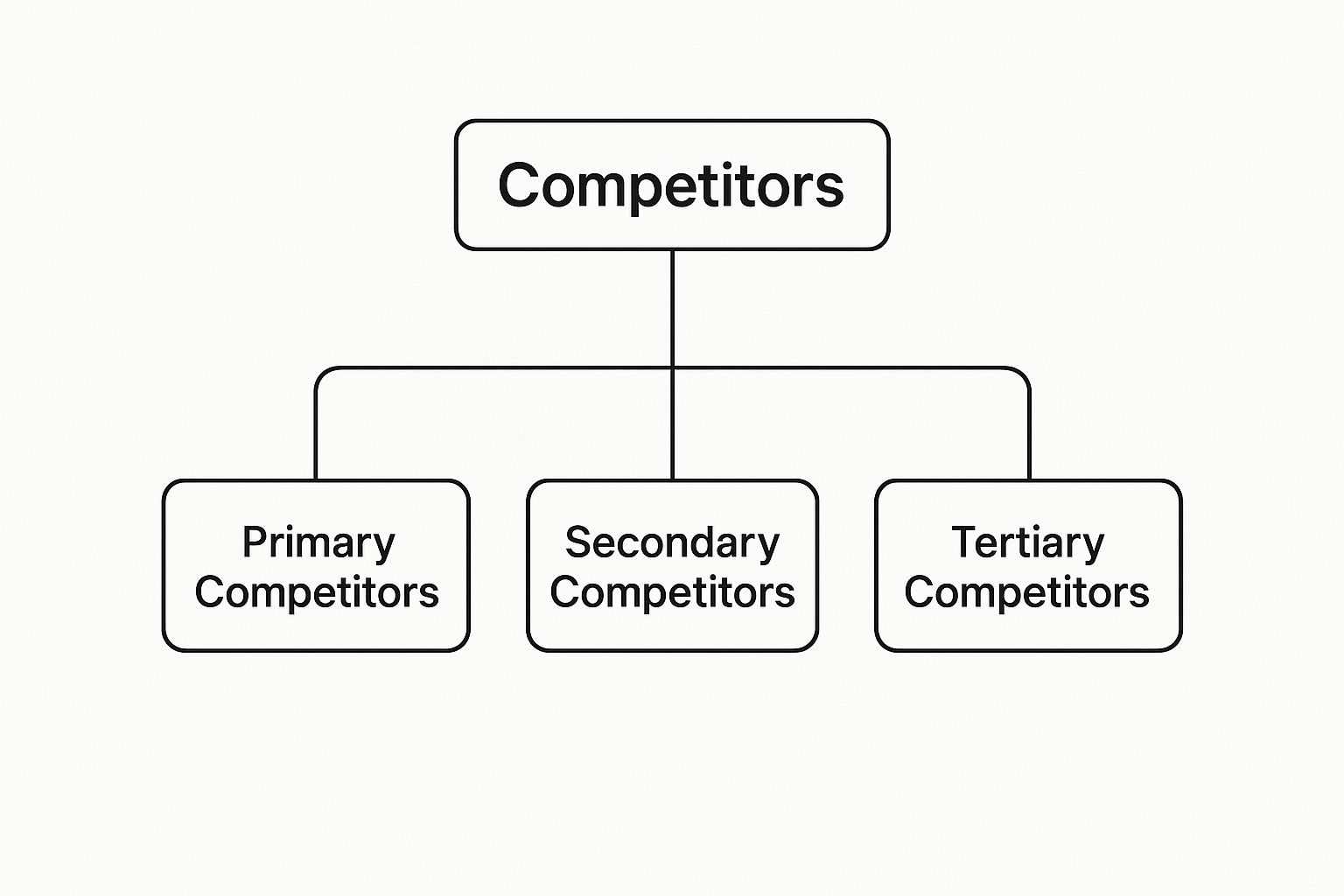
With your goals locked in, it’s time to figure out who you’re actually up against. The reality is, not all competitors are created equal, and lumping them all together will dilute your focus. You need to categorise them to make sure you're spending your energy in the right places.
A simple but effective way to do this is to think of your competitors in layers, from the ones you're in a daily tussle with to those on the outer edges of your market.
I find it helpful to break them down into three distinct tiers. This isn't just an academic exercise; it directly impacts where you spend your time and resources.
Here’s a quick table to help you visualise how this works.
| Competitor Type | Description | Example (for a Sydney-based artisanal bakery) |
|---|---|---|
| Primary | These are your direct rivals. They target the same audience with a very similar product or service. You're fighting for the same dollar. | The other specialty bakery just down the road in Surry Hills. |
| Secondary | These businesses solve the same core problem for a similar audience but with a different solution or at a different price point. | A major chain like Baker's Delight in the local shopping centre. They sell bread, but the experience and customer are different. |
| Tertiary | Often overlooked, these are businesses in a related space that don't directly compete right now. They could become future competitors or even potential partners. | A local cafe that doesn't bake its own pastries but attracts the same morning coffee crowd. |
Categorising your competitors this way helps you allocate your analysis budget and time wisely. You’ll naturally spend most of your energy on your primary competitors, but you'll still keep a close watch on the others.
Now that you've set your objectives and categorised your competitors, the final piece of the framework is defining the key questions you need to answer. These should flow directly from the goals you set earlier.
For instance, if your objective is to sharpen your content marketing, a key question would be: "What content formats and topics are driving the most engagement for our primary competitors?"
This kind of specific query is what guides your data collection, making the whole process more efficient and, most importantly, actionable. This focused approach is the foundation of any successful effort to conduct competitor analysis.

With your framework sorted, it’s time to roll up your sleeves and start the real investigation. Gathering intelligence isn't just about aimless scrolling through a competitor's feed. Think of it as a focused mission to collect specific data points that give you a genuine strategic edge.
This part of the process is all about dissecting your competitor's entire digital footprint, from how their website performs in search results right through to their paid ad campaigns. We want to move beyond surface-level observations and really understand the mechanics behind their success—or their failures. This means looking at everything from their product features and pricing tiers to the subtle nuances of their brand voice.
The first and most obvious place to look is their digital home base: their website and its SEO performance. This is where you can uncover the keywords they're chasing, the content that pulls in their traffic, and where their online authority really comes from.
Powerful tools like SEMrush or Ahrefs are non-negotiable here. They let you peek behind the curtain and analyse the metrics that actually matter. A great example is running a keyword gap analysis, which quickly shows you valuable terms your competitors are ranking for that you're currently missing out on.
The SEMrush screenshot above shows exactly how you can identify the top organic keywords driving traffic to a competitor's domain, along with their search volume and ranking position. It’s a goldmine.
Analysing this data reveals more than just a list of keywords. It tells you about the user's intent behind those searches, giving you a crystal-clear picture of their content strategy's focus. It's essentially a direct roadmap for the content you should create to start competing for that same audience.
To really get into the weeds, using dedicated social media competitor analysis tools can save you hours of manual research. These platforms track engagement rates, posting frequency, and the types of content that resonate most with their audience, giving you granular insights into their social strategies.
While SEO data tells you how they attract customers, understanding their products and the customer experience tells you how they keep them. This is often where you'll find your biggest opportunities.
Start by mapping out their core offerings. You'll want to dig into a few key areas:
Customer reviews are a goldmine of unfiltered intelligence. Scour sites like Google Reviews, Trustpilot, or industry-specific forums to find recurring themes. Consistent complaints about poor customer service or a clunky feature are direct invitations for you to highlight your strengths in those exact areas.
This sort of analysis helps you piece together the entire customer experience, from their first click to post-purchase support. You might find our customer journey mapping template handy for structuring these insights and visualising their entire process.
The methods we're talking about are becoming more sophisticated by the day, largely thanks to the power of data analytics. The Australian data analytics industry is a great example of this trend. In 2024, this market hit an estimated value of AUD 2 billion, and it's forecast to grow at a 25.30% compound annual rate through to 2034.
This rapid expansion shows just how seriously Australian companies are taking data-driven competitor evaluation and strategic decision-making.
This trend highlights the importance of not just gathering data, but having the right tools and skills to make sense of it. By combining quantitative data from analytics platforms with qualitative insights from customer reviews and social listening, you build a comprehensive and, most importantly, actionable picture of your competitive landscape. This blended approach is central to how you should conduct competitor analysis today.
Gathering a mountain of competitor data is one thing. Actually turning it into a game-changing strategy is something else entirely. Raw information is just noise until you start connecting the dots and spotting the patterns hiding just beneath the surface. This is where you graduate from simple observation to generating genuine, actionable insights that can shape your entire business.
The real trick is to apply a structured framework to make sense of everything you’ve collected. Without some kind of system, you’ll find yourself drowning in spreadsheets and completely missing the golden nuggets of opportunity hidden inside. This is exactly why a framework like SWOT analysis is so valuable when you’re sizing up the competition.
A SWOT analysis—Strengths, Weaknesses, Opportunities, and Threats—is a straightforward yet incredibly powerful tool for organising your findings. But instead of applying it to your own business, you're going to turn the lens on your competitors to categorise all that intelligence you've gathered.
This process helps translate a bunch of isolated data points into a meaningful strategic context. For instance, a competitor’s high search ranking for a critical keyword is a clear Strength. On the other hand, a steady stream of negative online reviews about their slow delivery times is an obvious Weakness for them and a potential Opportunity for you.
To get started, you can build a simple table to organise your thoughts. It’s a great way to map out where your competitors are winning, where they’re vulnerable, and how you can act on that information.
Use this template to help you organise your findings and identify strategic actions based on a competitor's positioning.
| Category | Guiding Questions | Example Finding |
|---|---|---|
| Strengths | What do they do exceptionally well? What assets give them an edge? | They have a highly engaged user community on social media that provides excellent peer support. |
| Weaknesses | Where are they falling short? What do their customers complain about most? | Their user interface is considered clunky and outdated by many reviewers, leading to a steep learning curve. |
| Opportunities | What market gaps are they not addressing? Where can you outperform them? | They lack integration with a popular new project management tool that our target audience uses daily. |
| Threats | What external factors could hurt their position? What are they vulnerable to? | A recent change in data privacy laws could impact how they collect user analytics, a core part of their model. |
By methodically filling this out for each key competitor, you start to create a strategic map. It pinpoints exactly where you should focus your efforts. This isn’t just about listing facts; it's about identifying your points of leverage.
The real magic happens when you start pulling together information from different sources. You can’t just look at data in silos. For example, you might notice a competitor's social media engagement has shot up recently. At the same time, your content analysis shows they've just started pushing out short-form video tutorials.
By connecting those two data points, you've uncovered a powerful insight: video tutorials are really hitting the mark with your shared target audience. That's a clear signal to start experimenting with a similar content format in your own strategy.
The goal is to find the story behind the data. A trend in negative reviews about a rival's customer service isn't just a weakness for them; it's an opportunity for you to win over their dissatisfied customers by showcasing your superior support.
This level of analysis is crucial, no matter what industry you’re in. The Australian Competition and Consumer Commission's May 2025 report on domestic airline competition highlights just how vital this ongoing monitoring is. With Qantas holding 37.5%, Virgin Australia 34.4%, and Jetstar 26.4% market share, these giants are constantly analysing each other’s pricing and capacity to find an edge. You can dig into the full ACCC airline competition report to see just how deep this analysis goes.
In the same way, spotting that a competitor is attracting customers with a low entry price but struggles with poor retention could reveal a massive opening. This is where knowing your own numbers is so important. When you know how to calculate customer lifetime value, you can confidently build a strategy that prioritises long-term value over short-term acquisition, attracting a more loyal and ultimately more profitable customer base.

Alright, you've done the hard yards. The data is in, and you've spotted the patterns. But here's where the real work begins: turning all that observation into action.
Without a clear plan to implement your findings, even the most brilliant competitor research is just an interesting report collecting digital dust. It’s time to translate those hard-won insights into tangible, measurable growth.
This is the point where you build your strategic roadmap. The key is to resist the temptation to do everything at once. You need to prioritise the opportunities that will deliver the biggest bang for your buck with the resources you actually have.
A simple way to get started is by mapping your opportunities against two axes: impact and effort.
High-impact, low-effort ideas are your quick wins. These are the obvious first moves that can generate immediate momentum and build confidence. Then you have the high-impact, high-effort projects – your bigger, strategic plays that will require more planning and resources down the track.
Let's say you discover a competitor is completely ignoring a high-volume keyword that’s a perfect fit for your business.
This simple framework helps you cut through the noise and focus on what truly matters, making sure your efforts are channelled effectively.
The goal isn't to copy your competitors. It's to understand the competitive landscape so well that you can anticipate market shifts and carve out a unique space where your brand can dominate.
Your competitive intelligence is the perfect tool for refining how you present your brand to the world. If you found that your main rival’s customers constantly complain about poor support, you can immediately adjust your messaging to highlight your company’s award-winning customer service.
Just like that, you’ve transformed their weakness directly into your strength.
Effective implementation also means optimising the marketing channels you're already using.
Ultimately, your analysis should touch every part of your strategy, from minor messaging tweaks to major product decisions. We provide more in-depth guidance on this in our overview of powerful brand positioning strategies.
This structured approach is what separates businesses that merely survive from those that truly thrive.
Even with the best framework in hand, questions always come up when the rubber hits the road. Getting your head around these common queries is the key to making sure your competitor analysis actually delivers the goods.
Let's walk through some of the questions I hear most often.
There’s no single magic number here. A good rule of thumb is to do a really deep dive every quarter, but keep a lighter, ongoing watch in between.
If you’re in a fast-moving space like e-commerce or tech, you’ll want to ramp that up. A monthly check-in on things like pricing shifts or big new marketing campaigns is a smart move. A great little trick is to set up automated alerts for competitor mentions. It lets you keep an ear to the ground in real-time without having to constantly check things yourself.
Hands down, the most common pitfall is collecting a mountain of data with no clear goal. It’s so easy to fall into the trap of gathering everything you can, only to end up with a folder full of spreadsheets and a serious case of "analysis paralysis."
Before you even open a single browser tab, you need to know why you're doing this. Are you trying to boost your SEO rankings? Figure out their pricing model? Find gaps in their product line? A clear goal is the difference between actionable insights and a pile of useless information.
Definitely not. In fact, that’s a pretty dangerous blind spot. Only watching the businesses that look exactly like yours is how you get blindsided.
A really thorough analysis needs to include:
Your indirect competitors are often where you’ll spot emerging trends before they hit the mainstream. And those aspirational brands? They can be an absolute goldmine of inspiration for your marketing, branding, and the whole customer experience you're trying to build.
For getting started, absolutely. If you're on a tight budget, free tools can give you some surprisingly valuable insights. Things like Google Alerts, social media ad libraries, and basic website analysers can uncover a lot of useful tidbits.
But let's be realistic. Paid tools like SEMrush or Ahrefs are popular for a reason. They offer much deeper, aggregated data that can save you an enormous amount of time. They pull back the curtain on insights that are incredibly difficult, if not impossible, to find on your own.
Often, the best approach is a bit of both. Use the free tools for your regular, light monitoring and then invest in a paid tool for those crucial quarterly deep dives.

 previous