
The cost per impression formula is your way of figuring out what you pay every time an ad gets a thousand sets of eyeballs on it.
In the industry, we call this CPM, which stands for Cost Per Mille (mille is Latin for thousand). It's a bread-and-butter metric for gauging how efficient your ad campaigns are, especially when your main goal is simply to get your brand name out there.
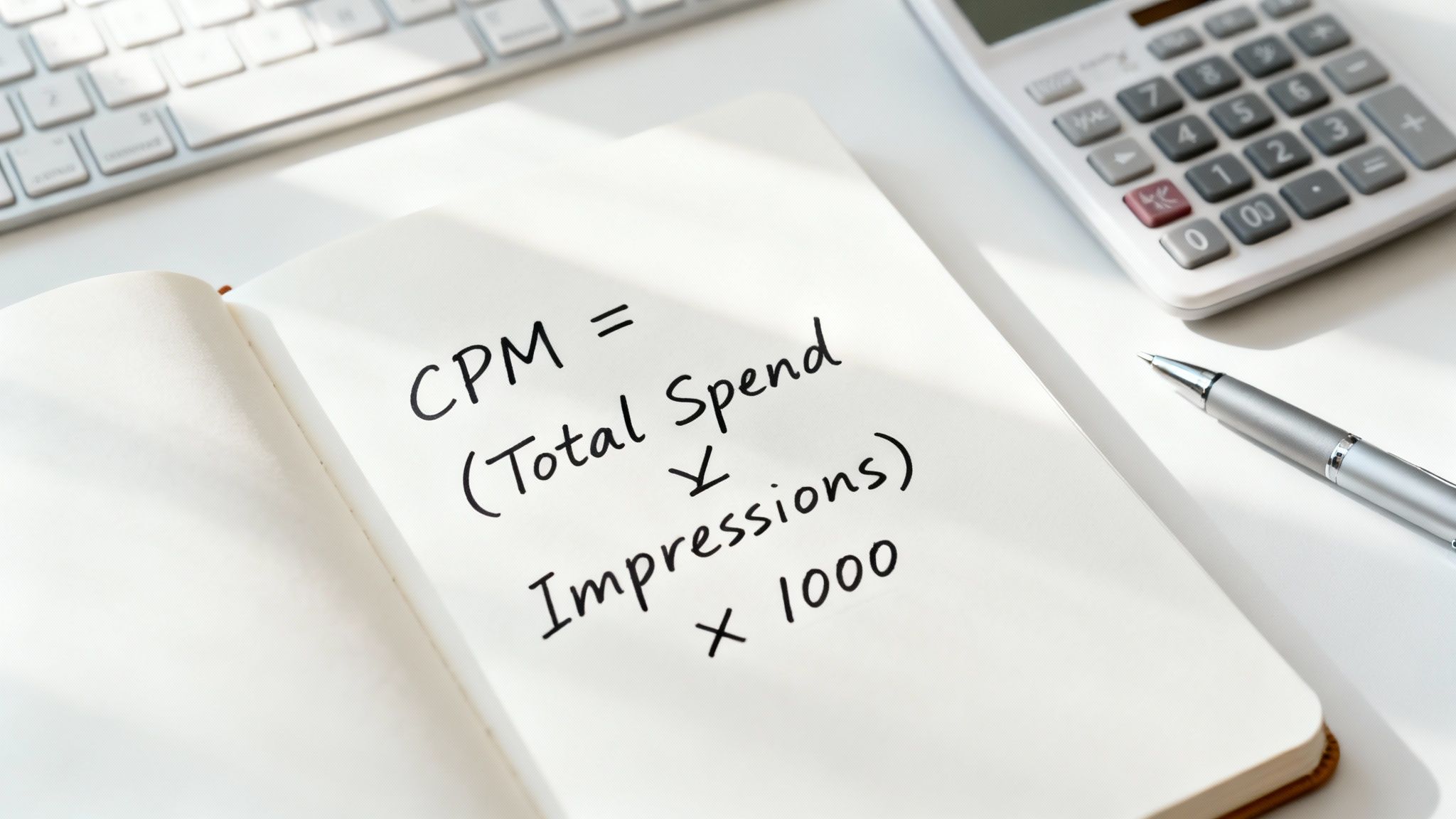
To work it out, you just divide your total ad spend by the total number of impressions, then multiply that figure by 1,000.

Think of the cost per impression formula as putting a price tag on visibility. You're not paying for clicks, leads, or sales here; you’re paying purely for the opportunity to be seen. It's a bit like buying a billboard on a digital highway—its value is all about how many people drive past and notice your message.
This makes CPM an absolute must-have metric for any top-of-funnel marketing. If you’re introducing your company to a new crowd or just want to stay top-of-mind, impressions are your currency. Calculating your CPM gives you a clear, simple benchmark for how well your campaign is performing.
By mastering this simple calculation, you can make smarter decisions about your budget. It allows you to compare the cost-effectiveness of different ad platforms, campaigns, and even specific ad creatives, ensuring your marketing dollars are working as hard as possible.
Getting your head around CPM isn't just about crunching numbers; it gives you some real, practical advantages.
Cost Per Impression is a vital piece of the digital advertising puzzle. To really see how it fits, it’s worth taking the time to master your Google Ads performance metrics as a whole. You can also get a more complete picture of your campaign's success by exploring other essential digital marketing performance metrics.
Ready to get your hands dirty and move from theory to action? Figuring out your cost per impression is actually quite simple, but it gives you an instant read on how efficiently your campaign is running. The tool for the job is the cost per impression formula.
At its heart, the formula is straightforward. You only need two numbers from your campaign report: the total amount you’ve spent and the total number of impressions your ads got.
The Formula: (Total Ad Spend ÷ Total Number of Impressions) × 1,000 = Your CPM
Wait, why multiply by 1,000? This step calculates your Cost Per Mille (CPM), which is the industry-standard way of measuring the cost for one thousand views. It just makes the final number much cleaner and easier to compare against other campaigns.
Let’s walk through a real-world example to see how this plays out. Imagine a local Adelaide café runs a new social media campaign to show off its winter menu.
Now, we just plug these figures into our cost per impression formula:
($500 ÷ 125,000 impressions) × 1,000 = $4.00 CPM
What this tells us is that the café paid exactly $4.00 for every 1,000 times its ad was shown to a potential customer. It’s a simple calculation, but it provides a clear benchmark for performance. To really get a handle on your ad spend, it pays to master the calculation of CPM for your campaigns.
This core formula – CPM = (Total Ad Spend ÷ Number of Impressions) × 1,000 – is your go-to for checking the cost-efficiency of any digital campaign. It’s especially handy on platforms like Facebook where costs can fluctuate. You can find out more about how the Facebook advertising cost can impact your budget right here.
Ever found yourself scratching your head, wondering why your Cost Per Mille (CPM) looks so different from one campaign to the next? It’s never a random number. There are a handful of key factors working behind the scenes, all pulling levers that directly impact the final cost you see on your reports.
Getting a handle on these variables is the difference between guesswork and making sharp, strategic decisions. The price you pay for those thousand impressions is a direct reflection of your campaign's DNA and the competitive waters you’re swimming in.
Your audience is arguably the biggest piece of the puzzle. It’s tempting to go broad, targeting a massive, general audience to get lots of impressions on the cheap. But if your ad doesn’t resonate with them, the platform’s algorithm will likely penalise you with higher costs over time. It’s a false economy.
On the flip side, a super-specific, niche audience can sometimes mean a higher starting CPM. Why? You’re in a bidding war for a smaller, more valuable pool of people. The real magic happens when you find that sweet spot: a highly relevant ad shown to a well-defined audience. This improves your ad's quality score and can seriously bring down your costs.
A well-targeted and engaging ad will almost always be rewarded with a more efficient CPM. It signals to the platform that you are providing a quality experience for its users, which is a win-win.
Where your ad shows up matters. A lot. Different platforms—and even different spots on the same platform—come with their own price tags. An ad placed in an Instagram Story, for example, will cost you a different amount than one in the Facebook feed. It often just boils down to simple supply and demand for that ad space.
Plus, some advertising methods are just more complex by nature. If you're keen to understand how different ad buying methods tick, you can dive into our detailed guide on what is programmatic advertising.
To give you a ballpark figure, the average Cost Per Mille for Facebook ads in Australia hovers around AUD 11.04. But remember, this number can swing dramatically based on ad relevance, targeting precision, and the quality of your creative. It proves that a thoughtfully built campaign can directly cut down your ad spend. You can find more insights about Facebook ad costs in Australia on advisible.com.au.
Knowing your cost per impression is one thing, but actively driving it down is where you really start to get ahead of the competition. A lower CPM means your budget simply goes further, putting your brand in front of more eyeballs for the exact same spend. The secret is to make your ads more relevant and efficient.
The good news is you have direct control over several key factors that influence your costs. It's not about spending more; it's about making smarter optimisations that have a real impact on your campaign's bottom line.
Without a doubt, the quickest way to lower your CPM is to stop showing ads to people who couldn't care less. A tighter, more relevant audience naturally leads to higher engagement, and ad platforms reward that with lower costs.
Drill down into your audience’s demographics, interests, and behaviours. Use exclusion lists to cut out segments that just aren't converting, making sure every dollar is spent on people who are genuinely likely to be interested. This kind of precision directly boosts the efficiency part of the cost per impression formula.
Never, ever assume you know which ad creative will be the winner. You've got to be continuously A/B testing different elements to find out what actually grabs someone's attention and, in turn, drives down your costs.
A tiny uplift in engagement from a winning creative can cause a surprisingly big drop in your CPM. Platforms want to show ads their users respond to, and they make it cheaper to do so.
When you systematically fine-tune your targeting and creative, you’re giving the ad platforms exactly what they want: interesting, relevant content for their users. Nailing this alignment is your most powerful lever for slashing your CPM and getting the best possible return on your ad spend.
Okay, so you've worked out your CPM. That’s a great first step. But the number itself doesn't tell you much on its own. How do you actually know if you’re getting a good deal or just burning through your budget?
This is where benchmarking comes in. To really understand your performance, you need to hold it up against the wider market trends. This context is everything.
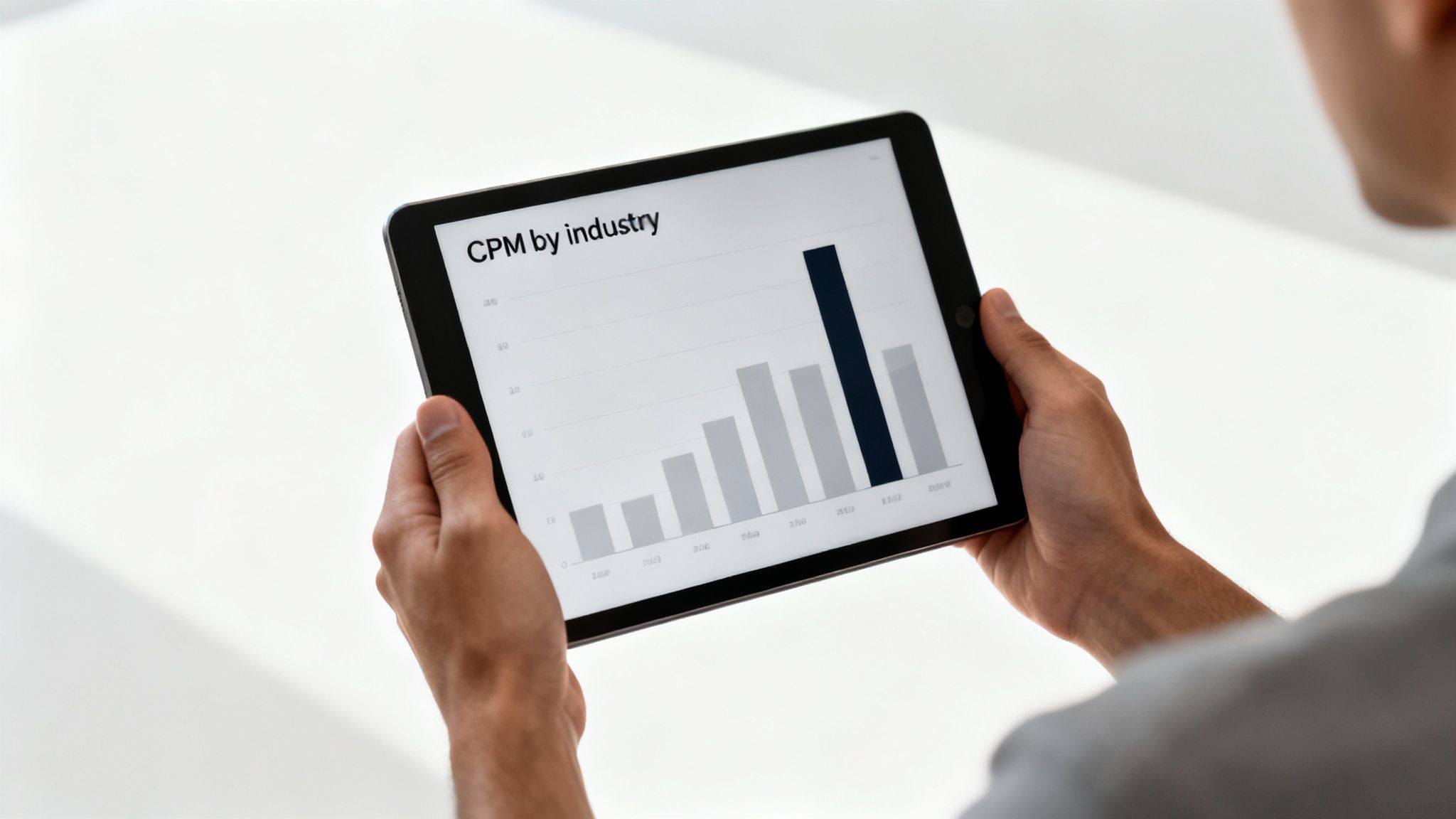
Think about it – advertising costs can swing wildly depending on the industry you're in, the platform you're using, and even the time of year. Comparing your numbers to relevant industry standards is the only way to get a true picture of how you're tracking.
Let's make this real with an example from social media advertising right here in Australia. It's a fast-moving space, with costs shifting all the time based on what everyone else is doing. Keeping tabs on these movements is the key to knowing whether your own campaign costs are on the money or way off base.
Knowing the average CPM for your market allows you to analyse performance more accurately. A high CPM might not be an issue if it's below the industry average, while a low CPM could still be inefficient if competitors are paying far less.
For instance, recent data on Facebook ads in Australia showed CPMs were actually on a downward trend over a twelve-month period. They started at AUD $18.09 and dropped by around 20% to finish at AUD $14.51.
The yearly average settled at AUD $15.00. What’s really interesting is that this was consistently about 25% lower than the global average during that same period. You can discover more insights about Australian Facebook ad costs on superads.ai.
What does this tell us? It shows that with a well-managed campaign, there’s a real opportunity to get great results without breaking the bank. It all comes down to knowing your numbers and the market you’re playing in.
Getting your head around the cost per impression formula can bring up a few tricky questions. No stress – here are some straight answers to help you use the metric like a pro and sort out any snags you hit along the way.
This is the million-dollar question, and the honest answer is: it depends. A "good" CPM isn't a magic number that fits everyone. It swings wildly depending on your industry, the platform you're on, and who you're trying to reach.
Highly competitive spaces like finance, for example, will almost always have higher CPMs than something like retail. While you might see a benchmark between $10-$20 floating around for platforms like Facebook, the real measure of a good CPM is one that actually helps you hit your campaign goals and turns a profit. The most useful comparison isn't against a generic number, but against your own past performance and what's typical for your specific industry.
Think of it this way: CPM is your go-to when you want to make a big splash. If your main game is getting your brand name, message, or new product in front of as many eyeballs as possible, then CPM is your best friend. It’s all about maximising reach and visibility for the lowest cost per view.
On the other hand, if you're after immediate action – like getting people to visit your website, sign up for a newsletter, or fill out a form – you'll want to pivot to CPC (Cost Per Click). With CPC, you only pay when someone is interested enough to actually click on your ad. It's about driving engagement, not just views.
The good news is you don't need a fancy calculator or a degree in mathematics to keep tabs on your CPM.
Almost every digital advertising platform worth its salt calculates it for you automatically. Just dive into the reporting dashboards of Meta (for Facebook and Instagram), Google Ads, or LinkedIn Ads, and you'll find it right there. It’s usually sitting in a column labelled 'Performance' or 'Cost', giving you a real-time look at how much you’re spending to get seen.

 previous