
Before you even think about writing a survey or scheduling an interview, you have to get one thing crystal clear: what exactly are you trying to learn?
Kicking off your research without a sharp objective is like setting sail without a map. You’ll definitely gather a boatload of information, but none of it will point you in the right direction. Vague goals like "we want to understand our customers better" just don't cut it. They’re too fuzzy to be useful.
You need to reframe your big business challenges into specific, answerable questions. This is the secret to turning broad ambitions into a focused research plan that actually informs your business decisions.
The whole point is to connect your research directly to a tangible business problem or a golden opportunity. Are you bleeding customers and can't figure out why? Is that new product idea you love failing to get any traction? Or are you eyeing up a new market and need to know if it's a good move?
Each of these scenarios demands its own unique line of inquiry.
The trick is to start with the core issue and work backwards to figure out what you need to ask.
Let's say your problem is this: "Our new software feature has really low adoption rates."
Instead of just guessing why, you can build a research plan around it:
This kind of structured thinking ensures your research delivers real intelligence, not just a pile of interesting but irrelevant data. A classic goal for any business is getting a handle on the competition. For a really deep dive on that, check out this ultimate guide to competitor analysis.
To help you get started, here's a simple framework to translate those big-picture goals into concrete research questions.
Use this framework to translate your broad business goals into specific and actionable research questions.
| Business Goal | Primary Objective | Key Research Questions |
|---|---|---|
| Increase Customer Retention | Understand the root causes of customer churn. | What are the main reasons customers stop using our service? At what point in the customer journey do they typically drop off? What do our most loyal customers value most about us? |
| Launch a New Product | Validate market demand and refine product features. | Is there a genuine need for this product in the market? What specific features would solve the biggest problems for our target audience? What price are they willing to pay? |
| Enter a New Market | Assess market viability and local consumer behaviour. | Who are the key competitors in this new region? What are the local cultural nuances and purchasing habits? What is the perceived value of similar products already on the market? |
| Improve Brand Perception | Measure brand awareness and identify brand strengths/weaknesses. | How do consumers describe our brand versus our competitors? What are the core associations people have with our brand? Which of our brand messages are resonating, and which are falling flat? |
By filling this out, you create a clear roadmap for your entire research project, making sure every question you ask serves a direct purpose.
Once you know what you need to find out, you can map out a realistic budget and timeline. These aren't just administrative boxes to tick; they’re essential for managing resources and keeping everyone on the same page from day one.
Your budget will heavily influence the methods you can use. A quick online survey is worlds cheaper than running a series of professionally moderated focus groups.
Similarly, your timeline has to account for everything—from the initial planning and finding participants (which always takes longer than you think) to analysing the data and putting together the final report. A solid plan stops the project from spiraling out of control and ensures you get the insights you need, on time.
A classic rookie mistake is underestimating how long it takes to recruit the right participants and then make sense of all the data. Always build in a buffer for unexpected delays. It’ll save you from having to rush at the end and compromise the quality of your findings.
Here in Australia, market research is leaning more and more on sophisticated data analytics to get a proper read on consumer behaviour. In fact, the Australian data analytics market hit an estimated AUD 2.00 billion and is set to grow massively. This surge shows just how much businesses are relying on predictive and customer analytics to make smarter, data-backed decisions. You can get more insights on the growth of the data analytics market on expertmarketresearch.com.au.
Once you’ve locked in your research goals, the next big question is how you’re actually going to get the answers you need. The world of market research is broadly split into two distinct flavours, and knowing when to use each one is the key to gathering intelligence that genuinely moves the needle.
Think of it as the difference between asking "why?" and "how many?". Both are critical questions for any business, but they demand completely different tools to answer properly.
This infographic breaks down the simple flow from your core business challenge to the specific research questions you need to ask.
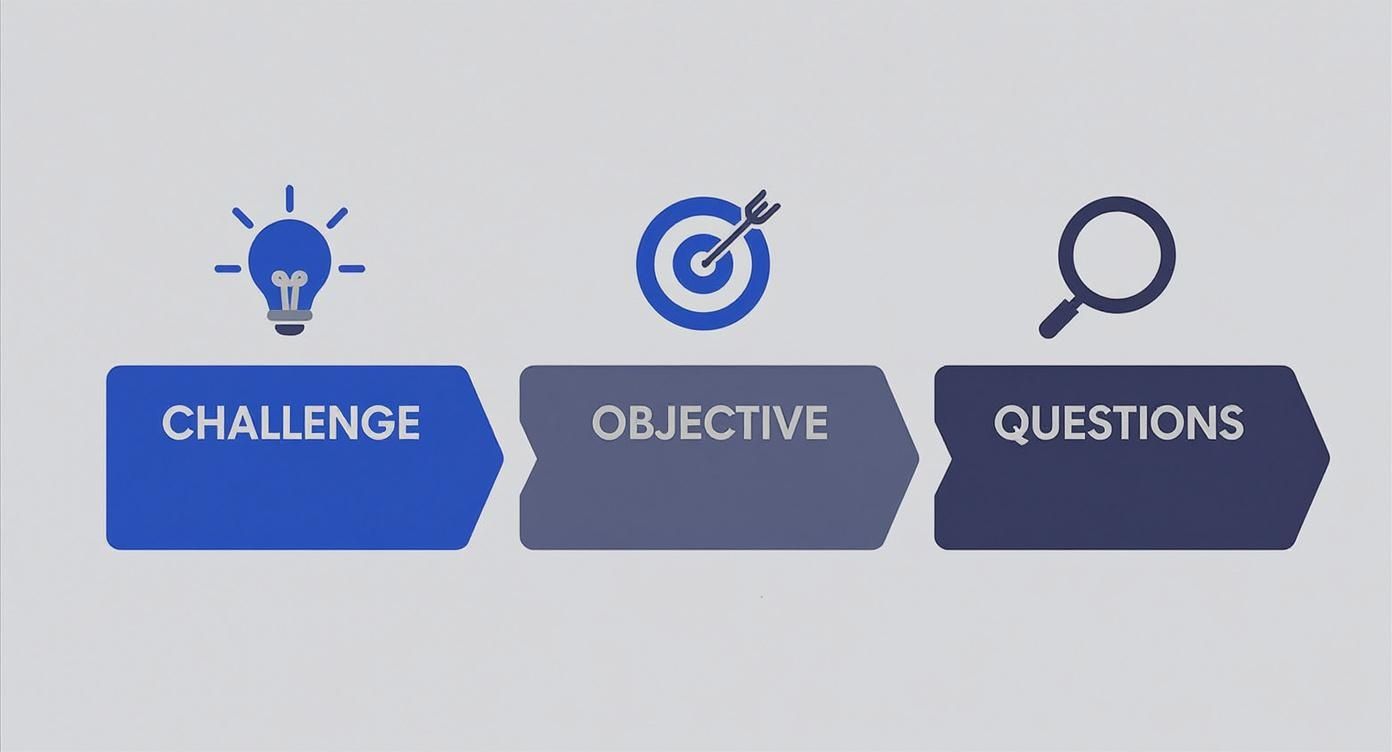
As you can see, every good research question should trace its roots back to a clear business objective and a real-world problem you're trying to solve.
Qualitative research is all about depth. This is where you roll up your sleeves and explore people's thoughts, feelings, and motivations on a much more personal level. Forget spreadsheets and statistical significance for a moment; this approach deals in stories, direct quotes, and raw human experience.
You'll lean on qualitative methods when you're in an exploratory phase. Maybe you’re trying to understand the tiny nuances of a customer problem before you build a solution, or perhaps you just want to hear the specific words people use when they talk about your industry.
Common qualitative methods include:
The goal here isn't to survey hundreds of people. You might only speak with 10-15 individuals, but the insights you get will be incredibly rich and detailed. This is the perfect way to generate sharp hypotheses that you can test on a larger scale later on.
While qualitative gives you the rich "why," quantitative research gives you the scale to back it up. This is where the numbers come into play. It’s all about collecting structured, numerical data that you can measure and analyse statistically.
This is the perfect tool for validating the hypotheses you cooked up during your qualitative phase. For instance, after hearing a few customers mention a specific frustration in interviews, you can use a survey to find out what percentage of your entire customer base feels the same way.
Typical quantitative methods are:
With quantitative research, the sample size is much larger. You need enough data points to be confident that your findings truly represent the broader market, not just a vocal minority.
A side-by-side look at these two approaches can make it easier to see where each one shines.
| Aspect | Qualitative Research | Quantitative Research |
|---|---|---|
| Primary Goal | To explore ideas, understand experiences, and uncover motivations ("Why?"). | To measure, validate, and test hypotheses with numerical data ("How many?"). |
| Data Type | Non-numerical: interview transcripts, observations, direct quotes. | Numerical: survey ratings, web traffic stats, percentages, sales figures. |
| Typical Sample Size | Small (5-20 participants) for depth and detail. | Large (100+ participants) for statistical significance and generalisability. |
| Best Used For | Discovering new product ideas, understanding customer journeys, exploring brand perception. | Validating market size, measuring customer satisfaction (CSAT/NPS), A/B testing. |
| Question Style | Open-ended: "Tell me about a time when…", "What was that experience like?". | Closed-ended: Multiple choice, rating scales (1-10), yes/no questions. |
Ultimately, understanding the strengths of each method helps you pick the right tool for the job at every stage of your project.
The most powerful market research rarely comes from choosing one method over the other. The real magic happens when you blend them to get a complete, 360-degree view of your market—a tactic often called a "mixed-methods" approach.
A classic mistake is jumping straight to a big, expensive survey without doing any qualitative homework first. You risk asking perfectly structured questions about things that don't actually matter to your customers.
A much better workflow is to start small, then go big.
This process ensures you’re not just gathering data, but gathering the right data. You get the rich human stories from your interviews and the hard numbers from your survey to back them up, giving you confidence in your final decisions.
This strategic thinking is also fundamental when you turn your attention to the competition. For a deeper look, check out our guide on how to conduct competitor analysis to understand their position in the market. Knowing their strengths and weaknesses helps you frame much smarter research questions from the very beginning.

Here's a hard truth: the quality of your market research insights is only ever as good as the questions you ask. It’s that simple. One poorly phrased question can send you down a rabbit hole, leading respondents, skewing your data, and pointing your entire strategy in the wrong direction.
Putting together a survey or an interview guide is a real art form. It’s about finding that sweet spot between structured inquiry and a natural, human conversation. The real goal is to design something that pulls out honest, unbiased feedback—the kind of stuff you can actually build a business decision on with confidence. This all comes down to the wording, the structure, and the flow.
The most common trap people fall into is leading the witness. It’s surprisingly easy to phrase a question in a way that hints at the "right" answer, and most people, wanting to be agreeable, will naturally lean that way.
Take this, for example. Instead of asking something loaded like, "How much do you love our new, user-friendly dashboard?" try a more neutral approach: "How would you describe your experience using the new dashboard?" The first version is fishing for a compliment. The second one opens the door for genuine feedback—good, bad, or completely indifferent.
The golden rule is to ask, not tell. Your questions should be a blank canvas for the respondent's thoughts, not a frame you’ve already built for them.
To get this right, stick to neutral language. Cut out any words that are emotionally charged or make assumptions about the user's feelings.
A good mix of open-ended and closed-ended questions is what gives your research both solid numbers and rich context. Each question type has a specific job to do.
Closed-Ended Questions: These are your quantitative workhorses. They give you clean, measurable data because they offer a fixed set of answers (think multiple choice, rating scales, or a simple yes/no). They’re perfect when you need to put a number on opinions or behaviours, like asking, "On a scale of 1 to 10, how likely are you to recommend our service?"
Open-Ended Questions: This is where you dig in and find the "why" behind those numbers. Questions that start with "What," "How," or "Tell me about…" invite people to share stories and detailed answers. They're absolute gold for exploring motivations and uncovering problems you never even knew existed.
A solid survey often kicks off with closed-ended questions to get the basic demographic data and high-level opinions, then moves into open-ended questions to explore the most important topics. It’s a smart way to respect the respondent's time while still getting the juicy details.
When you're doing qualitative interviews, your script shouldn't feel like an interrogation. It’s a guide—a roadmap that keeps the conversation flowing naturally while making sure you hit all your key research goals.
Always start with broad, rapport-building questions to help the person relax. For instance, if you’re researching a software tool, you could begin with, "Can you walk me through a typical workday for you?" This gives you valuable context before you dive into the nitty-gritty. Understanding their day-to-day is also a massive part of figuring out what is customer journey mapping and where your product actually fits into their world.
Break your interview guide into logical themes. Under each theme, list your main questions, but also jot down a few potential follow-up probes like, "Can you tell me more about that?" or "What happened after you did that?". This keeps you ready to explore those unexpected tangents where the best insights are often hiding. Remember, your job is to listen more than you talk.
You’ve got to tailor your questions to your specific goal. Here are a few examples you can adapt for different research needs:
Scenario 1: Testing a New Product Feature
Scenario 2: Measuring Customer Loyalty
When you take the time to carefully craft your questions, you stop just collecting data and start gathering real, actionable intelligence.

With a solid plan and some sharp questions ready to go, it’s time to get out in the field. This is where your research really comes to life—the part where you actually connect with people and gather the raw intel that’s going to fuel your business decisions.
But let’s be clear: finding the right people is more than half the battle.
You could have the most brilliantly designed survey in the world, but if you send it to the wrong audience, the data you get back is going to be completely useless. This step is all about being strategic and resourceful in how you find and engage your target market.
Before you start blasting out emails or running social media ads, you need a basic grip on sampling. It’s just the process of selecting a smaller, representative group from your total target market. You can't talk to everyone, so you have to talk to a carefully chosen few.
For quantitative research, where the numbers really matter, your goal is a sample that accurately mirrors the demographics and behaviours of your entire audience. This is where methods like random sampling (where everyone has an equal shot of being picked) or stratified sampling (dividing the market into subgroups and sampling from each) come in handy.
When it comes to qualitative research, the focus shifts from stats to relevance. You’re not trying to survey the masses; you’re hunting for individuals with direct, rich experience with the problem you’re solving. Here, your "sample" might only be 10-15 people, but they absolutely have to be the right 10-15 people.
A classic mistake is to only survey your existing, happy customers. Sure, their feedback is valuable, but it creates a "survivorship bias." To get the whole picture, you have to find ways to hear from people who chose a competitor or, even better, decided not to buy at all.
So, where do you actually find these people? Well, your approach will change completely depending on whether you’re a B2B software company or a local coffee shop.
Here are some of the most effective channels I've seen work:
A B2B company trying to understand IT managers might hit up LinkedIn ads and industry forums. A local café, on the other hand, could find participants through its Instagram followers and a flyer on the counter. The key is to go where your audience already is.
Not all data collection involves talking to people directly. Secondary research is all about using existing data that someone else has already published. This is a fantastic way to grasp broad market trends, get industry benchmarks, or gather competitive intelligence without the cost of a full-blown primary study.
Think government reports, industry association data, and market analysis from firms like IBISWorld or Gartner. The massive growth in Australian online shopping, for instance, provides a rich field for this kind of research. The sector is expected to hit $64.9 billion in retail revenue, with e-commerce growing at a compound annual rate of 7.5% in recent years.
Researchers can analyse this public data to understand how consumer behaviour is shifting, which in turn shapes digital marketing strategies. You can read more about the online shopping industry's growth on ibisworld.com.
By blending insights from these existing reports with your own primary research, you get a much more complete and contextualised view of the market. And that helps you make smarter, more informed decisions.

Collecting the data is just the starting pistol. Piles of survey responses and hours of interview recordings are essentially useless until you translate them into a clear story that can actually guide your business strategy. This is where the real grunt work of market research begins—turning raw info into powerful, actionable insights that drive smart decisions.
The whole process can feel a bit daunting, but it's really quite methodical. It's all about separating the signal from the noise, connecting the dots between different data points, and building a narrative your stakeholders can immediately grasp and act on.
When you’re staring at a spreadsheet packed with survey results, your first job is to hunt for meaningful patterns. This goes way beyond just calculating averages; you need to spot the trends that are statistically significant and directly relate back to your initial research questions.
Start by organising your data to answer your big questions. For example, if you wanted to know how customer satisfaction differs between age groups, you’d cross-tabulate those two data points. This is where visualisations become your best friend.
The goal here isn't just to make your report look pretty. A well-designed graph can reveal a crucial insight in seconds that might take paragraphs to explain. These insights are fundamental for understanding your key digital marketing performance metrics and seeing how your research connects to real-world business results.
Qualitative data from interviews or focus groups doesn't slot neatly into charts. It’s messy, rich with context, and full of human stories. The key to making sense of it is a process called thematic analysis, where you systematically identify recurring ideas and patterns across all your conversations.
Begin by just reading through your transcripts and making notes of interesting comments, powerful quotes, or common frustrations. As you do, you'll start to see themes emerge. For instance, you might notice that five different interviewees mentioned feeling "overwhelmed" by your product's user interface.
Group these related notes into core themes. This process helps you move from individual comments to bigger, more strategic insights. You're not just reporting that one person said something; you're identifying a sentiment shared by a significant chunk of your sample.
The most powerful qualitative insights often come from a direct quote. Pulling out a compelling sentence that perfectly encapsulates a customer's pain point or desire can be more persuasive to stakeholders than any chart or statistic.
The real magic happens when you weave your quantitative and qualitative findings together. Your survey data (the "what") tells you that 70% of users aren't using a specific feature. Your interview data (the "why") then reveals it's because they find the instructions confusing and the icon’s placement illogical.
See what happened there? This synthesis creates a complete, compelling narrative. It provides both the scale of the problem and the human context behind it, making the path to a solution crystal clear.
This integrated approach is critical when you're looking at consumer behaviour in dynamic areas like social media. For instance, with social media ad spending in Australia projected to hit AU$7.5 billion next year, understanding what makes users trust a brand is vital. Influencer marketing is also on the rise, with ad spend expected to reach nearly AU$944 million. Your research needs to uncover what builds that trust—like user-generated content and authentic reviews—to shape campaigns that actually work.
Your final step is to present your findings in a way that is clear, concise, and laser-focused on recommendations. A classic mistake is the "data dump"—a long-winded report filled with every single chart and finding. Don't do that. Instead, structure your report to guide your stakeholders towards a decision.
Kick it off with an executive summary that highlights the top three most critical insights and your corresponding recommendations. From there, dedicate sections to your key themes, using a mix of data visualisations, powerful quotes, and sharp analysis to back up each point.
Always, always end with a dedicated "Recommendations" section outlining specific, actionable next steps. Instead of saying, "Users are confused," recommend, "Redesign the onboarding tutorial and relocate the feature icon to the main toolbar to drive a 15% increase in engagement."
Once you've processed your data, the next step is crucial: creating reports that actually get read and drive decisions. You can learn more with these tips for creating actionable business reports to ensure your hard-earned insights get the attention they deserve. This is how market research moves from a simple academic exercise to a vital engine for business growth.
Even with the best-laid plan, your first market research project can feel like you’re trying to find your way through a new city without a map. There are always a few questions that pop up, and getting them sorted can be the difference between a project that sings and one that just… fizzles.
Let's tackle some of the most common hurdles I see people face.
One of the first questions that hangs over any project is always about the budget. How much should you really set aside for this?
The honest answer? It really depends on how you go about it. The cost can swing from practically zero all the way up to tens of thousands of dollars.
The key is to match your budget to your goals. Start with the methods that give you the biggest bang for your buck before you think about scaling up.
Never mistake cost for value. A well-designed study with ten targeted interviews that uncovers a critical product flaw is infinitely more valuable than a sloppy, 1,000-person survey that just confirms what you already suspected.
Time is the other resource you can't get back. A simple survey project—from writing the questions to having a first look at the results—can often be turned around in one to two weeks.
But a more complex study is a different beast entirely. A multi-stage project, maybe with some qualitative interviews followed by a big quantitative survey, could easily take two to three months from kickoff to final report. Your timeline is dictated by the scope, the methods you choose, and how quickly you can get the right people to participate.
This is the classic question, and the answer is completely different for qualitative and quantitative research.
For qualitative research like interviews, you aren't chasing huge numbers. You're looking for the point of "saturation"—that's when you stop hearing any new ideas or themes. This often happens after just 10-15 interviews with well-chosen participants.
For quantitative research like surveys, your sample size needs to be big enough to be statistically significant. This number depends on the total size of your target audience and how confident you need to be in the results. Thankfully, you don't need to be a statistician; there are plenty of free online sample size calculators that will give you a reliable number to aim for.
Getting your head around these practical details helps demystify the whole process. It turns market research from a daunting task into a manageable—and seriously powerful—tool for growth.
At Virtual Ad Agency, we turn market insights into marketing strategies that deliver measurable results. If you're ready to understand your market and drive real growth, let's talk about building your strategy.

 previous