
Ever wondered what it's really like to be one of your customers? Customer journey mapping is how you find out. It’s the process of creating a visual story of your customer's interactions with your business, from the moment they first hear about you to long after they’ve made a purchase.
Think of it as a detailed roadmap that charts every single step, every high, and every low.
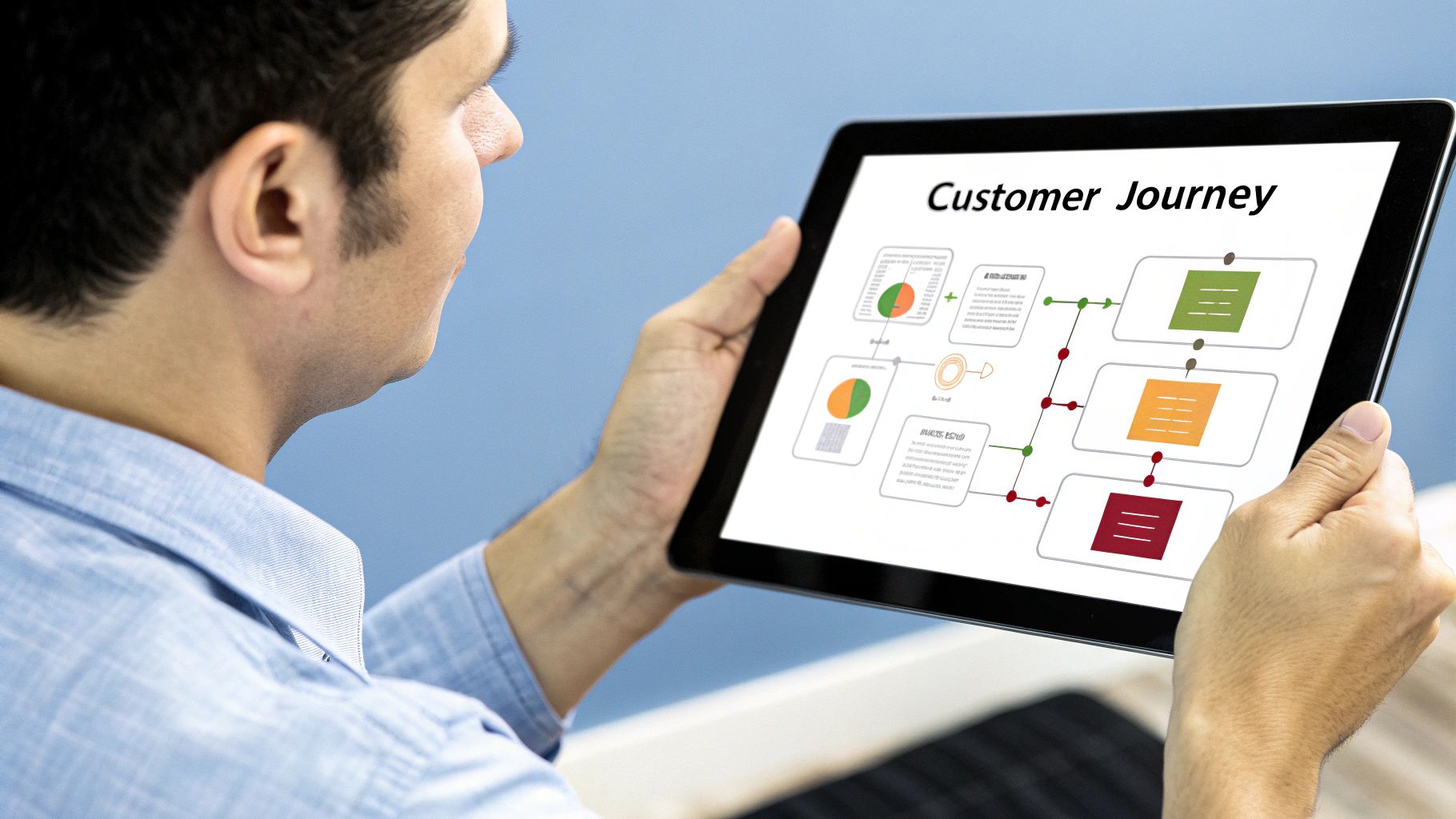
Imagine trying to explore a new city without Google Maps or a trusty old paper map. You might stumble upon your destination eventually, but you’d probably take a few wrong turns, hit some dead ends, and get pretty frustrated along the way. That’s what it feels like to run a business without truly understanding the path your customers take.
A customer journey map is that essential navigational tool. But it's so much more than a simple flowchart of your sales process. It’s a powerful visualisation that lets you step directly into your customer’s shoes, giving you a clear, chronological picture of their entire experience with your organisation.
By charting this path, you start to see things from their perspective. You uncover their motivations, frustrations, and the moments of delight at every touchpoint.
The whole point of this exercise is to shift your focus from an internal, business-first view to an external, customer-first one. It stops you from thinking about what you do (like "send a welcome email") and forces you to consider what the customer actually experiences (like "receiving a confusing and overwhelming email").
This change in perspective is a game-changer. It helps you spot the cracks in your customer experience—the disconnects and friction points that are often completely invisible when you’re looking from the inside out. The map brings the whole journey to life, not just the isolated interactions.
A customer journey map is a story about your customer’s experience. It tells the story from the customer’s perspective, which provides insights into their feelings, motivations, and questions.
One of the biggest benefits is that it helps break down those stubborn internal silos. When your marketing, sales, and support teams are all looking at the same map, they finally get a shared, unified understanding of the customer's reality. This ensures everyone is pulling in the same direction: creating a smooth, positive, and memorable experience.
To give you a better idea of what goes into one, here’s a quick summary of the essential elements you'll find in a typical customer journey map.
| Component | What It Represents |
|---|---|
| Personas | Fictional characters that stand in for your key customer segments. |
| Timeline | The distinct phases and stages the customer moves through on their journey. |
| Touchpoints | Every single point of interaction between the customer and your brand. |
| Emotions | The customer's feelings at each stage, from frustration to delight. |
| Opportunities | Actionable insights and ideas you can use to improve the experience. |
These core components come together to create a powerful story that’s packed with insights, helping you see exactly where you can make meaningful improvements.

Think of a customer journey map as more than just a flowchart. It's a powerful tool for growth that forces you to step outside your own business processes and see things from your customer’s point of view. It’s about connecting what your team does every day to what your customer actually experiences.
This is absolutely crucial because it gets different departments—marketing, sales, customer support—all on the same page. No more working in silos. Instead, everyone is united by a single, shared vision of the customer’s real-world path. Getting that shared understanding is the first real step towards building a cohesive customer experience.
By carefully plotting out the customer's path, journey mapping helps businesses sharpen their customer acquisition strategies and create a much smoother, more welcoming onboarding process.
Every single customer journey is peppered with what we call "moments of truth". These are the critical touchpoints where a customer’s opinion of your brand is either cemented or completely shattered.
A journey map throws a spotlight on these pivotal interactions. It could be anything from a clunky, frustrating checkout process on your website to a surprisingly delightful chat with your support team.
When you visualise these moments, you start to spot friction points you never even knew were there. For instance, your map might show that customers feel a bit lost or ignored right after they buy something because your follow-up emails are weak. That’s a moment of truth where you risk losing them forever. On the flip side, it might uncover a golden opportunity to create a moment of joy that builds fierce loyalty.
Getting this right has a huge financial upside. In fact, around 74% of Australian consumers are more likely to make a purchase based on their experience alone. With 58% of customers saying their service expectations have climbed in the past year, it's never been more important to deliver. You can dig into more Australian customer experience stats over at maxcontactaustralia.com.au.
The real magic of customer journey mapping is in turning all those visual insights into smart, strategic actions. It gives you a clear roadmap for what to fix first, helping you prioritise the changes that will make the biggest difference.
A journey map isn't just a diagnostic tool; it's a strategic blueprint that guides your organisation towards a more profound understanding of the customer experience love language.
This whole process allows you to make decisions based on a genuine understanding of customer needs and feelings, not just guesswork. The benefits are clear and easy to measure:
At the end of the day, journey mapping gives you the clarity to stop guessing what your customers want and start building experiences that fuel sustainable, long-term growth.
Every relationship with a customer follows a path, almost like chapters in a story. A customer journey map simply breaks this story down into distinct stages, helping you figure out exactly what your audience needs at every single step. When you organise the experience this way, meeting those needs becomes a whole lot easier.
The journey starts long before someone clicks "buy." It begins with a simple thought or a problem, and if you play your cards right, it ends with them becoming a passionate fan of your brand. Getting a handle on these phases is the first real step to creating a map that actually works.
This is the very beginning, the "lightbulb" moment. Your future customer has just realised they have a problem or a need, but they probably don't know you or your solution even exists yet. Right now, they're just exploring, usually driven by a nagging question or a pain point.
Think about a homeowner who notices their electricity bills are suddenly through the roof. Their first move isn't to shop for a product; it's to search online for something like, "why is my power bill so high?" At this stage, they're curious and maybe a little worried. They aren't looking for a brand; they're looking for answers. To really get inside their head, it helps to understand concepts like the five stages of customer awareness, which dives deeper into this initial phase.
Okay, so they're aware of the problem. Now they slide into the consideration stage. At this point, they're actively researching and comparing different solutions available to them. They know there are options out there, and their main goal is to find the best one for their situation and budget.
Let's go back to our homeowner. They've figured out that their old, inefficient air conditioner is the likely culprit. So, what's next? They start comparing different brands, digging into customer reviews, and looking up energy efficiency ratings. Their actions become much more focused and analytical as they weigh up the pros and cons of each option.
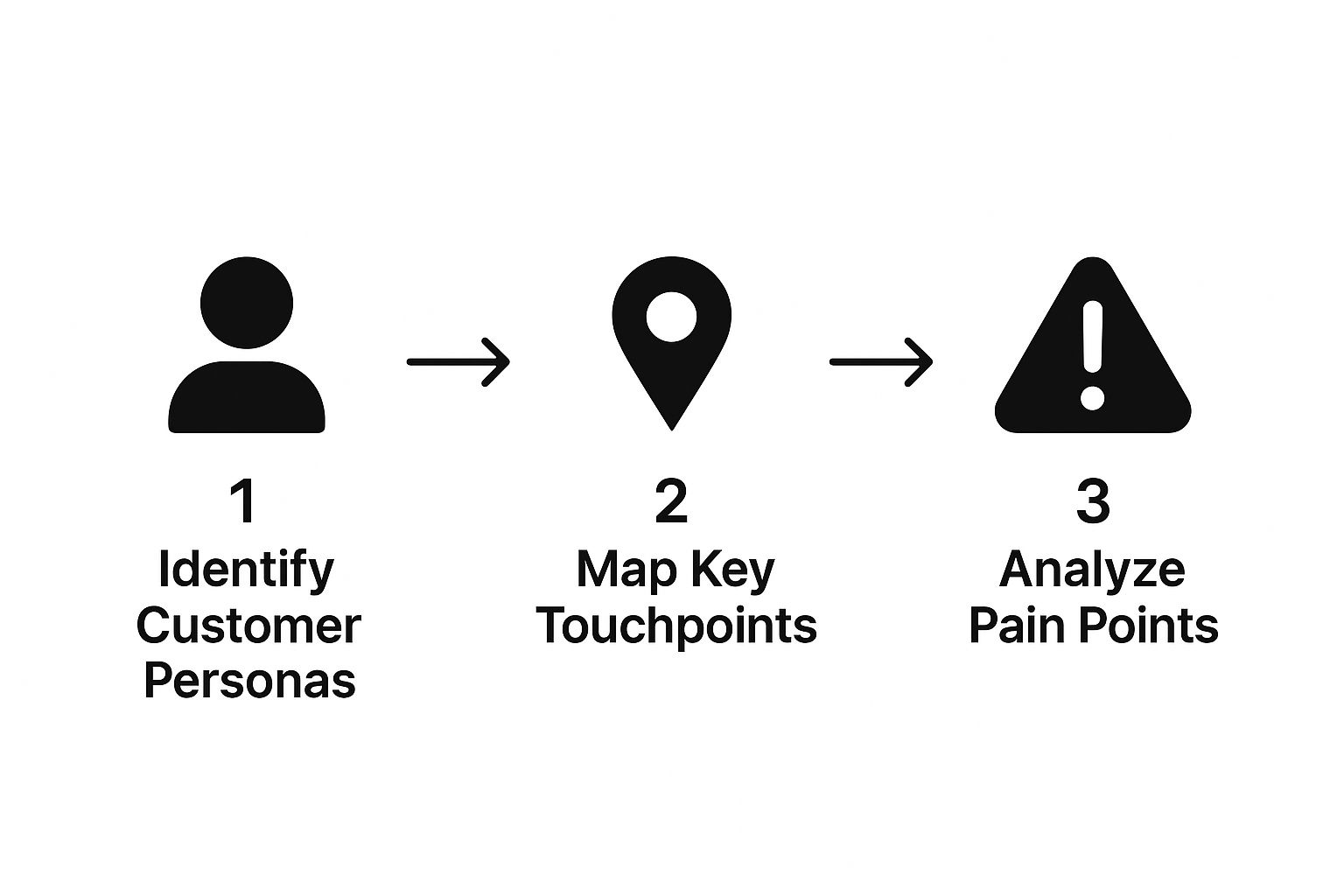
This process is about getting to the heart of the customer's experience—identifying who they are, where they hang out online (and off), and what’s causing them frustration.
It’s easy to confuse the customer journey with the old-school sales funnel, but they're fundamentally different. The sales funnel is a business-centric model focused on pushing leads toward a sale. The customer journey, on the other hand, is a customer-centric map that follows their actual experience, emotions and all.
Here’s a quick comparison to highlight the difference in perspective:
| Aspect | Customer Journey Stage | Sales Funnel Stage |
|---|---|---|
| Perspective | From the customer's point of view (outside-in) | From the business's point of view (inside-out) |
| Focus | Understanding customer needs, feelings, and pain points | Moving a "lead" through internal sales processes |
| Model | Often non-linear; can be a loop or complex path | Linear and top-down (TOFU, MOFU, BOFU) |
| Goal | Improve the overall customer experience to build loyalty | Convert a prospect into a paying customer (a sale) |
| Metric | Customer satisfaction, Net Promoter Score (NPS), retention | Conversion rates, lead velocity, cost per acquisition |
While the sales funnel has its place for internal tracking, the customer journey map gives you a far more realistic and empathetic view of what it’s actually like to interact with your brand.
This is it—the moment of truth. After all that research and comparison, the customer is finally ready to pull the trigger and make a purchase. Their mindset shifts from "which one is best?" to "how do I get this done?"
Your job here is to make buying from you as smooth and hassle-free as possible. Any little bit of friction—a clunky checkout form, surprise shipping costs, or a website that takes forever to load—can be enough to make them second-guess their decision and abandon the cart. The customer is feeling a mix of excitement and maybe a little apprehension, just hoping they've made the right call.
The journey is far from over once the payment goes through. The service (or post-purchase) stage is where you really cement a customer's feelings about your brand, for better or worse. This covers everything from the moment the product is delivered and set up to any interactions they have with your support team.
If that new air conditioner arrives on time and the installation is a breeze, the homeowner feels relieved and confident in their choice. If they have a question later and get a quick, helpful answer from support, that confidence grows even stronger. This is where a good experience starts to transform a one-time buyer into a genuinely happy customer.
This stage is absolutely crucial for building trust. Nearly 60% of consumers report that just one bad experience is enough to make them stop doing business with a company.
The final stage, and the one we’re all aiming for, is loyalty. A loyal customer doesn't just come back for more; they become a walking, talking advertisement for your brand. They’re the ones leaving glowing reviews, telling their friends and family about you, and actually engaging with your content.
This coveted stage is built on a foundation of consistently positive experiences across all the previous steps. Creating this seamless experience across every touchpoint is where understanding what is omnichannel marketing becomes so valuable, as it ensures your message and service are consistent everywhere. The feeling here isn't just satisfaction—it's genuine trust and a sense of connection, turning a simple transaction into a lasting relationship.
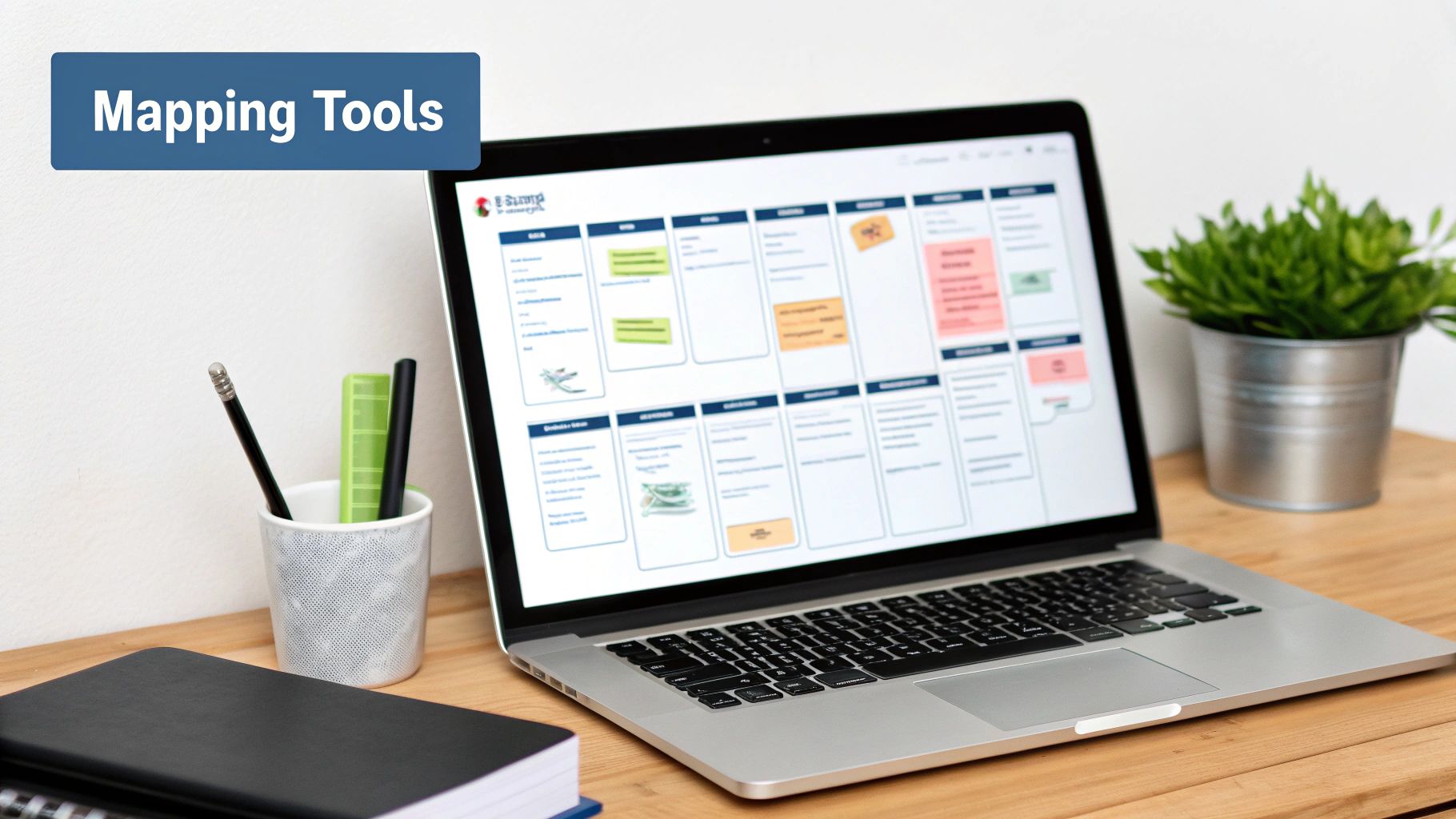
Building your first customer journey map can feel like a massive undertaking, but it's really just a logical, step-by-step process. Think of it less like writing a novel from scratch and more like assembling a puzzle. All the pieces are already there; your job is to put them together to see the full picture of your customer's experience.
It all starts with a clear purpose. Without one, your map becomes a collection of interesting-but-useless facts with no real direction. You’ve got to know what you’re trying to achieve before you even begin.
First thing's first: ask yourself, why are we actually making this map? Are you trying to figure out why people are abandoning their shopping carts? Maybe you want to smooth out the onboarding process for new clients. Or perhaps you're trying to pinpoint where your marketing efforts are really hitting the mark.
Setting a specific goal is absolutely critical. It defines the scope and focus of the entire project.
With a clear objective in place, you have a North Star to guide the entire process. It ensures your final map delivers insights you can actually act on.
Every story needs a main character, and for your map, that's your customer persona. A persona is a semi-fictional character, but it’s built from real data and research about your ideal customer. This isn't about guesswork; it's about grounding your map in reality.
To build a persona that works, you need to dig into both quantitative and qualitative data.
A common mistake is creating personas based on what the team thinks they know about customers. A map built on assumptions will only lead you down the wrong path, reinforcing internal biases instead of revealing the customer's truth.
For example, your persona needs more than just demographics. It should capture their motivations, goals, and—most importantly—their key pain points. What problems are they trying to solve? What frustrates them about the current solutions out there? This level of detail ensures you’re mapping the journey of a real person, not just a generic "user."
Now it’s time to find the raw materials for your map: real feedback from real customers. In Australia, customer journey mapping often relies heavily on qualitative research, like direct customer interviews, to uncover genuine behavioural patterns. You'd be amazed at what you can learn from talking to just a handful of customers about their decision-making process. For a deeper dive into how Australian service systems use this approach, check out the resources from the Australian Institute of Family Studies.
Here are a few proven methods for gathering this valuable information:
This research will give you the direct quotes, emotions, and pain points that truly bring your map to life. If you're looking for a structured way to get started, using a pre-built framework can be incredibly helpful. You can download a free customer journey mapping template to guide you through organising all this information.
It's one thing to talk about customer journey mapping in theory, but it’s another thing entirely to see it make a real difference. When a business gets this right, it can turn a clunky, frustrating process into something that feels effortless for the customer. Let’s look at a couple of examples of how organisations have used it to get some serious results.
A great place to start is in the public sector. Picture a government agency dealing with a notoriously complicated application process. Citizens were getting lost and frustrated, call centres were swamped with the same basic questions, and simple errors on forms were causing massive delays for everyone involved.
By mapping the entire process from the citizen’s point of view, the agency got a firsthand look at the chaos. They could finally see where the instructions were baffling, where the online forms were impossible to navigate, and exactly when people were giving up.
The insights from the map were a huge wake-up call. It turned out the biggest roadblocks weren't caused by complex policies but by terrible communication and clunky website design. With this clear picture, the agency could make some smart, targeted fixes:
The impact was immediate and impressive. Application errors plummeted by over 40%, citizen satisfaction scores went through the roof, and the whole agency ran more smoothly. It’s a perfect example of how journey mapping can solve practical problems, even outside of a typical business.
Customer journey mapping gives organisations a powerful way to understand how people actually interact with them, focusing on the feelings and experiences that shape the entire journey.
In Australia, really getting inside the customer's head is the key to spotting those pain points and finding opportunities to do better. As the Queensland Government puts it, journey maps help create a detailed picture of all the steps, touchpoints, and emotions involved. You can read more about their approach in the design playbook on the Queensland Government website.
Now, let's think about a big retailer with a fractured experience between its physical stores and its website. Customers browsing online had no idea what was in stock at their local shop, and the loyalty points they earned in-store wouldn’t show up on their online account. The whole thing was disconnected, and it was costing them sales and goodwill.
By mapping this "omnichannel" journey, the retailer finally saw where the gaps were. They realised customers didn't see "online" and "in-store" as two separate things—they expected it all to work as one. This led them to completely rethink their systems, building a unified experience where browsing online, buying in-store, and using loyalty points felt seamless. This wasn't just about a quick sales boost; it was about building the kind of solid customer relationships that fuel growth for years to come.
As more and more businesses start digging into the customer experience, a few questions tend to pop up again and again. Getting your head around these common queries is a great way to demystify the whole process and build the confidence to map out your own customer journeys.
So, let's tackle some of the most frequent ones.
This is usually one of the first things teams ask. After putting in all that work, you want to know your map isn't going to be obsolete in a month. It’s a great question.
A customer journey map isn't something you create, file away, and forget. Think of it more like a living guide to your customer's world—it needs regular check-ups to stay relevant and genuinely useful.
Customer behaviour, their expectations, and the tech they use are always shifting. A map you created two years ago probably doesn't capture what it's like to be your customer today. A good rule of thumb is to give your maps a proper review at least once a year. You'll also want to revisit them any time you make a big change to your product, service, or how you market yourself.
Think of your customer journey map as a dynamic tool, not a static artefact. Keeping it updated ensures it’s a true reflection of the customer experience, helping you make decisions with current, relevant insights.
For example, launching a new mobile app or completely overhauling your website’s checkout process are perfect triggers for a map refresh. Keeping it current means your team is always working with an accurate picture of the customer's real-world path.
It's really easy to get these two mixed up, but they actually do very different jobs.
A user flow is all about the tactics of a specific task. It charts the literal steps a person takes on your website or in your app to get something done, like "sign up for our newsletter" or "reset my password." It’s all about the clicks and actions within a single channel.
A customer journey map, on the other hand, is much bigger picture. It's strategic. It takes a bird's-eye view of the entire relationship a customer has with your brand, often stretching across different channels and over a long period. It’s not just about what they do, but what they think and feel along the way.
Here’s a simple way to break it down:
Here’s an analogy: a user flow shows you how someone walks through a single room in a house. The journey map shows you their entire experience of visiting that house—from finding it on a map and driving there, to how they felt when they walked in the door and what they remembered after they left.
Absolutely. This might be the most important question for smaller outfits working with tight resources. The brilliant thing about customer journey mapping is that it’s incredibly scalable. You don’t need a massive budget or a dedicated department to get real value out of it.
For a small business, even a simple map sketched out on a whiteboard can be a game-changer. It forces you to step outside your own perspective and think critically about what your customer is actually going through. This helps you focus your limited time and money on the moments that truly matter.
By spotting the biggest pain points, a small business can make targeted, high-impact improvements without needing to overhaul everything. It might be as simple as making your shipping information clearer on your website or sending a personal follow-up email after a purchase. Guided by a basic map, these small tweaks can lead to a huge boost in customer satisfaction and loyalty, giving you a powerful return on a very small investment.
At Virtual Ad Agency, we specialise in optimising the entire customer journey to deliver real, measurable results. Our team blends creative strategy with data-driven insights to help your business grow. Find out how our full-funnel marketing solutions can elevate your brand by visiting us at https://www.virtualadagency.com.au.

 previous