
Think of SEO as the art and science of getting your business found online. For a local small business, it’s about one simple thing: when someone in your neighbourhood searches for what you do, your name pops up, not your competitor’s. It’s one of the most reliable ways to build long-term, sustainable growth.
I get it. Running a small business means you’re already juggling a million things. The last thing you need is another complicated task on your plate. But search engine optimisation isn’t just another chore; it's your single best tool for connecting with customers who are ready to buy. It’s not just marketing fluff—it’s a direct pipeline to people actively looking for a solution you provide.
Your perfect customer isn't waiting for a flyer in their letterbox. They’re on their phone right now, typing in "emergency plumber Adelaide" or "best coffee near me." A smart SEO strategy makes sure you're the answer they find.
Here’s the great thing about SEO: unlike old-school advertising, the biggest budget doesn't always win. You might not be able to outspend a national chain on TV ads, but you can absolutely outsmart and outrank them in local search results with a bit of focus and consistency.
Good small business SEO also builds incredible trust. When your website consistently shows up at the top of Google, it sends a powerful signal that you're a credible, authoritative voice in your industry. People tend to trust these organic results far more than paid ads.
The numbers back this up. Australian small businesses are projected to spend around AUD 1.5 billion on SEO services in 2025 alone, which is a 12% increase from the year before. If you're curious about the data, you can explore more Australian local SEO statistics on redsearch.com.au.
SEO isn’t about trying to trick Google. It's about creating a genuinely helpful and seamless online experience for your customers—the kind of experience search engines are designed to find and reward.
Ultimately, SEO changes your entire approach. It stops being a technical headache and becomes your most direct path to more revenue. It’s how you turn casual online searchers into real, paying customers who were already looking for exactly what you offer.
Trying to guess what your customers are searching for is like throwing darts in the dark. A solid small business SEO strategy is built on knowing the exact words and phrases your ideal clients are typing into Google. This isn't about chasing huge, highly competitive terms; it's about uncovering the specific phrases that show someone is actually ready to buy.
Let's say you run a local bakery in Melbourne. Going after a massive keyword like "cakes" is a losing battle against the big national chains. You've got to think like a local customer. They aren't just searching for "cakes"; they're probably looking for something like "vegan birthday cakes South Yarra" or "custom wedding cakes near me."
These are called long-tail keywords, and they are absolute gold because the person searching has a very specific need—one you can solve.
To find these gems, you need to get your hands dirty with a bit of research. Your own brain is the best place to start. Jot down every service you offer and every problem you solve for your customers.
Then, put yourself in their shoes. What questions do they ask? A plumber might list "blocked drain repair" as a service, but a homeowner is far more likely to search for "how to fix a gurgling sink." See the difference?
This is where you start to build a clear process for organising your keyword research.
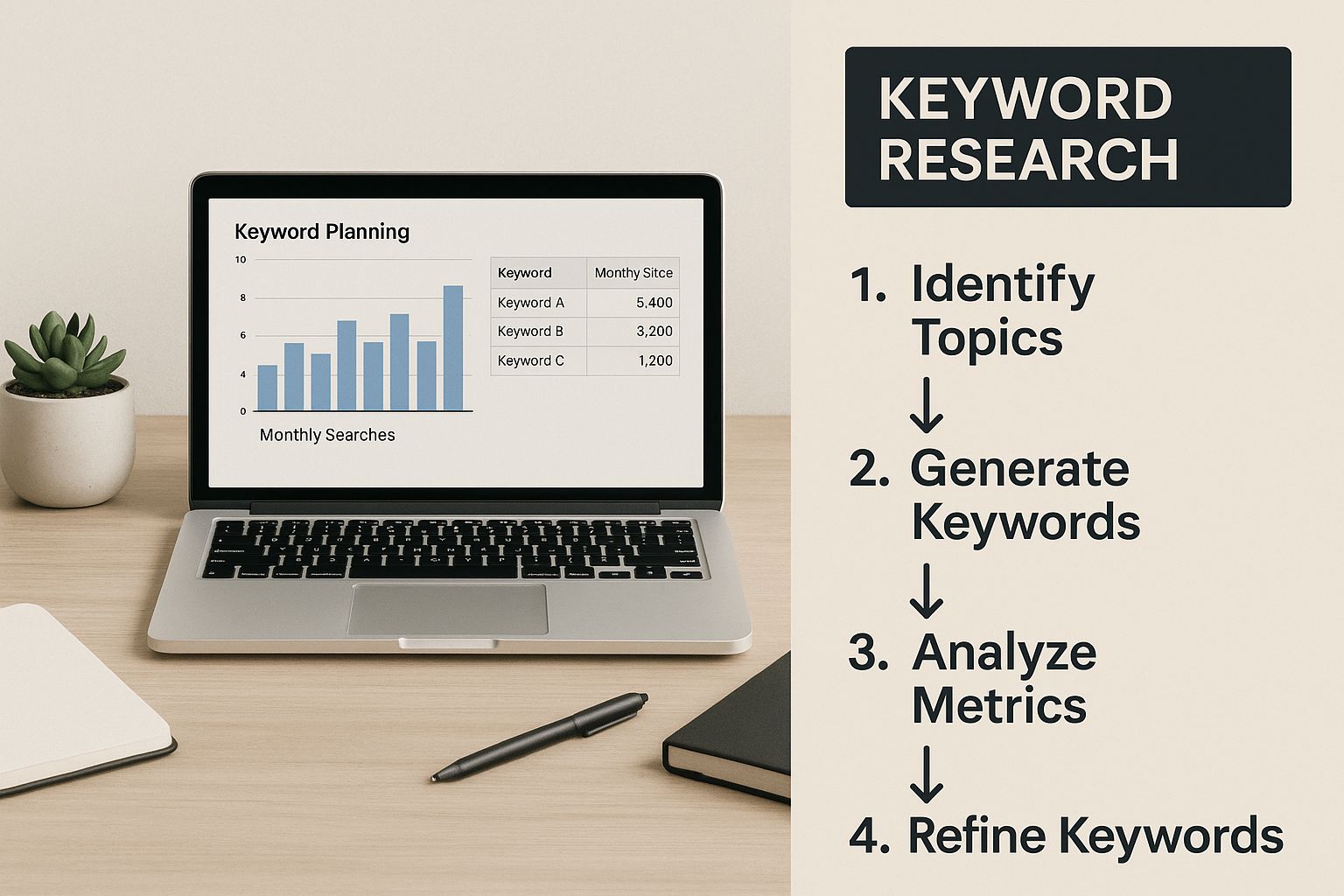
As you can see, a powerful keyword strategy comes from blending your initial brainstorm with data from proper tools and a peek at what your competition is doing. To really dig into the data, you’ll want to check out some of the best keyword research tools on the market—many have free versions that are perfect for getting started.
Okay, so you’ve got a big list of potential keywords. Now what? It's time to prioritise. You're looking for the sweet spot, which usually involves balancing two key things: search volume (how many people search for it each month) and competition (how hard it is to rank for). Ideally, you want terms with decent search volume and low competition.
Your goal isn't just to attract any traffic; it's to attract the right traffic. Targeting specific, intent-driven keywords ensures the visitors arriving on your site are much more likely to become paying customers.
Spying on your competitors is also one of the most effective tactics out there. See what keywords are already sending them traffic. This can uncover some brilliant opportunities you might have completely missed. If you’ve never done this before, learning https://virtualadagency.com.au/how-to-conduct-competitor-analysis/ is a fundamental skill that will pay off for years to come.
Finally, bring it all together in a keyword map. This is just a simple document that assigns a primary keyword (and a few related secondary ones) to each important page on your website. It keeps your efforts focused and strategic.
For an electrician in Adelaide, it might look something like this:
This map becomes your SEO blueprint, making sure every page and every piece of content you create has a clear purpose and targets a specific customer search.
Alright, you’ve got your keywords. Now for the fun part: putting them to work on your website. This is what we call on-page SEO, and it's less about 'optimising' and more about making it crystal clear to Google what each page is actually about.
Forget everything you've heard about "keyword stuffing." The real goal here is to create pages that are genuinely helpful for your visitors, using the same language they do when they search. Each page should have a distinct purpose – your homepage might target a broader term, while a specific service page should be laser-focused.
Let's ground this in a real-world scenario. Imagine you're a plumber in Perth, and you want your service page to rank for "hot water system repair Perth". There are three mission-critical places where this keyword (or a close variation) needs to show up.
Getting these three elements right creates a seamless and reassuring journey for a potential customer, from their initial Google search all the way to your website.
If you remember one thing, make it this: write for humans first, Google second. Your top priority is to create clear, helpful content that solves a problem. Google’s entire business model is built on finding the best answer for its users, so when you do that, you're already playing on the right team.
To help you keep track, here's a quick-reference table that breaks down the most important on-page elements you should be focusing on for every key page of your website.
| Element | Purpose | Best Practice Example |
|---|---|---|
| Title Tag | The clickable headline in search results. The #1 on-page factor. | Hot Water System Repair Perth | Same-Day Service |
| Meta Description | The descriptive text below the title. It entices users to click. | Fast, reliable hot water system repairs across Perth. Call our licensed plumbers for a free quote today! |
| H1 Heading | The main headline on your page. Confirms the page's topic. | Expert Hot Water System Repairs in Perth |
| Subheadings (H2, H3) | Break up content and improve readability. | Common Hot Water System Problems |
| Body Content | The main text. Naturally include your keyword and variations. | Our team can fix any hot water issue, from a leaking tank to no hot water at all... |
| Internal Links | Links to other relevant pages on your own site. Spreads authority. | ...we also offer expert <a href="/gas-fitting-services">gas fitting services</a>. |
| Image Alt Text | Describes an image for search engines and visually impaired users. | plumber-fixing-a-rheem-hot-water-system-in-perth |
Think of this table as your pre-flight checklist before you publish any new page or piece of content.
Beyond the main headlines, how you structure the rest of your page content really matters. Use subheadings (like H2s and H3s) to break your text into logical, scannable sections. No one wants to read a giant wall of text.
For our Perth plumber's page, they could use H2s like "Common Hot Water System Problems" or "Our 5-Step Repair Process". This not only makes the page easier to read but also creates natural opportunities to include related terms like "leaking tank," "pilot light out," or "no hot water."
Another powerful but often overlooked tactic is internal linking. It's as simple as it sounds: linking from one page on your site to another relevant page. On the hot water repair page, you could naturally link out to your "Gas Fitting Services" page. This does two brilliant things: it helps visitors discover more of what you offer, and it helps Google understand how your pages are related, which can boost the authority of your entire site. Getting this right is a fundamental part of improving your site's overall https://virtualadagency.com.au/seo-ranking-the-path-to-the-top-page/.
Finally, just like a car, your website needs a regular tune-up. To keep things running smoothly, it's smart to perform occasional check-ups. If you're using WordPress, a comprehensive WordPress website audit checklist is a fantastic resource for spotting technical glitches that could be quietly hurting your rankings.
For most small businesses, the real battle for customers isn't fought on a national stage—it’s won right on your own street. This is where your Google Business Profile (GBP) comes in, and frankly, it's the single most important tool you have for local SEO. A well-tended profile is your ticket to the top of the search results in that highly-coveted "map pack".
Think of your GBP listing as your digital shopfront. It's often the very first impression a potential customer gets of your business. An incomplete or neglected profile is just like a physical store with a dusty window and a flickering sign—it doesn't exactly scream "come on in".
Look, just claiming your profile is table stakes. The real magic happens when you start treating it like the active, dynamic marketing channel it is. This means digging into the details and using every single feature Google offers to show off what you do and earn people's trust.
Let's start with your business categories. Don't just pick one and call it a day. Google lets you choose a primary category and then add several secondary ones. So, if you run a café in Adelaide, don't just list "Café." You should also be adding "Coffee Shop," "Breakfast Restaurant," and "Lunch Restaurant" to cast a much wider net for all sorts of local searches.
Your business description is another piece of prime real estate. You get 750 characters to tell your story and explain why you’re the best choice. This is the perfect place to naturally work in your main local keywords, like "artisan sourdough Adelaide" or "pet-friendly café."
Your Google Business Profile isn’t a set-and-forget task. Treat it like a living, breathing part of your business that rewards regular attention. The more you put into it, the more Google sees you as a relevant, active player in the local community.
Google’s algorithm loves fresh content, and your GBP is no different. Get into the habit of regularly uploading high-quality photos. I’m talking about great shots of your storefront, your team in action, your products, and happy customers (always with their permission, of course). Photos are powerful proof that you're a real, thriving business.
Make use of the Google Posts feature. It's a fantastic way to share quick updates, announce special offers, or highlight new products right on your profile. A simple post about a "Weekend 2-for-1 Coffee Special" can be the final little push a local needs to drop by.
The Q&A section is another goldmine that’s often overlooked. People ask really important questions here, like "Do you have wheelchair access?" or "Is there parking nearby?" Answering them quickly shows you’re on the ball. Better yet, you can be proactive and post your own frequently asked questions and answer them yourself, clearing up common queries before they're even asked.
And then there are customer reviews—the absolute lifeblood of local SEO. Positive reviews are a massive ranking signal and provide incredible social proof. You need to build a simple process into your business for encouraging happy customers to leave a review. Make sure you respond to every single one, good or bad. A thoughtful, professional response to a negative review can often do more to win over future customers than a dozen five-star ratings.
The payoff for getting this right is huge. Here in Australia, local SEO is responsible for about 28% of all search traffic and converts three times better than standard organic search. With searches including "near me" having skyrocketed by 500% since 2015, optimising for your local area isn't just a good idea—it's essential. You can discover more about the power of local search on searchresults.com.au.
‘Link building’ often sounds like some mysterious, technical SEO task. But really, it’s quite simple. A backlink is just a link pointing from someone else's website to yours.
Think of each quality backlink as a vote of confidence. When another site links to you, it’s telling Google that your business is a credible and trustworthy resource. This is a massive part of a solid small business SEO strategy.
The key word here, though, is quality. A single link from a well-respected website in your industry is worth far more than a hundred links from random, spammy sites. The goal isn’t to collect as many links as possible; it’s to earn the best ones.
As a local business, your biggest advantage is your connection to the community around you. You don’t need to worry about complex global link-building schemes. Start by simply building on the relationships you already have.
Here are a few practical ideas that I've seen work time and time again:
See the common thread? It’s all about creating real-world value. When you’re an active participant in your community, you’ll find that link-building opportunities pop up naturally. You're basically just translating your offline reputation into online authority.
Another powerful way to get backlinks is to create something genuinely useful that people will want to share and reference. This is less about actively asking for links and more about earning them organically.
Think about the unique knowledge you have. What could you create that would genuinely help your customers or even other local businesses?
For instance, a real estate agent in a specific suburb could create the ultimate guide to local schools. They could include catchment zones, special programs, and parent reviews. This becomes an invaluable resource that parent blogs, community Facebook groups, and even other businesses would be happy to link to without you even asking.
Honestly, the most effective link-building strategy is to stop thinking about links. Instead, focus on creating fantastic resources and building genuine relationships. The links will follow as a natural result of your hard work.
When you do find a great opportunity to get a link, a simple and polite outreach email is all it takes. There’s no need to overcomplicate it.
Simple Outreach Template:
Subject: Quick question about [Their Website Name]
Hi [Name],
My name is [Your Name] and I'm the owner of [Your Business Name] here in [Your Town].
I was just on your site and saw your fantastic page listing local community partners. We recently sponsored the [Local Event/Team Name] and were wondering if you might consider adding a link to our website?
Either way, keep up the great work!
Cheers,
[Your Name]
This approach is personal, direct, and respectful. It frames the request around mutual community involvement, which makes it a much easier 'yes' and a core part of smart small business SEO.
So, you’ve put in the work. How do you know if any of it is actually paying off? Measuring your SEO success is non-negotiable, but it's incredibly easy to get bogged down in a swamp of data. The trick is to sidestep the ‘vanity metrics’ and laser-focus on the numbers that directly feed your bottom line.
Your two best friends here are going to be Google Analytics and Google Search Console. They’re free, and they tell you everything you need to know, from how people are finding you to which search terms are bringing in the best customers. You don't need to be a data scientist; just get familiar with a few key reports.
Forget obsessing over how many people visited your site today compared to yesterday. Instead, concentrate on the data that proves your small business SEO is delivering a real, tangible return on your investment.
These are the numbers that truly count:
This Google Analytics dashboard gives a fantastic bird's-eye view of where your website visitors are coming from.
You can see right there how "Organic Search" is a primary source of users, showing the direct impact of a solid SEO strategy.
Proving ROI is everything. When you set up proper conversion tracking, you can confidently report, "Our SEO work last month led directly to 15 new quote requests and 25 phone calls." That’s the kind of language that shows real business value, not just website traffic.
You can set these goals up right inside Google Analytics, giving you a clear window into how many leads your website is generating from search.
Of course, there are plenty of brilliant platforms out there to make monitoring this data easier. If you want to go a bit deeper, it's worth exploring some of the best SEO tools for agencies and businesses that can streamline your tracking and offer more detailed insights. This kind of data-driven approach turns SEO from a guessing game into a predictable engine for growing your business.
If you're diving into SEO for your small business, you've probably got a few questions buzzing around. It's completely normal. Here are some straight-shooting answers to the questions we hear most often from business owners.
I get it, you want to see a return on your time and effort. SEO is more of a long-term play than a quick win. While fixing a few technical snags might give you a small, fast boost, you should really plan on seeing significant, tangible results within about four to six months.
This isn't a hard and fast rule, of course. How competitive your industry is, your starting point, and how consistently you work on it all affect the timeline. Think of it as building a strong foundation for your business's future online.
Yes, you absolutely can. A lot of the foundational stuff we've covered in this guide – finding the right keywords, optimising your pages, and keeping your Google Business Profile updated – is well within reach for any hands-on business owner.
Don't feel like you have to be an expert overnight. Just start with the basics and be consistent. That’s the real secret.
Honestly, the biggest mistake is doing nothing at all. Even dedicating just a few hours a month to SEO will put you leagues ahead of competitors who are still on the sidelines.
This is the classic "how long is a piece of string?" question, but let's break it down. If you go the DIY route, your main cost is your own time. If you decide to bring in professionals, the cost can range from a few hundred dollars to several thousand per month, depending on the scope.
My advice? Start with what you can comfortably manage, whether that's a few hours of your time or a modest budget for a freelancer. Track your results closely, and as you start to see that investment pay off in new customers, you can scale up.
Ready to stop guessing and start growing? The expert team at Virtual Ad Agency can build a powerful SEO strategy that drives real customers to your door. Get in touch with us today for a free consultation!

 previous