
Media planning and buying lays out exactly where, when and how your ads reach the right people—making sure every dollar drives you closer to your goal.
Think of it as plotting a cross-country road trip: you research the route, budget for fuel, choose the best roads, negotiate tolls and then keep an eye on your mileage.
When you’ve nailed down your destination (your campaign goal), the journey becomes clear. Early research reveals where your audience hangs out—online and off—and uncovers what competitors are doing and what each channel costs. This groundwork steers every decision:
Budget is your fuel. You spread funds to balance awareness, frequency and conversions—and avoid running dry halfway through.
Choosing channels is like picking roads. A highway delivers mass reach (TV, video), while side streets offer precision (search, native ads). Blend them for the smoothest ride.
Now you haggle over toll fees and lock in your spots. Strong negotiation can score premium positions at better rates. Upfront buys and programmatic auctions each have their pros and cons.
Once you’re on the road, you track fuel efficiency. Dashboards display clicks, conversions and spend by channel. These insights help you reroute or adjust speed.
Key takeaway: Keep an eye on real-time data to dodge budget blowouts and stay on track.
The infographic below brings these steps to life:
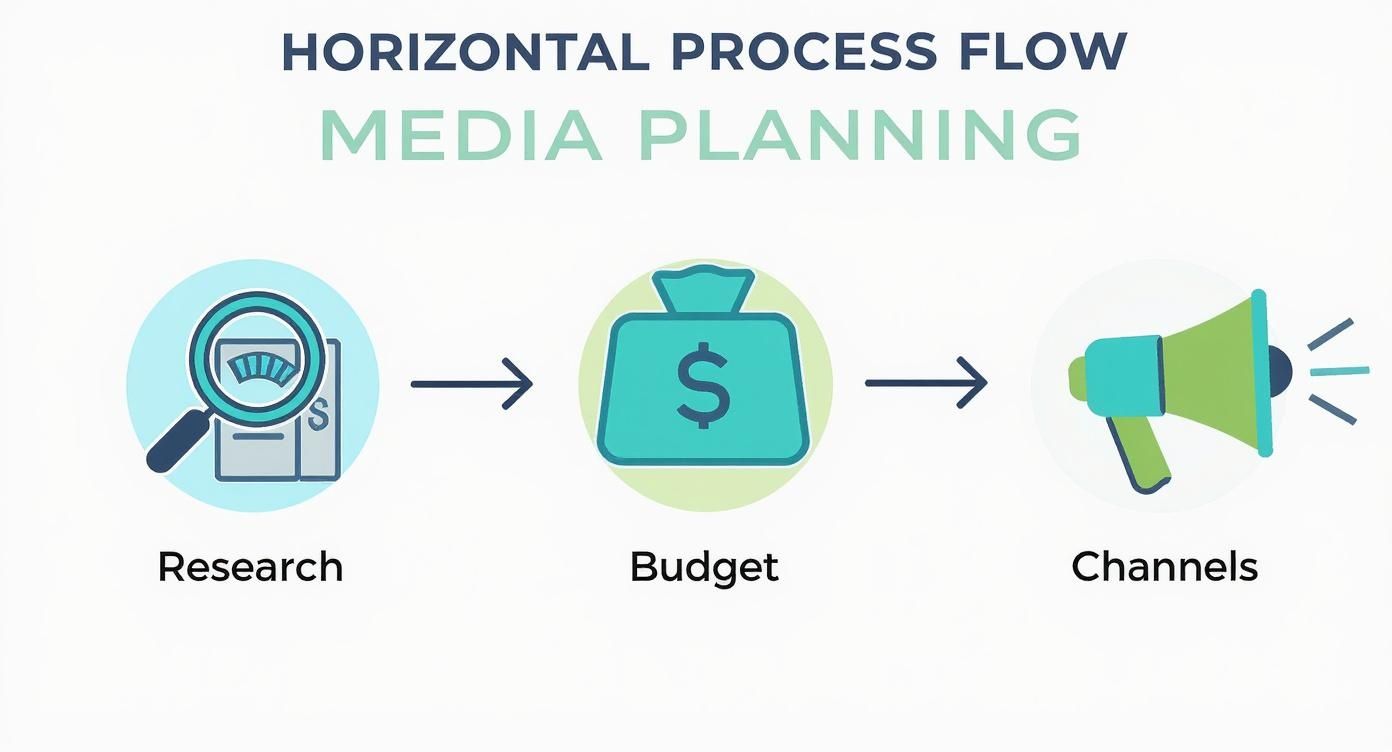
It shows how research, budgeting and channel choices connect in sequence to boost ad-spend efficiency.
Imagine driving from Sydney to Perth. You map out fuel stops, plan your budget and pick highways that bypass roadworks. You pre-buy toll passes for discounts, then watch your fuel gauge to avoid surprises.
Effective media planning and buying transforms spend into real results. When you know exactly where your audience is, you cut wasted impressions. For example, targeting shoppers with retail media can deliver a 18% lift in online sales.
Medium and large organisations juggle complex product lines and markets. A clear, repeatable process keeps teams aligned and budgets visible. Agencies like Virtual Ad Agency build measurable growth by following each step precisely.
Though AI and programmatic tools will speed things up, the core roadmap stays the same: research, allocate, select, negotiate and measure.
Below is a quick reference table of these stages. Keep it handy the next time you plan a media campaign.
Summary Of Media Planning And Buying Stages
| Stage | Primary Activity | Objective |
|---|---|---|
| Research | Audience profiling and market analysis | Discover where and how to reach your audience |
| Budget | Spend allocation and pacing | Balance reach, frequency and conversion goals |
| Channels | Channel mix selection | Match audience behaviour and intent |
| Buying | Negotiation and placement | Secure top positions at the right price |
| Measurement | Tracking and attribution | Optimise performance and prove ROI |
With this roadmap in hand, your team gains clarity, avoids wasted spend and builds a foundation for consistent, measurable media success.
Every successful media plan is built on a solid foundation of research. Skip this step, and you might as well be throwing your ad budget into the wind. Good research is what separates a targeted media buy that lands perfectly from a scattergun approach that hits nothing.
Think of it this way: a market scan shows you what your competitors are doing, where they're spending, and what it's costing them. This isn't about copying them; it's about finding gaps and opportunities they've missed, which informs your own channel choices and how you split your budget.
To get a complete picture of the market, you need to look in two places: directly at your potential customers and at the wealth of information that’s already out there. These primary and secondary research methods work together to paint a crystal-clear picture.
Primary research is all about getting answers straight from the source. Surveys, for example, can tell you exactly what motivates your customers. On the other hand, secondary sources like industry reports and public data give you the broader context without having to start from scratch. Auditing a competitor’s advertising is another fantastic tactic – it reveals their messaging, their offers, and sometimes even hints at their rate structures.
Some go-to research methods include:
"Effective research drives targeted media buys rather than scattershot ad placements."

Once you have the data, it's time to bring it to life with customer personas. These aren't just vague descriptions; they're detailed profiles of your ideal customers that guide your tone of voice, creative direction, and even the platforms you choose.
A well-crafted persona acts as a north star for your entire campaign. For instance, if you're targeting a budget-savvy shopper, you know they'll likely be found on price comparison sites. These profiles should include demographic data, digital habits, and the specific pain points your product solves.
Key persona components usually cover:
For medium-to-large businesses, these detailed personas are invaluable. They get everyone, from marketing to sales, on the same page, speaking the same language about who you're trying to reach.
In Australia, retail media networks are completely changing the game. The ability to use product-level insights to shape your media mix is a massive advantage. It’s no surprise that seven in ten advertisers have recently increased their investment here.
This shift has changed how budgets are sourced. A recent IAB report shows that budgets are increasingly drawn 35% from reallocated funds and 19% from new funds specifically to drive sales and purchase intent.
Investment in retail media is often funded by shifting existing budgets, rather than creating entirely new ones. Here's a typical breakdown of where the money comes from.
| Investment Source | Percentage |
|---|---|
| Existing Trade Spend | 46% |
| Reallocated Budget | 35% |
| New Funds | 19% |
This data shows that nearly half of all retail media spend comes from existing trade marketing budgets, highlighting its growing importance as a core sales channel.
Working closely with retail platforms is key. When you treat them as partners, data sharing improves dramatically. For example, feeding real-time search triggers from a retailer’s site into your programmatic bids can lift conversion rates by over 12%.
Personas are great, but they're still quite broad. The next step is to slice them into actionable audience segments. By grouping users with shared traits, you can tailor your creative and messaging with incredible precision.
Common segmentation tactics include:
And you don't have to stop there. Layering these segments adds another level of accuracy. Imagine combining purchase history with location data to push a highly relevant regional offer – that’s the power of smart segmentation.
This is where it all comes together. Your research findings should directly inform how you allocate every single dollar. If your data shows young urban males are glued to mobile games, it makes perfect sense to put more of your budget into in-app advertising inventory.
Here’s a simple process to link your research to your spending:
By letting the data guide your decisions on timing, creative, and bidding, you drastically reduce wasted impressions and give your ROI a serious boost.
Insight: The stronger your research and segmentation, the more efficient your media planning and buying becomes.
You don't have to do all this work manually. There are plenty of platforms that can speed up your research and targeting by pulling all your data into one place.
Tools like Google Analytics are brilliant for seeing how users move across your different channels. Social media dashboards give you a real-time pulse on brand sentiment and trending topics, letting you tweak your creative right before a campaign goes live.
When you combine these tools with your personas and segments, you can automate the creation of audiences in your ad platforms. This not only saves a massive amount of time but also makes your entire media planning and buying cycle much faster and more responsive.
In short, deep research and pinpoint targeting are what turn a standard media plan into a powerful revenue-generating engine. With this foundation in place, you're ready to move on to negotiating the best deals and building the perfect channel mix.
Once your groundwork is done and you know exactly who you’re speaking to, the next phase is all about locking in the right ad spots—without blowing up your budget. This step blends negotiation skills with a clear view of your data. Nail it, and your media plan delivers real value.
Think about it like planning a holiday: you could snap up a bargain at the last minute, or book a full package months ahead. Both get you where you want to go but with different trade-offs around price, flexibility and certainty. You’ll face a similar choice when weighing up direct deals against programmatic buying.
Media buyers mainly work with two strategies: direct deals and programmatic auctions. Neither is inherently better; each shines in different scenarios.
Direct deals mean sitting down with specific publishers—perhaps a well-read news site or an industry blog—and negotiating placement, price and extras in advance. This route is perfect for grabbing premium inventory and locking in guaranteed eyeballs.
Programmatic buying, on the other hand, uses tech to bid on ad slots in real time. For an in-depth look at this process, check out what programmatic advertising is. It’s ideal for reaching precise audience slices at scale, across thousands of websites and apps.
Key Insight: Blend direct buys for high-impact visibility with programmatic auctions for broader reach and agility.
Whether you’re hammering out a direct deal or setting up a programmatic auction, you bring your research to the table. Know your benchmarks: what’s a reasonable cost per impression or click in your industry?
Then, look beyond price. Publishers often have wiggle room to include perks that boost your campaign’s effect without hiking your spend:
Approach negotiations as a partnership, not just a transaction. When both sides win, you secure better value and foster stronger relationships.
A robust media plan is like a diversified investment portfolio. Relying too heavily on one channel—say, social or search—can expose you to platform shifts or audience fatigue.
Instead, spread your budget across channels that serve different stages of the customer journey:
In Australia, social media now accounts for 29% of total digital ad spend, rising from US$4.73 billion in 2025 to more than US$6 billion by 2030. These figures reinforce why social platforms deserve a strategic slice of your budget.
Below is a handy comparison to guide your choice between programmatic and traditional direct buying. Understanding these distinctions makes it easier to craft a media plan that ticks all the boxes.
Programmatic Versus Traditional Buying
| Buying Method | Description | Typical CPM Range | Primary Benefit |
|---|---|---|---|
| Programmatic | Automated, real-time bidding for ad space across networks. | $2 – $15 | Efficiency, pinpoint audience targeting and scale |
| Traditional Direct | Manual negotiation with individual publishers for specific slots. | $10 – $50+ | Guaranteed premium inventory and strong visibility |
While programmatic offers cost-effective scale, direct buys secure those prime spots your brand needs for maximum impact. A smart strategy weaves both approaches into a cohesive plan.
By mastering negotiation, mixing channels wisely and understanding your buying options, you’ll set the stage for a media campaign that delivers measurable, lasting results.
So, you’ve secured the perfect ad placements. Great start, but that's just the beginning. The real work kicks off with campaign trafficking—the nitty-gritty process of getting the right creative in front of the right eyeballs at exactly the right moment. This is the technical backbone of your whole media buy, where your beautifully crafted plan finally becomes a live, breathing campaign.
Think of a campaign trafficker as an air traffic controller for your ads. They aren't flying the plane (designing the creative), but they're managing all the flight paths, schedules, and destinations to make sure everything gets where it needs to go without a hitch. Using specialised ad-serving platforms, they upload all the creative assets, lock in the start and end dates, and apply the specific targeting parameters we figured out back in the planning stage.
This is what ensures a user in Sydney sees a different offer from someone in Melbourne, or that a weekend-only promotion actually runs just on Saturday and Sunday. Without precise trafficking, even the most brilliant creative and the smartest media plan will fall completely flat.
Once a campaign is live, the game shifts to optimisation. This isn't a "set and forget" exercise; it's a constant cycle of monitoring, analysing, and refining. You're tuning your campaign like a high-performance engine, always making small adjustments to squeeze out more efficiency and better results.
True optimisation is an active process. By monitoring real-time data, you can pivot quickly, reallocating budget from underperforming ads to proven winners and maximising your return on ad spend.
This optimisation cycle is built around a few key activities:
For example, in our own work with social media advertising services, we've found that simply rotating the main visual every two weeks can lift engagement by over 15%. It's these small, consistent tweaks that add up.
These days, modern media buying leans heavily on artificial intelligence to automate and sharpen the optimisation process. AI algorithms can crunch thousands of data points in seconds, spotting trends and making recommendations far faster than any human could. For any real, ongoing success, continuous improvement is vital, and there are many campaign optimization strategies you can explore to refine your approach.
These systems help fine-tune your audience reach by identifying new, high-potential segments you might have missed. They can even start to predict which creative combinations are most likely to click with your audience before you've spent a dollar. It's a proactive approach that helps head off common problems like poor budget pacing or low ad quality scores, ensuring your campaign runs at peak performance from day one.
Launching a campaign without a solid measurement plan is like flying blind. Sure, you’ll see plenty of activity, but you'll have no real idea which of your efforts are actually lifting you higher and which are just burning fuel. This is where effective measurement and attribution come in – they’re what connect your media spend directly to business outcomes, proving what’s working and what’s not.
The whole process boils down to answering the most critical question in media planning: which touchpoints actually deserve credit for a conversion? Think of it like a detective piecing together clues from a customer's journey. Did that first ad they saw on social media plant the seed, or was it the final search ad that finally sealed the deal?
Attribution models are simply the frameworks we use to assign this credit. Each one offers a different perspective on that customer journey, and picking the right one comes down entirely to what you're trying to achieve with your campaign.

Getting your head around how different models assign value is the first step towards reporting you can actually trust. The simpler models are a breeze to implement, while the more complex ones give you much deeper, more nuanced insights.
Choosing an attribution model isn’t just a technical box to tick; it’s a strategic one. The model you select will directly influence how you value each channel and, ultimately, where you decide to allocate future budgets.
For a truly complete picture, many organisations are looking beyond standard attribution to more advanced methods. These approaches paint a much clearer picture of your marketing’s total impact.
Data-Driven Attribution is a game-changer. It uses machine learning to analyse every single converting and non-converting path, automatically assigning credit based on which touchpoints have the greatest statistical impact. It takes the guesswork out of the equation and adapts on the fly to changing user behaviour.
Media Mix Modelling (MMM), on the other hand, takes a top-down view. It crunches historical data to figure out how different marketing inputs—including offline channels like TV and radio—contribute to sales. MMM helps you answer the big-picture questions about how to best slice up your budget across your entire portfolio. To really get under the hood of campaign impact, it’s worth exploring the different methodologies of advertising effectiveness measurement.
You can't measure what you don't track. Accurate measurement is built on a rock-solid tracking infrastructure. This means correctly implementing tracking pixels, using consistent UTM parameters across every single campaign, and integrating your analytics platforms with your CRM. Getting your offline sales data to talk to your digital analytics is absolutely crucial for creating a single source of truth you can rely on.
This is where performance dashboards become your best friend. They visualise all this data, letting you monitor key metrics like cost per acquisition (CPA) and return on ad spend (ROAS) in real time. This allows you to make smart, informed optimisations while the campaign is still live, rather than waiting until it’s all over to figure out what went wrong.
And if you’re tracking campaigns based on visibility, understanding the cost per impression formula is fundamental to gauging efficiency. When you master measurement, you can confidently communicate your campaign’s ROI and justify every single dollar you spend.
Even the most carefully crafted media planning and buying campaigns can hit a wall. In our experience, it's usually the same handful of common tripwires that bring them unstuck.
These aren't complex, high-level strategic failures. They're fundamental oversights: casting the net too wide with audience targeting, putting all your eggs in one channel's basket, skipping creative testing, and walking into negotiations unprepared.
Let’s break down how to sidestep these classic blunders.
Lumping your entire audience into broad categories like "males 25-54" is a recipe for irrelevance. It's the marketing equivalent of shouting into a crowded room and hoping the right person hears you.
When your message is generic, it simply doesn't connect. It becomes background noise.
Smart agency teams get granular. They build out detailed personas using checklists and data triggers to pinpoint exactly who they're talking to.
Going all-in on one platform—whether it's Facebook, Google, or TikTok—feels simple, but it's a massive gamble. When that platform’s algorithm changes overnight or your costs suddenly skyrocket, your entire campaign can grind to a halt.
Diversifying your channels is your insurance policy. It protects you against volatile performance and rising costs, giving you other avenues to reach your audience.
We use channel mix templates to strike the right balance between broad reach and surgical precision, making sure no single point of failure can derail the whole strategy.
Key takeaway: A diverse channel portfolio isn't just a good idea—it's what keeps a campaign agile and resilient enough to weather any storm.
Running a campaign with just one ad creative is like walking into a pitch with only one slide. You're banking everything on a single idea, and you have no idea if it will actually resonate with anyone.
Proper testing frameworks allow teams to iterate fast, pitting different visuals, headlines, and calls-to-action against each other to see what truly moves the needle.
Walking into a media buy without a clear plan is a surefire way to overpay for lacklustre placements. Too many teams accept the first offer, not realising how much value they're leaving behind.
Structured negotiation templates give agencies a playbook for securing better deals. It’s not about being aggressive; it’s about being prepared.
Anticipating challenges is what separates a good media plan from a great one. We build contingency plans from day one, with fallback budgets and alternative creative concepts ready to deploy.
Agencies can operationalise this by using standardised checklists to flag each of these common mistakes before they happen.
Templates for segmentation, channel mix, and testing don't just prevent errors; they accelerate launch times. A solid negotiation playbook empowers even junior team members to bargain from a position of strength.
Always have a contingency roadmap ready. You need to be able to switch tactics without missing a beat.
These aren't just documents; they're the tools that keep a campaign on track. By spotting these mistakes early, you protect your budget and give your performance a serious boost.
Got questions about the nuts and bolts of media planning and buying? Let's clear up some of the most common ones with straightforward answers.
Think of media planning as drawing up the architectural blueprints for a house. It’s the strategic part—the "where, when, and who." This is where all the research happens. We dig into your target audience, figure out your campaign goals, and map out the best channels to reach the right people at the right time.
Media buying, on the other hand, is the construction crew bringing those blueprints to life. This is the execution phase, the "how much and what." It's all about negotiating rates, purchasing the ad space, and making sure every single ad runs exactly as planned. One is the strategy, the other is the action.
It's less about "either/or" and more about "when and why." Programmatic buying uses sophisticated automation to purchase ad space in real-time. It’s incredibly efficient and lets you target very specific, niche audiences across millions of websites. If you need scale and precision, programmatic is your go-to.
Direct deals are more of a handshake agreement. You negotiate directly with a specific publisher for premium, guaranteed ad placements on their site. This gives you far more control and visibility, which is perfect for high-impact campaigns where you need to ensure your brand appears in a top-tier, brand-safe environment.
A balanced approach is often the smartest move. Use direct buys for that guaranteed impact on premium sites, and let programmatic do the heavy lifting for efficient, scalable reach across the wider web.
Measuring return on investment (ROI) properly means looking beyond the last click. We use what's called a multi-touch attribution model. Instead of giving 100% of the credit to the final ad a customer clicked before buying, these models distribute that credit across every touchpoint that influenced their journey.
This gives you a much truer picture of how different channels work together. You can see how a social media ad created initial awareness, a blog post nurtured interest, and a search ad finally closed the deal. By tracking everything with consistent UTM parameters and pulling it all into one central dashboard, you can see which combinations are actually driving results and shift your budget to what works.
Keeping a lid on spending comes down to proactive management, not reactive panic. It starts with a detailed budget that carves out specific funds for each channel and campaign—no vague slush funds. Then, we use pacing tools inside the ad platforms to keep a close eye on daily and weekly spend, making sure it's tracking against our targets.
We also set up automated alerts that ping us if spending is about to tip over a certain threshold. And finally, we always build in a small contingency fund, usually around 5-10% of the total budget. This little buffer allows us to jump on unexpected opportunities or manage performance hiccups without blowing up the whole plan. It’s all about staying in control.

 previous