
Figuring out the best time to post on TikTok in Australia is a bit like being a surfer trying to catch the perfect wave. You need to know when the tide is high and the swell is just right. For TikTok, that "perfect wave" usually rolls in during the late morning between 10 AM and 12 PM, and again in the evening from about 8 PM to 10 PM. These are the golden hours when most Aussies are taking a break and scrolling through their feeds.
Timing your posts isn't just a minor detail; it's a massive part of the game. Think of it like opening a pop-up shop in a busy city square. You wouldn’t set up at dawn when the streets are empty. You want to be there right when the lunchtime and after-work crowds start pouring in.
On TikTok, those digital crowds gather at pretty predictable times that line up with daily life. The late morning slot catches people on their smoko or coffee break, and the evening window is prime time for that post-dinner, feet-up-on-the-couch scrolling session.
Getting this right is a cornerstone of any solid social media marketing strategy. It’s all about meeting your audience exactly where they are, right when they’re most open to seeing what you've got. Posting during these peak times gives your content an instant head start, making it far more likely to get seen, liked, and shared from the moment it goes live.
The logic here is pretty simple and grounded in human behaviour. That 10 AM to 12 PM window aligns perfectly with morning breaks and the lead-up to lunch. Later, the 8 PM to 10 PM slot captures the biggest chunk of the population as they unwind for the day, phone in hand.
Heaps of analysis backs this up. Across Australia, late mornings and evenings consistently come out on top, with Mondays and Fridays often showing an extra spike in engagement as people start or end their working week. In fact, some industry data shows that Tuesday mid-mornings can deliver a 3x boost in visibility, while Thursday evenings regularly pull in 2x to 3x higher engagement rates.
A killer TikTok strategy isn't just about making great content. It's about delivering that content at the precise moment your audience is ready for it. Think of it as a perfectly timed punchline—delivery is everything.
To help you hit the ground running, we've put together a general schedule based on these high-traffic periods. Think of this as your starting block. The real magic will happen once you start digging into your own analytics, but this gives you a solid foundation to build from.
Here’s a day-by-day breakdown of recommended posting times to help you start testing what works best for your brand and your specific audience.
| Day of the Week | Morning Slot (High Engagement) | Afternoon Slot (Good Engagement) | Evening Slot (Peak Engagement) |
|---|---|---|---|
| Monday | 10:00 AM | 4:00 PM | 9:00 PM |
| Tuesday | 11:00 AM | 3:00 PM | 8:00 PM |
| Wednesday | 10:00 AM | 5:00 PM | 8:00 PM |
| Thursday | 11:00 AM | 4:00 PM | 9:00 PM |
| Friday | 10:00 AM | 3:00 PM | 7:00 PM |
| Saturday | 11:00 AM | 5:00 PM | 8:00 PM |
| Sunday | 10:00 AM | 4:00 PM | 7:00 PM |
Note: All times are based on AEST/AEDT.
Use this table as your launchpad, not the final word. Pay close attention to your own TikTok Analytics to see when your followers are most active and adjust accordingly.
While this guide is tailored for Australia, it’s always smart to keep an eye on broader trends. For a wider global perspective, checking out guides on the general best time to post on TikTok can offer some valuable extra context.
Timing your posts on TikTok isn't just about ticking a box on your to-do list; it’s about giving the algorithm exactly what it wants to see. Think of the algorithm as a talent scout, constantly scanning for the next big thing. Its first clue that you've got a hit on your hands is how the audience reacts the moment a video goes live.
When you post while your Australian audience is actively scrolling, you kickstart a powerful snowball effect. This first wave of likes, comments, shares, and saves is what we call initial velocity. A strong start tells TikTok your content is a winner, which means it gets pushed onto more For You Pages (FYPs). It's like giving a rocket just enough fuel to break through the atmosphere; that initial thrust changes everything.
This strategy packs a serious punch in Australia because the audience here is incredibly locked in. And that's not just a gut feeling—the numbers tell the same story. Australian Android users spend an average of 38 hours and 51 minutes a month on TikTok. That’s a fair bit higher than the global average of 34 hours and 56 minutes.
This high level of activity means there’s a massive, attentive audience ready and waiting, but you have to show up when they're there. You can get a deeper look at these engagement patterns and discover more insights about the Australian TikTok landscape here.
Nailing the best time to post on TikTok in Aus isn't a minor tweak; it's a fundamental part of a winning strategy.
When you post at peak times, you’re not just throwing content into the void and hoping for views. You're strategically placing it in front of a highly active audience, feeding the algorithm the positive signals it needs to give your content a serious boost.
Those first 60 minutes after you hit 'post' are make-or-break. The algorithm is watching your video's performance like a hawk during this period. A video that pulls in a hundred likes in its first hour is far more likely to get promoted than one that takes all day to hit the same number.
Here’s a quick look at how it all unfolds:
Getting this cycle right is how you go from a few hundred views to unlocking your viral potential.
Posting to a national Aussie audience comes with a unique headache that creators in many other countries just don't have: a continent split across multiple time zones. If you just post based on Sydney time, your brilliant new video could land with a thud for your followers in Perth. Getting your head around this geographical spread is non-negotiable if you want to find the best time to post on TikTok in Aus.
Australia is carved up into three main time zones. Understanding them is the first step to building a schedule that works for everyone, no matter where they are.
This timeline shows how one well-timed post can set off a chain reaction of engagement, kicking off that viral potential we're all chasing.
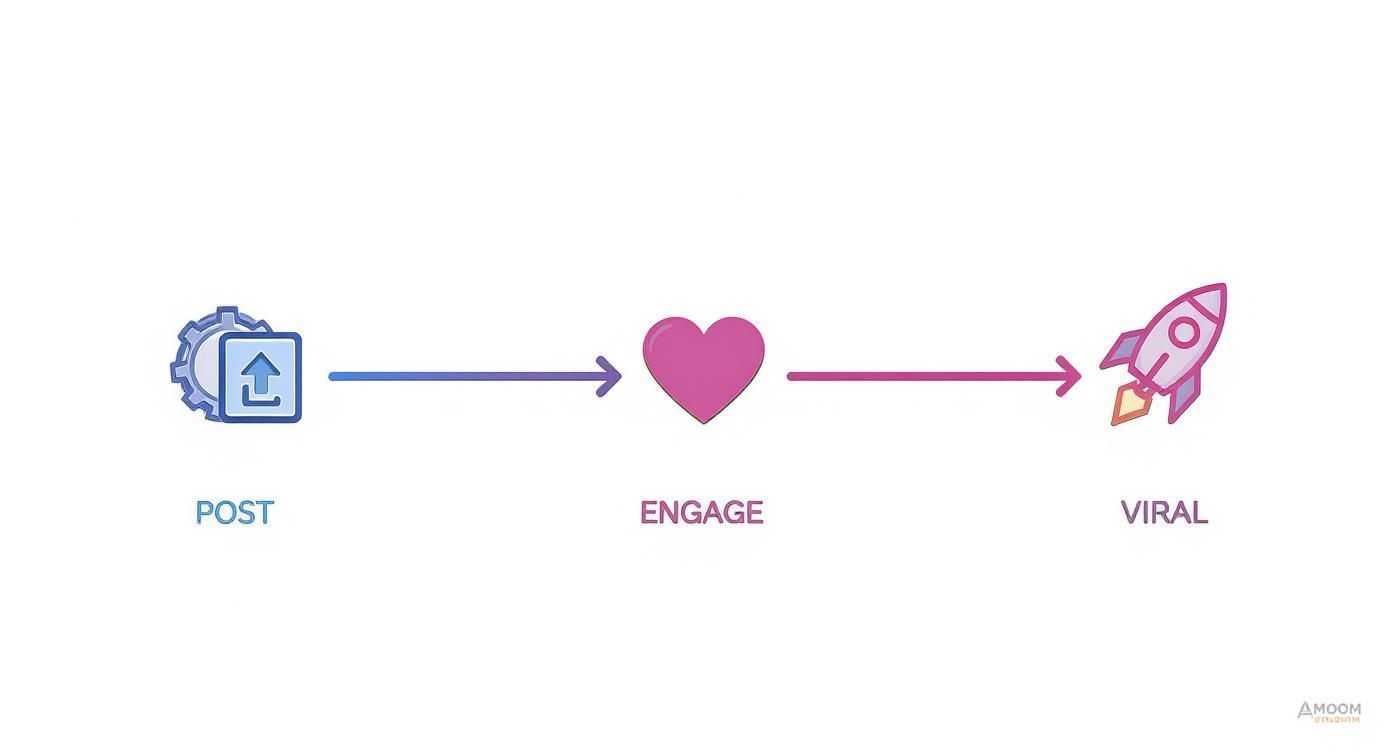
The visual really drives home that the initial upload is just the start. That first burst of likes and comments is the rocket fuel that launches a video into the feeds of a much wider audience.
So, how do you pick a time that works across this vast landscape? The trick is to aim for a 'sweet spot' that catches the biggest slice of your audience when they're most active. This usually means prioritising the eastern states, where most of the population lives, without completely forgetting about your western audiences.
A post at 8 PM AEDT is a brilliant example of this in action. It perfectly hits that peak evening wind-down for people in Sydney and Melbourne. But at the same time, it’s 7:30 PM in Adelaide—still prime time—and 6 PM in Perth, catching people just as they’re logging off work and starting their nightly scroll. That single time slot effectively blankets the after-work prime time for the entire country.
Don't think of it as posting at one time; think of it as hitting multiple peak windows at once. The goal is to find the overlap where engagement potential is highest across the board.
The most straightforward approach is to anchor your schedule to AEST/AEDT. Since this time zone is home to roughly 80% of Australia's population, it simply gives you the biggest bang for your buck.
Here’s a simple way to tackle it:
By thinking nationally and using AEST/AEDT as your North Star, you can build a schedule that neatly bridges the time gap from coast to coast.
General advice on when to post is a fantastic starting point, but the real secret weapon for explosive growth is already at your fingertips. Your own audience data holds the key to unlocking the perfect time to post for your account. It’s time to stop guessing and start letting your analytics guide the way.
The first step is making sure you can actually see this goldmine of information. To do that, you'll need to flick your standard TikTok account over to either a Business or Creator Account. Don't stress, it's free and takes about thirty seconds. Just head to your profile, tap the three lines in the top-right corner, select 'Settings and privacy,' then 'Account,' and choose 'Switch to Business Account.'
Once that's done, you've unlocked a powerful suite of tools designed to give you a direct look into how your audience behaves.
With your Business or Creator Account up and running, navigate back to the 'Settings and privacy' menu and find 'Creator tools' or 'Business suite'. This is where you’ll find the 'Analytics' tab, which is where the magic really happens. Your main target here is the 'Followers' tab.
This is where you'll see a clear breakdown of who your audience is, including where they're from and, most importantly, when they're scrolling.
Keep an eye out for the 'Follower activity' section. It usually shows two simple but powerful graphs:
This screenshot shows the TikTok for Business interface, where you can access these powerful analytics to understand your audience.
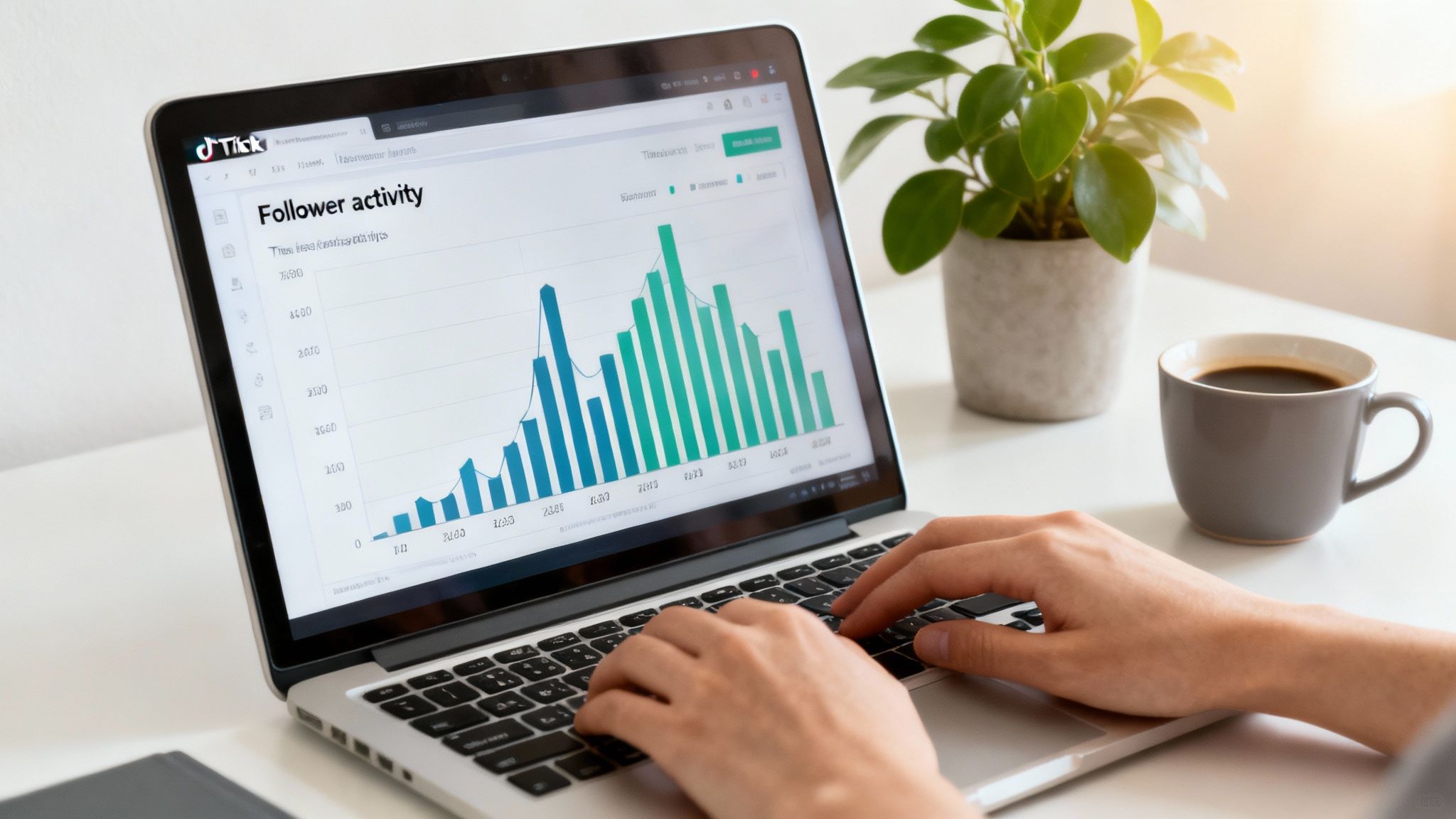
By digging into these charts, you can pinpoint the exact days and hours your specific followers are online and ready to see your content.
Right, let's turn those colourful graphs into an actual, actionable schedule. If your analytics show a huge spike in activity on Thursday nights at 8 PM and another on Saturday mornings at 11 AM, those are your new non-negotiable posting slots. Think of these as the times your content has the best possible chance of getting that critical initial push we talked about earlier.
Your analytics aren't just suggestions; they are a direct line to your audience's habits. Trusting your data over generic advice is the single biggest step you can take toward mastering the best time to post on TikTok in Aus for your unique brand.
For those who want to dig even deeper, you can supplement TikTok’s native tools with other resources. To really fine-tune your posting strategy, it's worth using dedicated TikTok account analysis tools. On top of that, pairing your manual analysis with the power of the best social media management tools can help automate scheduling and sharpen your approach even more. By combining native analytics with specialised software, you're building a data-driven content plan that consistently hits the mark.
Figuring out the perfect time to post for your audience isn’t a set-and-forget task; it’s more of a constant dance of testing and tweaking. Your analytics data is your dance partner, but you need a solid framework to turn those numbers into a smarter schedule. It’s time to think less like a casual scroller and more like a data scientist.
The core idea is beautifully simple: test, measure, and repeat. By systematically trying out different posting slots, you can swap out guesswork for hard evidence of what truly works for your audience. This is the secret sauce that separates creators who catch a lucky break from those who build lasting success.
The most powerful way to fine-tune your schedule is with a good old-fashioned A/B test. The goal here is to isolate the posting time as the only major variable, so you can clearly see what impact it has on your video’s performance. No fancy software needed—just a structured approach and a keen eye on your metrics.
Here’s a straightforward way to set it all up:
This head-to-head comparison gives you a crystal-clear picture of which time slot gave your content a stronger launch.
When you’re comparing your test videos, don’t just glance at the final view count. The early performance indicators are far more telling when it comes to finding the best time to post on TikTok in Aus.
Focus on the first few hours after posting. This 'golden window' is when the TikTok algorithm decides whether your content is worth pushing to a wider audience. Strong initial engagement is your ticket to the For You Page.
Specifically, you should be tracking these metrics:
By zeroing in on these early metrics, you can confidently pinpoint which posting times give your videos the best possible launchpad for success.
To keep your experiments organised, you can map out a simple testing plan. A structured approach ensures you’re making data-driven decisions, not just guessing.
| Day | Week 1 Post Time | Week 2 Post Time | Metric to Compare (e.g., Views in 1st Hour) |
|---|---|---|---|
| Monday | 7 PM AEST | 10 AM AEST | |
| Tuesday | 11 AM AEST | 8 PM AEST | |
| Wednesday | 5 PM AEST | 9 PM AEST | |
| Thursday | 8 PM AEST | 12 PM AEST | |
| Friday | 12 PM AEST | 6 PM AEST | |
| Saturday | 1 PM AEST | 7 PM AEST | |
| Sunday | 6 PM AEST | 2 PM AEST |
After running this two-week test, you'll have some fantastic data to compare. Look for the days and times that consistently produced higher initial views and engagement. This isn't about finding one single "magic" time, but about discovering a handful of powerful windows to build your content calendar around.
Nailing the best time to post on TikTok in Australia is a massive win, but it’s really only half the job. Think of it like a comedian telling a killer joke—the delivery and timing might be perfect, but if the joke doesn't actually resonate with the room, it's going to fall flat. Your content strategy needs that exact same level of thought.
Timing is at its most powerful when it’s paired with the right content for the right audience. It’s about looking beyond the clock and getting into the ‘who’ and ‘what’ of your strategy, creating a powerful one-two punch that grabs attention and gets people talking.
Different niches have completely different online rhythms. A one-size-fits-all schedule is a myth because every community lives by its own clock. Your posting times have to reflect the specific lifestyle and daily flow of the people you’re trying to reach.
Just look at how different these examples are:
Aligning your schedule isn't just about finding a generally busy time; it's about connecting with the specific, ingrained behaviours of your community. The goal is to become a natural, expected part of their daily scroll, not just another interruption.
At the end of the day, your content and your schedule have to be in sync. If you’re creating hilarious skits, posting during the evening wind-down just makes sense. If you offer study tips for uni students, late afternoons and evenings on weekdays are your prime real estate.
By thinking about the whole picture, you make sure every video you post doesn't just go live at a busy time—it arrives at the right time, for the right people. This is how you turn good timing into genuinely great results.
Even with the best plan in hand, a few questions always seem to surface. Let's tackle some of the most common ones we hear about nailing your TikTok timing in Australia.
Absolutely. Think of them as a powerful duo. Getting the timing right gives your video that crucial initial push, but it's consistent posting that really builds a loyal audience.
Aiming for 3-5 times a week signals to the algorithm that you're an active, valuable creator worth paying attention to. Combining a smart schedule with regular, quality content is the ultimate recipe for growth. One without the other just won't cut it.
This one's simple: always post according to the current time in Australia's eastern states. This is where the biggest chunk of the population lives.
Use Australian Eastern Daylight Time (AEDT) during daylight saving months (that’s roughly October to April) and switch back to Australian Eastern Standard Time (AEST) for the rest of the year. Following this keeps you perfectly in sync with the majority of your potential audience.
Trust your data over general advice. If your analytics show a peak at 2 AM, that's your unique golden hour. Your own audience data is always the most accurate guide.
Then you test it! If your data is pointing to a weirdly late peak time, don't dismiss it. It could be a massive competitive advantage.
It might mean your niche is full of night owls, or you’ve stumbled upon a time slot your competitors are completely ignoring. Post at that time for a week or two and see if the engagement is strong. If it is, you've struck gold. For trickier strategies like this, working with a professional social media marketing firm can help you make sense of the data and turn it into real results.
Ready to stop guessing and start growing? Virtual Ad Agency can build a data-driven TikTok strategy that gets real results. Let's create a posting schedule that puts your content in front of the right audience at the perfect time. Find out how we can help your brand shine on TikTok.

 previous