
A social media marketing strategy is your documented game plan. It’s what connects all your social media activity back to your bigger business objectives.
Think of it as the difference between just posting stuff and posting with a clear purpose. This plan lays out exactly who you're talking to, what you're trying to say, and crucially, how you'll know if it's actually working.
Let’s be honest: posting randomly on social media feels busy, but it rarely builds a business. Imagine you're the captain of a ship. Without a map, you’re just drifting in a vast digital ocean, burning fuel with no clear destination. A documented social media marketing strategy is that essential map.
It turns your social media from a time-sucking chore into a powerful engine for growth. Instead of guessing what to post, every single piece of content—from a quick story to a detailed video—has a reason to exist. This plan provides direction, keeps your brand looking and sounding consistent, and makes your results something you can actually measure.
Without a strategy, it’s chaos. Social media teams end up operating reactively, sharing content that doesn't really connect to the core business goals. They might jump on fleeting trends that don’t resonate with their target audience, leading to a scattered approach, wasted resources, and a confusing brand message.
A formal strategy forces you to think proactively. It gives you a framework to say "no" to random requests that don’t serve your goals, ensuring every dollar and every minute you spend is pushing you toward a bigger objective. To get your ideas structured, it can be a massive help to use a comprehensive social media marketing plan template.
A powerful strategy is the bridge between social media activity and real, tangible business outcomes. It’s what turns likes into leads, and shares into sales. This alignment is critical for proving the real value of your social media investment to the people holding the purse strings.
The key benefits of getting this strategic alignment right include:
Ultimately, a social media marketing strategy is more than just a document; it’s a commitment to being intentional. It’s the difference between simply being on social media and actually winning with it. This approach ensures your efforts aren't just visible but valuable, driving real, measurable growth for your organisation.

Before you even think about writing a single post, you need to hit pause and answer two fundamental questions: who are you actually talking to, and what do you want them to do? Trying to build a social media marketing strategy without this clarity is like trying to solve a puzzle without the picture on the box. It’s just frustrating guesswork that rarely, if ever, leads to success.
The entire foundation of a powerful strategy is a deep, data-driven understanding of your audience. Vague assumptions like "we're targeting young people" just don't cut it anymore. We need to move from a fuzzy outline to a high-definition portrait of your ideal customer.
An audience persona is basically a semi-fictional character you create based on real data about your customers. This isn't about stereotypes; it's about building a tangible representation of who you're trying to reach. It makes your content creation infinitely more focused and effective.
So, how do you build these personas? You need to dig into the data. Start by exploring these key areas:
This research helps you move from generic descriptions to specific, actionable insights. To understand the full picture, it's also worth exploring what customer journey mapping is and how it connects to your audience's experience from start to finish.
Once you know exactly who you're talking to, the next step is defining what you want to achieve. Too many businesses fall into the trap of chasing "vanity metrics" like follower counts or likes. Sure, those numbers feel good, but they don't necessarily translate into business growth.
This is where the S.M.A.R.T. goal-setting framework becomes your best friend. It forces you to move beyond fuzzy aspirations and create objectives that are concrete and measurable.
Every single goal you set should be:
For instance, instead of saying, "We want more leads," a S.M.A.R.T. objective would be: "Increase qualified lead generation from our LinkedIn campaigns by 20% by the end of Q3." See the difference? This goal is precise, trackable, and directly tied to a real business outcome.
Understanding the local market is also vital for setting achievable goals. Here in Australia, social media usage is incredibly strong. Early 2025 data shows there are about 20.9 million social media users, which is a whopping 77.9% of the country's population. Instagram alone has 14.3 million users, with an audience that's slightly more female (55.2%) than male (44.8%). Knowing these specifics helps you tailor your strategy to the platforms and demographics that matter most.
By combining detailed audience personas with S.M.A.R.T. objectives, you ensure every piece of content you create has a clear purpose and a measurable outcome. This is the critical first pillar of a successful social media marketing strategy.
Trying to be everywhere at once is one of the most common mistakes in social media marketing. It's a fast track to burning out your team and diluting your results, not growing your business. The rule for success here is simple but powerful: go where your audience genuinely spends their time. Spreading yourself too thin just means you won't connect properly with anyone.
Now that you have your detailed audience personas sorted, the next step is to strategically map their online habits to specific platforms. You wouldn't set up a seafood stall in the middle of the desert, right? The same logic applies here. Your social media marketing strategy has to be built on being in the right place at the right time.
Think about it. A B2B software company is going to find its key decision-makers networking and reading industry articles on LinkedIn, not scrolling through dance trends on TikTok. On the other hand, a local cafe trying to attract uni students should be pouring its creative energy into Instagram Stories and fun, engaging Facebook posts for the local community.
Every social media platform has its own unique culture, user base, and content style. Getting your head around these differences is critical for investing your time and budget where you'll see the best return. It’s all about working smarter, not harder, by zeroing in on the channels that matter most to your ideal customer.
Here’s a quick rundown of the major players to help you decide:
To really nail this, I’ve put together a simple matrix to help you visualise where your brand might fit best.
| Platform | Primary Australian Audience | Best Content Formats | Ideal for Achieving |
|---|---|---|---|
| Broad; Millennials (25-34), Gen X, Baby Boomers | Video, Community Posts, Links, Curated Content | Community Building, Lead Generation, Brand Awareness | |
| Gen Z (18-24), Millennials | High-quality Images, Reels, Stories, Carousels | Visual Branding, Influencer Marketing, E-commerce Sales | |
| Professionals, B2B Decision-makers (25-54+) | Articles, Case Studies, Text Posts, Professional Video | B2B Lead Generation, Thought Leadership, Recruitment | |
| TikTok | Gen Z, Young Millennials (Under 25) | Short-form Vertical Video, Trends, User-Generated Content | Brand Awareness, Viral Reach, Engaging Younger Audiences |
| X (Twitter) | News Consumers, Professionals (30-49) | Short Text Updates, News Links, GIFs, Polls | Real-time Engagement, Customer Service, Public Relations |
This table is a starting point, of course. The key is to cross-reference this with your own audience research to find that perfect match between where your customers are and what you want to achieve.
To really sharpen your platform choice, you have to look at local behaviour. Social media is now deeply woven into the daily lives of Australians, and it's massively shaping how they discover brands and make purchasing decisions.
As of 2025, Aussies use an average of 6.5 different social platforms each month and spend around 1 hour and 51 minutes a day scrolling. What’s more, over 58% now use social media to research brands before they buy—a huge shift in consumer habits.
This data tells us something crucial: your audience isn't just on one platform. They're flicking between different apps all day, which makes a focused, multi-platform approach—where it makes sense for your brand—so powerful.
The infographic below really drives home why some platforms punch above their weight when it comes to engagement.
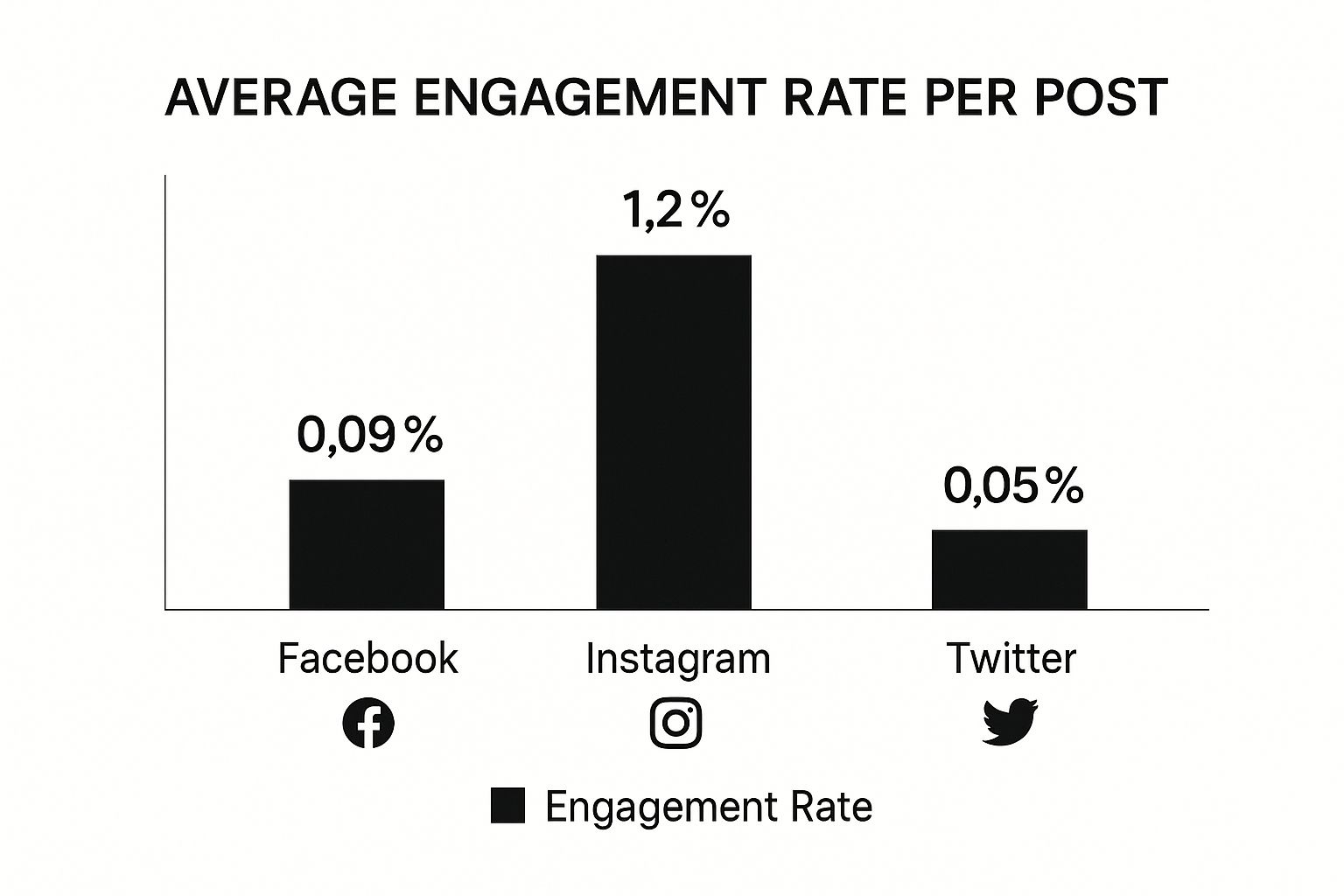
As you can see, Instagram's engagement rate is leagues ahead of Facebook or X. This makes it a much more potent platform for driving real interaction, if that’s where your audience is active. By carefully picking your platforms, you give every piece of content the best possible chance to connect, engage, and ultimately, convert.

If your social media strategy is the map for your journey, then your content is the fuel that actually gets you there. Even the most perfectly drawn map is useless if you're stalled on the side of the road. This is where we shift from thinking big picture to the nuts and bolts of your daily social media marketing strategy.
The idea is to build a content plan that gives you structure but also has the flexibility to adapt. It’s about being deliberate with every post, not just throwing content out there to stay active. Think of this plan as your guide, telling you what to post, when to post it, and why it matters.
Ever stared at a blank calendar and had no clue what to post? It’s a common roadblock. The way around it is to establish content pillars—these are the three to five core topics your brand will consistently own. Imagine them as the main sections of your brand’s own magazine; every piece of content you create should fit nicely into one of these buckets.
Your pillars should come directly from what your audience cares about and what you want to achieve as a business. For a local fitness studio, the pillars might look something like this:
By setting these pillars, you make sure every post reinforces who you are and gives your audience real value. It stops your feed from feeling like a random jumble of ideas and builds the kind of consistency that earns recognition and trust.
With your pillars in place, a content calendar is what turns your ideas into action. It’s much more than a simple schedule. It's a strategic planner that helps you stay consistent, manage your time, and map out bigger campaigns without the last-minute panic. A solid calendar lays out every post, including the words, the visuals, the hashtags, and which pillar it supports.
Planning your content in advance is a non-negotiable for an effective social media marketing strategy. It transforms your approach from reactive and chaotic to proactive and organised, freeing up valuable time to focus on genuine engagement rather than last-minute content creation.
Keeping a content calendar organised can be a job in itself, which is why many businesses lean on software to help. Checking out the best social media management tools can help you find a platform that pulls scheduling, reporting, and team collaboration into one neat package.
The final, and arguably most important, piece of the puzzle is engagement. Social media is meant to be social. It’s a two-way street, not a billboard. Just posting your content and walking away is like shouting into an empty room. Real success is found in building an actual community around your brand.
This means jumping into the conversation that your content starts. A good engagement plan goes way beyond just 'liking' a few comments.
Practical Engagement Tactics to Build Community:
When you bring together strong content pillars, a well-managed calendar, and a genuine plan for engagement, you create a social media presence that's alive and kicking. This approach doesn't just get you more followers; it turns them into a loyal community that champions your brand.
Let’s be honest, a strategy without measurement is just a bunch of nice ideas. Launching a social media plan without tracking its performance is like setting sail without a compass. Sure, you’re moving, but you have no idea if you’re actually getting closer to your destination. This final, crucial stage is where we close the loop, turning raw data into real insights that actually help you grow.
It's time to pull back the curtain on social media analytics and look beyond the flashy numbers. A climbing follower count might feel great, but it doesn’t pay the bills. Real success is measured by the numbers tied directly to your business goals—those S.M.A.R.T. goals we nailed down earlier.
To figure out if your strategy is genuinely working, you need to shift your attention from vanity metrics to actionable metrics. These are the numbers that show you how your audience is behaving and whether those behaviours are helping your business.
Here are the key metrics that should be front and centre on your dashboard:
Tracking these core metrics completely changes your perspective. You stop just making content and start creating content with a clear purpose, designed to drive specific actions that contribute to your bottom line.
You don't have to track all this by hand in a spreadsheet. There are plenty of tools out there to help you gather, analyse, and report on your performance. The smartest approach is usually a mix of the platforms' own tools and some third-party help to get the full picture.
Native analytics, like Facebook Insights or Instagram Insights, are brilliant for a quick, on-the-ground look at how you’re doing on that specific channel. For a more bird's-eye view, third-party dashboards like Sprout Social or HubSpot offer powerful reporting that pulls all your data into one spot. This makes it so much easier to compare how you're doing across different platforms and spot the bigger trends.
A social media strategy should never be a static document that gathers dust on a shelf. It needs to be a living, breathing plan that you constantly tweak based on what the data is telling you. This process of ongoing improvement is known as continuous optimisation, and it’s what separates the good strategies from the great ones.
This commitment to data is especially important given the money involved. In 2025, social media advertising in Australia is projected to hit around AU$7.5 billion, making up nearly 29% of all digital ad spending. With that kind of investment on the line, guesswork just isn't good enough. You can discover more insights about marketing statistics in Australia and see just how vital a well-optimised strategy is.
At its heart, optimisation is all about experimenting. Start with simple A/B tests. For example, you could test two different headlines for the same blog post link, try two different images for a product announcement, or even use different call-to-action phrases. By checking the reports from these tests, you can make small, data-backed adjustments that add up over time, steadily improving your results. This cycle of measure, learn, and adapt turns your strategy into a dynamic engine for predictable and sustainable business growth.
Even with the best-laid plans, questions always pop up when you start putting a social media marketing strategy into practice. This section tackles some of the most common queries with clear, direct answers to help you navigate those finer details.
We’ll dig into how often you should be posting, the best tools for the job, and how to approach that all-important budget. Think of this as your go-to guide for those "what now?" moments every marketer runs into.
This is the million-dollar question, but the answer isn't some magic number. The golden rule is that consistency and quality trump sheer frequency every time. Honestly, it's far better to post three high-value updates a week than seven low-effort ones that just get scrolled past.
Your ideal posting cadence really depends on the platform you're on and what your audience expects. A fast-paced platform like X (formerly Twitter) might need multiple updates a day just to stay in the conversation, while a professional network like LinkedIn usually calls for less frequent, more thoughtful content.
Here are some general guidelines to get you started:
The real takeaway here is to create a schedule you can actually stick to without letting quality slide. Keep a close eye on your analytics to see what posting frequency gets the most engagement from your specific audience, and don't be afraid to adjust from there.
Juggling multiple social media channels without the right tech can quickly become a massive headache. Thankfully, there’s a whole suite of excellent tools out there to help you streamline your workflow, save a heap of time, and pull better data.
Think of these tools as your social media command centre. They let you handle scheduling, analytics, and even content creation from one central place, which is vital for executing a cohesive social media marketing strategy.
Here are a few trusted tools, broken down by what they do best:
Choosing the right mix of tools really comes down to your team's size, your budget, and what you’re trying to achieve. Many of them offer free trials, so you can test them out and see which ones fit your workflow best before committing.
Figuring out a social media budget can feel a bit tricky because it involves both your time (for organic efforts) and your money (for paid ads). The right amount depends entirely on your business goals, your industry, and how quickly you need to see results.
A good way to start is by splitting your budget into two main categories: organic social media and paid social media.
1. Organic Social Media Budget
This part covers the resources you need to create and manage your non-paid content. Your main costs will be:
2. Paid Social Media Budget
This is the money you set aside for advertising, like boosting posts, running lead generation campaigns, or promoting products. How much you spend here is tied directly to your goals:
Our advice? Start with a modest, experimental budget for your paid ads. As you gather data and see what’s working, you can then confidently scale up your spending on the campaigns that deliver the best results for your business.
Crafting and executing a winning social media strategy takes careful planning and constant fine-tuning. If you're ready to take your results to the next level, the team at Virtual Ad Agency is here to help. We build data-driven strategies that connect with your audience and drive real business growth.
Discover how our expert team can elevate your social media presence.

 previous