
In a crowded marketplace, attracting a steady stream of new customers is the engine that drives sustainable growth. Yet, with countless channels and tactics available, many businesses find themselves grappling with ineffective strategies and escalating acquisition costs. It's no longer enough to simply be present; you need a sophisticated, multi-faceted approach to consistently win attention and convert interest into revenue. This guide is designed to cut through the noise and provide a clear, actionable playbook for modern customer acquisition.
We have compiled a definitive list of 10 powerful customer acquisition strategies, covering the full spectrum from foundational digital methods like SEO and content marketing to high-impact approaches like strategic partnerships and influencer collaborations. A critical component of any successful customer acquisition strategy is accurately assessing and optimising your spend, making understanding and lowering your Cost Per Acquisition (CPA) a fundamental skill for any marketer.
This isn't a theoretical overview. For each strategy, we will break down exactly how to implement it, showcasing real-world examples and highlighting the specific pros and cons to consider. You will gain practical insights into building a robust, diversified acquisition framework that delivers measurable results. Whether you are a marketing professional refining your current plan or a business leader aiming to accelerate growth, this comprehensive resource will equip you with the tools needed to not just find new customers, but to systematically build a loyal and profitable customer base for your brand.
Content marketing is a long-term strategic approach focused on creating and distributing valuable, relevant, and consistent content. Unlike traditional advertising that interrupts prospects, this method pulls them in by offering genuine solutions to their problems. It’s one of the most foundational customer acquisition strategies because it builds brand authority, fosters trust, and establishes a direct relationship with your audience long before they consider a purchase.
The core principle, popularised by experts like Joe Pulizzi and Marcus Sheridan, is simple: by becoming the most trusted source of information in your industry, you naturally attract qualified leads. A potential customer looking for answers finds your helpful blog post, watches your informative video, or downloads your insightful whitepaper. This positive interaction establishes your brand as a credible expert, making you the first choice when they are ready to buy.
This infographic summarises the typical investment and return timeline for a content marketing strategy.
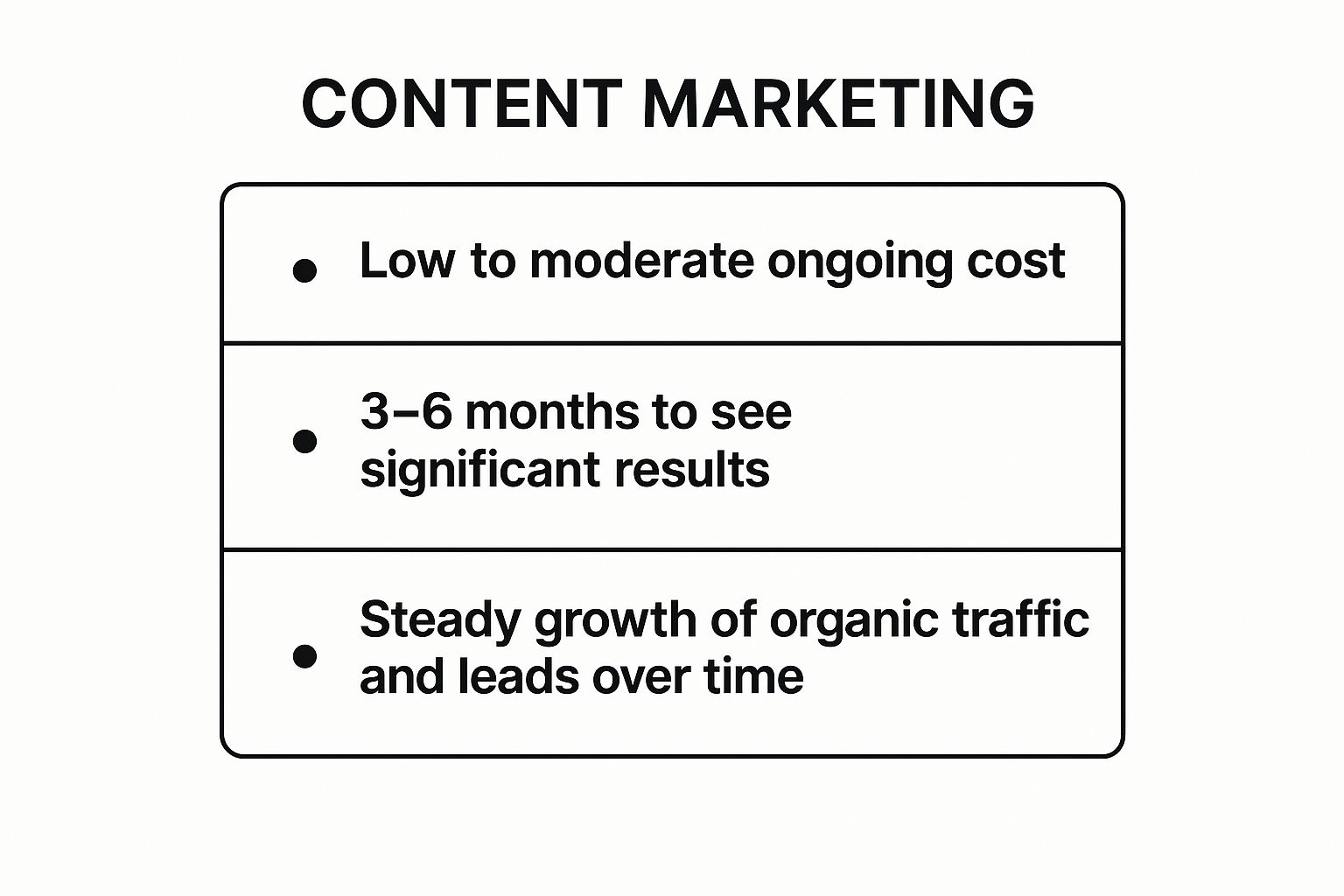
The data highlights that while content marketing requires patience, it is designed to deliver compounding, long-term growth. To succeed, it's crucial to follow established guidelines and stay consistent. You can explore a deeper dive into content marketing best practices to ensure your efforts are effective.
Search Engine Optimisation (SEO) is the practice of enhancing your website to rank higher in search engine results pages (SERPs). This strategy focuses on increasing organic (non-paid) visibility to attract potential customers who are actively searching for solutions your business provides. As one of the most effective customer acquisition strategies, SEO connects you with high-intent prospects at the exact moment they need you.
The principle, championed by experts like Brian Dean and Rand Fishkin, is to align your digital presence with what search engines value: relevance, authority, and user experience. A business that successfully optimises its site, like Canva ranking for design-related keywords, doesn't just gain traffic; it gains qualified leads. When a user searches for something specific and finds your website at the top, it immediately establishes your brand as a credible and relevant authority in that space.
Social media marketing is a powerful customer acquisition strategy that leverages online platforms to connect with your audience, build brand personality, and drive conversions. It moves beyond simple broadcasting by creating a two-way dialogue, allowing brands to engage directly with potential and existing customers on platforms like Instagram, Facebook, LinkedIn, and TikTok. This direct interaction helps build authentic relationships and community around your brand.

The approach, championed by experts like Gary Vaynerchuk and Mari Smith, focuses on meeting customers where they spend their time. Whether through Dollar Shave Club’s viral video campaigns or Wendy’s witty Twitter engagement, the goal is to create shareable and memorable content that captures attention. By doing so, brands can foster loyalty and turn followers into paying customers, making social media an indispensable tool in modern marketing.
Effectively managing multiple platforms requires a coordinated effort. To streamline your workflow and ensure consistent posting, you can explore the best social media management tools available to help you schedule content and analyse performance.
Referral marketing is a powerful customer acquisition strategy that transforms your existing, loyal customers into brand advocates. It systemises word-of-mouth by incentivising satisfied customers to recommend your products or services to their network. This approach is highly effective because it leverages trust; a recommendation from a friend or colleague is often more credible and persuasive than any traditional advertisement.
This strategy was famously popularised by tech giants like Dropbox, whose co-founder Drew Houston implemented a simple yet brilliant program offering extra storage space for both the referrer and the new user. The result was exponential growth driven by genuine user enthusiasm. Similarly, early growth teams at PayPal and pioneers like Reid Hoffman at LinkedIn demonstrated that a well-structured referral system can be a cost-effective engine for acquiring high-quality customers who often exhibit higher lifetime value and retention rates.

Email marketing is a powerful and direct customer acquisition strategy that involves communicating with prospects and customers via their inbox. It stands out because it leverages a channel you own, your email list, to build relationships, nurture leads, and drive conversions without being subject to the changing algorithms of social media or search engines. This method allows you to deliver personalised, targeted messages directly to an audience that has already opted in.
The core principle, championed by experts like Ann Handley and Ryan Deiss, is to treat the inbox as a privileged space. Instead of broadcasting generic promotions, effective email marketing focuses on providing consistent value. A brand like Morning Brew does this by delivering an engaging daily newsletter that people genuinely want to read, while Sephora uses it to send personalised product recommendations. This approach transforms email from a simple sales tool into a vital relationship-building channel, making it one of the most cost-effective customer acquisition strategies available.
Email marketing remains a cornerstone of digital strategy due to its high ROI and ability to foster direct customer relationships. To maximise your success, it's essential to stay updated on the latest techniques and compliance rules. You can find more details in this guide to email marketing best practices to ensure your campaigns are both effective and well-received.
Pay-Per-Click (PPC) advertising is a powerful digital marketing model where advertisers pay a fee each time one of their ads is clicked. It offers a way to "buy" visits to your site, rather than attempting to "earn" those visits organically. As one of the most immediate customer acquisition strategies, PPC allows businesses to place ads in front of audiences who are actively searching for solutions, making it incredibly effective for capturing high-intent leads.
Pioneered and popularised by platforms like Google Ads, the principle is straightforward: you bid on specific keywords or target demographics relevant to your business. When a user's search query or profile matches your criteria, your ad appears. For example, a potential customer searching for "e-commerce platform" might see a highly relevant ad from Shopify. This direct targeting ensures your marketing budget is spent on reaching people already interested in what you offer.
PPC provides rapid feedback, allowing you to measure performance and adjust your campaigns in near real-time. For those new to paid advertising, getting started can feel overwhelming, but a structured approach simplifies the process. You can explore this complete guide to PPC for beginners to build a strong foundation for your campaigns.
Partnership marketing is a strategic collaboration where two or more businesses team up to promote each other’s products or services. This customer acquisition strategy works by tapping into a partner's established audience, leveraging their credibility and reach to acquire new customers that would otherwise be difficult or expensive to access. It is a powerful way to accelerate growth and build brand authority through association.
The principle, championed by partnership platforms like PartnerFleet and Crossbeam, is built on mutual benefit. By aligning with a complementary, non-competing brand, you can offer combined value to both audiences. A classic example is the Spotify and Uber partnership, where riders could control the music during their trip, enhancing the experience for both sets of customers. This symbiotic relationship creates a win-win scenario, driving acquisition for both companies simultaneously.
Event marketing is a powerful customer acquisition strategy centred on creating, sponsoring, or participating in events to directly engage with a target audience. This hands-on approach includes everything from large-scale trade shows and conferences to intimate webinars and experiential pop-up activations. Instead of relying solely on digital channels, it creates memorable, in-person or live virtual experiences that forge strong brand connections and generate high-quality leads.
The core principle, championed by event industry leaders and major brands like Salesforce with its Dreamforce conference, is to move beyond passive advertising and build a community. By facilitating direct interaction, you can showcase your brand's personality, demonstrate product value firsthand, and capture immediate feedback. A potential customer attending your webinar or visiting your trade show booth gets a tangible sense of your company's expertise and culture, making a far more lasting impression than a digital ad.
Influencer marketing is a powerful strategy that involves collaborating with individuals who have established credibility and a dedicated following in a specific niche. Rather than marketing directly to a large group of consumers, you inspire or hire influencers to get the word out for you, leveraging their trust and relationship with their audience to drive brand awareness and conversions.
This approach works by borrowing the authentic connection an influencer has built with their followers. When a trusted creator like a popular food blogger for HelloFresh or a fitness icon for Gymshark recommends a product, it comes across as a genuine endorsement rather than a traditional advertisement. This social proof makes it one of the most effective customer acquisition strategies for reaching engaged, niche audiences that might be resistant to conventional marketing.
The Free Trial/Freemium model is a powerful customer acquisition strategy centred on letting potential customers experience a product's value first-hand before committing to a purchase. A free trial offers full access for a limited time (e.g., Netflix), while a freemium model provides a feature-limited version indefinitely (e.g., Spotify). This approach dramatically lowers the barrier to entry, allowing users to integrate the product into their workflows or daily lives with zero financial risk.
Popularised by SaaS pioneers like Dropbox and Slack, this method flips the traditional sales model. Instead of telling prospects about the product's benefits, it allows them to prove the value to themselves. A user who experiences tangible results during their trial or with the free version is far more likely to see a paid subscription as a natural next step rather than a pressured sales decision. This "try-before-you-buy" philosophy builds trust and generates highly qualified leads who already understand and appreciate the solution.
| Marketing Strategy | Implementation Complexity | Resource Requirements | Expected Outcomes | Ideal Use Cases | Key Advantages |
|---|---|---|---|---|---|
| Content Marketing | Moderate to high (content creation & multi-channel) | Low to moderate ongoing costs (content & tools) | Long-term organic traffic & lead growth (3-6 months) | Brand awareness, trust building, education | Cost-effective, builds authority, supports other channels |
| SEO | High (technical, ongoing optimization) | Low to moderate if in-house; higher for agencies | Sustainable organic traffic & high conversion (3-12 months) | Businesses targeting active searchers | Highly targeted, cost-effective long-term acquisition |
| Social Media Marketing | Moderate (platform-specific content & ads) | Variable: free organic to high ad spend | Immediate reach; meaningful engagement in 1-3 months | Brand engagement, targeted ads | Direct audience communication, viral potential |
| Referral Marketing | Low to moderate (program setup & tracking) | Pay-per-acquisition (5-25% of customer value) | Quick results if base exists (weeks) | Customer base leverage and viral growth | High conversion rate, low acquisition cost |
| Email Marketing | Moderate (list building, segmentation, automation) | Low cost ($10-100+/month depending on list size) | Immediate for existing lists; 1-3 months to grow | Lead nurturing, retention, promotions | High ROI, direct & measurable communication |
| PPC Advertising | High (campaign setup, bidding, ongoing optim.) | Variable ($1-50+/click based on industry) | Immediate traffic; optimized in 1-4 weeks | Quick customer acquisition & testing | Immediate results, precise targeting, scalable spend |
| Partnership Marketing | Moderate to high (coordination, alignment) | Revenue sharing or fixed fees | 1-3 months to establish; ongoing growth | Accessing new audiences, co-marketing | Shared costs, credibility boost, faster market entry |
| Event Marketing | High (planning, logistics, execution) | High upfront cost ($5,000-$100,000+) | Immediate lead generation; 3-6 months planning | Brand experience, relationship building | High-quality leads, personal engagement, brand credibility |
| Influencer Marketing | Moderate to high (vetting, collaboration) | $100 to $1M+ depending on influencer tier | 1-2 months setup; immediate audience reach | Targeted niche markets, social proof | Authentic endorsements, high engagement, content outsourced |
| Free Trial/Freemium Model | Moderate (onboarding, conversion optimization) | High initial cost for free users | Immediate acquisition; 7-30 days conversion | SaaS, subscription services, digital goods | Removes purchase barrier, high conversion potential |
We've explored a comprehensive suite of ten powerful customer acquisition strategies, from the long-term authority building of content marketing and SEO to the immediate impact of PPC advertising and the trust-building power of referral programs. Each tactic, whether digital like email marketing or experiential like event marketing, offers a unique pathway to connect with your ideal audience and drive meaningful growth. However, the most profound takeaway is not the strength of any single strategy, but the exponential power they unlock when working in concert.
The most successful businesses don't just pick one channel and hope for the best. They meticulously build an integrated customer acquisition engine where each component supports and amplifies the others. This is the difference between sporadic gains and a predictable, scalable system for sustainable growth.
Imagine this synergistic approach in action. Your SEO efforts don't just exist to rank on Google; they drive organic traffic to the high-value blog posts, guides, and case studies you've developed through your content marketing strategy. That content, in turn, isn't just for reading; it contains compelling calls-to-action that capture visitor information for your email marketing list.
Simultaneously, your social media marketing isn't just about posting updates. It's about distributing that same high-value content to a wider audience, engaging with potential customers, and driving them back to your website. You can then use targeted PPC campaigns to retarget those website visitors or reach new, lookalike audiences with precision, accelerating the entire process. This interconnected web ensures that no effort is wasted and every marketing dollar works harder.
Key Insight: The goal isn't to master every strategy at once. The goal is to master the integration of a select few strategies that are perfectly aligned with your business model, resources, and target audience.
The sheer number of available customer acquisition strategies can feel overwhelming. The key is to start small, be strategic, and build momentum. Here’s a practical, step-by-step approach to get started:
By adopting this methodical approach, you transform customer acquisition from a series of disjointed activities into a sophisticated, data-driven growth engine. You create a virtuous cycle where each success fuels the next, building a formidable and resilient market presence that consistently attracts and converts your ideal customers.
Navigating the complexities of building a multi-channel acquisition engine requires deep expertise and constant optimisation. If you're ready to create a predictable and scalable system for growth without the guesswork, the team at Virtual Ad Agency specialises in developing and executing full-funnel marketing strategies. Explore how we can build a tailored acquisition plan for your business at Virtual Ad Agency.

 previous