
Despite the constant churn of new digital channels, email marketing remains a formidable tool for building customer relationships and driving significant revenue. Its power lies in its directness, offering a personalised channel to connect with your audience in a space they check daily: their inbox. However, achieving standout results requires more than just a sizable mailing list and a generic monthly newsletter. The difference between an email that gets deleted and one that converts is a strategy built on proven, data-backed techniques.
To truly capitalise on this channel, you must move beyond surface-level tactics and embrace a more sophisticated approach. This comprehensive guide provides a definitive roundup of the top 10 email marketing best practices you need to master. We will delve into specific, actionable strategies covering everything from advanced segmentation and mobile-first design to automation, A/B testing, and sender reputation management.
Each practice is broken down with practical implementation steps and real-world examples to help you transform your email program into a high-performing growth engine. Forget generic advice; this is your blueprint for creating campaigns that not only capture attention but also deliver measurable, impactful results for your business. Let's explore the essential techniques that separate standard campaigns from truly exceptional ones.
Gone are the days of one-size-fits-all email blasts. Segmentation and personalisation represent a fundamental shift in email marketing best practices, moving from mass communication to meaningful, individual conversations. This involves dividing your subscriber list into smaller, more focused groups based on specific criteria like demographics, purchase history, or on-site behaviour. By tailoring content to these segments, you deliver hyper-relevant messages that resonate deeply with each recipient.
Think of how Amazon suggests products based on your browsing history or how Spotify curates playlists just for you. This level of customisation makes the user feel understood, dramatically increasing engagement and conversions.
This infographic visualises the powerful impact of a well-organised segmentation strategy on key email metrics.
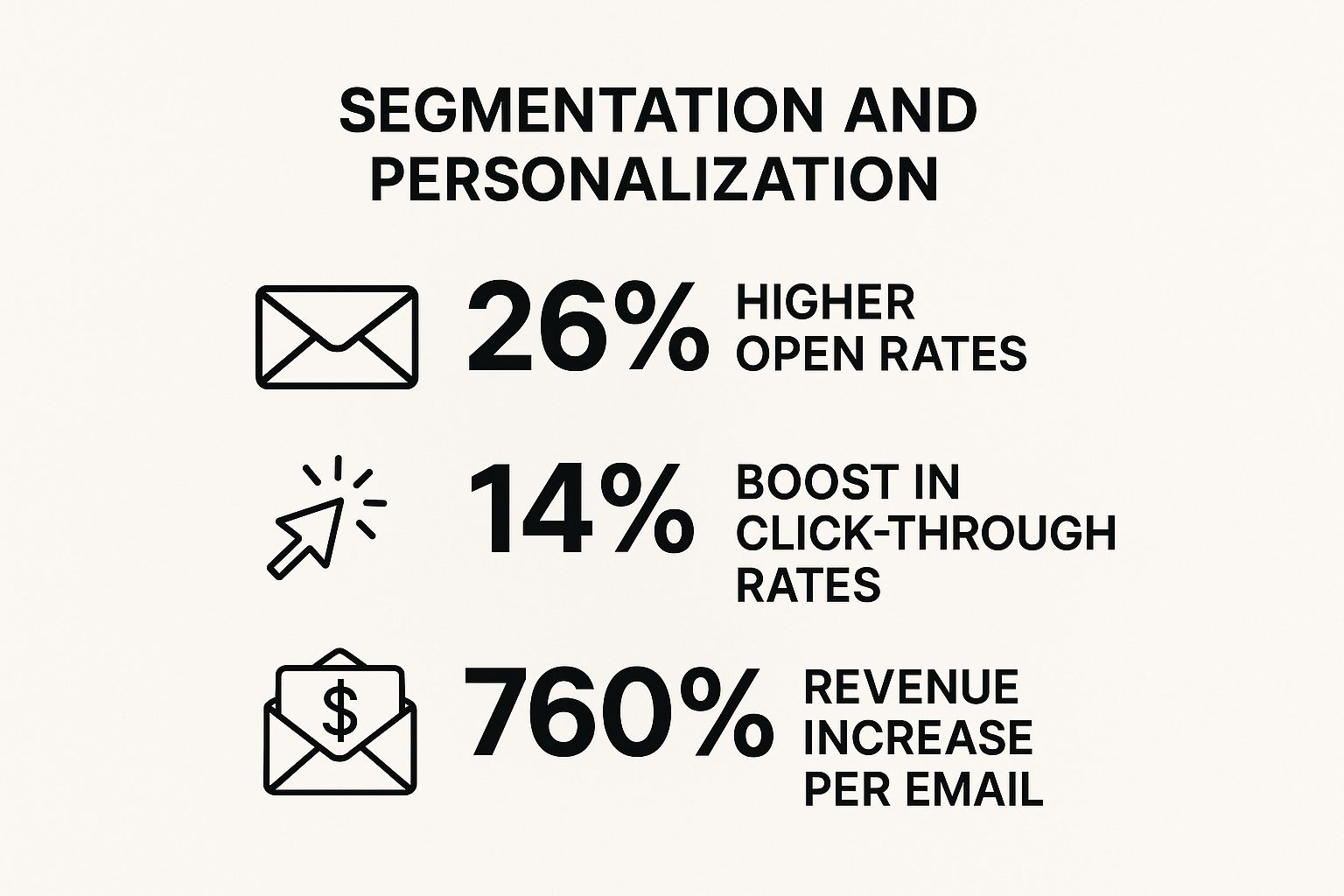
These statistics clearly show that sending the right message to the right person is not just good practice; it's a direct driver of opens, clicks, and a staggering increase in revenue.
The subject line is your digital handshake, the first impression that determines whether your email gets opened or ignored. Optimising this tiny but mighty piece of text is a cornerstone of email marketing best practices. It involves strategically crafting compelling, concise, and relevant headlines that stand out in a crowded inbox and entice the recipient to click.
Think of BuzzFeed's curiosity-piquing lines like 'You Won't Believe What Happened Next' or Dollar Shave Club's witty approach: 'Your Razor Is Duller Than a Butter Knife'. These examples master the art of grabbing attention by using psychology, humour, and personality, making the decision to open the email almost irresistible. A well-optimised subject line directly impacts your open rates, which in turn affects every subsequent metric.

By treating the subject line as a critical component of your campaign, you set the stage for higher engagement and better overall performance. It’s a small detail that delivers a significant impact on your success.
With a significant majority of emails now opened on smartphones, designing for a small screen first is no longer optional-it's an essential email marketing best practice. A mobile-first approach means creating your email layout for the constraints of a mobile device and then scaling it up for desktop, rather than the other way around. This ensures a seamless and engaging experience for the largest portion of your audience.
Consider the clean, single-column receipt emails from Uber or Airbnb’s mobile-optimised booking confirmations. They prioritise clarity and ease of use on a small screen, making key information and actions immediately accessible without pinching or zooming. This user-centric design builds trust and improves interaction rates.

A powerful email list is the engine of any successful email marketing strategy, and it doesn't grow by accident. The strategic practice of list building involves attracting high-quality subscribers by offering a valuable incentive, known as a lead magnet, in exchange for their email address. This ensures you're not just collecting contacts, but building an audience that is genuinely interested in what you have to offer.
Think of how HubSpot offers free marketing templates or how Neil Patel provides a free SEO analysis tool. These brands aren't just giving away resources; they're initiating a relationship. By providing immediate value, they attract qualified leads who are far more likely to engage with future communications, making this one of the most effective email marketing best practices for sustainable growth.
Moving beyond manual sends, email automation and drip campaigns are essential email marketing best practices for nurturing relationships at scale. This involves creating systematic, triggered email sequences that are automatically sent based on user actions, behaviours, or specific time intervals. This allows businesses to guide subscribers through personalised journeys without constant manual effort.
Think about the welcome series you receive from Slack that introduces new features, or the abandoned cart reminders from Amazon that prompt you to complete a purchase. These automated touchpoints keep your brand top-of-mind and deliver timely, relevant information, significantly boosting engagement and conversions.
This video from ActiveCampaign offers an excellent overview of how to get started with building your first automated email series.
By automating these communications, you ensure no lead is left behind and every customer receives a consistent, valuable experience.
Relying on assumptions is one of the quickest ways to stall your email marketing progress. A/B testing, or split testing, is a systematic and data-driven optimisation method that removes guesswork. It involves creating two versions of an email (Version A and Version B), sending each to a different subset of your audience, and analysing which one performs better against a specific goal.
This scientific approach is a cornerstone of effective email marketing best practices because it provides concrete evidence of what resonates with your subscribers. For instance, Obama's 2012 campaign famously A/B tested every email element, from subject lines to call-to-action buttons, ultimately raising an estimated $690 million. This demonstrates how small, incremental improvements can lead to massive gains over time.
Timing is everything in email marketing. Send Time and Frequency Optimisation is the strategic practice of delivering your emails at the precise moment they are most likely to be opened and acted upon, while also managing how often you contact subscribers to prevent fatigue. It's about finding the sweet spot between staying top-of-mind and becoming a nuisance in the inbox.
Getting this right transforms your emails from an interruption into a welcome, timely message. For instance, Morning Brew’s consistent 6 AM delivery targets business professionals starting their day, while Groupon’s Friday afternoon sends cater to people planning their weekends. This is a critical component of email marketing best practices, as it directly impacts open rates and overall campaign performance.
Crafting the perfect email is useless if it never reaches the inbox. Deliverability and sender reputation management are the behind-the-scenes foundations of all successful email marketing best practices. This involves maintaining a positive reputation with Internet Service Providers (ISPs) to ensure your emails land in the primary inbox, not the spam folder. Your sender reputation is like a credit score, built on factors like authentication, subscriber engagement, and complaint rates.
Think of it this way: ISPs like Gmail and Outlook are gatekeepers protecting their users. A strong sender reputation signals that you are a trustworthy source sending valuable content, granting you access to the inbox. Tools like SendGrid’s reputation dashboard provide critical insights into how ISPs view your domain, allowing you to proactively manage your email health and ensure maximum reach.
The call-to-action is the single most important element in a goal-oriented email. A compelling CTA design is more than just a button; it's the gateway that guides recipients from your message to the desired action. It combines persuasive copywriting, strategic visual design, and psychological principles to drive conversions and make your email’s purpose clear and irresistible.
Think of Dropbox’s simple ‘Get Started’ buttons that reduce friction for new users or Spotify’s direct ‘Listen Now’ CTAs that instantly gratify. These examples show how an effective CTA eliminates ambiguity, telling the reader precisely what to do next and what value they will receive by doing it. This clarity is a cornerstone of effective high-performance email marketing.

Ignoring legal requirements isn't just a poor choice; it's a direct threat to your business. Adhering to email marketing laws like GDPR in Europe and the CAN-SPAM Act in the United States is a non-negotiable best practice. These regulations are designed to protect consumers from unsolicited emails and ensure transparency, which in turn helps you build a foundation of trust with your audience.
Think of compliance as the framework that supports a healthy and sustainable email program. By respecting subscriber rights, you not only avoid hefty fines but also foster a more engaged and loyal list. For instance, global brands like Mailchimp have integrated GDPR-compliant tools directly into their platform, making it easier for businesses to meet these critical legal standards.
| Item | Implementation Complexity | Resource Requirements | Expected Outcomes | Ideal Use Cases | Key Advantages |
|---|---|---|---|---|---|
| Segmentation and Personalization | High – requires data collection and ongoing optimization | High – data management systems and analytics | Increased open rates (26%), click rates (14%), and revenue (760%) | Targeted campaigns needing personalization | Enhances loyalty, relevance, and revenue |
| Subject Line Optimization | Low to Medium – ongoing testing | Low – mostly creative resources | Directly boosts open rates and ROI | Campaigns aiming to increase opens quickly | Cost-effective, easy to test and iterate |
| Mobile-First Email Design | Medium – design and testing across devices | Medium – design and development effort | Improved mobile UX, higher mobile click-through and conversions | Emails with high mobile audience | Future-proof, better deliverability |
| List Building and Lead Magnets | Medium – content creation and setup | Medium – content and marketing effort | Builds qualified, engaged subscriber base | Growing organic email lists | Higher engagement and list quality |
| Email Automation and Drip Campaigns | High – setup of workflows and monitoring | High – automation platforms and planning | Saves time, nurtures leads, increases conversions | Lead nurturing and customer onboarding | Scalable, timely, and personalized communication |
| A/B Testing and Data-Driven Optimization | Medium to High – test design and data analysis | Medium – testing tools and analytics | Data-backed improvements, maximized ROI | Optimization-driven campaigns | Reduces guesswork, improves performance |
| Send Time and Frequency Optimization | Medium – ongoing testing and adjustments | Low to Medium – analytics tools | Higher engagement, reduced unsubscribes | Campaigns sensitive to timing and frequency | Improves deliverability and subscriber experience |
| Deliverability and Sender Reputation Management | High – technical setup and continuous monitoring | Medium to High – technical expertise | Maximizes inbox placement and brand trust | All email senders to ensure inbox arrival | Protects reputation, improves performance |
| Compelling Call-to-Action (CTA) Design | Low to Medium – design and content testing | Low to Medium – creative resources | Increased conversions and click-through rates | Conversion-focused email campaigns | Clear guidance, measurable impact |
| Compliance with Email Marketing Laws and Regulations | Medium to High – legal understanding and process setup | Medium – legal and technical resources | Avoids legal penalties, builds trust | All marketers concerned with regulations | Ensures ethical practices, protects reputation |
We’ve journeyed through the ten pillars of modern email marketing, from the foundational importance of segmentation and personalisation to the technical necessities of deliverability and legal compliance. It’s clear that sending an email is easy, but sending an email that consistently delivers results is a sophisticated art and science. The landscape is no longer about batch-and-blast tactics; it's about building genuine, one-to-one relationships at scale.
Mastering these email marketing best practices is not a one-time project but an ongoing commitment to improvement. The most successful marketers understand that the inbox is a personal, crowded space. Earning your place there requires a deep respect for the subscriber, demonstrated through relevant content, optimised design, and a value-first approach. It's about transforming your email list from a simple database into a vibrant community of engaged followers and loyal customers.
Feeling overwhelmed is natural, but progress is about iterative steps, not a single giant leap. Your immediate goal should be to identify the one or two areas from this guide that represent the biggest opportunity for your business right now.
The core principle is continuous optimisation. Every email you send is a chance to learn something new about your audience. Treat every campaign as an experiment, analyse the data without bias, and reinvest those learnings into your next send. This data-driven cycle of testing, learning, and refining is what separates good email marketers from great ones. For those in a business-to-business context, applying these principles with a focus on professional value is paramount. For additional strategies on maximizing your return, explore further insights on B2B Email Marketing Best Practices.
Ultimately, the power of email lies in its unique ability to nurture relationships over time. By combining powerful personalisation with data-driven optimisation and a steadfast commitment to ethical standards, you create a sustainable, predictable, and highly profitable channel for growth. You’re not just sending marketing messages; you’re building a direct line of communication that fosters trust, drives revenue, and secures long-term customer loyalty.
Ready to transform your email strategy from an afterthought into a powerful revenue engine? The team at Virtual Ad Agency specialises in implementing these advanced email marketing best practices for Australian businesses, creating full-funnel strategies that deliver measurable results. Contact us today to discover how we can elevate your campaigns and drive real growth.

 previous