
Chances are you’ve heard the term EDM floating around marketing conversations. So, what exactly is an EDM (Electronic Direct Mail)? In simple terms, it's a digital message sent directly to a list of subscribers via email. You can think of it as the modern, more strategic version of an email marketing campaign, designed to promote products, share news, or build lasting customer relationships right inside their inbox.
Remember getting a promotional flyer or a catalogue in your letterbox? An EDM operates on the exact same direct-to-consumer principle, just without the paper and postage. Instead of a physical mailbox, you're landing in a digital one, using an email platform to send a carefully crafted message to an audience that has already given you the thumbs up to contact them.
This direct line is precisely what makes EDM so effective. Unlike broader advertising like social media ads or billboards that cast a wide, often impersonal net, an EDM campaign speaks to a specific, engaged group. These are people who have already raised their hand and shown interest in your brand by subscribing, making them far more open to what you have to say.
At its heart, EDM is all about building and nurturing relationships. It’s not just a sales tool; it’s a channel for consistent, valuable conversation. When you truly get your head around "what is an EDM in marketing," you see it's much more than just another email—it’s a crucial touchpoint in the customer journey.
Here in Australia, this strategy is a heavy hitter. Electronic Direct Mail has cemented itself as a top-tier digital channel with incredible financial returns. In fact, it's projected that email marketing in Australia will deliver an average ROI of $42 for every $1 spent in 2025. On top of that, 64% of small businesses across the country rely on it as their main tool for bringing in new customers. That’s a testament to its staying power. If you want to dive deeper, you can explore more data on Australian email marketing strategies for more insights.
An EDM is your brand’s personal conversation with a customer. It bypasses the noise of public feeds and lands in a personal, curated space: the inbox. This direct access allows for a level of personalisation and intimacy that other marketing channels struggle to match.
To make this even clearer, let's break down the essential ideas behind a successful EDM strategy.
The table below offers a quick summary of the core components, explaining what each concept means and why it matters for your marketing goals.
| Concept | Simple Explanation | Marketing Goal |
|---|---|---|
| Subscriber List | The group of people who have opted-in to receive your emails. | Build a targeted, engaged audience that wants to hear from you. |
| Segmentation | Dividing your list into smaller groups based on interests or behaviour. | Deliver highly relevant content to increase engagement and conversions. |
| Personalisation | Using subscriber data (like their name or purchase history) to tailor content. | Make the subscriber feel seen and understood, strengthening the relationship. |
| Call-to-Action (CTA) | The specific instruction in your email, like "Shop Now" or "Learn More." | Guide the reader toward a desired action, such as making a purchase. |
| Automation | Setting up emails to send automatically based on triggers (e.g., a welcome email). | Nurture leads and customers efficiently without manual effort. |
Understanding these building blocks is the first step toward creating an EDM program that doesn't just send emails, but actually drives real business results.
Alright, let's get into what makes EDM such a powerhouse in your marketing toolkit. Knowing what it is is one thing, but understanding why it works so well is where the real value lies. When you weave Electronic Direct Mail into your strategy, you’re not just firing off messages; you’re building direct, profitable, and lasting bridges to your audience.
One of the biggest drawcards for businesses is the incredible return on investment (ROI). Think about it: with paid ads, you're constantly renting space to reach people. Your email list, on the other hand, is an asset you own outright. It's a direct line to your customers that isn't at the mercy of some social media algorithm deciding to change its mind overnight.
That ownership gives you a level of control and predictability that other channels just can't touch. You call the shots on when and how you communicate, making sure your message actually lands in front of your audience without having to shout over the noise of a crowded feed.
The real magic of EDM is how it lets you get personal, even when you're talking to thousands. It's all about segmentation. Imagine a local retailer sending a special offer only to customers in a certain postcode, or a B2B company sharing hyper-relevant industry stats with different tiers of clients. This is a world away from generic email blasts; it's precision marketing.
By carving up your audience based on their behaviour, location, or past purchases, you can make a mass email feel like a one-on-one chat. That relevance is what gets people to open, click, and ultimately, buy.
This approach works so well because you're respecting the customer's time with content they genuinely find useful. An e-commerce store, for instance, can automatically send a reminder about an abandoned cart, complete with pictures of the exact products left behind. This kind of timely, personal touch doesn't just recover sales—it builds trust and strengthens the relationship.
The numbers don't lie; email marketing consistently proves its worth. Globally, there are over 4.6 billion active email users, a figure that's expected to climb to 4.9 billion by 2027. Right here in Australia, the confidence is clear, with 53% of small business owners naming it their go-to strategy for finding and keeping customers in 2024.
And it gets better. Research from the same year shows that email is a staggering 40 times more effective at winning new customers than social media giants like Facebook or Twitter. These aren't just stats to skim over; they represent a massive, untapped opportunity for businesses to connect directly with a huge, engaged audience. If you want to dive deeper into the data, you can discover more email marketing statistics and insights.
Ultimately, a solid EDM strategy gives you a powerful framework for:
Each of these pieces works together, creating a powerful engine for business growth that’s not only cost-effective but can scale right alongside you.
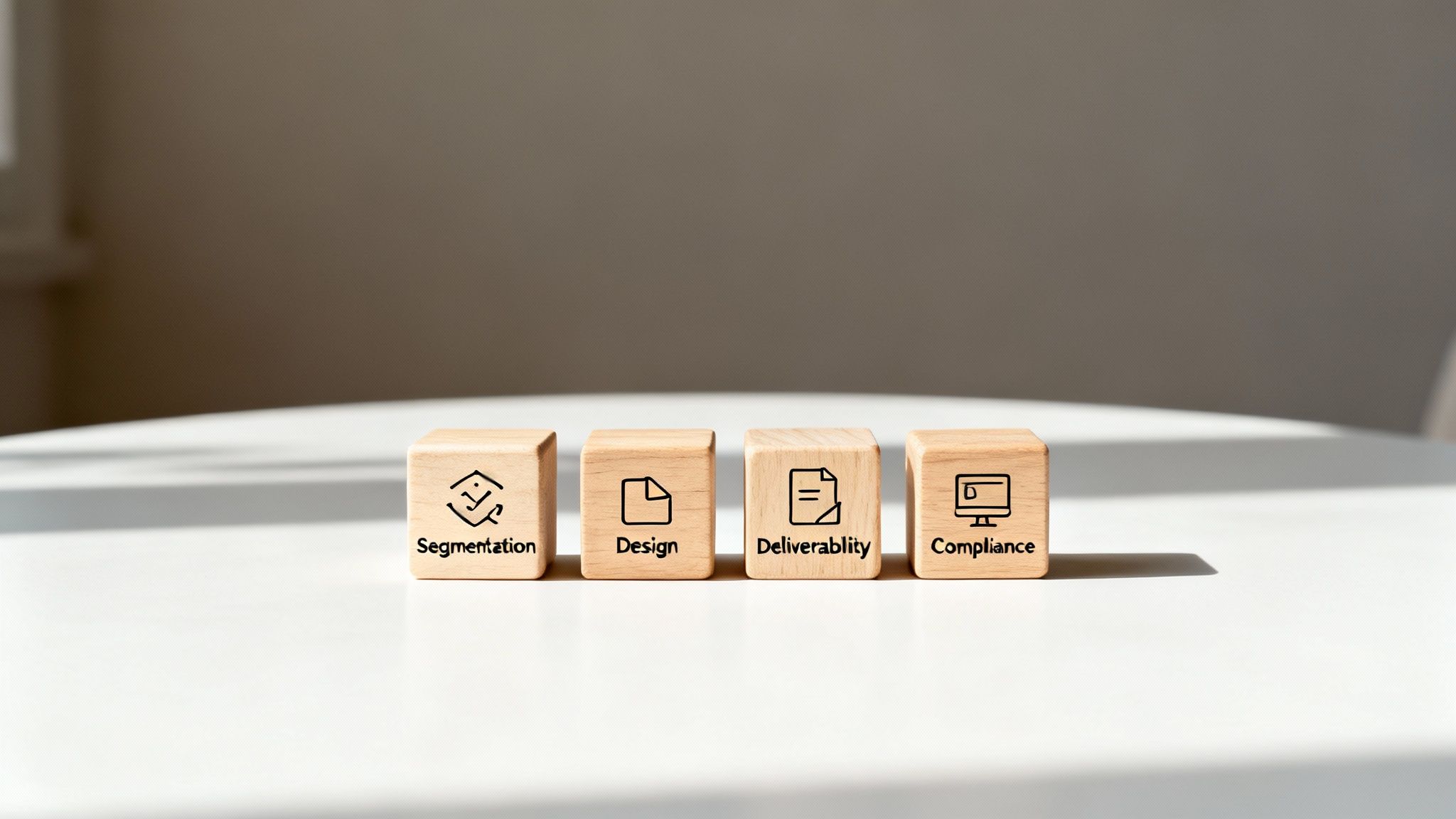
Putting together an EDM campaign that actually gets results isn't about throwing things at the wall and seeing what sticks. It's a structured approach, really, built on four core pillars. Get these right, and you transform a basic email blast into a marketing powerhouse that delivers a real return.
Let's break down each of these foundations.
The first, and arguably the most important, is audience segmentation. It’s just common sense. Imagine you run a clothing store. Firing off an email about a new line of men's suits to your entire database—including customers who've only ever bought women's dresses—is a fast track to the ignore button or, even worse, an unsubscribe.
Segmentation is simply the art of slicing your big audience list into smaller, more specific groups. This lets you send messages that are hyper-relevant and genuinely resonate, because they speak directly to what that person cares about, what they've done before, or who they are.
There are countless ways to group your subscribers to make your message hit home. Some of the most effective strategies we see are:
Once you've figured out who you're talking to, the next pillar is what you're saying and how you're presenting it. Your email's design and copy are a tag team; they have to work together to grab attention and push for action.
A cluttered, messy, or poorly written email gets deleted in a heartbeat, especially on a phone—where over 50% of emails are now opened.
Your design needs to be clean, mobile-responsive, and feel like it comes from your brand. The words, starting with a subject line that packs a punch, have to be clear, direct, and persuasive, guiding the reader straight to your call-to-action (CTA). If you really want to get this right, understanding how to make an email marketing campaign for maximum engagement is a great place to start.
These last two pillars go hand-in-hand, and they are absolutely non-negotiable. First up is email deliverability—your ability to actually land in the inbox instead of the spam folder. If your emails are bouncing or people are marking them as spam, your sender reputation takes a hit, making it even harder for future campaigns to get through.
Think of deliverability as your passport into the inbox. A clean list, an authenticated sending domain, and engaging content are your visas. Without them, you won't get past the border guards (spam filters).
Finally, you have to play by the rules. In Australia, the Spam Act 2003 is very clear. You must have permission to email someone, you have to clearly identify who you are, and every single message needs a simple, working unsubscribe link. Following these rules isn't just about avoiding hefty fines; it’s about basic respect for your audience and building trust that lasts. For a deeper dive, VAA has a guide covering the essential email marketing best practices.
Right, so you've got the theory down. You know what an EDM is. But where the rubber really meets the road is seeing how businesses actually use them to get results. This isn't just about sending out bulk messages; it's about creating specific, tangible outcomes that fuel real growth and forge stronger bonds with customers.
From the second someone new joins your list to the delicate art of winning back a customer who's gone quiet, there’s an EDM for that. It’s an incredibly versatile tool that slots neatly into every stage of the customer journey, making sure your message always hits the mark at just the right time.
Let’s dive into some of the most powerful ways businesses are putting EDM into practice:
Beyond chasing new leads, EDM is a retention powerhouse. A re-engagement campaign, for example, targets subscribers who haven't opened an email in months. The goal is simple: win them back. This could be with a compelling offer or even a simple "we miss you" message. It’s an effective way to clean up your list and wake up those dormant contacts.
The real magic of modern EDM is automation. Emails triggered by a user's specific action deliver hyper-relevant, timely content that gets incredible results. This is the very core of a high-performance email marketing and EDM strategy.
The data from right here in Australia backs this up, loud and clear. Triggered emails are responsible for a staggering 38% of all email revenue, even though they make up less than 5% of the total emails sent. What's more, lifecycle emails like welcome series and re-engagement flows boast a 70.5% higher open rate than your standard promotional blast.
The classic abandoned cart email is a perfect example. A customer browses your online store, adds a few things to their cart, and then vanishes. An automated EDM can send them a gentle reminder, complete with a direct link to finish their purchase. This one simple, automated email can recover a huge chunk of otherwise lost sales, turning hesitation into revenue.
Sending out an EDM is really only half the job; understanding how it performed is where the real growth kicks in. You need to look beyond just hitting 'send' and start digging into the data. Measuring your campaigns shows you what clicks with your audience, what falls flat, and how all that effort translates into actual business results.
Think of it like this: your EDM campaign is a conversation starter. The metrics are how you listen to the reply. They tell you who opened the door, who was interested in your message, and who actually took the action you were hoping for. Without these insights, you're pretty much just talking into an empty room.
The good news is you don't need to be a data scientist to make sense of it all. To figure out if your EDMs are hitting the mark, you need to track the right essential email marketing KPIs. These numbers tell a story about your campaign’s health and its impact on your bottom line.
Let's break down the most important numbers you'll find on your EDM platform's reporting dashboard.
The infographic below really highlights just how powerful a specific, automated EDM can be for driving both revenue and engagement.
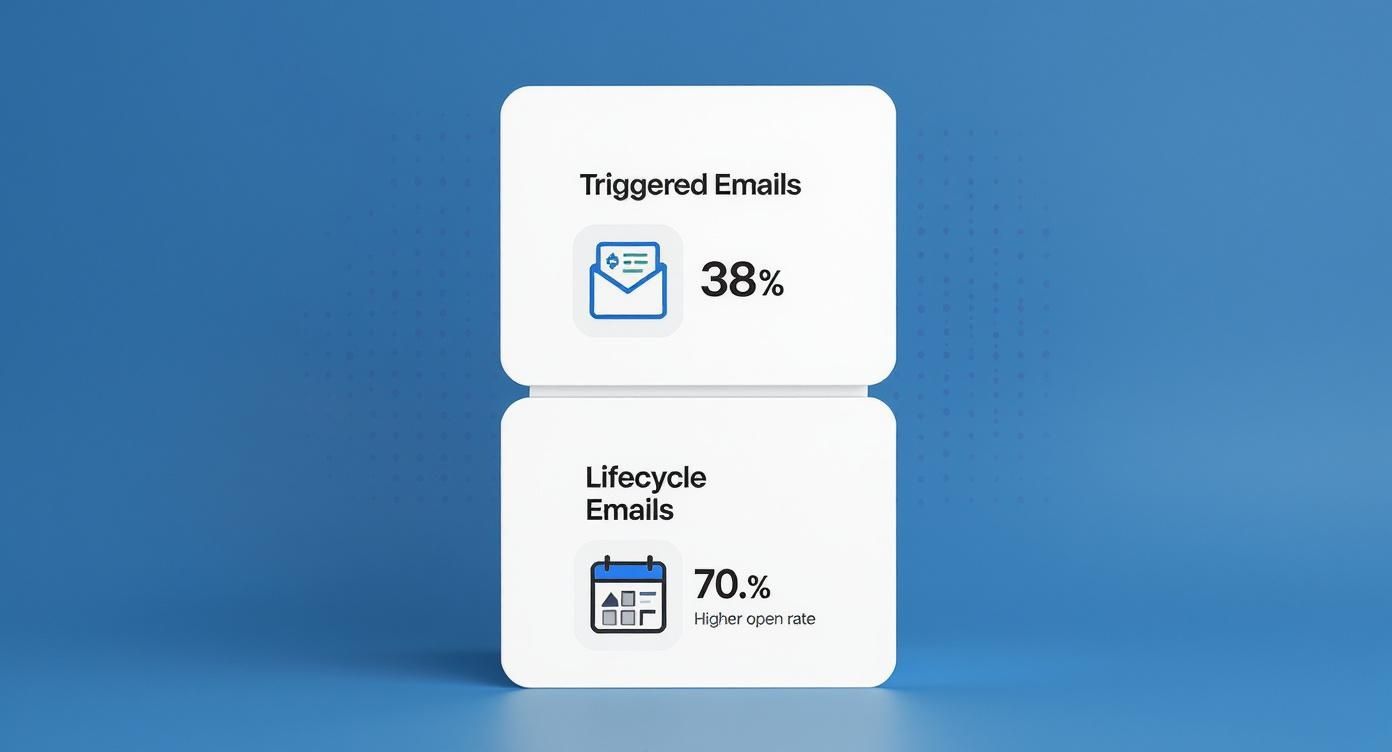
As the data shows, emails triggered by a customer's behaviour consistently blow standard campaigns out of the water, bringing in more revenue and achieving much higher open rates.
It's so important to know the difference between metrics that show people are interested and those that show you're getting results.
Don't confuse activity with achievement. High open and click rates are positive signs, but they are 'engagement metrics'. The real story of success is told by 'outcome metrics' like conversions and return on investment (ROI).
Here's a quick guide to what you should be tracking and why.
This table breaks down the most important EDM metrics, explaining their significance and the business question each one answers.
| Metric | What It Measures | Why It's Important |
|---|---|---|
| Open Rate | The percentage of recipients who opened the email. | Answers: "Is my subject line compelling enough to grab attention?" |
| Click-Through Rate (CTR) | The percentage of openers who clicked a link. | Answers: "Is my content and call-to-action engaging and relevant?" |
| Conversion Rate | The percentage of clickers who completed a goal. | Answers: "Is this email actually driving business results?" |
| Bounce Rate | The percentage of emails that failed to deliver. | Answers: "How healthy and up-to-date is my email list?" |
| Unsubscribe Rate | The percentage of recipients who opted out. | Answers: "Are we sending the right content to the right people?" |
| Return on Investment (ROI) | The total revenue generated vs. the campaign cost. | Answers: "Is our EDM strategy profitable and worth the investment?" |
Focusing on outcome metrics like ROI ensures your EDM strategy is tied to tangible business goals, not just vanity numbers. Calculating your ROI gives you a crystal-clear picture of profitability, helping justify your marketing spend and guiding smarter decisions for future campaigns.
Picking the right software for your EDM campaigns is a foundational step, but it doesn't have to be a headache. The best platform is simply the one that fits your business size, technical know-how, and where you plan to be in a few years. Think of it like buying a vehicle; a startup might just need a reliable ute to get around, while a large enterprise needs an entire fleet of delivery trucks to get the job done.
Your choice of platform directly shapes your ability to segment your audience, automate workflows, and design emails that actually get opened. The software out there generally falls into a few key categories, each built for different business needs.
Making the right call starts with being honest about where your business is at right now. Here’s a simple way to think about it:
The goal isn’t to find the platform with the most bells and whistles, but the one with the right features for you. Overpaying for complex tools you don't use is just as wasteful as outgrowing a basic plan too quickly.
Before you sign on the dotted line, run through a quick checklist. Answering these questions will cut through the noise and help you compare your options properly. And to help you weigh them up, check out our detailed guide on the best email marketing software for Australian businesses.
Here’s what to consider:
Even after getting a handle on the basics, a few practical questions always seem to surface. Let’s tackle some of the most common ones that marketers run into, giving you clear, straightforward answers to clear up any lingering doubts before you dive in.
So, the big question first: "How often should I actually send these things?" There's no magic number here. The right frequency really comes down to your industry and what your audience wants from you. A good place to start might be once a week, but the real trick is to deliver genuine value every single time. If your emails are consistently useful, people will be happy to see them. If they’re just adding to the noise, even sending one a month will feel like too much.
This is a frequent point of confusion, and it’s a good one to clear up. What really separates a promotional EDM from a regular newsletter?
Think of it like this: a promotional EDM is your direct sales pitch. It’s designed to get an immediate reaction, like a click to buy something. A newsletter, on the other hand, is all about building the relationship. It’s for sharing great content, company updates, and insights that keep your brand top-of-mind over the long haul.
Both play a crucial role in a smart EDM strategy. Your promotional emails are there to drive sales now, while your newsletters build the loyalty that keeps customers coming back for more.
Finally, how do you get people to sign up in the first place? Starting a list from zero can feel like a massive task, but it all begins with a simple value exchange. You need to give people a good reason to hand over their email address. This could look like:
The golden rule is pretty simple: always make it easy and worthwhile for people to join your community.
Ready to turn these insights into a high-performance marketing strategy? The team at Virtual Ad Agency specialises in creating EDM campaigns that build relationships and drive real business growth. Learn how we can help you connect with your audience today.

 previous