
At its core, search engine optimisation (SEO) for a small business is all about improving your website's ranking on search engines like Google. It’s the process of making your business more visible to the exact customers actively looking for what you offer, driving what we call organic traffic—and growth—without paying for every single click.
Imagine your business is a brilliant new shop on a busy street, but you’ve forgotten to put up a sign. People will walk straight past, completely unaware you even exist. SEO is that sign. It’s the map and the friendly local guide pointing people directly to your digital front door. It’s not just a technical chore; it’s your most powerful tool for sustainable growth.
Think of Google as a super-helpful librarian. When someone asks for "the best local plumber" or "handmade gifts in Adelaide," the librarian instantly scans millions of books (websites) to find the most relevant, trustworthy, and helpful one. SEO is how you organise your book, give it a clear title, and collect positive reviews so that librarian confidently hands yours over first.
The real magic of SEO is intent. Unlike traditional ads that interrupt people, SEO connects you with customers at the precise moment they’re searching for a solution you provide. This means higher-quality leads and a much better chance they'll become a customer. For many business owners, understanding why SEO is important for every business is the first real step toward building a reliable sales funnel.
SEO is the only marketing channel that helps your business get found by customers who are already looking for you. It's about pulling customers in, not pushing your message out.
Here in Australia, the shift to online visibility is undeniable. Organic search now drives over 53% of all website traffic for Australian small businesses, making it a more powerful channel than social media or email. This reliance on search is why SEO spending is tipped to hit AUD 1.5 billion by 2025, as more owners realise its direct impact on winning new customers. For a deeper dive into our approach, check out our guide to small business SEO.
The infographic below really paints a picture of what’s driving this investment for Aussie small businesses.
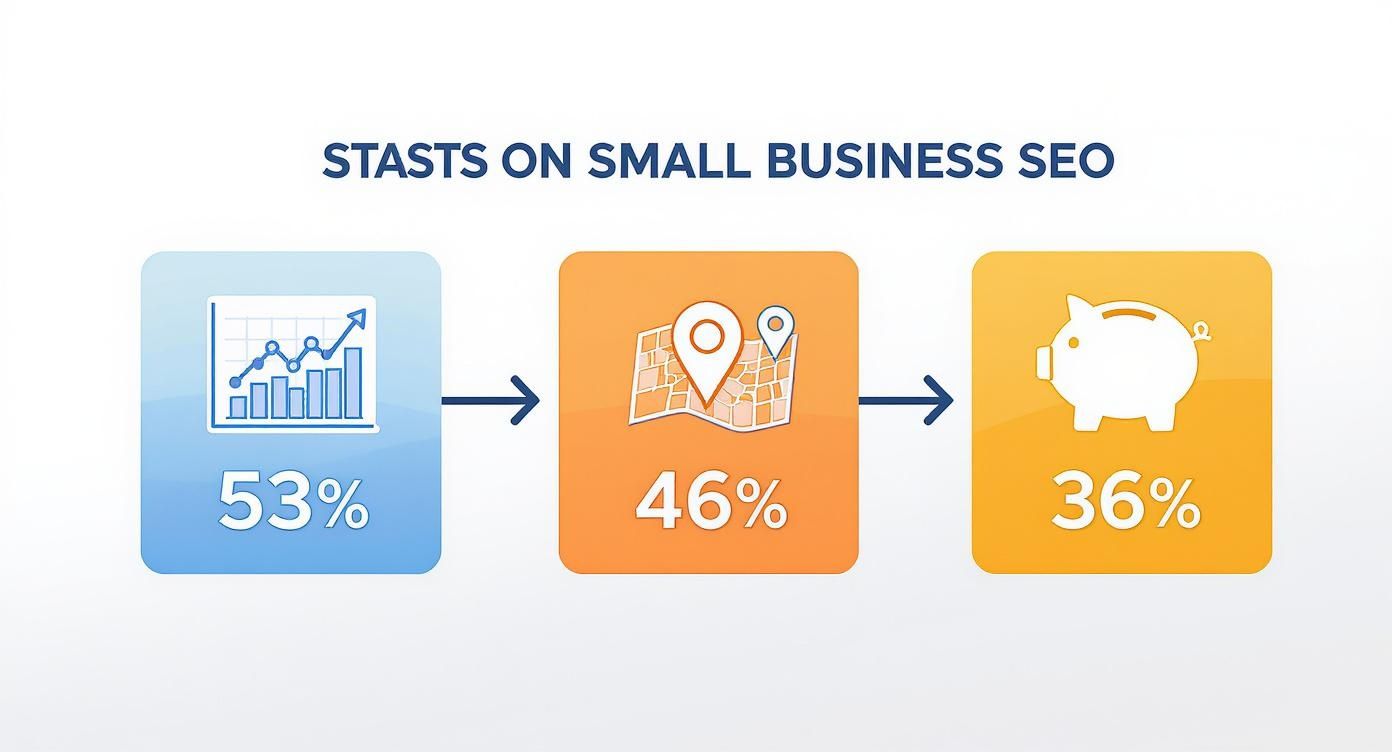
This data shows it’s not just about any old traffic. It’s about attracting local customers, with a massive 46% of searches having local intent. The smart 36% of businesses investing wisely in SEO are the ones capturing this incredibly valuable market.
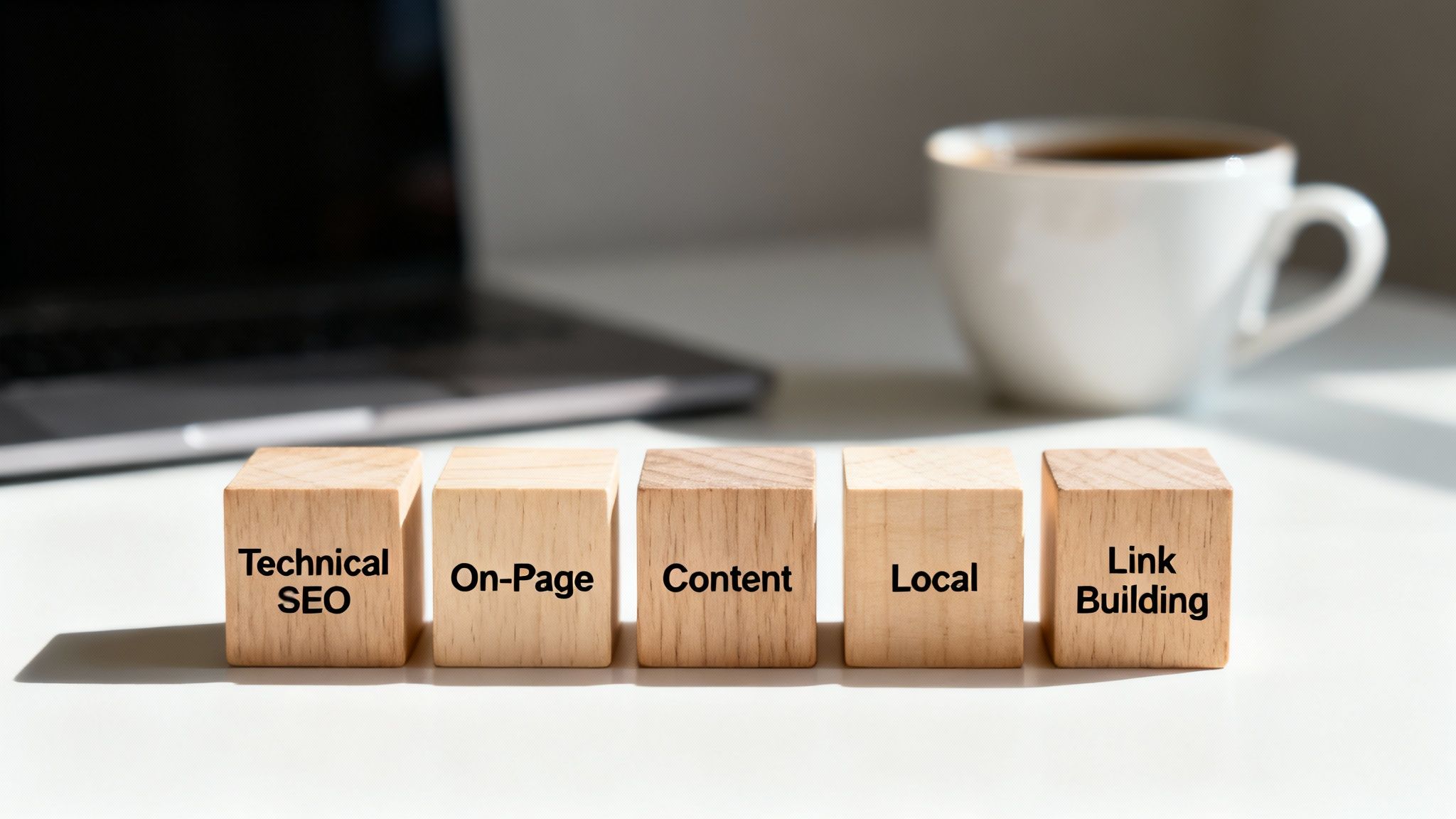
Think of a solid SEO strategy like building a house. You can’t hang pictures or choose paint colours before you’ve poured a solid foundation and put up the walls. Each part relies on the others to create a strong, functional structure that people want to visit—and stay in.
That’s exactly how professional search engine optimisation services for small business approach it. They don't just focus on one thing. Instead, they weave together several core components, with each playing a crucial part in building your online presence. Let’s break down these essential pillars.
Before Google even glances at your content, it has to be able to find, crawl, and understand your website without hitting any roadblocks. This is the domain of technical SEO. It’s the plumbing, wiring, and concrete slab of your digital home. If the foundation is cracked, everything you build on top of it is at risk.
A technical SEO service makes sure your site is built to be understood by search engines. This covers things like:
Without a solid technical base, even the most amazing content can stay hidden from view. It’s the non-negotiable first step in any real SEO campaign.
With a solid foundation in place, it’s time to frame the rooms. On-page SEO is all about optimising individual web pages so they rank higher and pull in more of the right kind of traffic. It’s about making it crystal clear to both people and search engines what each page is about.
This involves smartly placing keywords in key spots like your page titles, headings, and throughout your text. But it's about much more than just keywords. It’s also about creating a great user experience by structuring content for easy reading, using images with descriptive alt-text, and writing meta descriptions that make people want to click.
Think of it as organising the aisles in your digital shop so customers can easily find exactly what they're looking for. To get this right, you can dive into detailed guides on SEO optimisation best practices that offer actionable tips.
If technical SEO is the foundation and on-page SEO is the structure, then content is the very reason people walk through the door. It’s the helpful blog posts, detailed service pages, and insightful guides that answer your customers' questions and prove you know your stuff. Without good content, people have no reason to visit.
High-quality content is the currency of the web. It solves problems, builds trust, and gives search engines a reason to show your site to people. It's not about selling; it's about serving.
An effective content strategy focuses on creating material that your ideal customers are actively looking for. This doesn't just attract organic traffic; it positions your business as a trusted authority in your field—a powerful way to build a loyal following.
For small businesses with a physical shopfront or a specific service area—like a cafe in Adelaide or a plumber in Perth—Local SEO isn’t just important, it’s essential. This piece of the puzzle is all about making you visible in location-based searches, especially in Google's "Map Pack."
Key activities here include:
When someone searches "best coffee near me," local SEO is what gets your cafe to pop up. It’s about dominating your immediate market and connecting with customers right in your backyard.
Finally, link building is like getting a great recommendation from a respected person in your community. When another reputable website links to your site, it acts as a "vote of confidence" in the eyes of search engines. These links, often called backlinks, tell Google that your site is a credible and valuable resource.
The game here is all about quality, not quantity. A single link from a well-regarded industry blog is worth more than hundreds of links from spammy, irrelevant sites. To build a strong SEO profile, it's vital to understand the key types of links for SEO and how to earn them the right way. This off-page strategy is often what separates the businesses on page one from those lost on page two.
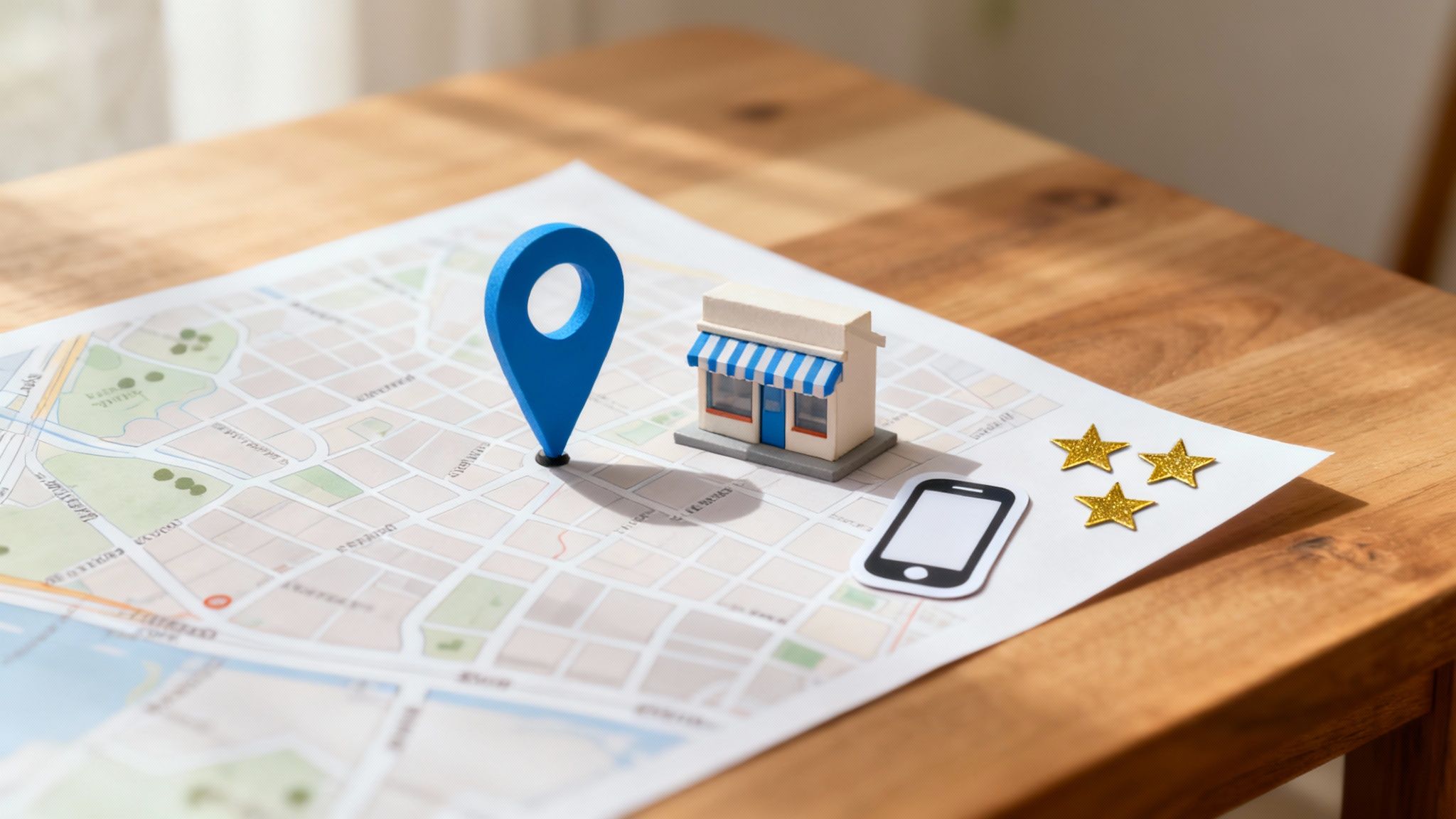
For most small businesses, the online battle isn't about taking on the entire country. It’s about winning your own neighbourhood. This is exactly where Local SEO steps in. It’s a specialised strategy designed to put your business front and centre for customers searching right in your service area.
Think about it. When someone whips out their phone to search for "cafe near me" or "emergency plumber Adelaide," they aren’t looking for a business on the other side of Australia. They need a local solution, and they need it now. Local SEO is how you convince Google that you are the best and most relevant answer to that search.
The ultimate prize is a spot in the coveted Google "Map Pack"—that box at the top of the search results with a map and three business listings. Landing here is the digital equivalent of having the best shop on the busiest street in town. It grabs the attention of customers who are ready to buy.
The absolute foundation of Local SEO is your Google Business Profile (GBP). It's a free tool, but it's probably the most powerful local marketing asset you have. A neglected profile is like a shop with no sign on the door, unreliable hours, and nobody answering the phone. It just doesn't inspire confidence.
A professional search engine optimisation service for small business will begin by meticulously optimising your GBP. This is more than just filling in a few details; it's a strategic process.
Beyond your GBP, Google scans the web for consistent signals that verify your business is legitimate. Your Name, Address, and Phone number (NAP) needs to be identical everywhere it appears online, from your website to directories like Yellow Pages. Any inconsistencies can create confusion for search engines and erode trust.
Customer reviews are today’s word-of-mouth marketing. They provide powerful social proof and are a massive local ranking factor. A steady stream of recent, positive reviews tells Google that you offer a high-quality service, which can seriously boost your visibility in the Map Pack. A good strategy always involves actively encouraging happy customers to share their feedback.
It's true that businesses with multiple locations can have an advantage. Recent Australian research shows that multi-location businesses drive, on average, a staggering 557% more website traffic than their single-location counterparts. This is because they cast a wider geographic net and send stronger authority signals. You can dig into the full findings on Australian local SEO statistics and trends to learn more.
So, how can a single-location business possibly compete? By going deep, not wide.
A single-location business can't win on breadth, so it must win on depth. This means creating hyper-localised content that proves you are the undisputed expert in your specific community.
Instead of creating generic service pages, think about content that speaks directly to the unique needs of your local area. An Adelaide SEO consultant, for instance, might create a guide to "SEO for Glenelg Cafes," packed with specific advice relevant to that suburb. This kind of targeted approach builds immense local authority and helps you outrank larger, less focused competitors right where it counts.
Investing in search engine optimisation services for small business can feel like a big step, especially when you're looking at the price tag. How much should you really be spending? And the million-dollar question: is it even worth it?
The trick is to stop thinking of SEO as just another business expense. It's not. It's a strategic investment in the long-term health and visibility of your brand online. Once you make that mental shift, everything else clicks into place.
There's no single price for SEO because every business is different. A local bakery trying to attract foot traffic in a small town won't have the same needs—or budget—as a national e-commerce brand fighting for online market share. The cost really depends on how competitive your industry is, what you're trying to achieve, and the scope of work needed to get you there.
When you start getting quotes, you'll notice agencies tend to structure their pricing in a few common ways. Understanding these models helps you figure out which one is the right fit for your business goals and cash flow.
Here’s a breakdown of what you'll typically come across:
This table breaks down the typical SEO pricing structures to help you understand what to expect when you're shopping around.
| Pricing Model | Typical Cost Range (AUD/Month) | Best For | Potential Pitfall |
|---|---|---|---|
| Monthly Retainer | $1,500 – $5,000+ | Businesses looking for consistent, long-term growth and a strategic partnership. | Requires a minimum commitment (usually 6-12 months) to see meaningful results. |
| Project-Based | $2,000 – $25,000+ (one-off) | Businesses with a specific, defined need, like a website audit or local SEO setup. | Doesn't provide ongoing optimisation, which is crucial for sustained growth. |
| Hourly Consulting | $150 – $400+ (per hour) | Companies needing expert guidance for their in-house team or help with a complex issue. | Costs can add up quickly, and it lacks the comprehensive execution of a full service. |
Most small businesses find the monthly retainer model makes the most sense. It’s predictable for budgeting and ensures your SEO efforts are consistent and always moving forward. A one-off project is great for getting started, but SEO isn't a "set it and forget it" game.
Okay, so you've figured out the cost. But how do you justify it? Unlike paid ads where you see an immediate (though short-lived) result, SEO is a marathon, not a sprint. Its value builds and compounds over time, like a snowball rolling downhill.
Measuring its success means looking beyond just the numbers on an invoice and focusing on the Key Performance Indicators (KPIs) that actually matter to your bottom line.
The true measure of SEO success isn't just about rankings; it's about the tangible business growth driven by organic traffic. It’s about turning visibility into valuable customer actions.
Instead of getting hung up on "Are we number one yet?", you need to track the metrics that show real business impact. This is how you prove the investment is paying off.
Here are the essential KPIs you should be watching:
Organic Traffic Growth: This is your foundation. Are more people finding your website through search engines this month than last month? A steady increase in visitors from Google is the first sign that things are working. You can track this easily in Google Analytics.
Keyword Ranking Improvements: While rankings aren't the only thing, they are important. Seeing your main service keywords climb from the depths of page three to the top of page one is a huge win. It directly translates to more eyes on your business and more clicks to your site.
Conversion Rate from Organic Traffic: Traffic is nice, but customers are what pay the bills. This metric tells you what percentage of those organic visitors are taking the action you want them to—whether that’s filling out a form, buying a product, or picking up the phone. It’s the metric that connects your SEO efforts directly to tangible leads.
Lead Generation and Sales: This is where the rubber meets the road. By tracking goals in Google Analytics, you can see exactly how many leads and how much revenue your organic search traffic is generating. If your $1,500 monthly investment in SEO brings in $6,000 of new business, the return on investment is crystal clear. That’s how you know it's working.

Picking an agency to handle your SEO is easily one of the most important marketing decisions you’ll make. This isn't just about hiring a contractor. It's about bringing on a partner who will have a direct hand in your company's growth.
Get it right, and you unlock a steady, sustainable stream of new customers. Get it wrong, and you can waste a lot of time, burn through your budget, and even do lasting damage to your website's reputation with Google.
The trick is to go into the process with a sharp eye for red flags and a clear list of questions. A great partner will welcome your diligence and answer everything transparently, building trust from the very first chat.
Before you even think about signing a contract, you need to dig deeper than just the price tag. You’re trying to understand their process, how they communicate, and what success actually looks like to them. Any reputable provider of search engine optimisation services for small business should be able to answer these questions without skipping a beat.
Use this checklist on your discovery calls to really vet potential partners:
A true SEO partnership is built on collaboration, not secrecy. The right agency will act as an extension of your team, focused on tangible business outcomes rather than confusing technical jargon.
How they answer these questions will tell you a lot. Are they strategic and focused on your goals, or are they pushing a one-size-fits-all solution? A good partnership is built on clarity and shared goals from day one.
Unfortunately, the SEO world has its fair share of operators selling snake oil. Knowing what to watch out for can save you from a very expensive headache. If you hear any of the following, it’s probably best to walk away.
Here are the most common warning signs:
Choosing the right partner comes down to finding a team that’s genuinely aligned with your business goals, communicates openly, and is laser-focused on delivering real, measurable value for the long haul.
Diving into the world of search engine optimisation services for small business always stirs up a few questions. It’s a big commitment of time and money, so you naturally want to get a few things straight before you jump in. Let's tackle some of the most common queries we hear from business owners.
Getting frank answers to these questions is the first step. It helps you set realistic goals and make a smart decision that actually lines up with where you want to take your business.
This is always the first question, and the honest answer is: it takes time. SEO is definitely a marathon, not a sprint. While you might spot some small, encouraging movements early on, it generally takes four to six months to see significant results that actually move the needle for your business.
Think of it like planting a garden. You can’t just stick a seed in the ground and expect a prize-winning tomato tomorrow. You have to prep the soil (that's your technical SEO), plant the right seeds (your content), and then consistently water and care for them (that’s the ongoing optimisation and link building).
Those first few months are all about building a solid foundation. An agency will be running audits, fixing technical gremlins, beefing up your existing pages, and mapping out a content strategy. All this work is critical, but it doesn't always lead to instant ranking jumps. The real, compounding growth in traffic and leads usually kicks in around the six-month mark and builds from there.
The short answer is yes, you absolutely can. With a mountain of free tools and online guides available, a DIY approach is definitely on the table. But the more important question is: should you?
Doing it yourself can be a great way to save cash upfront, especially if you have more time on your hands than budget. It’s just vital to be realistic about what you’re signing up for.
Pros of DIY SEO:
Cons of DIY SEO:
Hiring a professional brings expertise, specialised tools, and a dedicated focus that's tough to replicate on your own. It turns SEO from another chore on your to-do list into a properly managed growth strategy.
This is a really important one to get your head around. Both are powerful ways to get your business noticed on Google, but they work in completely different ways.
Think of it like owning a house versus renting one.
SEO (Organic Search) is like owning your visibility. You invest time and effort into building a strong presence. Once it's established, it delivers a steady stream of traffic without you having to pay for every single click. It's a long-term asset.
Google Ads (Paid Search) is like renting your visibility. You pay to be at the top, and the moment you stop paying, you disappear. It's fantastic for getting immediate results and targeting specific campaigns.
The two aren't an either/or choice; in fact, they work best when you use them together. Ads can drive traffic and sales right now while your SEO strategy is still getting up to speed. Over time, as your organic rankings climb, you can start to rely less on your ad spend.
It’s a familiar story for many small business owners. You see some promising early results from your SEO work, only to watch your visibility—and your leads—suddenly drop off a cliff. This kind of volatility is a real challenge in the Australian market. Without a strategy that can adapt, the impact on your lead flow can be huge. Recent data shows that a staggering 42% of small business websites in Australia saw significant drops in search visibility, which hit customer enquiries hard. You can learn more about the volatile nature of SEO for small businesses and how to adapt.
These sharp declines often happen when a website can’t keep pace with Google's evolving algorithms, especially with the rise of AI and voice search. Google now heavily favours content that screams expertise and trustworthiness. The businesses that bounce back the strongest are those focusing on structured, helpful content that directly answers the kinds of questions people are asking, particularly with their voice. In Australia, about one-third of people use voice search every day, often asking long questions of 6-10 words. Shifting your content to answer these queries isn't just a good idea anymore—it's essential for keeping and growing your customer base.
Ready to turn your website into a powerful, consistent lead-generation machine? At Virtual Ad Agency, we build SEO strategies that deliver measurable, long-term growth. Get in touch with our team today to discover how we can help your business thrive online.

 previous