
Ecommerce SEO marketing is all about making sure your online store shows up when people are actually looking to buy what you sell. It’s a mix of smart technical tweaks, using the right keywords, and creating content that gets potential customers to your site—and clicking ‘add to cart’.

Before you even think about ranking for competitive terms, you need to get the basics right. This isn’t just theory; it's about the practical, nuts-and-bolts architecture of your online store. Getting this right from the start saves a massive headache down the track.
A solid ecommerce SEO strategy starts with a site structure that's not only intuitive for shoppers but also dead simple for search engine crawlers to figure out. Think of it like a well-organised department store. You wouldn't put the milk in the hardware aisle. Your category and product pages need that same logical flow to create a seamless journey.
This foundational work is critical. A messy site structure frustrates users and, just as importantly, stops Google from properly indexing your key pages, basically making them invisible.
Keyword research is the absolute bedrock of any successful SEO plan. It’s about getting out of your own head and discovering the exact phrases your Aussie customers are typing into Google. It's rarely what you think it is.
Start by brainstorming the obvious "head" terms related to your products, like "women's running shoes." But don't stop there. You need to go deeper to find the long-tail keywords—those longer, more specific phrases like "best cushioned running shoes for women in Melbourne." These often have less competition and convert like crazy because the searcher knows exactly what they want.
Here are a few ways I find these golden nuggets:
Getting your keywords right is non-negotiable. In Australia, a huge 53% of all website traffic comes from search engines, and a wild 75% of clicks go to the top three organic results. This just hammers home how vital a strong SEO foundation is for getting customers through your digital door.
Once you know what people are searching for, it's time to put that knowledge to work on your product pages. This is where your on-page SEO skills really shine. It’s a bit of an art, blending persuasive copy that speaks to humans with the right signals for search algorithms.
Your product titles and meta descriptions are your first handshake in the search results. They need to be interesting enough to earn the click while also including your main keyword. A generic title like "Blue T-Shirt" is a waste. Something like "Men's Classic Crew Neck T-Shirt in Navy Blue | Free AU Shipping" is much more compelling and informative.
A well-optimised product page does more than just rank; it builds trust and answers a customer's questions before they even have to ask. Think of each page as your best digital salesperson, working 24/7.
Below is a quick reference table outlining the core elements every single one of your product pages should have nailed down.
| SEO Element | Best Practice | Why It Matters |
|---|---|---|
| Page Title | Include the primary keyword, brand name, and a key benefit (e.g., "Free Shipping"). Keep it under 60 characters. | This is your main headline in search results. A compelling title directly impacts your click-through rate (CTR). |
| Meta Description | Write a compelling 155-160 character summary. Include the keyword and a clear call-to-action. | It's your ad copy in the search results. While not a direct ranking factor, it persuades users to click on your link over a competitor's. |
| Product Descriptions | Create unique, benefit-driven copy (at least 300 words). Use keywords naturally and include bullet points for scannability. | Avoids duplicate content issues and sells the product by focusing on how it solves the customer's problem. Good copy keeps people on the page longer. |
| Header Tags (H1, H2) | Use one H1 tag for the main product name. Use H2s for subsections like "Features" or "Specifications." | This helps Google understand the page's structure and hierarchy, giving more weight to the content in your H1. |
| Image Alt Text | Write descriptive alt text for all product images, including keywords where natural (e.g., "Nike Air Zoom Pegasus 39 from side angle"). | Makes your images accessible and helps them rank in Google Images, which can be a significant source of traffic for ecommerce sites. |
| Internal Linking | Link to related products or relevant blog content (e.g., "See our full range of running shoes"). | Helps search engines discover other pages on your site and spreads link equity, boosting the authority of other pages. |
Getting these elements right consistently across your store is the secret to building on-page SEO momentum.
If your store is on Shopify, there are some platform-specific tricks you can use. This guide on Mastering SEO for Shopify Stores is a fantastic resource for that.
Ultimately, every single element on your product page can help or hinder its ability to rank and convert. For a deeper dive into these fundamentals, check out our guide on SEO optimisation best practices.
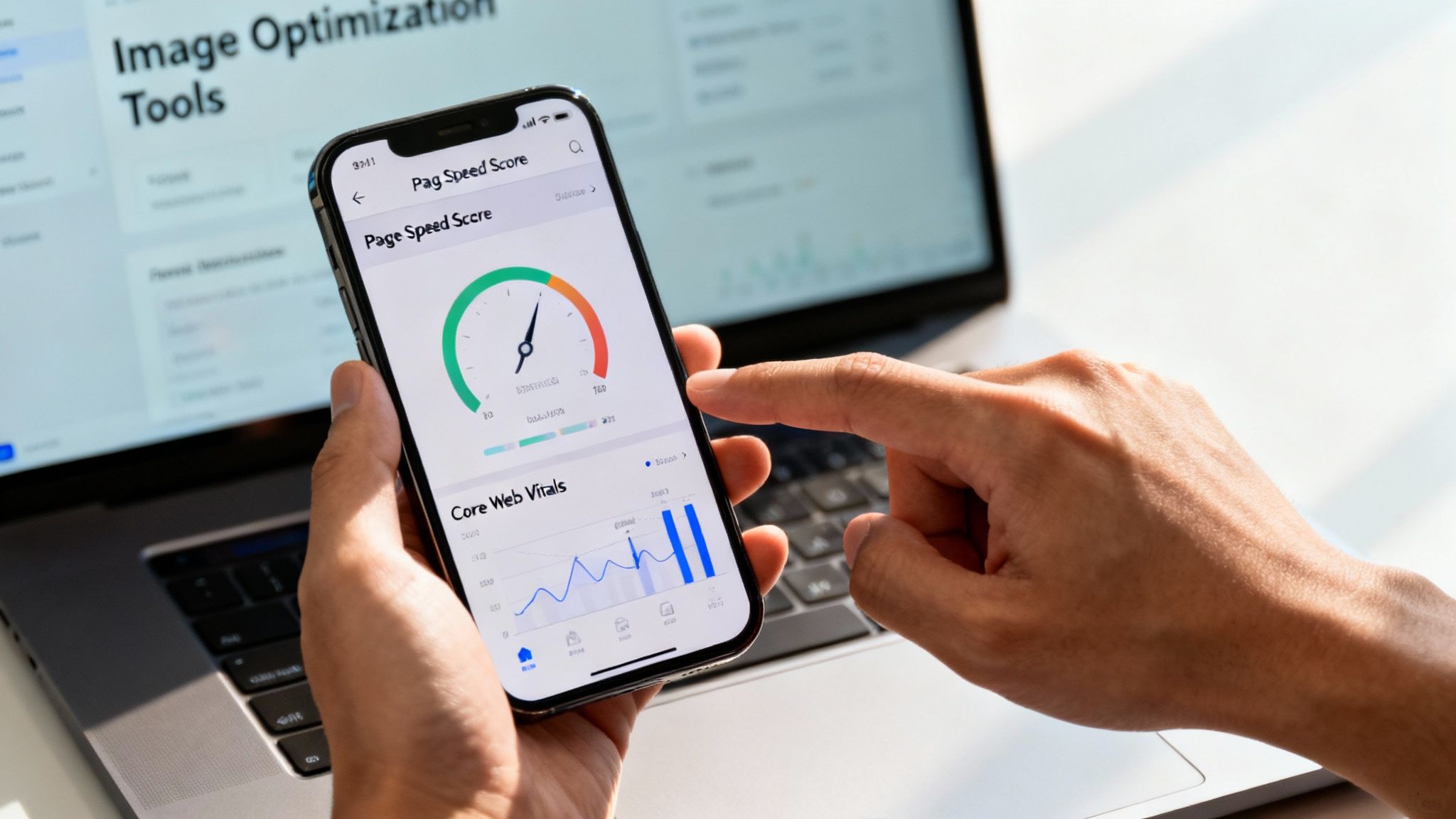
Let’s be honest, technical SEO can sound a bit intimidating. It's the engine running under the bonnet of your ecommerce machine, and while you might not need to know how to rebuild it from scratch, you absolutely need to know how to keep it tuned up.
Get this part right, and everything else—your beautiful product shots, your persuasive copy—actually gets seen by Google and your customers. Get it wrong, and you might as well have a ‘closed’ sign on your digital front door. A slow, buggy, or confusing site is a fast way to lose sales and rankings.
The good news? You don't need to be a developer to make a huge impact. We'll break down the essentials that move the needle most for online stores: speed, structured data, and mobile-friendliness.
In ecommerce, speed is money. It’s not just a nice-to-have; it's a critical conversion factor. A mere one-second delay in page load times can slash your conversions by 7%. That’s real revenue walking out the door simply because your site was too slow.
Google knows this, which is why its Core Web Vitals are a direct ranking signal. These metrics are Google’s way of measuring the real-world experience a person has on your site, focusing on load speed, interactivity, and whether the page jumps around as it loads. A bad score is a clear signal to Google that your site offers a clunky experience, and your rankings will suffer for it.
Here are a few high-impact fixes you can tackle right away:
Ever wonder how some search results show star ratings, pricing, and stock levels right there on the Google results page? That’s schema markup at work.
Schema (also called structured data) is a special kind of code you add to your site. It doesn't change what your customers see, but it acts like a translator, giving search engines super-specific information about your products in a language they can process instantly. For an online store, this is an absolute game-changer.
By implementing Product schema, you’re basically spoon-feeding Google all the juicy details: your product’s name, price, availability, and review ratings. This is what unlocks those eye-catching rich snippets that make your listing far more compelling than a plain blue link.
This extra info makes your listings stand out from the crowd, seriously boosting your click-through rate. You're giving shoppers the key info they need to make a decision before they even click, which means the traffic you get is more qualified and closer to making a purchase.
The debate is over: the majority of online shopping now happens on a smartphone. This isn't just a trend; it's the new standard. Because of this, Google now operates on mobile-first indexing. This means it primarily looks at the mobile version of your site to decide how to rank you.
Let that sink in. If your mobile site is a pain to use, your rankings will suffer everywhere, not just on mobile.
A truly great mobile experience is about more than just having a "responsive" design that shrinks to fit a small screen. It means:
Make it a habit to regularly walk through your entire site on your own phone. Go from the homepage, to a category, to a product, and all the way through checkout. Every time you feel a moment of frustration, you can bet your customers are feeling it too. Fixing those friction points isn’t just good for your customers—it’s fundamental to your technical SEO success.
Your product and category pages are built to convert, there’s no doubt about that. But it's your wider content strategy that builds a brand people actually trust and come back to. This is where your ecommerce SEO marketing goes beyond just making a sale. You stop being just another online store and start becoming a go-to resource, catching customers' attention long before they even think about pulling out their credit card.
This isn’t about just pumping out blog posts to fill a quota. It’s a calculated play to attract shoppers right at the beginning of their journey. The goal is to create genuinely useful content that answers the real, practical questions your customers are asking.
Think for a moment about the questions a potential customer has before they even search for a specific product. They’re looking for solutions to their problems, not just items to buy. This is your golden opportunity to meet them right where they are with content that helps.
So, what does this look like in the real world?
This kind of content is designed to target those informational keywords that your product pages could never hope to rank for. It’s how you get on a potential customer’s radar early, building the trust you'll need to eventually make the sale.
Remember, content marketing in ecommerce isn't a separate task; it's the connective tissue of your entire sales funnel. It warms up cold traffic, nurtures leads, and gives customers the confidence they need to click 'buy'.
The Australian online shopping scene is absolutely booming, with the industry hitting a market size of $64.9 billion. And with 9.8 million Australian households shopping online in the past year, just having a catalogue of products isn't enough to stand out. You need to build a relationship through valuable content. You can dig into more of these stats over at IBISWorld.
Creating fantastic content is only half the job. You also need to actively promote it to build your site's authority. Backlinks—links from other websites back to yours—are still a massive signal to Google that your site is credible and trustworthy. For an online store, that’s pure gold.
But let’s be honest, a lot of traditional link-building tactics can feel a bit clunky and disconnected from ecommerce. The trick is to focus on strategies that feel natural, are genuinely relevant, and get your products in front of the right eyeballs.
Here are a few proven tactics that work a treat for Australian ecommerce brands:
This two-pronged attack—creating exceptional, problem-solving content and then actively building high-quality links—is the foundation of a sophisticated ecommerce SEO marketing strategy. It’s how you build a resilient brand that isn’t just propped up by paid ads.
The right content doesn't just attract visitors; it plays a huge role in turning them into buyers. You can explore our expert tips on how to improve your conversion rate to make your content work even harder for you.
Got your foundations sorted? Good. Now it’s time to shift from just competing to actually dominating your market. Advanced ecommerce SEO isn’t about broad strokes; it’s about surgical precision. This is where you pull away from the pack who are all still fussing over the basics.
Let’s get into the complex, high-impact stuff that really drives scalable growth, starting with taking your Aussie brand onto the world stage.
Expanding beyond Australia is a massive opportunity, but it demands a careful technical strategy to avoid confusing the search engines. Just translating your site won’t cut it. You need to explicitly tell Google which version of your page is meant for which audience.
This is where the hreflang tag comes into play. It’s a snippet of code that signals to search engines the specific language and region a page is targeting. For example, if you have one product page for your Aussie customers and another for shoppers in the US, hreflang tags stop them from fighting each other in the search results.
Nail the implementation, and you’ll ensure that:
When you're ready to expand, you'll need to decide on the best technical setup for your business. Each approach comes with its own set of challenges and benefits.
| Approach | Pros | Cons | Best For |
|---|---|---|---|
| ccTLDs (e.g., .com.au, .co.uk) | Strongest geo-targeting signal; builds trust with local users. | Most expensive; requires managing separate websites. | Businesses with significant resources and a strong commitment to specific markets. |
| Subdirectories (e.g., .com/au/) | Easiest to manage; consolidates domain authority. | Weaker geo-targeting signal than ccTLDs. | Businesses looking for a scalable and cost-effective way to target multiple regions from one domain. |
| Subdomains (e.g., au.yourstore.com) | Relatively easy to set up; can be hosted on different servers. | Can dilute SEO authority; may be seen as separate sites by Google. | Businesses needing to separate international sites for technical or branding reasons. |
Ultimately, the right structure depends entirely on your budget, technical resources, and long-term global ambitions.
Hreflang is your passport for international search. It tells Google, "Show this page to users in this country," ensuring a relevant, localised experience that boosts conversions and stops SEO cannibalisation.
Faceted navigation—those handy filters for size, colour, brand, and price—is brilliant for customers. For SEO, however, it can be an absolute nightmare if you don’t get it right.
Every time a user clicks a filter, a new URL is often spat out (e.g., yourstore.com.au/dresses?colour=red&size=10). If Google starts indexing all these variations, you suddenly have thousands of low-quality, near-duplicate pages. This just burns through your crawl budget and waters down the ranking power of your main category page.
The fix is to control what Google can and cannot index. The best practice is to use a canonical tag on all filtered URLs, pointing them back to the main, unfiltered category page. This tells Google, "Hey, this is just a tweak of the main page. Pile all the SEO value over there." Combine this with some smart rules in your robots.txt file, and you’ll have tight control over how search engines crawl your site.
To get a clearer picture of how different content pieces fit into your overall strategy, a decision tree can be a huge help.
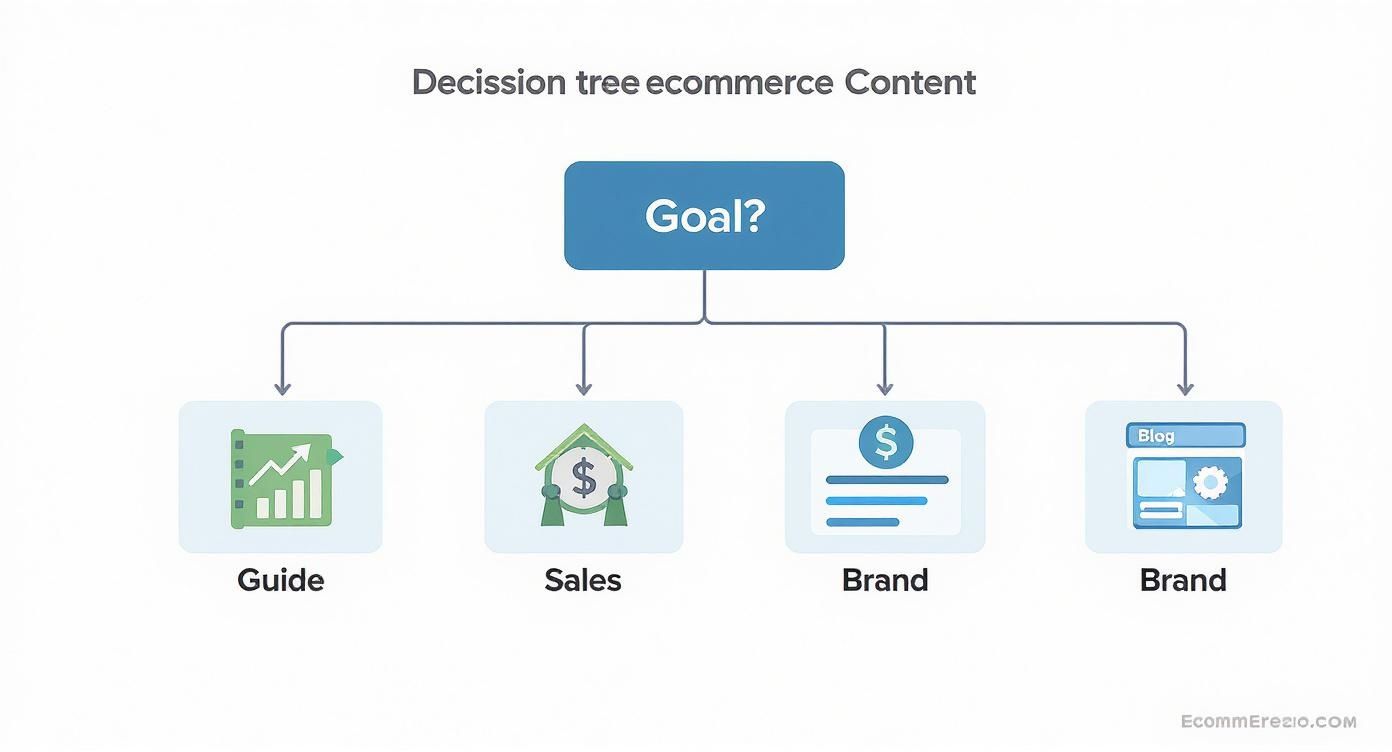
This really just shows that your strategy needs to branch out depending on whether your goal is to drive immediate sales or build long-term brand authority.
Treating paid search (PPC) and organic search (SEO) as two separate things is a classic missed opportunity. When you align them, they create a powerful synergy that fast-tracks your growth. SEO gives you that long-term, sustainable traffic, while paid ads deliver instant visibility and a goldmine of data.
You can, for instance, use the data from your Google Ads campaigns to sharpen your SEO strategy. Which ad copy gets the best click-through rate? Those phrases are probably great candidates for your organic page titles and meta descriptions. Which paid keywords are converting like crazy? You’ll want to prioritise optimising your category and product pages for those exact terms. Having the right kit helps, and you can see what the pros use by checking out some of the best SEO tools for agencies.
To really stay ahead, it’s also crucial to think about how AI is changing product discovery. Learning how to make your products visible in an AI-powered world is quickly becoming non-negotiable. This combined approach turns your ecommerce marketing into a data-driven machine, making sure every dollar and hour you spend hits the bottom line.
If you're not measuring, you're just guessing.
A genuinely effective ecommerce SEO strategy isn't built on gut feelings or assumptions; it stands on a solid foundation of data. Without tracking the right numbers, you have no real way of knowing what’s working, what’s a complete waste of time, or how any of your efforts are actually affecting your bottom line.
This is how you shift from simply hoping for results to actively proving them. When you focus on the right metrics, you can justify your SEO investment, make much smarter decisions, and constantly refine your approach for better and better performance. Let’s get practical about tracking the key performance indicators (KPIs) that really matter.
Before you can measure a single thing, you need the right tools set up correctly. For any ecommerce store, two free platforms are completely non-negotiable: Google Analytics 4 (GA4) and Google Search Console (GSC). Think of them as your business's central dashboard and your direct line to Google itself.
GA4 is where you see what people do once they land on your site. GSC, on the other hand, tells you how your site is performing in Google search, showing you the exact queries people use to find you and flagging any technical issues Google runs into.
Linking these two accounts is your first critical step. This integration pipes your GSC data directly into your GA4 reports, finally connecting the dots between pre-click search behaviour and post-click user actions on your site.
It’s easy to get distracted by vanity metrics like total traffic, but they can be incredibly misleading. A million visitors are completely worthless if none of them ever buy anything. For an ecommerce business, you need to be laser-focused on the KPIs that are directly tied to sales and real business growth.
Here are the core metrics you should be watching like a hawk:
A rising organic conversion rate is one of the strongest signs that your SEO and on-page experience are perfectly aligned. It means you’re not just attracting more people, but the right people, and your product pages are doing a brilliant job of persuading them to buy.
The consistent growth in online retail really underscores why these metrics are so vital. In Australia, the proportion of online sales has climbed to 12.7% of total retail, a significant jump from previous years. This trend is happening across both food and non-food sectors, showing a clear, steady shift in how consumers shop. Keeping a close eye on your organic performance is the only way to ensure you're capturing your share of this expanding market. You can find more insights about these Australian retail trends on abs.gov.au.
Getting organic traffic to your site is only half the battle. The next, and arguably more important, part is converting those visitors into paying customers. This is the world of Conversion Rate Optimisation (CRO).
CRO is the systematic process of testing and improving elements on your website to increase the percentage of visitors who take a desired action—in this case, making a purchase. It’s the crucial intersection where SEO traffic meets user experience.
A great place to start is by A/B testing different elements on your key product and category pages. An A/B test is pretty simple: you create two versions of a page (Version A and Version B) and show them to different segments of your audience to see which one performs better.
Simple tests you can run right away include:
By continuously testing and implementing the winning variations, you can make small, incremental improvements that add up to significant gains in revenue over time. This data-driven approach transforms your website from a static catalogue into a dynamic, optimised sales machine, ensuring you get the maximum possible return from all that hard-won organic traffic.
Jumping into ecommerce SEO can feel like you're trying to solve a puzzle where the pieces keep changing shape. To cut through the noise, we've laid out some straight-talking, practical answers to the most common questions we get from Australian online retailers.
These are the real-world problems that stop store owners from getting a decent return on their SEO investment. Let's get into it.
This is the big one, and honestly, it’s crucial to set realistic expectations from day one. SEO isn't like flicking a switch on a paid ad campaign; it’s more like planting a garden. You’ve got to prepare the soil, plant the right seeds, and nurture them consistently before you see any real growth.
Realistically, you should start seeing some early green shoots within three to six months. This could be a few improved rankings for less competitive keywords, a small but welcome lift in organic traffic, or just Google getting a better handle on indexing your product pages.
But for the kind of results that actually move the needle—I’m talking significant organic revenue and top rankings for high-value commercial keywords—you need to be thinking of a six to twelve-month journey. The hard yards you put in today building a solid SEO foundation will pay off for years, creating a genuine business asset that keeps bringing in traffic and sales long after the initial push.
Patience is the secret ingredient in any successful ecommerce SEO strategy. It's a long-term play that builds sustainable, compounding growth, unlike paid ads where the traffic dies the second you stop paying.
It’s incredibly easy to get lost in a sea of data, obsessing over vanity metrics that don't actually impact your bottom line. For an ecommerce business, your focus needs to be laser-sharp on the numbers that directly connect to revenue.
Forget about tracking every tiny keyword fluctuation. Instead, zero in on these essential KPIs that tell the real story of your SEO performance:
This isn't an either/or situation. A smart strategy needs both, but they play completely different roles in a customer's path to purchase. Think of your site like a physical shop: your category pages are the big, clearly marked aisles, and your product pages are the individual items on the shelves.
Your category pages are your heavy hitters. They need to be optimised to target those broader, high-volume search terms like "women's hiking boots" or "leather crossbody bags." These pages are designed to catch shoppers who are still browsing and comparing their options.
Your product pages are your closers. They are built to capture super-specific, long-tail searches like "Salomon X Ultra 4 Mid GTX womens size 9." These searches show clear buying intent, and the page's only job is to provide every detail needed to convert that decisive shopper. A winning strategy uses category pages to cast a wide net and perfects product pages to seal the deal.
Look, you can technically succeed without one, but choosing not to have a blog is a massive missed opportunity and puts you at a serious competitive disadvantage. A blog is your single most powerful tool for attracting customers at the very top of the sales funnel—long before they even know they want to buy from you.
It lets you target informational keywords that your product and category pages will never rank for. Someone might search "how to choose the right hiking boots" weeks before they ever search for a specific brand. A genuinely helpful blog post answering that question builds instant trust and positions your brand as an expert.
On top of that, high-quality blog content is a magnet for natural backlinks from other websites. Those links are a huge signal to Google that your site is an authority, which in turn helps lift the rankings of all your pages, including your all-important category and product pages.
Ready to stop guessing and start growing your online store with a data-driven strategy? The team at Virtual Ad Agency specialises in full-funnel ecommerce marketing that delivers measurable results. Discover how we can help you build a powerful online presence by visiting us at https://www.virtualadagency.com.au.

 previous