
When we talk about marketing agency content, we’re not just talking about churning out articles and videos. It's the strategic creation and use of those assets, both for growing your own agency and for getting real, measurable results for the clients you serve. It’s less about making things and more about building a valuable asset that actually drives growth.
It's tempting to see content as individual pieces – a blog post here, a social media update there. That’s like looking at a pile of bricks and timber and calling it a house. The real value is in the architectural blueprint that ties everything together. This plan is what guides the construction, ensures the whole thing is stable, and creates something built to last. For any agency, this blueprint serves two vital, parallel functions.
First, it’s the engine for your own agency's growth. High-quality content is how you show you know your stuff, build trust with prospects, and bring new business through the door. At the same time, it’s the very product you deliver to clients – meticulously designed to get them more leads, drive sales, and build their brand authority.
This dual purpose is a unique challenge. Agencies have to master producing strategic, high-impact content at scale for a whole portfolio of different clients, all while running a top-notch marketing program for themselves. This guide is your roadmap to navigating that challenge, from the first spark of an idea all the way to final optimisation.

This really gets to the heart of modern content marketing. It's all about attracting, engaging, and keeping a clearly defined audience with one ultimate goal in mind: driving profitable customer action. That’s the core principle behind every agency’s mission.
To get a proper handle on its function, it helps to break down agency content into two main categories, each with its own distinct goal:
The demand for this kind of strategic work is undeniable. The Australian content marketing industry is on track to hit a market size of $453.2 million in 2025, growing at a healthy 4.3% each year. This boom shows just how central content has become for businesses all across the country.
A successful agency doesn’t just sell content services; it embodies content excellence. Its own marketing should be the best case study it has, proving its ability to deliver results before a client even signs a contract.
Trying to create powerful content for your agency without a strategy is a bit like setting off on a road trip with no map. Sure, you’re moving, but are you actually getting anywhere? A content strategy is the ‘why’ that gives every piece of content its purpose. It’s what turns random blog posts and social updates into a coordinated campaign that actually grows your business.
For an agency, a solid framework is non-negotiable. It’s not just for your own marketing; it’s the blueprint you’ll use, tweak, and perfect for every single client. Think of it as your repeatable system for delivering quality and consistency, every time.
Don't just keep this plan in your head, either. Writing it down makes a huge difference. In fact, Australian businesses with a documented strategy see a 3.2x higher return on investment than those flying blind. It's no surprise that as we look towards 2025, 74% of Australian businesses now have a formal content marketing strategy in writing. They know it works.
Before you even think about writing a headline, you need to know exactly who you're talking to. And I mean really know them, not just their job title and location. This is where detailed target audience personas come in. You're essentially creating a character profile for your ideal customer, digging into their goals, their biggest headaches, and what a day in their life looks like.
What keeps them awake at night? What problems are they desperately trying to solve? When you get inside their head, you can create content that genuinely helps them, building a foundation of trust from the very first click.
Once you know who they are, you need to map out how you'll talk to them as they get to know you. A customer journey map lets you see the whole path, from a complete stranger stumbling upon your blog to a loyal client. This helps you serve up the right content at the right time.
With your audience clearly defined, it’s time to put on your detective hat. This research phase is where you uncover the opportunities that will make your content stand out and, most importantly, get found by the people who need it.
Here’s what that looks like:
A strategy without a goal is just a wish. Every piece of content you create must be tied to a specific, measurable business outcome. Are you trying to generate more qualified leads? Build brand awareness in a new industry? Or keep your current clients happy and engaged?
A content strategy isn't a "set and forget" document. It's a living, breathing plan that needs to adapt to market shifts, performance data, and your clients' changing needs. You have to review it and tweak it regularly to keep it sharp.
A great guide on mastering your social media content strategy can be a huge help for agencies looking to build out a robust plan. To make sure your framework is actually doing its job, you need to attach Key Performance Indicators (KPIs) to each goal. For example, if your goal is lead generation, your KPIs might be the number of form submissions, demo requests, or consultation bookings.
Pulling together a strategic framework from scratch is a big job. If you need an expert eye to help build or refine your plan, a professional content marketing consultation can get your efforts lined up with real, tangible business results.
Creating the right marketing agency content isn’t just about what you say; it's about when you say it. Think of it like this: you wouldn't propose on a first date. It’s too much, too soon. The same idea applies in marketing – your message has to match where someone is on their journey with you.
This is where the marketing funnel comes in. It’s a simple but incredibly useful model that maps out a potential customer’s path, from the first time they hear about a brand to the moment they decide to buy. By lining up the right content formats with each stage, agencies can guide people smoothly through that journey, building trust and showing their value every step of the way.
At the top of the funnel (ToFu), your audience is just realising they have a problem or a need. They aren't looking for a specific fix just yet; they're in exploration mode, gathering information. The goal here is broad-stroke education and engagement, not a hard sell.
Your content needs to be easy to find and share, answering their early questions and positioning your client (or your agency) as a genuinely helpful resource.
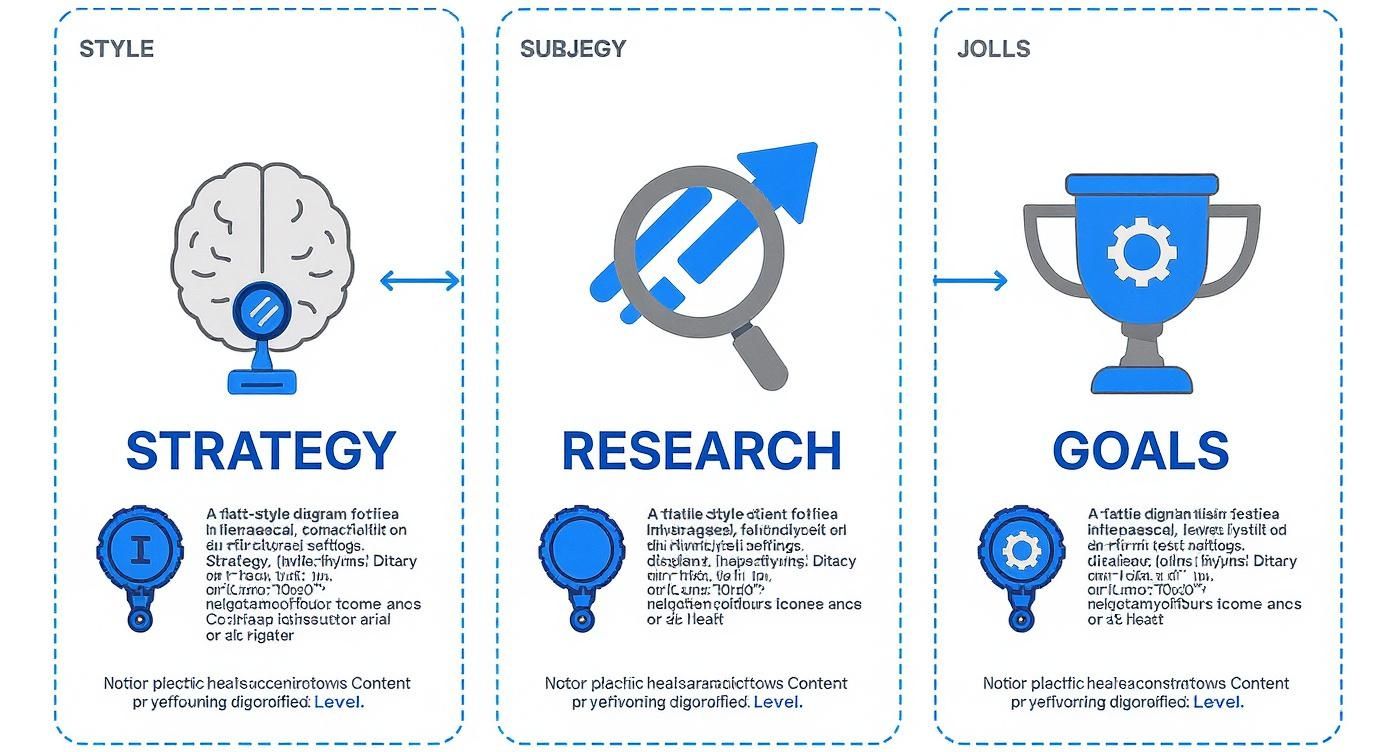
As the visual shows, great content doesn’t happen by accident. It all starts with a solid strategy, which guides the research needed to hit clear business goals. Each step builds on the last.
Video, in particular, has become an absolute powerhouse in Australia. Projections show that by 2025, video will make up 64% of all digital content consumed in the country. This isn't just a fleeting trend; a huge 89% of Australian marketers say video delivers the best return on investment, making it essential for top-of-funnel success. You can dive deeper into these trends by exploring Australian marketing statistics.
Once someone moves into the middle of the funnel (MoFu), they’ve confirmed they have a problem and are now actively researching solutions. They've gone past casual browsing and are starting to seriously weigh up their options. Now, your content’s job shifts from grabbing attention to building trust and proving your expertise.
This is the stage for more in-depth, valuable resources that help people make an informed decision. The goal is to nurture that budding relationship and show them that your client is the best choice.
Content in the middle of the funnel is the bridge between initial interest and the final decision. It’s where you prove you not only understand their problem but have the specific expertise to solve it.
Effective MoFu formats include:
Finally, at the bottom of the funnel (BoFu), your prospect is on the verge of making a decision. They’re comparing their final options and just need that last nudge to commit. The content here needs to be super-targeted and action-focused, making it as easy as possible for them to choose you.
This is where you directly address their last-minute hesitations and remove any remaining obstacles to purchase. The focus is on conversion, plain and simple.
Content formats that seal the deal include:
To help visualise this, here’s a quick breakdown of which content formats work best at each stage of the funnel, along with what you’re trying to achieve and how to measure it.
| Funnel Stage | Primary Goal | Effective Content Formats | Key Performance Indicators (KPIs) |
|---|---|---|---|
| Top of Funnel (ToFu) | Build brand awareness & attract a broad audience. | Blog Posts, Infographics, Social Media Updates, Short-Form Video, Checklists. | Website Traffic, Social Shares, Video Views, Search Rankings. |
| Middle of Funnel (MoFu) | Nurture leads, build trust & showcase expertise. | Case Studies, White Papers, E-books, Webinars, Email Newsletters. | Lead Conversions (e.g., form fills), Time on Page, Email Open/Click Rates. |
| Bottom of Funnel (BoFu) | Drive conversions & facilitate purchase decisions. | Free Trials, Demos, Consultations, Pricing Pages, Testimonials, FAQs. | Demo Requests, Trial Sign-ups, Sales Qualified Leads (SQLs), Conversion Rate. |
Using a map like this ensures you’re not just creating content for the sake of it. You’re strategically delivering the right message at the right time to guide prospects from stranger to customer.
A brilliant strategy is only half the battle. For any marketing agency juggling multiple clients, the real magic—and the key to profitability—happens in the execution. Being able to pump out high-quality content consistently isn't just a nice-to-have; it's the engine that lets you scale. This means ditching the ad-hoc chaos and building a well-oiled production machine where every piece of content follows a clear, repeatable path from idea to publication.
Think of it like a professional kitchen. The head chef (your strategist) designs the menu, but it’s the disciplined workflow of the entire kitchen crew that ensures every dish comes out perfect, on time, every single time. A solid content workflow does exactly the same thing for your agency, delivering quality and predictability for every client.
Without that structure, you're just inviting chaos. Deadlines get missed, quality is all over the place, and team members are left guessing what they're supposed to do next. A streamlined workflow turns that potential mess into a predictable, scalable, and profitable operation.

First things first: you need to get crystal clear on who does what. Even in a small agency where people wear multiple hats, understanding the core responsibilities is crucial for accountability and making sure handoffs between stages are seamless.
Once the roles are set, it's time to map out the journey each piece of content will take. A typical workflow for marketing agency content, like a blog post, can be broken down into these manageable stages. Following this process means nothing falls through the cracks.
Creating Standardised Operating Procedures (SOPs) for this workflow is an absolute game-changer for agencies. An SOP document makes each step official, defines your quality standards, and gives the team a clear playbook to follow, ensuring consistency across every client account.
Technology is the glue that holds a modern content workflow together. The right tools create transparency, make collaboration easier, and automate the boring stuff, freeing up your team to focus on the creative and strategic work they do best.
Here are a few must-haves:
By setting up clear roles, a documented process, and the right toolkit, your agency can turn content production from a constant scramble into a streamlined, scalable, and highly effective operation.
Pushing ‘publish’ on a new piece of content isn’t the finish line; it’s the starting gun. The real skill—and where the best agencies prove their worth—is in meticulously measuring what happens next and constantly fine-tuning the approach.
Without this feedback loop, you’re just guessing. You're spending your time and your client’s budget without any real idea of what’s actually working. It's the difference between hoping for results and knowing exactly how to create them.
This whole process has to go way beyond feel-good numbers like page views or social media likes. Sure, those numbers are nice to see, but they don't pay the bills. When we talk about performance, we mean tying every single piece of marketing agency content back to tangible business outcomes that you and your clients actually care about.
If you want to show real value, you have to get laser-focused on business-centric Key Performance Indicators (KPIs). These are the metrics that prove your content is directly fuelling growth and delivering a clear return on investment. The aim is to draw a straight line from a blog post to a signed contract.
Here are the key business-focused KPIs we live by:
You can't track this stuff with guesswork. You need a solid toolkit. Platforms like Google Analytics, SEMrush, and your marketing automation software are essential for seeing how people interact with your content and what they do afterwards. For a deeper dive into the numbers that really matter, check out these key digital marketing performance metrics.
Data is completely useless if you don't do anything with it. A systematic optimisation cycle makes sure your content library doesn’t just get bigger, it gets better and more valuable over time. This involves regularly auditing your existing assets to see what’s a hit, what’s a miss, and where the hidden opportunities are. To really get a handle on this and prove your ROI, it's vital to know How to Measure Content Performance.
This isn't a task you do once and forget about. It's an ongoing rhythm. By constantly reviewing performance, you can make smart, informed decisions instead of just churning out more content for the sake of it.
A content audit is like a health check-up for your marketing assets. It tells you which pieces are strong and healthy, which are under the weather and need attention, and which might be ready for retirement.
The process helps you find those underperforming blog posts and guides—the ones that just aren't bringing in traffic, generating leads, or ranking for the keywords they should be. Once you’ve identified them, you can roll out a whole range of strategies to breathe new life into them.
Instead of letting old content gather digital dust, you can give it a new lease on life to boost its performance and extend its value. Honestly, this is often way more efficient than starting from scratch.
Here are three simple but powerful tactics we use all the time:
When you adopt this measure-and-optimise mindset, your content stops being just a creative exercise. It becomes a predictable, data-driven engine for growth that delivers real, measurable value for your agency and every single client you work with.
Theory and frameworks are all well and good, but nothing beats seeing a strategy deliver real, tangible results. It’s what truly matters at the end of the day. To show you just how effective a smart content approach can be for a marketing agency, let’s walk through two very different examples where getting the right content in front of the right audience drove serious business growth.
The Challenge: We started working with a growing Aussie B2B SaaS company that was really struggling to get high-quality leads through the door. Their content felt a bit generic and just wasn't cutting through to the C-suite execs and technical decision-makers they needed to reach. These people needed deep, specific insights before they’d even consider booking a product demo.
The Strategy: Our plan was simple: stop casting a wide, shallow net with broad-appeal blog posts and start creating high-value, gated content that screamed authority. We focused on a bottom-of-the-funnel approach, centring the campaign on in-depth white papers that solved very specific industry pain points. These were then amplified with targeted LinkedIn articles to get right in front of decision-makers where they spend their time.
The Execution:
The Results: This laser-focused approach paid off big time. In the first quarter alone, the campaign delivered a 47% increase in marketing qualified leads (MQLs). Even better, the quality of those leads was through the roof, resulting in a 30% lift in qualified demo requests from their perfect customer profiles.
The Challenge: A new Australian e-commerce fashion brand came to us needing to make a splash in a super competitive market. With a tight budget, they needed a content strategy that could build brand awareness and drive sales—fast. It had to create both buzz and direct revenue.
The Strategy: We went with a two-pronged attack. First, top-of-funnel awareness to get their name out there. Second, bottom-of-funnel conversion to get the cash register ringing. The plan involved using trendy, engaging short-form video on TikTok and Instagram to grab attention, while we built a solid foundation of SEO-optimised blog content to pull in organic search traffic from people ready to buy.
The Execution: We kicked off a consistent stream of short videos featuring user-generated content, influencer collabs, and behind-the-scenes snippets. At the same time, we published weekly blog posts targeting long-tail keywords people were actually searching for, like "best summer dresses for Melbourne" and "sustainable fashion brands Sydney." We were directly answering the specific questions their customers were asking Google.
The Results: It worked. The video campaign went viral within two months, leading to a massive 300% increase in social media followers and a huge spike in brand mentions. The SEO blog posts started climbing the ranks, landing on the first page of Google for key transactional searches and driving a steady flow of high-quality traffic. All up, this integrated effort delivered a 55% uplift in online sales over six months, proving that a smart, combined content strategy really works.
Even with the best strategy in the world, a few common questions and challenges always seem to crop up. Getting ahead of these will make your workflows smoother and keep both your team and your clients on the same page.
For a small agency, especially one watching the budget, the answer is a ‘lean content’ approach. Instead of trying to be everywhere and do everything, get really good at one or two things. Master a specialised blog or a super-targeted podcast, for example.
The real magic, though, is in repurposing. That one deep-dive article you wrote? It can be sliced and diced into a dozen social media updates, a quick explainer video, a shareable infographic, and even your next email newsletter. Bringing in freelance talent for specific jobs like writing or graphic design can also be a smarter move than hiring full-time staff straight out of the gate. Just remember: quality always trumps quantity. One brilliant piece a month will do more for you than four so-so ones.
A painless client review process all comes down to setting clear expectations from day one. Ditch the confusing email chains and use a single platform for all feedback, whether that's a shared Google Doc or a project management tool.
The secret to a smooth approval process isn't complicated: it's all about proactive communication and clear boundaries. Define the rules of engagement upfront, and you’ll keep feedback focused, constructive, and on schedule.
Give clients a clear timeline showing exactly when they’ll get drafts and when you need their feedback by. It's also a good idea to write a set number of revision rounds into your agreement (e.g., two rounds are included). When you do present the content, always tie it back to the strategy and goals you both agreed on. This keeps the feedback productive and stops things from going off-track.
This is a big one. Content marketing is a long game, not an overnight fix. While you might get some early buzz, the really meaningful results—think better SEO rankings and a steady flow of leads—typically take 6 to 12 months of consistent, high-quality work.
Of course, this timeline isn't set in stone. It can shift depending on:
It’s vital to have this conversation with clients right at the start to manage their expectations. Along the way, focus on tracking the early wins like organic traffic growth, new keyword rankings, and email list sign-ups to show them you’re making solid progress.
At Virtual Ad Agency, we don't just create content; we build and execute strategies that deliver measurable growth. If you're ready to see what an expert-led content plan can do for your business, get in touch with us.

 previous