
At its core, Google Ads management is the process of planning, running, monitoring, and fine-tuning your paid advertising campaigns on the Google network. It’s all about having a steady hand on the controls—from keywords and ad copy to bidding and budget—to make sure you’re getting the best possible return on your investment.

So many businesses fall into the trap of treating Google Ads like a crockpot. They throw in their ingredients, turn it on, and just hope for a decent result hours later. That ‘set it and forget it’ mindset is a recipe for wasting money and missing the mark completely.
Think of it like putting a high-performance aircraft on autopilot without plugging in a destination. You’re burning a lot of expensive fuel to go nowhere in particular.
Proper Google Ads management is the complete opposite. It's an active, hands-on process. It’s the pilot constantly making small adjustments for turbulence, weather, and air traffic to ensure a smooth flight and a safe landing at the intended destination.
Without active management, ad spend quickly becomes a cost rather than an investment. The process ensures every dollar is working to generate leads, drive sales, and build brand awareness, preventing costly leaks in your marketing budget.
This constant attention is what turns clicks into actual customers and ensures your budget delivers real, tangible results.
When you get right down to it, Google Ads management is all about making smart decisions based on data. It’s not about getting a flood of clicks; it’s about getting the right clicks, from the right people, at the right price. This involves a whole suite of activities that all have to work together.
The key activities really boil down to this:
The world of digital advertising is never static. Your competitors are always changing their tactics, what customers search for evolves, and Google itself is constantly rolling out updates to its algorithms and platform features.
A campaign that was knocking it out of the park last month could easily start to flounder this month if no one’s watching.
That’s why real management is a dynamic, ongoing process. It needs someone to be consistently looking at the data, figuring out what’s working, diagnosing what isn't, and tweaking the strategy. It’s this proactive approach that keeps your campaigns competitive, relevant, and profitable for the long haul.

A high-performing Google Ads account is never an accident. It’s built with a deliberate, logical structure. Think of it like building a house. You wouldn’t start throwing up walls without a solid foundation and a clear architectural plan. Every part needs to be carefully placed for the whole thing to be strong and effective.
This blueprint covers the absolute essentials of Google Ads management, from the foundational setup to the fine details that actually drive sales. Following this plan makes sure every piece of your campaign is working together to hit your business goals.
Everything starts with your account structure. A messy, disorganised account is like a supermarket with no aisle signs—customers can't find what they’re looking for, and you have no hope of managing your stock. A logical structure, on the other hand, makes your campaigns a breeze to manage, analyse, and tweak.
The goal here is to create campaigns and ad groups with tight, specific themes.
This level of detail is critical. It allows you to write incredibly relevant ad copy that speaks directly to what the user is searching for, which in turn boosts your Quality Score and overall ad performance.
Once your structure is solid, it's time to make sure your ads are seen by the right people. Showing an ad for a juicy steak to a lifelong vegetarian is a complete waste of money. Proper Google Ads management involves layering different targeting methods to really zero in on your ideal customer.
This goes way beyond just keywords. We're talking about:
By combining these targeting options, you move from shouting your message into a crowded room to having a direct, relevant conversation with potential customers who are most likely to be interested in what you offer.
With your structure built and audience defined, we get to the auction itself. Your bidding strategy is how you compete for ad placements. While manual bidding gives you total control, automated strategies like Maximise Conversions or Target ROAS (Return On Ad Spend) use Google's AI to optimise your bids in real-time, all based on your goals.
At the same time, your ad copy and creative are your sales pitch. They need to be good enough to earn that click. A great ad always:
A high click-through rate is a strong signal that your ads are hitting the mark. You can dive deeper into what makes a good CTR in our detailed guide.
The final, absolutely non-negotiable piece of the puzzle is conversion tracking. Without it, you are flying blind. It's the system that tells you which keywords, ads, and campaigns are actually driving valuable actions on your website, like sales, form submissions, or phone calls.
Getting this set up correctly is the very foundation of good Google Ads management. It’s the only way to measure your return on investment and make decisions based on data, not guesswork. The average conversion rate for Google Ads in Australia is around 7.52%, but that number doesn't mean much without context. Shockingly, studies have shown that in many accounts, 88% of keywords produce zero sales.
This is precisely why tracking is so essential—it helps you find and cut that wasted spend. This data gives you the power to double down on what works and kill what doesn't, turning your ad spend from an expense into a profitable investment.
One of the first questions any Australian business asks when looking at paid search is always about the money. "How much do I actually need to spend to get results?" The truth is, there's no single number. Google Ads isn't like a shop with fixed price tags; it’s a dynamic, live auction happening millions of times a second.
Getting your head around this auction is the first step to budgeting smartly. Every time someone types in a keyword you’re targeting, Google runs a lightning-fast auction between all the advertisers bidding on that term. But here’s the kicker: your spot on the results page isn't just about who throws the most money at it. It's a blend of your bid and your Quality Score.
This Quality Score is Google's way of rating how relevant your keywords and ads are to the user. It’s a massive piece of the puzzle in effective Google Ads management because a higher score can actually mean you pay less for a better ad position.
Several moving parts determine what you'll end up paying for each click, known as your Cost Per Click (CPC). The biggest one by far is industry competition. Think of it like real estate. A keyword like "local bakery in Adelaide" is like buying a house in a quiet suburb—more affordable and not as fiercely contested.
But a keyword like "personal injury lawyer Sydney"? That’s prime CBD real estate, with dozens of law firms bidding aggressively for that top spot. This intense competition sends the auction price through the roof. On top of that, your ad's relevance and the quality of your landing page also play a huge role by directly influencing your Quality Score.
The core idea is simple: the more relevant your ad is to what the person searched for, and the better their experience is after they click, the less Google charges you. It’s their way of rewarding advertisers who actually help their users.
The price of a single click can vary wildly from one sector to another here in Australia. For a clearer picture, this table breaks down the average CPCs, showing just how much competition can impact your budget.
| Industry Sector | Average CPC (AUD) | Competition Level |
|---|---|---|
| Legal Services | $10.61 | Very High |
| Insurance | $13.37 | Very High |
| Finance | $7.55 | High |
| Real Estate | $3.88 | High |
| Home & Garden | $3.21 | Medium |
| Health & Medical | $4.12 | Medium |
| Travel & Hospitality | $2.05 | Medium |
| E-commerce/Retail | $1.97 | Low-Medium |
While many industries hover around a manageable $2 to $4 AUD per click, you can see how sectors like legal and insurance demand a much larger investment just to get in the game. This data shows why many small businesses in Australia start with a test budget of $1,000 to $2,000 AUD per month. This isn't for immediate profit, but to gather enough data to see what works before scaling up.
So, where do you begin? Forget trying to find a "magic number." A successful budget isn't a fixed amount; it’s a strategic starting point for gathering data. The goal of your initial budget is to learn, not necessarily to hit a home run on day one.
Here’s a practical way to approach it:
For a deeper dive into the numbers, check out our comprehensive guide on how much Google advertising costs.
Once your campaigns are up and running, great Google Ads management means treating your budget like a fluid investment portfolio. You need to be actively watching performance and shifting your money to the areas that are delivering the best returns.
This means pulling budget from underperforming ad groups and funnelling it into your top performers. As you figure out which keywords and ads are actually driving sales or leads, you can confidently increase your investment in those proven winners. This data-driven approach is what turns budget guesswork into a confident financial strategy built for growth.
So, who’s going to run your Google Ads? It’s a massive decision, and it’s one that directly shapes your budget, your results, and even your day-to-day workload. This is a classic business crossroads: do you build an internal team that lives and breathes your brand, or partner with a specialised agency that brings a truckload of outside experience to the table?
There’s no single right answer here. It’s all about finding the right fit for your business right now. You're basically weighing total control and brand immersion against broad expertise and industry perspective. Let's break down what each path looks like.
Bringing your Google Ads management in-house means unparalleled control. Your internal specialist becomes a true part of the company fabric, understanding the little quirks of your products, the specific voice of your brand, and your bigger business goals on a level an external partner rarely can.
This direct line of communication is lightning fast. Strategies can be cooked up and tweaked on the fly because your ads manager is right there, chatting with the sales, product, and marketing teams in real-time. No communication gaps, no delays—just a powerful, unified approach.
But, and it’s a big but, this path has its hurdles.
Working with a Google Ads management agency gives you instant access to a whole team of specialists. These are people who live in the platform day in, day out, managing multiple accounts across all sorts of industries. This gives them a massive advantage—they see what’s working and what’s failing across the board, an experience that’s almost impossible for one in-house person to get.
Agencies also show up with their own advanced toolkits and proven processes, ready to hit the ground running. This is a huge plus for businesses that need to get their advertising efforts firing on all cylinders quickly, without the headache and overhead of building a team from scratch.
An agency’s real value is in its collective brainpower. When you hire one manager, you get one person's experience. When you hire an agency, you tap into the insights and problem-solving skills of their entire team.
Of course, the agency model isn’t perfect. Communication might not be as instant as yelling across the office, and you need to do your homework to make sure the agency you pick really gets your brand and what you’re trying to achieve.
To help lay it all out, here’s a side-by-side look at the key factors to consider.
| Factor | In-House Management | Agency Management |
|---|---|---|
| Expertise | Deep knowledge of one brand. | Broad expertise across many industries. |
| Cost | Full-time salary plus benefits, tools, & training. | Monthly retainer or percentage of ad spend. |
| Control | High level of direct control and rapid execution. | Less direct control; communication can add time. |
| Resources | Limited to internal knowledge and purchased tools. | Access to a team and advanced software. |
| Scalability | Scaling requires hiring more staff. | Can typically scale campaigns quickly. |
Ultimately, the right path hinges on your company’s size, budget, and where you see yourself in the long run.
If you have the resources to invest in top talent and see Google Ads as a core, long-term part of your business, an in-house team can be an incredibly powerful asset. But if you need specialised expertise right now and want to tap into wider industry knowledge without the HR overhead, an agency is often the smarter move. For more guidance, checking out a list of the top digital advertising agencies can give you a clearer picture of what a great partner can bring to the table.
Knowing the theory is one thing, but putting it into practice is what actually drives growth. It’s time to move from understanding the concepts to actively improving your account. Think of this as your repeatable roadmap for auditing, refining, and lifting your Google Ads performance.
Good Google Ads management isn't a "set and forget" project. It's a continuous cycle of improvement. By following a structured process, you can systematically find the weak spots, capitalise on the wins, and make sure your ad spend is always working as hard as it possibly can. This action plan turns all that theory into a practical playbook for real, sustained success.
The following diagram shows the two main paths businesses take to manage their ads. It helps to visualise where your own action plan will come to life.
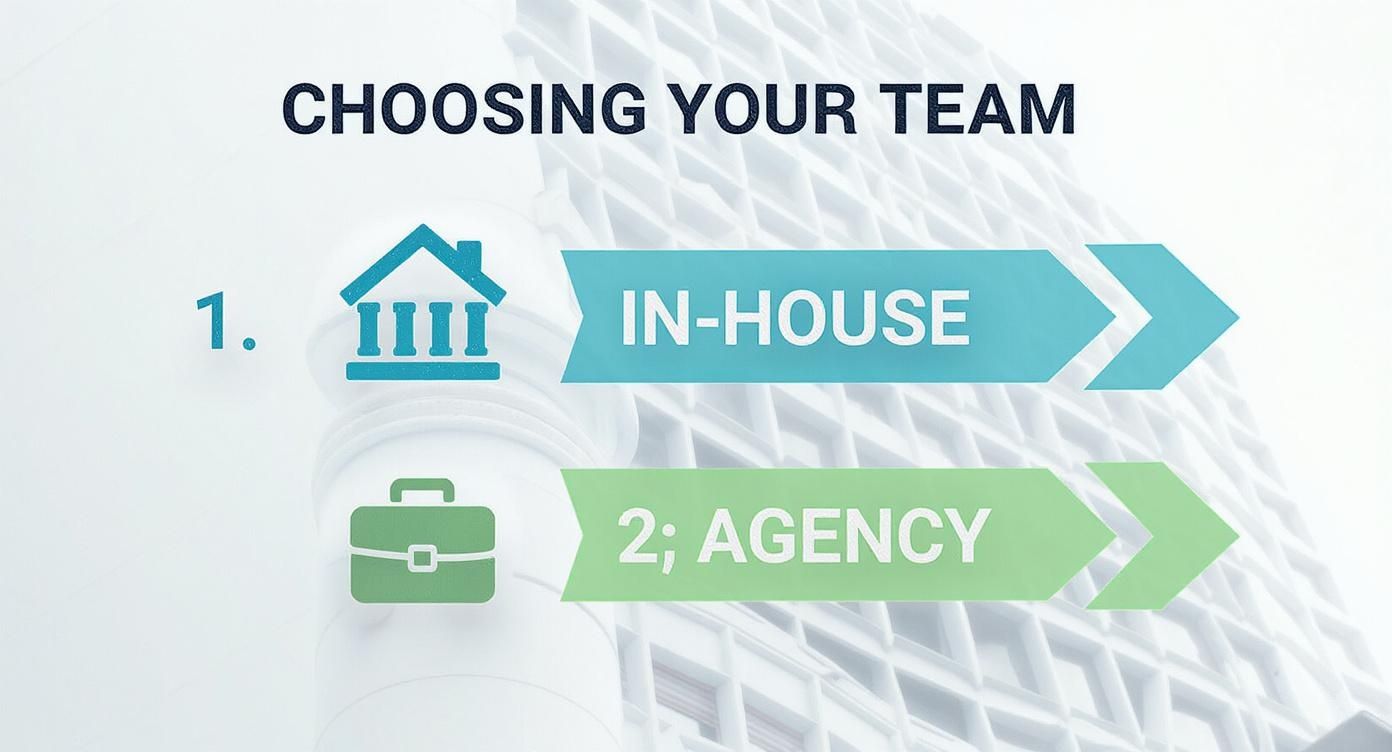
Whether you bring in an in-house expert or partner with an agency, the core principles of campaign optimisation stay the same. This structured approach creates accountability and a clear path to better results, no matter who's at the controls.
Before you start tweaking things, you need a crystal-clear picture of where you stand right now. Think of it as a diagnostic check-up for your campaigns. A thorough health check gives you the baseline data you need to make smart decisions, not just guesses.
Your audit should zoom in on a few key areas:
This initial review will instantly highlight the most urgent fires to put out, giving you a clear starting point for your optimisation work.
With your health check done, the next step is to sharpen your targeting. This is all about refining who sees your ads and making sure you’re not paying for clicks from tyre-kickers. The goal here is precision, not just volume.
Start by diving into your Search Terms Report. This is gold. It shows you the actual search queries that triggered your ads. Hunt for irrelevant terms that are chewing through your budget and add them to your negative keywords list. For example, if you sell premium "men's leather boots," you’d add terms like "cheap," "repair," and "second-hand" as negatives.
A well-maintained negative keyword list acts as a filter, protecting your budget from unqualified traffic. This simple but powerful task is a cornerstone of disciplined Google Ads management, directly boosting your return on investment.
This proactive clean-up ensures your budget is spent only on the searches most likely to turn into customers, instantly making your campaigns more efficient.
Now that you’re reaching the right people, you need to make sure your message hits the mark. A/B testing, or split testing, is simply the process of running two versions of an ad or landing page to see which one performs better.
Don't try to test everything at once. You'll just get confusing results. Focus on one element at a time:
Small changes can lead to surprisingly big improvements in click-through and conversion rates. Continuous testing is how you find that winning combination of words that truly connects with your customers.
The final step in this loop is to put your money where the results are. Use the data you've gathered to make strategic decisions about where your budget goes. This is where your management efforts really hit the bottom line.
Go through your campaigns and ad groups to find the top performers—the ones delivering the most conversions at the lowest cost. Shift your budget away from the underperforming areas and reinvest it into these proven winners. As you refine your campaigns, consider adding tools like lead generation chatbots to efficiently capture and qualify the high-quality traffic you're now driving.
This dynamic approach to budgeting is essential in a crowded market. The simple fact that Google Ads usage among Australian small businesses has nearly tripled since 2016 shows that more and more companies are realising the need for an active, strategic approach. By constantly optimising where you spend, you ensure you're always set up for the best possible return.
Diving into Google Ads for the first time can feel a bit like learning a new language. You’ve got questions about budgets, timelines, and what kind of results to expect, and you need clear, straightforward answers to feel confident about your investment. This section tackles some of the most common queries we hear day in and day out.
Our goal is to cut through the jargon and give you the practical insights you need to manage your expectations and your ad spend effectively.
This is the big one, and the honest answer is: it depends, but you need to be patient. Google Ads isn't a magic button you press for instant sales. The first phase, usually the first 30 to 90 days, is all about gathering data and learning what works.
During this time, Google’s algorithm is figuring out your account, your team is testing different ad copy and offers, and you’re discovering which keywords actually bring in customers. You might see some early wins like clicks and impressions, but meaningful, profitable results—like a steady stream of leads or sales—take time to build.
Think of it like planting a garden. You don't get fruit on day one. The first few months are for tilling the soil, planting the right seeds, and watering. The real harvest comes after that initial period of careful work and optimisation.
Once you’re past that 90-day mark, you should have enough solid data to start making strategic moves that lead to a predictable and positive return on your investment.
Good Google Ads management is an active, ongoing process, not a "set it and forget it" task. How often you need to jump in depends on the account's size and ad spend, but having a consistent rhythm is crucial for success.
Here's what a typical schedule looks like for a well-managed account:
Letting a campaign run unchecked for weeks is a surefire way to waste money. It’s the consistent, hands-on attention that separates the profitable campaigns from the expensive ones.
A "good" Return On Ad Spend (ROAS) is completely unique to your business, your industry, and your profit margins. There's no single magic number that applies to everyone.
For instance, an e-commerce store selling a product with a juicy 70% profit margin would be over the moon with a 3:1 ROAS. That means for every $1 they spend on ads, they get $3 back in revenue. But a service-based business with tighter margins might need a 10:1 ROAS just to break even.
To figure out your target ROAS, you have to know your own numbers inside and out:
You’ll often hear the industry average cited as $2 in revenue for every $1 spent, but that should only be treated as a very loose benchmark. The only metric that truly matters is what makes financial sense for your business.
Ready to turn your ad spend into measurable growth with a team of experts? Virtual Ad Agency provides the strategic oversight and hands-on optimisation your campaigns need to deliver real results. Explore our services and see how we can help at https://www.virtualadagency.com.au.

 previous