
So, what actually is a marketing campaign?
In simple terms, a marketing campaign is a focused, organised effort to hit a specific business goal, like launching a new product or drumming up fresh leads. It’s not just one ad or a random social media post; it's a complete game plan with a clear start and finish line.
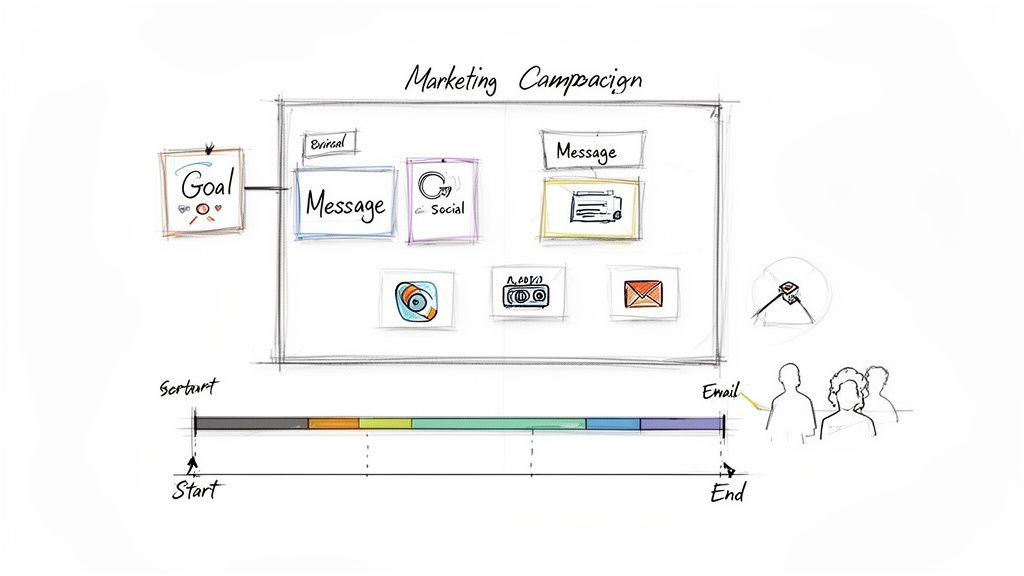
Too many businesses fall into the trap of treating marketing like a series of disconnected actions—a Facebook post here, an email blast there. Sure, these individual bits and pieces might stir up some activity, but they rarely have the punch needed to make a real impact.
This is where a proper, structured campaign changes everything.
Think of it like planning a huge music festival. You wouldn't just book a random band and cross your fingers, hoping people show up. Of course not. You’d have a clear goal (say, sell 10,000 tickets), a defined timeline, and a coordinated plan to make it all happen. A marketing campaign runs on the exact same logic.
To really get our heads around this, let's stick with the festival idea. Every single part of organising a festival has a direct parallel in a marketing campaign, turning what can feel like an abstract concept into a concrete plan.
To make this crystal clear, here’s a quick breakdown of how the festival analogy lines up with the core parts of a marketing campaign.
| Campaign Element | What It Is | Music Festival Analogy |
|---|---|---|
| The Goal | The specific, measurable outcome you want to achieve. | Sell all the tickets and create an unforgettable experience. |
| The Audience | The group of people you're trying to reach. | The die-hard fans of the bands you’ve booked. |
| The Message | Your core creative idea and what you communicate. | The "lineup" – the artists and vibe that attract the crowd. |
| The Channels | The platforms you use to deliver your message. | The posters, radio ads, and social media hype to sell tickets. |
| The Timeline | The defined start and end dates for your activities. | The festival's official opening and closing dates. |
This table shows how each piece fits together to create a cohesive whole, just like a well-run festival.
A marketing campaign isn't just a random collection of ads. It's a focused, strategic mission with a singular objective, a clear audience, and a defined timeline for success. It’s the difference between shouting into the void and starting a meaningful conversation.
This structured approach means that every marketing activity—from the emails you send to the ads you run—works together. Instead of scattered, forgettable tactics, you have a unified force pushing towards a single, measurable result. That’s what separates marketing that just makes noise from campaigns that deliver real, tangible business growth.
For a deeper dive, this guide on how to create a marketing campaign that truly works is a great resource, covering strategy from start to finish.
Every marketing campaign that truly hits the mark, no matter the industry or scale, is built on the same five pillars. Nailing these components is the difference between firing off random tactics and executing a focused, powerful strategy. It’s your blueprint for success, ensuring every action is deliberate and aimed at a specific outcome.
Think of it like building a custom piece of furniture. You wouldn’t just start sawing wood without a clear plan. You need to know who it’s for, what it should look like, and what tools you'll need. A campaign is no different and requires careful thought across five key areas.
Before a single word is written or an ad is designed, you have to answer the most critical question of all: Who are you trying to reach? A vague answer like "everyone" is a direct route to wasting your budget. The sharper your focus, the more your message will cut through the noise.
This goes way beyond basic demographics like age or location. A truly effective campaign is built on rich buyer personas—detailed profiles of your ideal customers. What are their goals? What keeps them up at night? What are their daily challenges? Knowing your audience is a "35-year-old project manager struggling with team productivity" is infinitely more powerful than just knowing they live in Sydney.
Once you know who you're talking to, you need to figure out what you're going to say. Your core message is the central idea of your campaign. It's the one thing you want your audience to remember long after they’ve scrolled past your ad or closed your email.
This isn't the place for dry corporate jargon. Your messaging needs to be clear, compelling, and connect on an emotional level. It has to speak directly to your audience’s needs, showing them exactly how you can solve their problem or make their life better.
For instance, a weak message is: "We sell innovative software solutions." A strong one is: "Stop wasting hours on admin and get back to leading your team." See the difference? The second one hits a nerve.
Your channels are simply the paths you use to get your message in front of your audience. The golden rule here is to be where your audience already spends their time. If your ideal customer is deep in conversation on LinkedIn, running a TikTok campaign is just throwing money away.
Common channels include:
The best strategies usually blend a mix of channels that work together. To see how the pros select the perfect media mix for maximum impact, check out our guide on strategic media planning and buying.
No campaign runs on hopes and dreams alone. Your budget and timeline are the real-world constraints that will shape every decision you make. The budget dictates the scale of your activities—from the polish of your creative content to the reach of your paid advertising.
The timeline gives your campaign structure, setting a clear start, finish, and key milestones along the way. A typical product launch campaign might run for six weeks, with distinct phases for building pre-launch buzz, the big launch day, and the post-launch follow-up.
Defining a clear budget and timeline isn't about limiting creativity; it's about focusing it. These constraints force you to make smart, strategic decisions about where to invest your time and money for the greatest return.
Finally, how will you know if any of this actually worked? That’s where objectives and Key Performance Indicators (KPIs) come in. Your objective is the big-picture goal—what you ultimately want to achieve. For it to be useful, it needs to be specific, measurable, achievable, relevant, and time-bound (SMART).
KPIs are the specific metrics you’ll track to see if you're on the right path to hitting that objective. For example:
These five components are all interconnected; a shift in your audience will change your message, which will affect your channels, and so on. To get a better handle on how these elements fit together into a cohesive plan, it's worth exploring different campaign frameworks. When all five are aligned, they create a powerful engine for genuine growth.
Knowing the nuts and bolts of a marketing campaign is one thing. Connecting all those moving parts to the real-world customer journey is where the magic really happens. A powerful way to do this is by mapping different campaigns to the marketing funnel, ensuring you’re sending the right message, on the right channel, at precisely the moment your audience needs it.
Think of the marketing funnel as the path a potential customer takes, from their very first "hello" with your brand all the way to becoming a loyal fan. It’s usually split into three key stages: Top of Funnel (TOFU), Middle of Funnel (MOFU), and Bottom of Funnel (BOFU). Each stage has a completely different goal, which means each needs a different kind of campaign to succeed.
This flow chart nails the fundamental order of operations. It all starts with the audience.
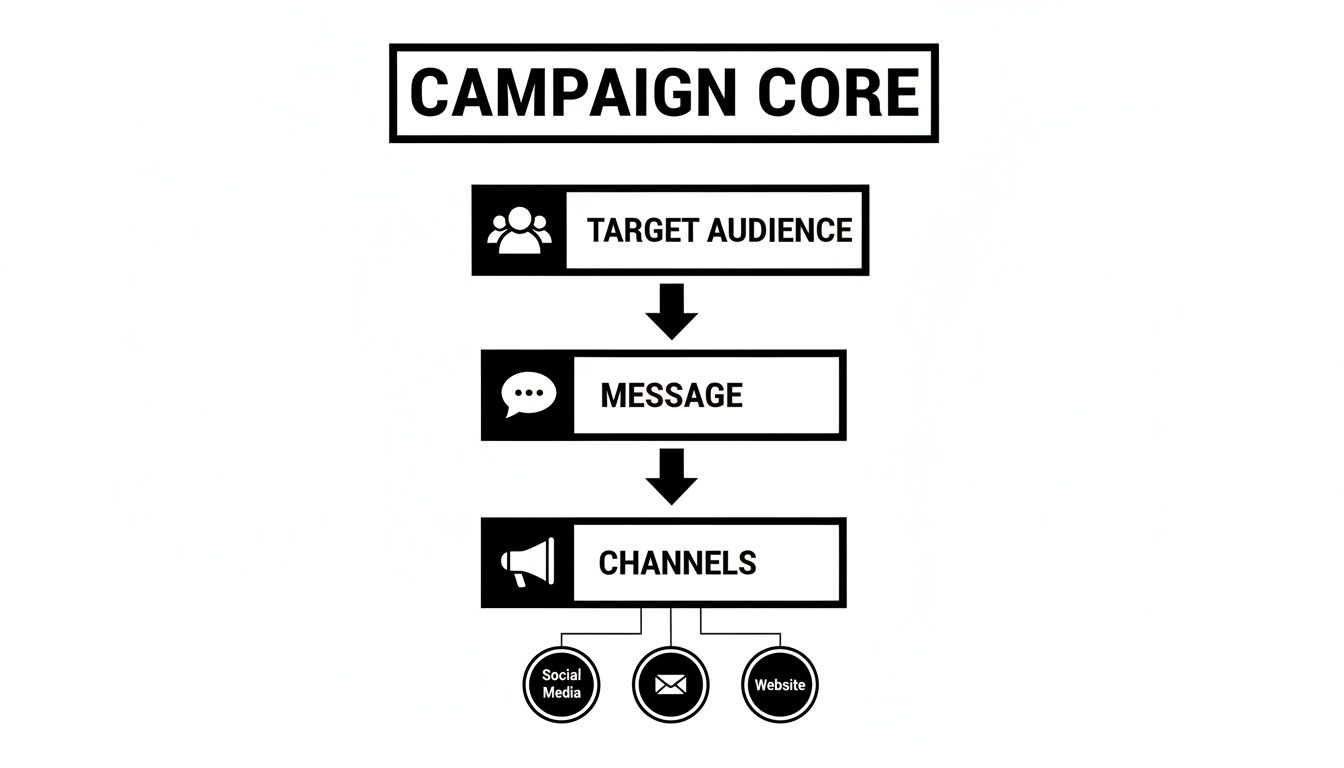
This hierarchy is critical—every successful campaign is built audience-first. Get that right, and your message and channels will naturally fall into place.
Way up at the top of the funnel, your audience isn't actively shopping. They might not even realise they have a problem you can fix. Your mission here is simple: brand awareness and reach. This isn't the time for a hard sell. It's about introducing your brand as a helpful, authoritative voice in your space.
Brand awareness campaigns are the workhorses of this stage. They’re all about capturing a broad audience by offering value—whether that's through education, entertainment, or inspiration—without asking for anything back.
Common TOFU campaigns look like this:
Forget sales for a moment. Here, you’re focused on metrics like impressions, reach, website traffic, and social engagement. You're planting seeds.
Once someone knows who you are, they slide into the middle of the funnel. Now, they're actively researching and weighing up their options. The goal for a MOFU campaign is to generate leads and nurture that initial spark of interest, positioning your business as the obvious choice.
This is where you start asking for a small commitment—an email address, perhaps—in return for something of high value.
At this stage, you shift from broadcasting to a crowd to building a one-on-one relationship with a qualified prospect. The focus moves from reach to genuine engagement and trust.
Lead generation campaigns are your go-to here. They often involve:
Success is measured by lead conversion rates, cost per lead (CPL), and email open rates.
Finally, at the bottom of the funnel, your prospect is ready to pull the trigger. They’ve done their homework, they trust your brand, and now they just need that final nudge. The objective of a BOFU campaign is crystal clear: drive conversions and sales.
Your messaging gets more direct and product-focused. You’re highlighting features, benefits, and special offers that make saying "yes" a no-brainer.
Conversion campaigns at this stage might look like:
The investment here is serious business. In Australia’s digital ad market, social media ad spend jumped 12% year-on-year, proving just how vital these channels are for reaching customers at every stage.
To get a clearer picture of how this all fits together, the table below breaks down the objectives, campaign types, channels, and KPIs for each funnel stage.
| Funnel Stage | Primary Objective | Common Campaign Types | Example Channels | Key KPIs |
|---|---|---|---|---|
| Top (TOFU) | Build brand awareness & reach | Brand Awareness, Content Marketing, Social Media Engagement | Social Media, Blogs, SEO, PR, Video Ads | Impressions, Reach, Website Traffic, Social Engagement |
| Middle (MOFU) | Generate leads & nurture interest | Lead Generation, Gated Content, Email Nurturing, Retargeting | Landing Pages, Email Marketing, Webinars, Downloadable Guides | Lead Conversion Rate, Cost Per Lead (CPL), Email Open/Click Rate |
| Bottom (BOFU) | Drive conversions & sales | Conversion, Product-Focused, Social Proof Campaigns | Product Pages, Sales Pages, Targeted Ads, Case Studies | Sales, Conversion Rate, Return On Ad Spend (ROAS), Customer Lifetime Value (CLV) |
For medium to large businesses focused on lead generation, understanding this flow is non-negotiable. You can learn more about Australia's digital trends and how they shape campaign strategy in the full We Are Social 2025 report.
By strategically aligning your efforts with each funnel stage, you create a seamless and persuasive customer journey that turns total strangers into your biggest advocates.
Launching a marketing campaign without knowing how you’ll measure success is like setting sail without a compass. You’re putting in the effort, spending the budget, but have no real way of knowing if you’re heading in the right direction. To figure out if your campaign actually worked, you need to look past the superficial vanity metrics and focus on the Key Performance Indicators (KPIs) that connect directly to your business goals.
These KPIs are the vital signs of your campaign. They’re what tell you what’s working, what isn’t, and where your money is making the biggest impact. Getting this right is the difference between guessing and knowing.
It’s easy to get a buzz from a sudden spike in social media followers or a high number of impressions. And while these numbers show your message is getting out there, they don’t tell the whole story. A thousand likes on an Instagram post mean very little if none of those people ever visit your website or become a customer.
Real measurement is all about the metrics that reflect tangible business outcomes. These are the numbers that matter to your bottom line.
Here are a few core KPIs that provide genuine insight:
Tracking these allows you to have a much more meaningful conversation about a campaign's performance and prove its value. For a deeper dive into the numbers that drive success, check out our in-depth guide to key digital marketing performance metrics.
In a perfect world, a customer would see one ad, click it, and buy your product. Simple. But the real customer journey is far more chaotic. A person might discover your brand through an SEO-optimised blog post, see a retargeting ad on Facebook a week later, and finally convert after clicking a link in an email newsletter.
So, which channel gets the credit? This is the tricky challenge of marketing attribution.
Attribution is the science of assigning value to the various touchpoints a customer interacts with on their path to conversion. It helps you understand which channels are actually driving results, not just which one was the last click.
Different attribution models give credit in different ways:
Understanding your KPIs and attribution is just the first step. The real magic happens when you use this data to make smarter decisions and continuously improve your results. Analytics tools like Google Analytics are essential for gathering this data, letting you see which messages are resonating and which channels are delivering the best return.
By regularly reviewing your campaign data, you can spot trends, identify underperforming creative, and shift your budget to the strategies that are proven to work. This cycle of measuring, analysing, and optimising is what turns a good campaign into a truly great one.
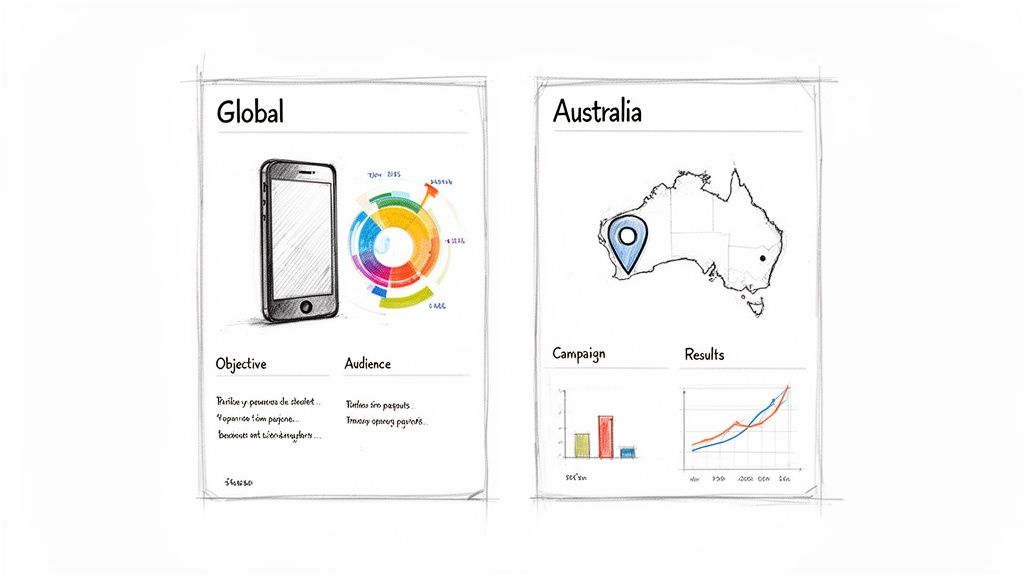
Theory and frameworks are one thing, but seeing a perfectly executed campaign in the wild is what makes it all click. To bring everything we've talked about to life, let’s pull apart two brilliant campaigns—one global sensation and one Aussie success story—and see how they expertly nailed the fundamentals to get incredible results.
These examples show how a deep understanding of audience, a compelling message, and the right channels can create something truly memorable. They're a clear blueprint for how strategic planning leads to real-world, business-driving outcomes.
Spotify Wrapped is so much more than a marketing campaign; it's practically a cultural holiday. Every December, millions of users eagerly await their personalised summary of listening habits, which they then plaster all over social media. It’s a masterclass in turning customer data into a shareable, emotional experience.
Let's break down its success:
Objective: The primary goal wasn't just user engagement. It was about driving fierce brand loyalty and sparking a massive wave of user-generated content, effectively turning every listener into a brand ambassador. It’s a massive retention and brand awareness play.
Audience: The campaign targets every single Spotify user, from the casual listener to the die-hard music nerd. By making the data so personal, it connects with each user on a surprisingly deep level.
Core Message: The underlying message is simple but powerful: "We get you and your unique taste in music." It validates users' identities and makes them feel seen, forging a strong emotional bond with the platform.
Channels: This is where the genius lies. The campaign kicks off in-app with a slick, personalised slideshow, but its real power comes from its seamless link to social media. Spotify makes it ridiculously easy to share your "Wrapped" results to Instagram Stories, X (formerly Twitter), and Facebook, fuelling a viral loop of organic promotion.
Spotify Wrapped wins because it doesn't feel like marketing. It offers genuine personal value and a kind of social currency that people are genuinely excited to share. It's proof that the best marketing is making something people want to talk about.
The results are just staggering. Every year, the campaign generates billions of social media impressions and widespread media coverage, all for a relatively low cost. It reinforces Spotify's top-dog status in the streaming world, all by cleverly repackaging the data its users gave it in the first place.
Closer to home, the "Dumb Ways to Die" campaign by Metro Trains in Melbourne is a legendary example of public service advertising done right. Launched back in 2012, its mission was to cut down on accidents and deaths on the city's train network. Instead of resorting to grim shock tactics, it took a completely unexpected—and brilliant—approach.
Here’s why it worked so well:
Objective: The campaign had a crystal-clear, life-or-death goal: promote rail safety and reduce the number of accidents, particularly among young people. This was a pure behavioural change campaign.
Audience: While the safety message was for all commuters, the campaign was specifically crafted to connect with a younger, harder-to-reach crowd that is often immune to traditional warnings.
Core Message: The message was "Be safe around trains," but it was delivered through deliciously dark humour. By contrasting gruesome deaths with cute, cartoonish characters and an insanely catchy song, it made a dull topic totally unforgettable and shareable.
Channels: The campaign exploded onto the scene with a viral YouTube video featuring that earworm of a song. This was backed up by outdoor ads, radio spots, and even a mobile game, ensuring the message hit the target audience wherever they were.
The campaign was a runaway success. It led to a reported 21% reduction in train-related accidents in its first year alone. The song hit the top 10 on iTunes charts globally, and the video has racked up hundreds of millions of views, proving that a creative, audience-first approach can not only save lives but also create an enduring cultural phenomenon.
Knowing what goes into a marketing campaign is one thing. Actually running them at a high level, across a bunch of different channels, all while constantly tweaking and improving them? That’s a whole different ball game. This is where bringing a specialist agency into the fold can take your results from pretty good to genuinely exceptional.
Think of your in-house marketing team as a really talented band. Each member knows their instrument inside and out and can play their part beautifully. An agency partner is like the seasoned producer who comes in. They don’t just hear the individual instruments; they hear the whole song, making sure every part works together to create a massive hit, not just a collection of nice sounds.
An experienced agency brings a level of know-how that’s almost impossible to build internally. They live and breathe this stuff—market trends, new tech, and the tiny, crucial details of how different ad platforms work. That deep expertise translates directly into campaigns that just plain work better.
Instead of your team burning precious hours trying to get up to speed on the latest algorithm change, an agency partner is already on top of it. They come to the table with strategies that have been tested in the trenches, helping you sidestep common mistakes and get to a strong return on your investment, faster.
A dedicated agency partner gives you more than just an extra pair of hands; they bring a strategic brain trust. Their entire focus is on taking your business goals and turning them into measurable marketing wins, using specialised tools and insights from across different industries to give you a real competitive advantage.
One of the biggest wins is getting a true, top-to-bottom view of your marketing funnel. It’s so easy for internal teams to end up in their own lanes, with one person focused on social media and another completely absorbed in email. An agency partner connects all those dots. They build one seamless customer journey, from the first time someone hears about you right through to them becoming a loyal advocate.
This integrated approach means your media planning, buying, and monitoring all pull in the same direction. The upshot? Your budget gets used more efficiently, and your campaign builds momentum at every single stage. A well-orchestrated effort, guided by expert digital marketing and consulting, makes sure every dollar you spend is directly contributing to real business growth.
Even with the best-laid plans, a few practical questions always seem to pop up when you're trying to wrap your head around marketing campaigns. Let's clear the air on a few common ones to make sure we're all on the same page.
This is a classic, and it’s a great question. Think of your marketing strategy as the architectural blueprint for your entire business's growth. It’s the big-picture, long-term vision—the document that maps out your goals, who you’re trying to reach, and how you want your brand to be seen over the next few years. It answers the fundamental question: "Where are we going?"
A marketing campaign, then, is a single, focused project within that master blueprint. If the strategy is the plan for the whole house, a campaign is the detailed plan for building the kitchen. It has a very specific goal (like generating 50 qualified leads for the new kitchen range), a clear timeline, and its own dedicated budget. Campaigns are the tactical, boots-on-the-ground actions that bring your wider strategy to life, piece by piece.
There’s no one-size-fits-all answer here. A campaign’s timeline really comes down to your objectives, the channels you're using, and the budget you have to play with. The most important thing is setting a timeframe that’s actually realistic for hitting your goal.
As a general rule of thumb, many businesses find a quarterly cycle works well for digital campaigns. It's long enough to gather solid data and optimise what you’re doing, but not so long that the campaign runs on autopilot and goes stale.
Absolutely. In fact, they often run some of the most creative ones. Success isn't measured by the size of your budget; it’s measured by how effective your strategy is. Small businesses can get incredible results by being smarter and more focused than their bigger competitors.
Success isn't about outspending everyone; it's about outsmarting them. A well-targeted campaign that deeply resonates with a niche audience will always outperform a generic, big-budget effort that tries to be everything to everyone.
The trick is to play to your strengths. Zero in on a specific niche audience you understand inside and out. Craft an authentic message that genuinely connects. Then, pick one or two channels where that audience hangs out and absolutely master them. Creativity, focus, and a real human connection are the most powerful tools a small business has.
Ready to put theory into practice? The team at Virtual Ad Agency lives and breathes this stuff, building and fine-tuning full-funnel marketing campaigns that drive real, measurable growth for medium to large businesses. Let's build a campaign that actually delivers. Discover how we can elevate your marketing.

 previous