
So, what exactly is digital marketing and consulting?
Think of it as a strategic partnership. It’s where an expert consultant first maps out a custom marketing blueprint designed around your specific business goals, and then an agency brings that plan to life. It’s the perfect blend of high-level strategy and hands-on implementation, making sure every marketing dollar directly fuels measurable growth.

A lot of businesses see marketing agencies as just doers—a team you hire to run your ads or post on social media. While getting the work done is obviously important, it often skips over the foundational strategy needed to actually move the needle. This is where the "consulting" part of the equation changes the entire game.
It's a bit like building a custom home. You could hire a builder (your standard agency) to work off a generic plan, but you might end up with a house that doesn't quite fit your family’s needs. A consultant, on the other hand, is your architect first. They sit down with you to really understand your vision, your budget, and what you want in the long run before a single blueprint is drawn.
This strategic blueprint ensures every decision—from the slab to the roof tiles—serves a clear purpose. In the same way, a digital marketing and consulting partnership figures out the why before getting bogged down in the what.
An agency focused purely on execution might dive straight into tactics. They'll kick things off with questions like, "What’s your ad budget?" or "Which social platforms do you want us to manage?"
A consultant-led approach starts from a completely different place, asking much deeper, more strategic questions:
Getting clear on these answers first means all the marketing activities that follow are perfectly aligned with your business objectives. It stops you from wasting money on channels where your ideal customers aren't hanging out, or on campaigns that don't actually help your sales team close deals. A great example of this is developing a targeted LinkedIn marketing strategy for B2B instead of just posting randomly.
Ultimately, digital marketing and consulting shifts the relationship from being purely transactional to truly collaborative. Your consultant effectively becomes an extension of your leadership team, offering objective, data-backed guidance to help you navigate the chaos of the modern marketplace.
The core difference is moving from "doing marketing" to "building a marketing system." A consultant designs the engine for growth; the agency team then operates and fine-tunes that engine for peak performance.
This integrated approach creates real accountability and transparency. Every campaign, every piece of content, and every ad dollar is tied back to that initial strategic plan. This makes it possible to measure true return on investment (ROI), not just vanity metrics like clicks and likes. It's all about creating a predictable, scalable system for winning and keeping customers—turning your marketing into an investment, not just another expense on the P&L.
A genuine digital marketing and consulting partner doesn't just focus on isolated campaigns. They see the big picture—the entire journey a customer takes with your brand. Think of it like a river. A piecemeal approach is like trying to catch fish randomly along the bank. A strategic, full-funnel approach, on the other hand, guides the flow from the source right down to the ocean, making sure the journey is smooth and purposeful.
We often visualise this path as a marketing funnel, broken down into three crucial stages. Each stage has its own job to do, powered by a specific set of marketing services. The real magic of consulting is making sure all these moving parts work in harmony, creating a seamless experience that turns complete strangers into your biggest fans.
The top of the funnel (or ToFu) is all about discovery and awareness. At this point, your potential customers might not even realise they have a problem you can solve. Your job is to get on their radar, introduce your brand, and start building a reputation as a helpful expert.
This isn't the time for a hard sell. It’s about casting a wide, but smart, net. The focus is on broad reach and sparking that first bit of interest.
Once someone knows who you are, they slide into the middle of the funnel (MoFu). Now, they’re actively weighing up their options and digging into potential solutions. Your goal shifts from just being seen to educating them and building a real connection.
This is where you prove your worth. You need to show that you don’t just understand their problems, but that you have the best solution. You’re no longer just a name; you’re a serious contender.
A proper full-funnel strategy ensures the promises you make at the top of the funnel are proven and expanded on in the middle. It’s all about building a consistent story that logically guides people toward making a choice.
The bottom of the funnel (BoFu) is crunch time. Your prospect is ready to pull the trigger, and your job is to make choosing you the easiest, most obvious decision they can make. And once the sale is done, the focus shifts to keeping them happy, turning that new customer into a loyal, repeat buyer.
This is where sharp targeting and irresistible offers seal the deal. The services here are laser-focused on getting action and maximising the lifetime value of every customer.
To give you an idea of the scale, Australia's digital ad market recently ballooned to AUD $17.2 billion, a jump of 10.6% in one fiscal year. While search advertising still commands the lion's share at 44%, it's video advertising that's really driving growth, now accounting for 29% of the total spend. This shows just how critical it is to use paid channels effectively when it's time to close. You can explore more about these paid advertising statistics on RockingWeb.
Key services for this final push include:
To pull this all together, here’s a quick map showing how these services align with the different stages of the customer journey.
| Funnel Stage | Objective | Key Services (Examples) |
|---|---|---|
| Top of Funnel (ToFu) | Build brand awareness & attract a wide audience | SEO, Content Marketing (Blogs, Guides), Social Media Marketing, Video Advertising |
| Middle of Funnel (MoFu) | Nurture leads & build trust and consideration | Email Marketing, Lead Nurturing, Retargeting Ads, Social Media Engagement |
| Bottom of Funnel (BoFu) | Drive conversions, sales & foster customer loyalty | PPC Advertising (Google Ads), Conversion Rate Optimisation (CRO), Customer Loyalty Programs |
As you can see, a successful digital strategy isn’t about picking one or two services. It’s about orchestrating a complete system where each part supports the next, guiding customers smoothly from "Who are you?" to "I can't live without you."
Turning ambitious business goals into actual marketing results isn't a happy accident. It’s the product of a methodical, repeatable framework that brings a smart strategy to life. Any high-impact digital marketing and consulting partnership is built on four distinct phases, with each one setting the stage for the next.
Think of it like getting a check-up from a specialist. You wouldn't agree to a course of treatment without a proper diagnosis, and you certainly wouldn't keep taking the medicine without checking if it's actually working. The same logic applies here—it’s how you make sure your marketing investment is delivering a healthy return.
This is the diagnostic stage. Before anyone even thinks about a plan, we need to do a deep dive to get a complete picture of your current marketing health. It's all about gathering the right data and context to find your strengths, weaknesses, opportunities, and any lurking threats.
This involves taking a hard look at a few key areas:
Without this foundational audit, any strategy that follows is just guesswork. It's the critical first step to ensuring every decision is backed by solid evidence.
With all the insights from the audit in hand, the next job is to build the treatment plan. This is the blueprinting phase, where we construct a customised, data-backed digital marketing strategy. This isn't just a shopping list of tactics; it’s a cohesive roadmap that connects every single action directly back to your big-picture business objectives.
A great strategy acts as a filter for every decision. It doesn't just clarify what you should do, but just as importantly, what you shouldn't, saving you from wasting time and money on things that won't move the needle.
The strategic blueprint lays it all out: the key performance indicators (KPIs) that matter, realistic targets, how the budget will be allocated to the most promising channels, and the core messaging that will actually connect with your target audience. This plan becomes the single source of truth for the entire project.
This is where the strategy comes to life—the therapy and treatment phase. The consulting team, often working alongside an execution agency, starts rolling out the planned initiatives. This might mean launching new SEO campaigns, building out valuable content, running highly targeted ad campaigns, or refining your social media presence.
But execution is never a "set and forget" deal. The modern marketing world moves too fast for that. We're constantly monitoring real-time data and optimising campaigns on the fly. If an ad isn't hitting the mark, it’s tweaked or swapped out. If a piece of content starts getting real traction, we amplify its reach. This agile approach means the strategy adapts to what the market is telling us, maximising results and slashing wasted spend.
This is where technology really steps up. The Australian digital marketing technology sector is on track to hit USD 1.95 billion by 2030, powered by tools that make this kind of precision possible. In fact, 77% of Australian marketers are already seeing better engagement from AI-powered personalisation, which nicely complements the $1.5 billion local businesses are expected to spend each year on foundational services like SEO. You can discover more insights about the Australian digital marketing software market here.
The final phase is all about monitoring progress. Transparent, regular reporting gives you a clear window into what’s working, what isn’t, and how your marketing activities are directly impacting the bottom line. This closes the loop, connecting the initial goals with the final outcomes.
This infographic shows how different activities are mapped across the customer's journey to get these results.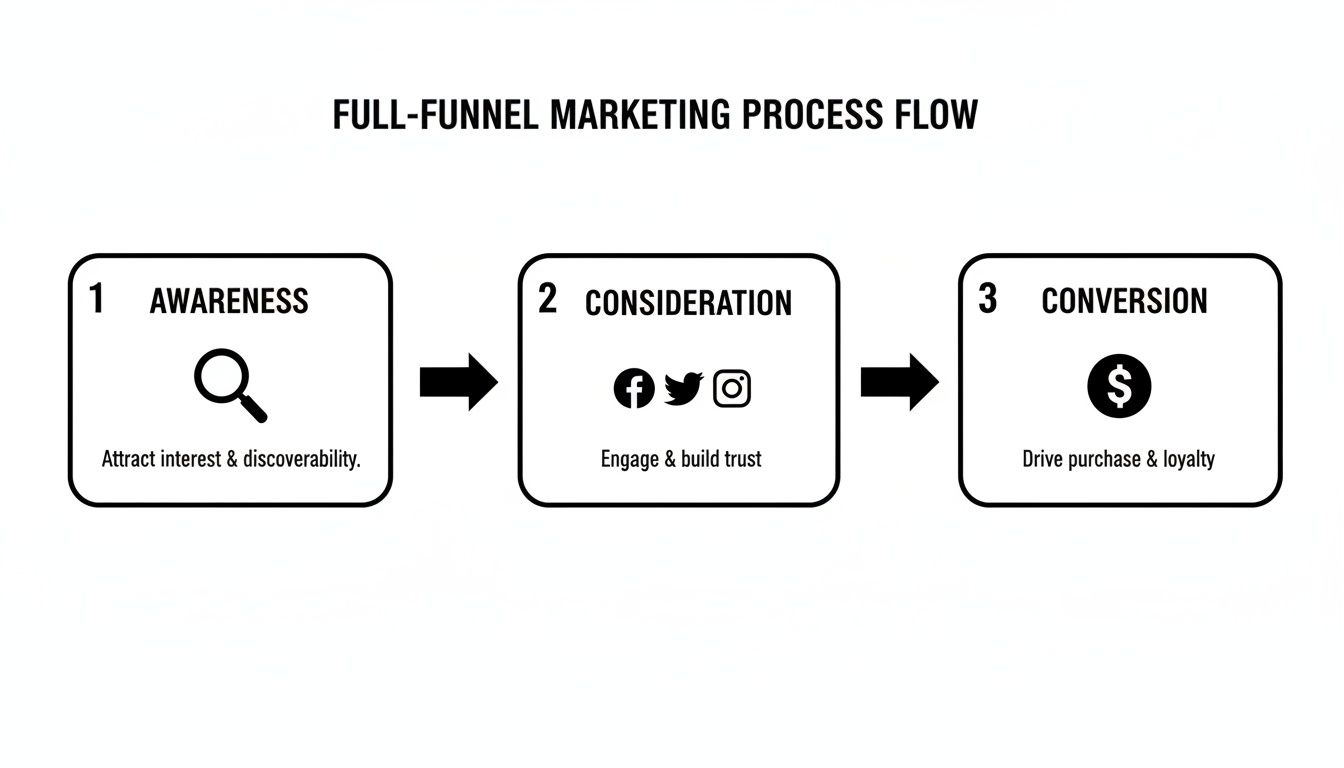
The process maps out a clear path from grabbing someone's attention to actually making a sale, which is exactly what good reporting needs to demonstrate.
Meaningful reports cut through the noise of vanity metrics like clicks and impressions. They zoom in on the data that really matters to the business, such as:
This four-phase process creates a powerful cycle of continuous improvement, making sure your digital marketing and consulting partnership becomes a predictable engine for business growth.
Let’s cut through the buzzwords and get right to what matters: Return on Investment (ROI). A consultant-led approach fundamentally changes your marketing from a business expense into a strategic investment. Every dollar becomes accountable, aimed at a specific, profitable outcome.
Without a solid strategy, marketing budgets often get spread too thin across too many channels, just hoping something sticks. This "spray and pray" method is a classic recipe for wasted cash and underwhelming results. Strategic consulting flips this script entirely.
By starting with a deep dive into your business goals and customer behaviour, a consultant can allocate your budget with surgical precision. We funnel resources into the channels proven to deliver the highest returns for your specific industry and audience, starving the ones that only drain your funds.
True success isn't about surface-level metrics like likes or impressions. For a growing business, success is defined by numbers that directly hit the bottom line. A consulting partnership focuses everyone on the KPIs that actually measure business health.
Three of the most critical metrics are:
Focusing on these core numbers ensures every campaign is built not just for visibility, but for tangible, profitable growth. If you want to get into the nitty-gritty, you can learn more about the key digital marketing performance metrics that show the real impact of your efforts.
The core principle is simple: An investment must generate a return. A strategic consulting process installs the discipline and systems needed to ensure your marketing budget works as hard as any other capital investment in your business.
Let’s look at a practical, anonymised case study to see how this plays out. A mid-sized B2B tech firm was spending a huge amount on generic social media ads across multiple platforms. Sure, they were getting plenty of clicks, but the leads were mostly low-quality. Their sales team was wasting time chasing prospects who were never going to be a good fit, and their Customer Acquisition Cost was spiralling.
Our initial deep-dive audit—the first step in our consulting process—quickly pinpointed the core problem. Their ideal customer, a senior IT manager in a specific industry, wasn't making buying decisions based on broad social ads. They were researching solutions on Google and seeking expert advice within professional networks like LinkedIn.
Armed with these data-backed insights, we developed a new strategy:
The results after just six months were outstanding. By shifting from a scattered, tactical approach to a focused, strategic one, the client achieved a 40% reduction in their Customer Acquisition Cost. Even better, the number of marketing-qualified leads delivered to their sales team shot up by 150%, completely transforming their sales pipeline.
Ultimately, the goal of digital marketing and consulting is to deliver this kind of measurable growth. It's achieved by implementing proven strategies for online business growth. This case study perfectly illustrates how a consulting-first approach doesn't just improve marketing—it builds a more efficient and profitable business.

Picking the right partner for your digital marketing and consulting is one of the biggest growth decisions you'll make. Get it right, and it's like strapping a rocket to your business. Get it wrong, and you’re looking at wasted budgets and opportunities that have sailed right on by.
This isn't like hiring a vendor to tick off a list of tasks. It's more like bringing a key executive onto your leadership team. You’re not just after someone to do the work; you need a strategic thinker who gets your vision and is genuinely invested in where you're headed long-term. This means you’ve got to look past the slick sales pitch and start asking the hard questions that reveal what they're really made of.
Here's the first big fork in the road: is an agency a strategist, or are they just an executor? An execution-only agency might be fantastic at running PPC campaigns or managing your socials, but they often lack the top-level business sense to connect those activities to your actual revenue goals. They’re all 'how', with very little 'why'.
A true consulting partner, on the other hand, always starts with 'why'. They’ll want to get under the hood of your business—your model, profit margins, competitors, and sales cycle—before they even think about suggesting a tactic.
To figure out if you're talking to a strategist, try asking things like:
Their answers will tell you everything you need to know. You'll quickly see if you're dealing with a genuine partner or just an order-taker.
Every agency has a highlight reel, but you need to dig deeper to see if their wins actually apply to your challenges. A brilliant e-commerce case study means very little if you’re a B2B software company with a six-month sales cycle.
Look for proof that they've solved problems like yours. They don't need to be experts in your specific niche, but they absolutely must show they have a clear process for getting up to speed and delivering results in new territory.
A great consulting partner doesn't just show you what they did; they explain how they did it. Their process for diagnosing problems and building solutions is often more important than their industry-specific experience.
When you're looking at their work, ask about the roadblocks they hit, the strategic pivots they had to make, and how they measured the real business impact—not just vanity marketing metrics. If their success stories sound a bit too perfect, they’re probably leaving out the important bits. If you want more on finding the right fit, you can check out this guide to top digital marketing agencies.
A solid partnership is built on trust, and you can’t have trust without complete transparency. Your consulting partner should be giving you clear, honest, and regular updates on performance. This means reporting on the metrics that actually matter to your bottom line, not just vanity numbers that make them look busy.
Before you sign on the dotted line, get crystal clear on what communication and reporting will look like.
The right partner will welcome these questions with open arms. They’ll already have structured processes in place to make sure you always know exactly how your investment is performing.
Stepping into the world of digital marketing and consulting can feel a bit like learning a new language. Naturally, you'll have questions before you commit. We get it. Business leaders want to know exactly what they're signing up for.
Let's cut through the jargon and get straight to the practical answers for some of the most common queries we hear. Our aim here is to give you the clarity you need to make the right call for your company's future.
It's a great question, and the distinction is crucial. Think of a consultant as the architect of your house and an agency as the builder who brings the blueprint to life.
A consultant’s job is purely strategic. They’re the ones doing the deep-dive audits, poring over market data, and drawing up a custom growth plan that makes sense for your business. They figure out the why and the what. An agency, on the other hand, is all about execution. They're the team on the tools, running the ad campaigns, producing the content, and getting their hands dirty with the day-to-day tasks.
When you bring digital marketing and consulting together under one roof, you get the best of both worlds—a rock-solid strategy that's perfectly executed, with no detail lost in translation.
This is the big one, isn't it? The honest answer is: it depends on the game plan. Some moves get you quick points on the board, while others are about winning the championship.
A smart partner will build you a balanced strategy that delivers both the quick wins to get things moving and the long-term growth that builds real, lasting value.
Tracking the return on investment (ROI) is everything. We steer clear of vanity metrics like clicks and impressions and zero in on what actually moves the needle for your bottom line.
We believe every marketing activity must be tied directly to a business outcome. Success isn't about looking busy; it's about generating real, measurable revenue and proving a clear return on every dollar you invest.
To show you exactly how our work is paying off, we focus on a few key numbers:
This obsession with data means you get complete transparency. You'll always know exactly what financial impact our strategic work is having on your business.
At Virtual Ad Agency, we know that a powerful strategy is the bedrock of any meaningful marketing result. Our digital marketing and consulting services are built to give your business the clarity and direction it needs to unlock predictable, scalable growth.
Book a no-obligation strategy session with our experts today

 previous