
Picture this: your online store is a fantastic physical shop, brimming with amazing products. But it’s hidden down a quiet laneway with no sign. How will anyone find you?
Ecommerce SEO services are the signposts, the flashy billboards, and the helpful directions that lead a steady stream of keen customers right to your digital front door. It’s a very specific type of search engine optimisation, built from the ground up to make your product and category pages impossible to miss in search results.
While your standard SEO might focus on getting eyes on a blog post or a services page, ecommerce SEO is all about one thing: making the cash register ring. Think of it like this – a blog is happy if someone reads an article and leaves. For an online store, that’s just a missed sale. Success isn’t measured in clicks; it’s measured in conversions.
This is where a dedicated strategy becomes absolutely essential. A real expert doesn't just throw a few keywords at your pages and hope for the best. They build a powerful engine designed to pull in qualified traffic—people who are actively typing into Google what you sell. It’s a multi-layered approach that goes way beyond a few simple tweaks.
True ecommerce SEO isn’t a one-off task you can "set and forget". It’s a continuous process of building, refining, and adapting, weaving together several key disciplines to create a rock-solid foundation for growth. A comprehensive service should be looking after:
The online marketplace is more packed than ever. Just having a website up and running guarantees you nothing. Without a deliberate SEO strategy, your store is basically invisible, buried deep on page five of the search results where shoppers rarely, if ever, go.
An effective SEO partnership transforms your store from a hidden gem into a landmark destination. It’s about building sustainable, long-term revenue by connecting with customers at the exact moment they’re looking for what you offer.
The need for robust ecommerce SEO services is especially critical right here in Australia. The local ecommerce sector is on track to hit a massive $42.2 billion in value by 2025. And where is all that business coming from? Organic search. It drives a whopping 53.3% of all traffic to ecommerce sites, leaving paid ads and social media in its dust.
You can get the full picture of this trend by reading the complete Australian ecommerce marketing guide. This explosive growth means competition is brutal, making SEO the absolute backbone for any business that wants to carve out a serious slice of the online market.
A successful ecommerce SEO campaign isn't just one single action; it’s more like a finely tuned engine where every part has to work in perfect harmony to drive your online store forward. Getting your head around these core components is the first step toward building a strategy that doesn’t just bring in clicks but actually generates revenue.
Think of it like this: your website is the car. Technical SEO is the engine, chassis, and transmission—the absolute non-negotiable foundation. On-page optimisation is the slick design and intuitive dashboard that makes the whole experience enjoyable for the driver. And finally, off-page strategies are the fuel and the positive word-of-mouth that get you noticed on the road.
This flowchart breaks down how all those pieces come together to produce real business results, focusing on driving traffic, building authority, and ultimately, increasing your revenue.
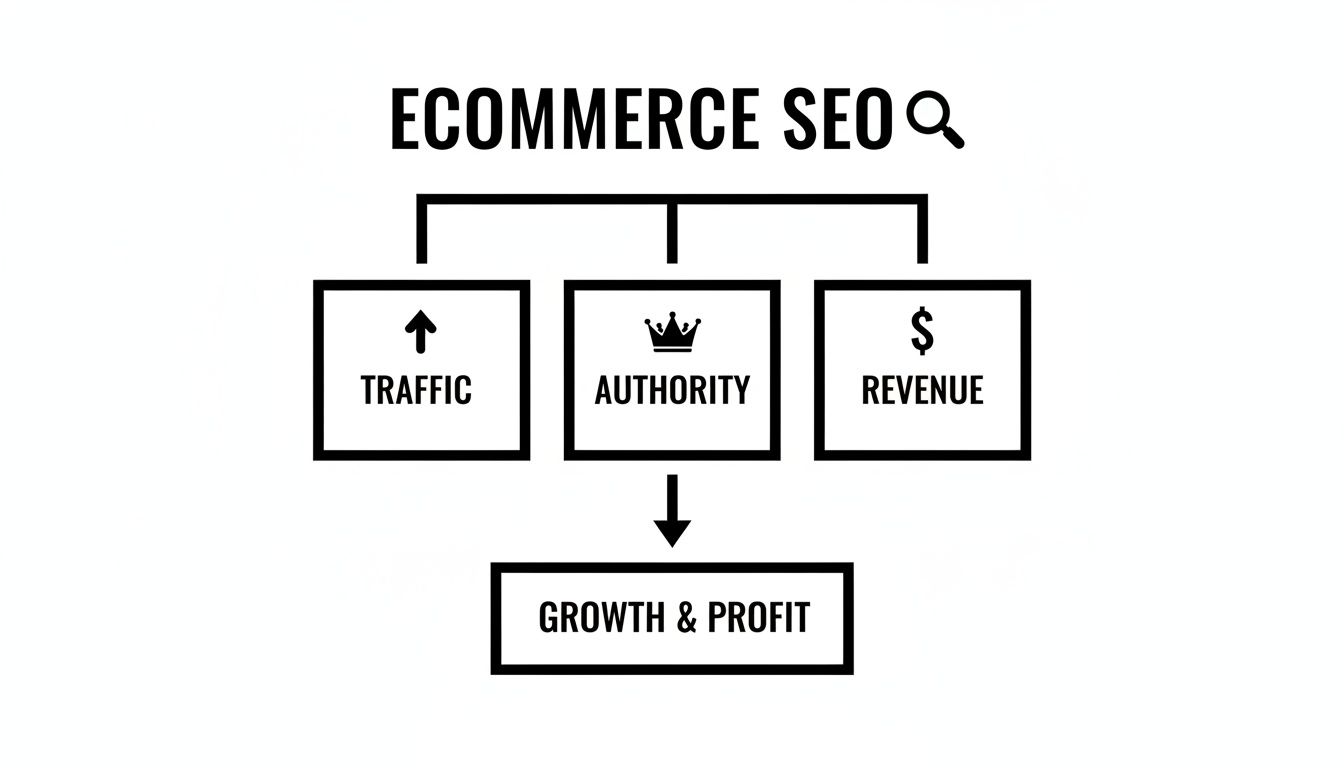
As you can see, every element is designed to build on the others, creating a powerful cycle of growth and profitability for your store.
To make this clearer, let's break down the essential services an ecommerce SEO specialist provides and the direct impact each has on your online store's performance.
| Service Component | Primary Goal | Business Impact Example |
|---|---|---|
| Technical SEO Audit | Ensure search engines can crawl & index the site efficiently. | Fixing a crawl issue could make thousands of product pages visible on Google, directly increasing potential sales. |
| Product & Collection Page Optimisation | Match pages to high-intent buyer keywords. | A well-optimised product page ranks for "buy black leather boots size 9," capturing a sale-ready customer. |
| Site Architecture & Internal Linking | Distribute authority and improve user navigation. | A logical structure helps customers find products in fewer clicks, reducing bounce rates and boosting conversions. |
| Schema & Structured Data Markup | Enhance search listings with rich snippets (reviews, price, stock). | Star ratings appearing in search results can increase click-through rates by up to 35%, driving more qualified traffic. |
| Content Strategy & Link Building | Build topical authority and earn high-quality backlinks. | A popular buying guide attracts links from industry blogs, boosting the authority of your entire domain. |
| Conversion Rate Optimisation (CRO) | Improve the user journey to increase sales from existing traffic. | A/B testing a "Buy Now" button colour could lift add-to-cart actions, turning more visitors into customers. |
Each of these components is a critical piece of the puzzle. Neglecting one can undermine the success of the others, which is why a holistic approach is always the way to go.
Before you even think about a single keyword, your site's technical health has to be flawless. This is the bedrock of any successful campaign, making sure search engines can find, crawl, and understand your content without hitting any snags. It’s all the behind-the-scenes work that makes everything else possible.
A proper ecommerce SEO service will always kick off with a deep dive into your site’s technical setup. This isn't just a quick check-up; it's a full diagnostic designed to root out any roadblocks that could be holding you back in search results.
Key areas of focus always include:
A thorough initial check-up is a brilliant starting point, which is why we often recommend a professional SEO audit to uncover hidden issues before kicking off any campaign.
Once the technical foundation is rock-solid, the focus shifts to what your customers and the search engines actually see. This is where you perfectly align your product and category pages with the exact phrases your target audience is typing into Google. It's a real blend of art and science.
Every single product and category page is a potential front door for a new customer. Optimising them means turning each one into a powerful magnet for organic traffic. This goes way beyond just "stuffing" keywords into the text.
A well-optimised page answers a user's search query so perfectly that it becomes the most logical and compelling result for them to click on. It’s about fulfilling intent, not just matching words.
Effective on-page optimisation includes:
/womens-shoes/running-shoes) that are easy for both people and search engines to understand.Finally, a winning strategy always uses advanced tactics to give your store a real competitive edge. These are the techniques that help search engines understand your content on a much deeper level, making your listings far more attractive and informative in the search results.
One of the most powerful tools here is Schema Markup. This is basically a special type of code you add to your site that gives search engines explicit information about your products—things like price, availability, and review ratings. This info can then show up as "rich snippets" right there in the search results, making your listings seriously eye-catching.
At the heart of any effective ecommerce SEO strategy is the goal of boosting visibility and engagement. You can discover more proven ways to increase organic traffic to really maximise your online presence.

So, how do you actually know if your investment in ecommerce SEO services is making a difference? Sure, seeing your website climb the search rankings feels great, but it’s just a vanity metric if it doesn’t translate into real, tangible business growth.
Success isn't about getting more eyeballs on your site; it's about getting profitable traffic that converts. Measuring the return on your SEO spend means digging deeper than surface-level numbers and honing in on the Key Performance Indicators (KPIs) that directly fatten your bottom line. It's about drawing a straight line from every SEO action to a financial result.
For any online store, the one metric that reigns supreme is organic revenue. This is the cold, hard cash generated from visitors who found your site through a search engine without you paying for an ad. It’s the ultimate proof that your SEO strategy is pulling in customers who are ready to open their wallets.
A good agency will make this the North Star of your campaign, setting it up as a primary goal in your analytics so you can see exactly how much money SEO is bringing in. This isn't just about traffic volume; it's about the quality and buying intent of that traffic.
Tracking organic revenue growth is the clearest way to prove ROI. If this number is climbing month-on-month, your SEO is working. Simple as that. It isolates the impact of your strategy from all the other noise, like paid ads or social media.
This laser focus on revenue ensures that the entire strategy is geared towards commercial outcomes, not just getting visible for the sake of it.
Beyond the headline revenue figure, a few other crucial KPIs give you a much richer picture of your SEO performance. Watching these numbers helps you understand not just what is happening, but why.
By analysing these numbers, you can connect a better keyword ranking directly to an increase in market share, healthier profit margins, and a more sustainable business. For a deeper look, check out our guide on the most important digital marketing performance metrics you should be tracking.
At the end of the day, the success of your ecommerce SEO has to be communicated in a way that makes sense to the business. An experienced partner knows how to translate the technical jargon into clear, compelling business benefits.
Think of it like this:
This approach ensures SEO is seen for what it is: not a cost, but a powerful engine for predictable and sustainable growth.
Choosing a partner for your ecommerce SEO services is easily one of the biggest marketing calls you'll make. This isn't just about hiring another supplier. It's about finding a genuine partner who gets the unique rhythm of online retail and can tie their strategy directly to your revenue goals.
The right agency becomes an extension of your team, building the kind of sustainable growth that keeps delivering long after a paid ad campaign has fizzled out.
The real challenge is cutting through all the noise. Plenty of providers will make bold promises, but very few have the deep, specialised expertise needed to win in the cutthroat ecommerce arena. Your job is to tell the difference between an agency that just talks a good game and one that has a proven, results-driven process baked into everything they do.
It all comes down to asking the right questions and knowing what a great answer actually sounds like. It’s time to move beyond the slick pitches and get into the real substance of their approach.
Before you even think about signing a contract, you need to do your homework. A top-tier ecommerce SEO agency won't just tolerate detailed questions; they'll welcome them with transparent, straightforward answers. Their confidence should come from a solid track record and clear, logical strategies—not from buzzwords or vague guarantees.
Start by digging into their specific experience with ecommerce. An agency that mainly handles local plumbers or B2B software companies probably won't grasp the complexities of a site with thousands of product SKUs, faceted navigation, and ferocious keyword competition. You need a specialist, not a generalist.
Here are a few critical areas to probe:
Once you've got a shortlist, it's time to get down to the nitty-gritty. The quality of their answers to these questions will tell you everything about their strategic depth and whether they're the right fit for your business.
1. How do you approach technical SEO for a large product catalogue?
A great answer will get into the weeds of managing index bloat, optimising crawl budget, using canonical tags for product variants, and handling faceted navigation without creating a duplicate content nightmare.
2. What is your strategy for building topical authority and earning backlinks?
Look for a response that goes way beyond generic "outreach." A strong ecommerce strategy involves creating genuinely useful content like buying guides, targeting product roundup lists, and fixing broken links on relevant resource pages.
3. How do you measure and report on the ROI of your SEO efforts?
The best agencies are laser-focused on core business metrics: organic revenue, conversion rates from search, and average order value. If they only want to talk about rankings and traffic, that’s a big red flag.
A true ecommerce SEO partner should be as obsessed with your sales figures as you are. Their success should be directly tied to your bottom line, with every action justified by its potential to drive profitable growth.
Don't forget to ask about their pricing models. While cost is always a factor, the cheapest option is rarely the best one. It pays to learn more about typical SEO packages and pricing to get a feel for what a fair investment for quality service looks like.
The goal is to find a partner who delivers exceptional value and a clear return on your investment, turning your SEO spend into a powerful engine for long-term success.
Theory is one thing, but the real test of any professional ecommerce SEO service is seeing the impact on your bottom line. It's the moment abstract ideas like "authority" and "optimisation" stop being jargon and start looking like actual revenue growth and a flood of qualified leads.
To get a clearer picture, let's walk through two realistic scenarios. These aren't just stories; they're blueprints for how a smart SEO partnership can deliver a powerful return on investment, pulling a business out of the digital shadows and into the spotlight.
Picture 'Company A', an online fashion store. They’ve got a gorgeous website and fantastic products, but their organic sales are flatlining. Their key category pages for things like "women's linen dresses" and "men's casual shirts" are languishing on page three of Google, practically invisible to anyone ready to buy.
Their new SEO strategy zeroed in on breathing life back into these high-value category pages, backed by a content plan designed to build their authority on the topic of style.
Now, let's look at 'Company B', a B2B supplier selling specialised industrial equipment. On the surface, their website looked fine, but a proper audit uncovered some serious technical problems holding them back. Google's crawl budget was being wasted on thousands of pointless filtered URLs, and their most important product pages were missing the schema markup needed to really pop in search results.
This SEO project was all about the nuts and bolts—fixing the site’s foundation so Google could finally understand and rank their content properly.
This is a crucial point: sometimes the biggest wins in ecommerce SEO aren't about flashy content. They're about clearing away the invisible technical roadblocks that are secretly throttling your website's potential.
The fix was surgical. They implemented strict crawl rules to stop the waste and added detailed product schema to make their listings stand out. The results came fast. Within a single quarter, organic impressions for their high-value product keywords jumped by 200%, and qualified leads coming from organic search grew by a massive 150%.
These examples draw a straight line from specific SEO tactics to powerful business outcomes. In a cut-throat market, that kind of strategic edge is priceless. And while digital ad spend in Australia rocketed to $4.2 billion in the March 2025 quarter alone, SEO offers a more sustainable, cost-effective way to grow. As you can discover in more detail from recent statistics, this is becoming even more vital as AI-driven search continues to change how customers find what they need online.

Starting out with an ecommerce SEO service can feel a lot like setting off on a long voyage. While the final destination is sustained, long-term growth, the first 90 days are absolutely critical for plotting the right course and building momentum.
Let's be clear: this initial period isn't about magical, overnight ranking jumps. Instead, it's a methodical process. It’s all about building a rock-solid foundation that can support scalable growth for months, and even years, to come. Any professional campaign will break this down into clear phases, each with its own goals.
The first 30 days are dedicated to deep analysis and careful planning. Before a single change is made, your SEO partner needs to get under the hood of your website, understand your market, and know your business goals inside and out. Think of it as the surveyor's work before breaking ground on a new build.
This phase is defined by a few key activities:
By the end of this month, you'll have a clear, data-backed strategic roadmap. This isn't just a fluffy document; it's a blueprint that outlines the priorities, timelines, and specific actions needed to hit your targets.
With a solid strategy in hand, month two is all about execution. This is where the high-impact fixes we found during the audits get rolled out. The focus is on clearing away technical roadblocks and optimising existing pages to grab some quick wins.
This period is critical. Fixing deep-seated technical issues and optimising core pages is like tuning the engine of a race car—it must be done perfectly before you can even think about hitting top speed.
Typical actions here include fixing crawlability issues, boosting site speed, and refining the on-page SEO for your most valuable category and product pages. It's about building a stable platform for everything that comes next.
In the final month of this initial push, the strategy shifts from fixing the old to building the new. With the foundational work in place, our attention turns to creating new assets and starting the long game of building your site's authority.
This is when a real content strategy starts to take shape. You might see new buying guides or blog posts appear, designed to attract shoppers at the top of the funnel and earn valuable backlinks. The first steps in strategic outreach often kick off here, too, laying the groundwork for future link-building campaigns. This is the phase that truly sets the stage for scaling your results.
When you're looking into ecommerce SEO services, a few practical questions always come up. How long will it take? What's the budget? How does all this new AI tech fit in? Getting straight answers to these is key before you jump into any strategy. Let’s tackle the big ones so you know exactly what to expect from a professional SEO partnership.
Making the right call means looking past a sales pitch. You need the specifics on how a campaign actually works, how long until you see a real return, and what a sensible investment looks like for results that genuinely move the needle.
While you might see some quick wins in a few weeks—like fixing a major technical glitch—the real, revenue-driving results from ecommerce SEO typically start showing up around the four to six-month mark. This isn't an overnight fix; think of it as a long-term investment in building a powerful, sustainable growth channel for your store.
Why the wait? Well, a few crucial things need time to happen:
The best way to think about SEO is as a compounding investment. The consistent effort you put in builds serious momentum over time, delivering returns that far outlast any paid ad campaign.
Honestly, budgets can vary a lot. It really depends on how big your product catalogue is, how fierce your industry competition is, and exactly what services you need. For a medium to large ecommerce business here in Australia, retainers usually start from a few thousand dollars a month and scale up from there for more aggressive, all-in campaigns.
It’s so important to focus on the potential value and return on investment (ROI), not just the monthly cost. A cheap service often means cutting corners on the important stuff, like content quality or strategic link building, which can end up hurting you more than helping. Any reputable agency will give you a custom proposal, but only after they’ve done a thorough audit of your website, your position in the market, and your specific growth goals.
Artificial Intelligence is an incredible tool that helps us execute strategy faster and smarter, but it absolutely doesn't replace it. The best agencies are using AI to turbocharge tasks that used to take an enormous amount of time—things like deep keyword research, competitor analysis, brainstorming content ideas, and running technical site audits.
For instance, AI can sift through thousands of search data points to uncover untapped ranking opportunities or predict emerging customer trends with amazing accuracy. This frees up the human experts to concentrate on what they do best: high-level strategy, creative problem-solving, and building real connections with your customers through great brand storytelling. An agency that intelligently weaves AI into its workflow is one that can deliver faster, sharper, and more impactful results for your business.
Ready to see how a strategy built for you can transform your online store? The team at Virtual Ad Agency specialises in building powerful ecommerce SEO campaigns that drive measurable revenue growth. Get in touch today for a custom proposal.

 previous