
Think of an SEO audit as a full diagnostic health check for your website. It’s a deep dive that uncovers the root causes behind poor rankings, dropping traffic, or disappointing conversion rates, giving you a clear, strategic roadmap to get things back on track.
Imagine your website is a high-performance race car. You might have a powerful engine (great products) and a sleek design, but you’ll never win the race if the tyres are flat, the alignment is off, or the fuel line is clogged. This is where an SEO audit comes in. It’s like having a master mechanic run a complete diagnostic to find every single issue holding you back from peak performance.
An SEO audit goes way beyond the surface-level checks you get from free online tools. It’s a proper investigation, inspecting every component of your digital presence to make sure it’s perfectly tuned for search engines like Google. The goal isn't just to find what's broken, but to uncover hidden potential and real strategic advantages.

A professional audit hands you a clear, prioritised action plan. Instead of a confusing list of technical jargon, you get a strategic roadmap that sorts fixes by effort versus impact. This lets your team jump on the "quick wins" for immediate results while planning for the bigger projects that will secure long-term growth.
This whole process involves getting under the hood and scrutinising a few core areas of your site:
By systematically analysing these pillars, an SEO audit transforms guesswork into a data-driven strategy. It ensures your marketing budget isn't wasted on a faulty foundation and aligns every part of your website with what both users and search engines want to see.
At the end of the day, an audit is about delivering a measurable return on your investment. It’s about more than just climbing the rankings; it’s about attracting qualified traffic from your target Australian audience and turning those visitors into loyal customers. To really get a handle on how powerful this can be, it's worth exploring how dedicated website auditing services drive real growth.
Without this foundational analysis, businesses often pour money into content and ads that just don't perform, simply because underlying technical or structural issues are holding them back.
To get your head around what professional SEO audit services actually deliver, it helps to break the whole thing down into its core pillars.
Think of it like a builder inspecting a property before you buy. They don't just glance at the fresh paint; they get right in there to check the foundations (technical SEO), the layout and functionality of the rooms (on-page and content), the neighbourhood's reputation (backlinks), and how easy it is to actually live in the place (user experience).
A thorough SEO audit works the same way. Each piece analyses a different aspect of your website's performance, but they all fit together to give you a complete picture of your site's health and, most importantly, where the real growth opportunities are hiding. Let's pull these critical pillars apart.
First up, it's helpful to see how these components fit together.
This table shows the main parts of a full SEO audit and the key questions each area tries to answer for your business.
| Audit Component | Primary Goal | Example Checks |
|---|---|---|
| Technical SEO | Ensure search engines can find, crawl, and index the site without issues. | Site speed, mobile-friendliness, crawl errors, XML sitemap health, URL structure. |
| On-Page & Content | Align page content with user search intent and Google's quality guidelines. | Keyword targeting, content quality and originality, E-E-A-T signals, meta tags. |
| Backlink & Authority | Evaluate the quality and quantity of links pointing to the site to gauge trust. | Link profile analysis, identifying toxic vs. authoritative links, competitor link gaps. |
| Local SEO & UX | Optimise for local search visibility and analyse the user's on-site journey. | Google Business Profile optimisation, local citations, user behaviour flow, bounce rate. |
Each of these areas tells a part of the story, and a skilled auditor pieces them all together to create a clear, actionable plan.
This is the foundational check-up of your website's engine room. A technical audit makes sure that search engines like Google can find, crawl, and index your pages without hitting any frustrating roadblocks. If your technical SEO is a mess, even the most brilliant content might as well be invisible.
Imagine you've written a fantastic book, but the library it's in has no doors, broken shelves, and confusing signage. No one will ever find or read your work. That's exactly what technical errors do to your website.
Key areas of a technical audit include:
Once we know the technical foundation is solid, the focus shifts to the quality and relevance of what's actually on your pages. This part of the audit checks whether your content is hitting the mark for your target audience while signalling its value to search engines. It's all about matching your expertise with what potential customers in Australia are actually searching for.
This audit dives deep into:
A great content audit doesn’t just look for problems; it identifies opportunities. It might reveal content gaps your competitors are ranking for or find underperforming pages that could be updated to become traffic-driving assets.
Think of backlinks as votes of confidence from other websites. The more high-quality, relevant sites that link to yours, the more authoritative Google sees your site as being. But be warned, not all links are created equal; some can be actively harmful.
A backlink audit carefully inspects your entire link profile to separate the good from the bad and the ugly. It’s like tending a garden—you have to pull out the weeds (toxic links) to let the healthy plants (authoritative links) thrive. This analysis answers critical questions, like whether your link profile looks natural or spammy, and uncovers opportunities to earn more high-authority links.
For any Australian business serving a specific geographic area, a local SEO review is non-negotiable. This component ensures you show up prominently in local search results and on Google Maps when customers nearby are looking for exactly what you offer.
The audit focuses heavily on your Google Business Profile (GBP), checking for its completeness, accuracy, and overall optimisation. For Aussie businesses, this is an absolute powerhouse for attracting local customers. In fact, a properly optimised GBP can generate over 200 local interactions per month, with data showing a breakdown of roughly 48% website visits, 29% direction requests, and 21% phone calls.
Finally, the user experience (UX) review ties it all together. It analyses how real people interact with your site. Are they finding what they need easily? Are they sticking around or bouncing straight off? Poor UX sends negative signals to Google, suggesting your site isn't satisfying user needs, which can directly torpedo your rankings.
Handing your website over for an SEO audit can feel a bit like giving your car keys to a mechanic. You know it’s necessary, but you’re not always sure what’s happening behind the garage door. A great audit, though, isn’t a mystery. It’s a structured, transparent process that turns a complex analysis into a clear journey with distinct, manageable phases.
Think of it as a four-stage expedition to uncover your website’s hidden potential. Each phase builds on the last, ensuring the final strategy is rooted in solid data and perfectly aligned with your business goals. A proper audit isn’t just a quick scan; it's a methodical investigation that delivers a far more valuable, data-driven plan in the end.
The journey usually breaks down into a few core analytical stages, from checking the technical foundations to assessing your authority online.
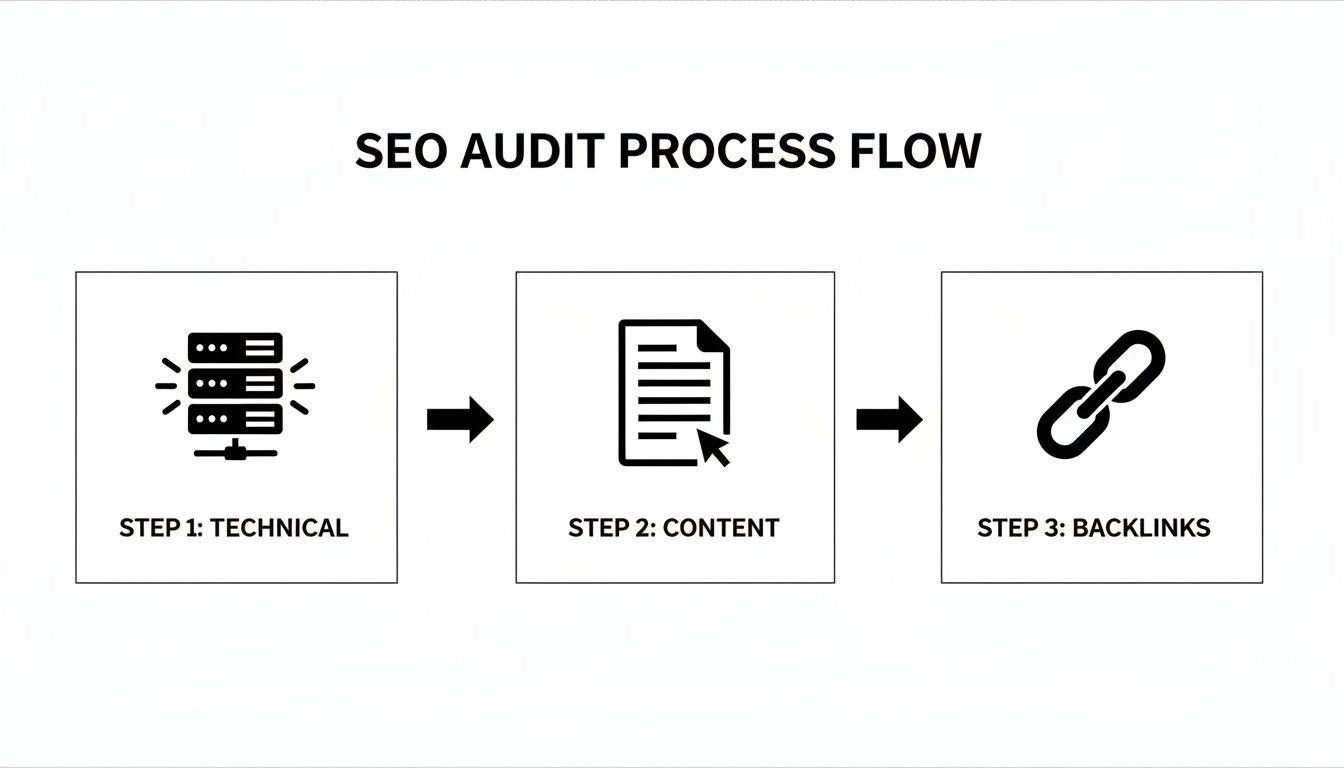
As you can see, a successful audit process relies on interconnected analyses of your site's technical health, content effectiveness, and backlink profile.
The whole thing kicks off with a deep-dive conversation. This isn't just a formality; it's the crucial foundation for the entire project. The agency needs to get inside your business—to understand your target audience, who your main competitors are, your revenue goals, and what success really looks like for you.
This initial chat gets everyone aligned on the key performance indicators (KPIs) that actually matter. Are you focused on increasing online sales? Generating more qualified leads for your service business? Or maybe boosting local foot traffic in Adelaide? Nailing these goals down from the start ensures the audit focuses on the metrics that will directly impact your bottom line.
With clear objectives set, the real technical work begins. This is where the experts fire up their advanced tools and start the manual checks, collecting a massive amount of data on every aspect of your site's performance. It’s easily the most time-intensive part of the audit, often taking several weeks to do thoroughly.
The analysis covers all the core components we’ve talked about:
A professional audit doesn't just collect data—it interprets it. The real value comes from connecting the dots between a technical issue, like slow page speed, and a business problem, like a high bounce rate on a key product page.
Raw data on its own is overwhelming and not very useful. In this critical phase, the audit team transforms spreadsheets and reports into a strategic list of high-impact opportunities. They pull together all the findings from the analysis stage and start to build a coherent story about your website's performance.
Most importantly, they prioritise the recommendations. Not all issues are created equal. An experienced auditor will categorise action items based on a simple formula: effort versus impact. This separates the "quick wins" from the larger, more resource-intensive projects, giving you a clear and manageable starting point. For a closer look at the practical steps involved, you can learn more about how to conduct an SEO audit that drives results.
Finally, all that analysis and prioritisation gets compiled into a final report and strategic plan. This isn't just a list of problems; it's your blueprint for growth. A quality report will include an executive summary for stakeholders, detailed findings with plain-English explanations, and that all-important prioritised action plan.
The agency will then walk you through the report, making sure you understand the "why" behind each recommendation so you can move forward with confidence.
After weeks of deep-dive analysis, the final report from your SEO audit service lands in your inbox. This document is much more than just a list of problems; it’s a strategic blueprint, a roadmap designed to steer your business towards real, measurable growth. A great audit report doesn't just tell you what's wrong—it shows you exactly how to make it right.
Think of it like getting a detailed building inspection combined with an architect's renovation plan. First, it points out any structural weaknesses. Then, it gives you a clear, prioritised set of instructions to not only fix the issues but also add significant value to your digital property. The whole point is to turn a mountain of complex data into a clear path forward.

A professional audit report is usually broken down into three core sections, with each one speaking to a different audience within your organisation. This structure ensures everyone, from the C-suite to the dev team, gets the information they need in a format they can actually use.
You should expect to receive these three things:
This multi-part structure makes the audit's findings accessible and, most importantly, actionable for your entire team.
The real power of an audit is unlocked in its action plan. A simple list of 100+ issues is just noise; it’s overwhelming and frankly, not very helpful. A strategic action plan, on the other hand, empowers your team by organising tasks logically so you can start making progress from day one.
A professional audit doesn't just hand you a problem; it hands you a solution. The action plan should be a clear, prioritised guide that turns analysis into measurable improvement, ensuring the audit becomes a catalyst for growth, not just another report on the shelf.
A well-structured plan will sort recommendations based on two key factors: impact (how much it will move the needle on performance) and effort (how many resources it will take to get it done). This immediately creates a clear hierarchy for what to tackle first.
This approach helps you see three distinct types of tasks:
By sorting tasks this way, the audit gives you a clear starting point and a long-term vision. It makes sure your team’s time and money are focused where they will make the biggest difference, turning the insights from the SEO audit into a genuine return on investment.
When you start looking into professional SEO audit services, one of the first questions on your mind is usually, "What’s this going to cost me?". The answer isn’t a simple, off-the-shelf number. Instead, the price reflects the scope, complexity, and sheer depth of analysis your website actually needs.
It's a mistake to view this as a pure expense. Think of it more as a strategic investment—one that uncovers costly, hidden issues and unlocks some serious opportunities for growth.
The final price tag is directly tied to a few key factors. A small local business with a tidy 20-page website is a completely different beast to a massive e-commerce store juggling thousands of products and a complex technical setup. The deeper and more thorough the audit, the more value it delivers, and naturally, the cost reflects that.
The final quote you receive for an SEO audit is built on a few core variables. Getting your head around these will help you understand why pricing can vary so much from one agency to another.
So, what should you realistically expect to budget? While every project is different, there are some common pricing models and ranges you'll see in Australia. These usually fall into one-off projects or ongoing retainers that include regular website health checks.
For one-time projects, you'll see costs framed as a direct financial figure. A leading Australian pricing study shows that project-based SEO work, like a comprehensive site audit, typically lands somewhere between AU$2,000 and AU$5,000. This, of course, depends on the size and complexity of your website. To dig deeper into these numbers, you can explore detailed SEO cost breakdowns in Australia.
An SEO audit is not an expense; it is an investment in your digital foundation. The insights gained can pay for themselves many times over by preventing wasted ad spend, improving conversion rates, and securing sustainable organic traffic growth.
It’s crucial to weigh this cost against the potential return. An audit might uncover a single critical technical error that's costing you thousands in lost sales every month. Fixing that one thing delivers an immediate and ongoing return on your investment.
Likewise, it could pinpoint content gaps that, once you fill them, start attracting highly qualified traffic that converts—all at a fraction of what you’d spend on paid ads. The initial spend on a thorough audit quickly becomes a powerful tool for making your entire marketing budget work harder and smarter.
To get a clearer picture of how these costs fit into a broader strategy, it's worth checking out various SEO packages and pricing. You'll see how an audit serves as the essential first step in any successful campaign.
Picking the right agency for your SEO audit services is every bit as critical as the audit itself. The partner you bring on board determines the quality of the insights you get, the real-world value of their recommendations, and ultimately, whether you see a return on your investment. Think of it as hiring a strategic partner, not just a service provider.
This decision needs to go way beyond just looking at the price tag. You're looking for genuine expertise, a process you can see and understand, and a team that gets what you're trying to achieve with your business. The gap between a one-size-fits-all template and a truly customised audit is often the difference between stagnation and real, tangible growth.
Before you sign on the dotted line, you need to arm yourself with the right questions. This is how you'll gauge an agency's depth of knowledge and how they think strategically.
Kick things off by asking about their process and the tools they rely on. This peels back the curtain on their technical skills and how they handle data analysis. A great follow-up is to ask how they prioritise recommendations; this tells you if they're focused on business impact or just handing you a long list of problems.
Here are a few essential questions to add to your list:
Their answers will quickly show you whether they're offering a genuine partnership or just a generic report. For a bit more context on what top agencies offer, our list of the best SEO companies for small businesses is a great resource.
Knowing what to look for is only half the battle; knowing what to run from is just as important. Certain promises and practices are huge red flags and should make you hit the brakes.
Be extremely wary of any agency that guarantees a #1 ranking on Google. Real SEO is about building a sustainable, long-term strategy. No one can guarantee specific rankings because the search algorithms are always changing.
Another massive red flag is a lack of transparency. If an agency is cagey about its methods or won't explain the "why" behind their suggestions, it's best to walk away. This can often mean they're using outdated or even harmful "black-hat" tactics that could land your site in Google's penalty box.
In competitive markets, the value of a quality audit is becoming clearer by the day. Businesses that do a deep audit every 12–18 months and actually act on the findings tend to stabilise or even grow their organic leads. On the flip side, those stuck with old tactics often see traffic drops of 20–40% after big algorithm updates. A skilled partner is your guide to navigating these shifts without losing ground.
Diving into the world of SEO audit services can bring up a fair few questions. To help you feel confident about the next steps, we’ve put together some straight answers to the queries we hear most often from Australian businesses.
Think of it as the final check of your toolkit before you start a big project. Having the right info on hand means you’re fully prepared for the journey ahead and can get the most out of the insights an audit provides.
For most businesses, we recommend a deep-dive SEO audit every 12 months. This rhythm is usually enough to spot issues before they snowball and to keep your strategy in step with Google's constant algorithm updates.
That said, some situations call for an immediate audit, outside of your usual schedule.
It’s a bit like servicing your car. You have your annual check-up, but you’d also take it straight to the mechanic if you heard a weird noise or it suddenly lost power.
You can definitely use free online tools for a basic health check, but a DIY audit really only scratches the surface. These tools are great for catching obvious errors like broken links or missing meta descriptions, but they don't offer the strategic depth of a professional service.
A proper audit goes way beyond a simple checklist. It takes an experienced human to connect the dots between technical data, content quality, user behaviour, and your actual business goals.
A free tool can tell you what is broken. A professional audit tells you why it's broken, how it's hitting your bottom line, and gives you a prioritised plan on exactly how to fix it for the biggest impact.
This is a really important distinction to make. An SEO audit is a one-off project—a deep diagnostic designed to create a strategic roadmap. Ongoing SEO is the continuous work of following that roadmap and tweaking it over time.
The audit provides the crucial foundation and direction for any successful SEO campaign. Without it, you risk spending your monthly marketing budget on activities that won't move the needle because underlying problems are holding your site back. It makes sure your long-term efforts are focused on the right things from day one.
Ready to turn insights into action and build a stronger digital foundation? Virtual Ad Agency provides expert SEO audit services that deliver a clear, prioritised roadmap for growth. Let's start the conversation and uncover your website's true potential.

 previous