
Let's be honest, a social media media plan isn't just a list of posts you want to publish. Far from it. It’s the strategic blueprint that separates the businesses getting predictable ROI from those just shouting into the void. This is the document that makes sure every dollar and every minute you spend is directly tied to a real, measurable business goal.
So many businesses fall into the trap of thinking their content calendar is their plan. It's an easy mistake to make. A content calendar tells you what you're going to post and when. A proper social media media plan, on the other hand, digs much deeper. It forces you to answer why you're posting, who you're trying to reach, and how you'll actually know if any of it is working.
This is what turns your social media from a cost centre into a reliable growth engine.
Imagine two businesses. Business A is posting every day, throwing out a mix of product updates and company news. Their engagement is all over the place, their ad spend feels like a gamble, and if you asked them how social media impacts their bottom line, they’d struggle to give you a straight answer.
Then there's Business B. Armed with a media plan, their story is completely different. They've defined a clear goal: generate 50 qualified B2B leads per month. They know their audience hangs out on LinkedIn during business hours and have set aside a specific budget to target them with case studies and genuinely useful educational content. Every single action is deliberate. Everything is measurable.
At its core, a solid media plan creates accountability. It shifts your team’s focus away from vague, subjective goals like "getting more likes" and zeroes in on concrete business outcomes. Think of it as the essential tool for making sure every dollar is spent with purpose.
This is what a data-informed, strategic approach actually looks like in practice.

The numbers don't lie. A well-structured plan, constantly fed and refined by real analytics, is the only way to unlock consistent, predictable growth.
For any company in Australia, the sheer scale of social media usage makes having a formal plan non-negotiable. We're talking about over 20.9 million active users—that's nearly 78% of the entire population. On average, Australians spend 1 hour and 51 minutes every single day on social platforms. That means almost 30% of their total online time is up for grabs for your targeted content and ad sequences.
Ultimately, the difference between having a plan and winging it is the difference between guesswork and strategy. Without a plan, you're constantly reacting. With one, you're proactively guiding your audience down a carefully constructed path that ends with a conversion.
A social media media plan transforms your activities from a series of disconnected tactics into a cohesive system designed for growth. It's the framework that allows you to test, learn, and optimise your way to predictable results.
To really get your head around what goes into one of these, it's worth exploring some real social media marketing plan strategies that are proven to get results. This guide will walk you through building your own, step by step.
Every solid social media media plan kicks off with two fundamental questions: what are we really trying to achieve, and who are we trying to reach? Getting honest, detailed answers here is what separates a plan that delivers measurable ROI from one that just burns through your budget. Vague goals like "get more likes" are useless; they have no direction and no accountability.
Instead, your strategy needs to be anchored by SMART objectives—that’s Specific, Measurable, Attainable, Relevant, and Time-bound. This framework isn't just business jargon; it forces you to turn broad ambitions into precise targets your team can actually work towards.

This isn’t about wishful thinking. It's about tying every single social media action back to a tangible business outcome. For instance, instead of aiming for "better engagement," a B2B tech company might set a goal to "increase qualified B2B leads from LinkedIn by 20% in Q3." Now that’s a goal you can build a real strategy around.
Once you’ve nailed your SMART objective, the next move is to break it down into Key Performance Indicators (KPIs). These are the specific metrics you’ll watch like a hawk to see how you're tracking.
For that goal of boosting leads by 20%, your KPIs might look something like this:
By setting these KPIs upfront, you create a clear scorecard for your campaign. It kills the guesswork and lets you make decisions based on data, not gut feelings.
Knowing your objectives is only half the battle. You also need to know exactly who you're talking to. And I don’t mean generic demographic data like "males aged 25-40." That’s not nearly enough to be competitive anymore. Your media spend is far too valuable to waste on people who will never need what you're selling.
This is where detailed buyer personas come into play. A buyer persona is a semi-fictional profile of your ideal customer, pieced together from real data and sharp insights. It goes way beyond the basics to uncover their motivations, daily challenges, and online habits.
Building a truly effective buyer persona means putting yourself in your customer's shoes. It’s not just about their job title; it’s about understanding their daily frustrations and what they’re trying to achieve.
To build these profiles, you need to become a bit of a detective. A great place to start is analysing your existing customer data in your CRM. Look for patterns in job titles, company size, and industry. But don’t stop there.
Scout your competitors' audiences on platforms like LinkedIn. It can reveal who they're successfully engaging. What kind of content gets their followers talking? What questions are people asking in the comments? This is an absolute goldmine of information.
Platform analytics from Meta or LinkedIn also offer rich insights into the interests and behaviours of people already interacting with your brand. Combine this with deeper investigation. You can learn more about how to conduct market research in our detailed guide, which covers everything from surveys to social listening.
Let’s go back to our B2B tech company. Through this process, they might discover their ideal customer isn’t just any "IT Manager." Their ideal persona is "Solutions Architect Sarah":
With this level of clarity, your social media media plan becomes incredibly focused. You know exactly what content Sarah needs to see (like a case study on financial data integration) and precisely where and when to show it to her. This laser-targeted approach is the key to maximising your media spend and driving results that actually matter.
With your goals locked in and a crystal-clear picture of your audience, the next question is where you’ll actually connect with them. So many businesses make the classic mistake of trying to be everywhere at once. This just drains your budget and makes your message feel diluted. A truly powerful social media media plan isn't about blanketing the internet; it's about being surgically precise.
You need to show up where your ideal customers are already spending their time and are open to what you have to say.
Don't just chase the biggest platforms by default. Think about matching your audience's natural behaviour with what each platform does best. For a B2B services firm hunting for high-value leads, LinkedIn is a no-brainer. It's the perfect environment for professional context and pinpoint targeting. That same firm might then use YouTube to publish in-depth educational videos that build authority with the technical decision-makers they need to impress.
On the flip side, an e-commerce brand selling directly to consumers lives and dies by visual storytelling. Their main battlegrounds will be Instagram and TikTok, where product aesthetics, user-generated content, and influencer marketing are the currencies that drive sales.
Making the right call means looking at local data. A quick glance at Australian platform stats shows why a focused, multi-channel approach always beats random posting.
Facebook alone has about 22.8 million users in Australia, which is a staggering 82–83% of the population. The largest group on the platform are those aged 25–34, numbering around 6.1 million users. This makes it a goldmine for both B2C and B2B brands trying to reach everyone from young families to key business decision-makers.
But it doesn't stop there. YouTube reaches about half of all Aussies, Instagram about one in three, and Snapchat roughly one in four, with a solid 6.4 million monthly active users on its own. Digging into this data is what turns a good guess into a great strategy. If your audience is under 25, ignoring TikTok and Snapchat is like leaving money on the table.
Your platform choice isn't about what's popular; it's a strategic decision based on where you have the highest probability of connecting with your ideal customer in a meaningful way.
To help guide your thinking, let's break down the major players in the Australian market.
This table offers a simplified view of where different demographics spend their time online in Australia and how your business can best engage them.
| Platform | Primary Australian User Demographic | Best Use Case for Medium/Large Businesses |
|---|---|---|
| Professionals, B2B decision-makers (25-55+) | Lead generation, employer branding, industry thought leadership. | |
| Broad (strongest in 25-54 age range) | Community building, top-of-funnel awareness, local business marketing. | |
| Millennials & Gen Z (18-34) | Visual brand storytelling, e-commerce, influencer marketing. | |
| YouTube | Broad (strong across all age groups) | Educational deep-dives, product demonstrations, brand storytelling. |
| TikTok | Gen Z & Younger Millennials (Under 30) | Viral marketing, brand personality, user-generated content campaigns. |
As you can see, each platform has its own distinct flavour and audience. Choosing the right mix is fundamental to your success.
Okay, you've picked your platforms. Now you need a plan for what you're actually going to post. This is where content pillars come in.
Think of these as the 3-5 core themes or topics your brand will consistently own. They act as a compass, ensuring every post, video, and story is relevant to your audience and aligned with your business goals. These pillars are the foundation of your entire content house.
For example, a B2B software company's pillars might look like this:
With these pillars in place, you’ll never be scrambling for ideas again. Every single piece of content should map back to one of these core themes, creating a consistent and valuable experience for your followers.
The final piece of the puzzle is to map your content pillars to the different stages of your customer's journey. Your content needs to meet people where they are, whether they're just starting to research a problem or are pulling out their credit card.
Awareness Stage: At the top of the funnel, the goal is simple: attract new eyeballs. Use your "Industry Education" and "Behind the Brand" pillars to create engaging, shareable content. Think short videos, infographics, and blog posts that address broad pain points without being pushy. For those heavily invested in video, checking out some great social media video strategy examples can provide a ton of inspiration.
Consideration Stage: Now, people are actively looking for solutions. This is where your "Customer Success" pillar takes centre stage. It's time to deploy targeted case studies, detailed product demos, and webinars that prove your expertise and build undeniable trust.
Decision Stage: At the bottom of the funnel, it's all about compelling action. This is the moment for clear calls-to-action, free trial offers, and powerful testimonials that tackle any last-minute hesitation and seal the deal.
By building this strategic framework, you ensure that every single post has a purpose. You’re no longer just shouting into the void; you’re guiding potential customers on a deliberate path, turning your social media presence into a reliable engine for business growth.
You've figured out your audience and sketched out a content strategy. Great. Now comes the part where we make it real: putting actual dollars and dates behind those ideas. This is the operational engine room of your social media media plan. Without a solid budget and a clear calendar, even the most brilliant strategy is just a nice document collecting digital dust.
Smart budgeting isn't about pulling a number from thin air. It's about allocating funds with surgical precision. One of the most effective ways I've seen this done is through objective-based funding. You essentially work backwards from your goal. Let's say your objective is to generate 200 qualified leads next quarter. If you know from past campaigns that your average Cost Per Lead (CPL) is about $50, then you have a logical starting point: you'll need to allocate $10,000 to hit that target. Simple, right?
Let's make this tangible. Picture a B2B tech company here in Australia with a quarterly paid social budget of $100,000. Just spending it isn't a strategy. The smart money is on splitting it up to cover the entire customer journey.
A tried-and-true approach is the 70/30 or 60/40 rule:
You can then slice it even finer. For instance, knowing video grabs attention early on, you might dedicate 50% of your prospecting budget to video ads and the other 50% to carousel or single-image ads that point to a downloadable whitepaper.
Once the budget is carved up, you need to speak the language of the platforms to manage your campaigns. These are the metrics that tell you exactly what you're paying for.
There are three big ones you'll live and breathe:
Really getting your head around media planning and buying is what separates the pros from the amateurs, helping you squeeze every drop of value from your spend.
Think of your budget as a strategic tool, not just a spending limit. By allocating it across your funnel and understanding what you’re paying for with metrics like CPM and CPA, you gain incredible control over your campaign’s performance and ROI.
The final piece of the puzzle is pulling it all together into one, cohesive media calendar. And I don't just mean a simple schedule of your organic posts. A proper media calendar is your command centre, integrating every moving part of your plan.
This is the workflow in a nutshell—turning your budget into a scheduled, actionable plan.
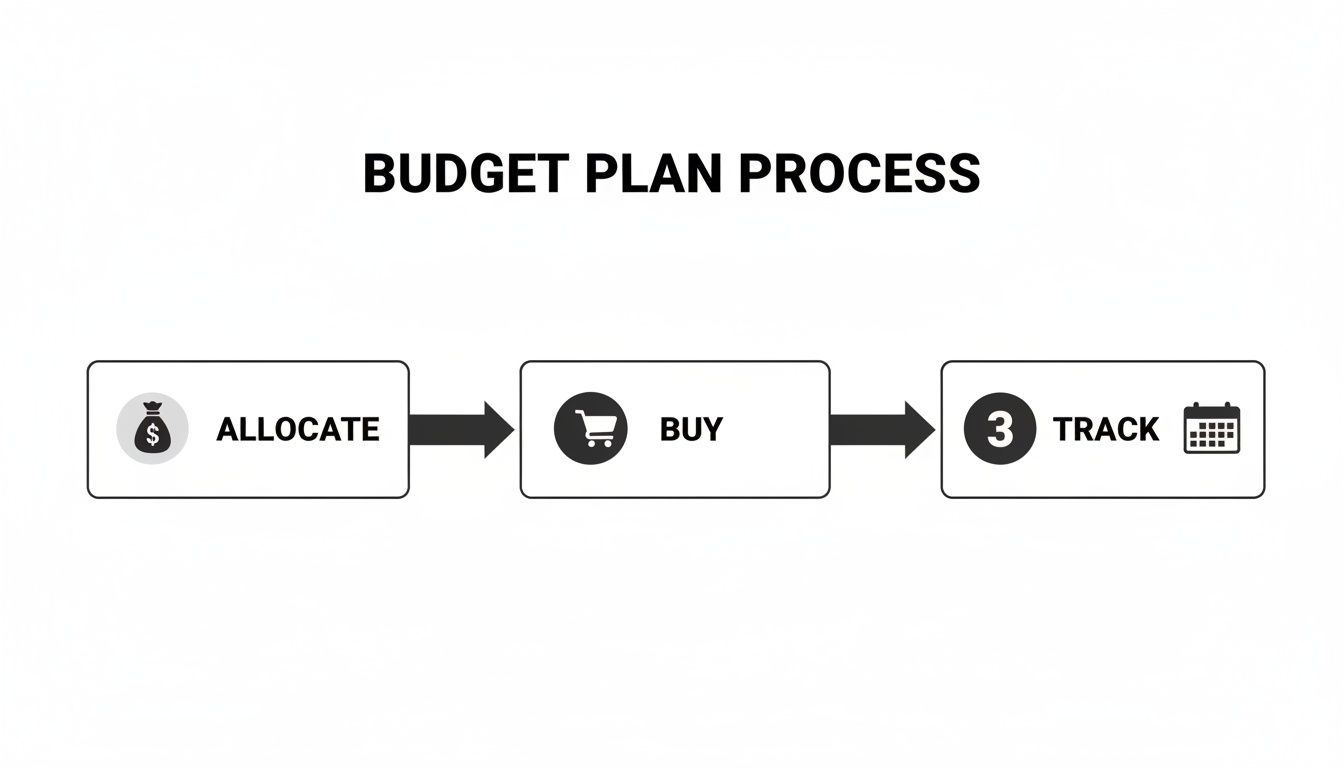
This process ensures every dollar has a job, is used to buy the right media placements, and is scheduled to go live at the moment of maximum impact.
Your calendar needs to be the single source of truth for the entire team, laying out:
When you do this, your organic and paid efforts stop being two separate things and start working together. You can see when to put paid amplification behind a top-performing organic post or time your retargeting ads to launch just as a major blog post goes live. This transforms your calendar from a simple schedule into the strategic heart of your entire social media media plan.
A static plan is a failing plan. I've seen it time and time again. The real power of a well-thought-out social media media plan isn't in the document itself, but in its ability to bend and adapt based on what's actually happening in the real world. Measurement isn't just a final step; it's the engine that turns good campaigns into great ones and drives consistent ROI.
Your strategy’s success really hinges on tracking the right metrics. Vague goals inevitably lead to vague results, so your Key Performance Indicators (KPIs) need to be tied directly back to the business objectives you set earlier. Not all metrics are created equal, and what’s critical for one campaign can be a complete distraction for another.
For instance, if your goal is pure brand awareness, your dashboard should be laser-focused on metrics that signal visibility. You aren't chasing sales here; you're building mindshare.
But if your objective shifts to lead generation, the whole game changes. The focus snaps from visibility to action and efficiency. Here, every dollar needs to be accounted for.

To track these KPIs effectively, you need a robust setup. This means going beyond the default dashboards to make sure your data is clean, accurate, and telling you the whole story.
Your primary tools for this will be the native ad managers (like Meta Ads Manager or LinkedIn Campaign Manager) and a solid web analytics platform like Google Analytics 4. This setup is non-negotiable.
It involves installing tracking pixels (the Meta Pixel or LinkedIn Insight Tag) on your website and configuring specific conversion events that match your goals, such as "Lead" or "Form Submission." This is what allows you to connect a person's action on your website directly back to the specific ad they clicked. For a deeper look into this, check out our guide on the digital marketing performance metrics that truly matter.
Data is pretty useless without a process to act on it. This is where an optimisation cycle comes in. Think of it as a simple, repeatable framework for turning insights into action and ensuring your campaigns are always getting better.
Your first campaign is just a baseline. The real performance gains come from a relentless cycle of reviewing data, forming a hypothesis, making a small change, and measuring the impact.
The demographic and behavioural patterns right here in Australia perfectly illustrate why this is so critical. There are around 20.8 million social media users in Australia, but their habits are wildly different. Gen Z Australians, for example, spend about 10 hours and 5 minutes a week on social media, while Boomers clock in at just 4 hours and 30 minutes.
Without tracking and segmenting, you'd treat these vastly different groups the same, wasting a significant chunk of your ad spend.
A practical optimisation cycle involves a weekly or bi-weekly check-in on your campaign data. During this review, you're looking for what's working and, just as importantly, what's bombing.
By sticking to this disciplined cycle, you move away from guesswork and towards a system of continuous improvement. This is how you ensure your social media media plan doesn't just launch well, but consistently delivers better results over time.
Even with the best guide in hand, putting together a proper social media media plan can leave you with some nagging questions. It’s one thing to fill out a template, but it's another thing entirely to build a living document that actually grows your business.
Let's run through some of the most common hurdles I see marketing managers and business owners face. Getting these right from the start can save you a world of pain—and wasted ad spend—down the track.
Think of your media plan as a living, breathing document, not a set-and-forget file buried in a folder somewhere. I like to break it down into two layers: strategy and tactics.
Your high-level strategy—the big picture stuff like your core objectives, audience personas, and the platforms you've chosen to dominate—needs a proper review every quarter. Business goals shift, priorities change, and a quarterly check-in ensures your social media efforts are still pulling in the same direction as the rest of the company.
The day-to-day execution, however, needs a much closer eye. You should be diving into your campaign performance, ad spend, and creative results weekly, if not daily. This is where the magic happens, allowing you to make quick, data-backed tweaks on the fly.
The trick is to find that sweet spot between long-term vision and short-term agility. A quarterly review keeps the ship pointed in the right direction, while weekly check-ins help you navigate the choppy waters of algorithm changes and performance fluctuations.
Of course, sometimes the market throws you a curveball. A major competitor launches something new, a platform rolls out a game-changing feature, or an algorithm update sends shockwaves through the industry. When that happens, don't wait for the quarterly meeting—rip the plan open and adapt immediately.
This is the million-dollar question, isn't it? While there’s no magic number, a solid rule of thumb for paid social is to earmark somewhere between 5-12% of your total marketing budget. For a medium-sized Australian business, that could be anything from $5,000 to over $25,000 a month. It really depends on how competitive your industry is and how much it costs to get in front of your ideal customer.
But here’s a much smarter way to approach it: work backwards from your goals.
Let's say you need to generate 100 qualified leads this month. If your past campaigns show an average Cost Per Lead (CPL) of around $50, then you know your starting budget for that specific goal has to be at least $5,000. This approach takes the guesswork out of it and ties your spending directly to a tangible outcome.
If you’re flying blind with no historical data, set aside a test budget for the first one to three months. Your only goal during this phase is to gather intelligence. Find out your baseline CPC, CPL, and conversion rates. Once you have those numbers, you can scale your investment with confidence.
Never. Absolutely not. Treating them as two different things is one of the most common—and costly—mistakes I see. They aren't separate channels; they're two halves of the same whole, and each one makes the other stronger.
A truly effective social media media plan uses paid ads to pour fuel on your best organic content. At the same time, it uses the engagement from your organic posts as a testing ground. See a post with off-the-charts shares and comments? That’s your green light to put some paid budget behind it and show it to thousands more people just like your current fans.
This one stumps a lot of people. You can't measure the ROI of a brand awareness campaign with a simple Return On Ad Spend (ROAS) figure like you can with a direct-response campaign. But that doesn't mean it’s impossible to measure its value. You just need to look at the right things.
Instead of direct sales, you're tracking leading indicators that show your efforts are working. The key metrics to watch here are:
But the real proof is what happens next. While your awareness campaign is running, keep a close eye on your "downstream" metrics. Are you seeing a lift in direct traffic to your website in Google Analytics? Is your branded search volume (people Googling your company name) going up in Google Search Console? When you see these numbers rise in correlation with your ad spend, you have strong evidence that your top-of-funnel efforts are creating real business value.
At Virtual Ad Agency, we specialise in building and executing data-driven media plans that deliver measurable results. If you're ready to transform your social media from a cost centre into a growth engine, let's talk.

 previous