
Successful lead generation for IT services is about so much more than just throwing tactics at the wall to see what sticks. It all starts with a rock-solid foundation. This is the behind-the-scenes work that ensures every dollar you spend attracts qualified leads who genuinely need what you're selling, rather than just casting a wide, ineffective net.
Before a single campaign goes live, the most important work needs to happen. Without this foundational prep, even the most creative and well-funded marketing efforts will fall flat. It's not about guesswork; it's about building a precise, data-driven framework that will guide every decision you make down the track.
This means getting crystal clear on who you're targeting, truly understanding their journey to making a purchase, and knowing exactly how you stack up against the competition.
Taking the time to do this properly prevents wasted ad spend and makes sure your message connects with the right people from their very first interaction with your brand. A crucial part of this is knowing how to calculate marketing ROI, so you can prove the value of your campaigns and justify future investment.
This is where so many IT service providers go wrong. A vague description like "small business owner" is pretty much useless. For complex IT services, you need a hyper-specific Ideal Customer Profile (ICP) that goes way beyond basic demographics. We’re talking firmographics, technographics, and the specific triggers that signal a need for your help.
Forget flimsy personas. Think of it more like building a detailed dossier on your perfect-fit client.
Here are the kinds of details you should be digging into for your ICP:
When you’re creating a profile for your ideal buyer, it’s essential to cover all the bases to ensure your targeting is as sharp as possible. The table below outlines the key components you should include.
| Component | Description | Example (For a 'Cybersecurity Steve' Persona) |
|---|---|---|
| Demographics | Basic personal information to humanise the persona. | Male, 45-55, married, lives in a major metro area. |
| Role & Responsibilities | Their job title, seniority, and what they're accountable for. | CTO at a mid-sized financial services firm. Manages a team of 15 IT staff. Responsible for network security, data integrity, and tech budget. |
| Goals | What success looks like in their role. | To ensure 99.9% uptime, pass all compliance audits, and reduce security incidents by 50% year-on-year. |
| Challenges & Pain Points | The specific problems and frustrations they face daily. | Struggling with an outdated firewall, worried about ransomware attacks, and finding it hard to hire skilled cybersecurity talent. |
| Watering Holes | Where they go for information and professional development. | Reads TechCrunch and Wired, follows cybersecurity experts on LinkedIn, attends the annual CyberCon conference. |
| Triggers | Events that would cause them to actively seek a solution. | A recent data breach in their industry, a failed compliance audit, or a mandate from the board to improve their security posture. |
Building out these detailed profiles gives you a clear picture of who you're talking to, making your marketing infinitely more effective.
A well-defined ICP is the filter for your entire marketing and sales process. It gives you the confidence to say "no" to bad-fit prospects, freeing up your team to focus on high-value opportunities that are far more likely to close and stick around for the long haul.
Selling a high-value IT service isn't like selling a pair of shoes; it's a long, considered journey that often involves multiple stakeholders. The path a CTO takes to purchase a new security solution is worlds away from a simple consumer transaction. If you don't understand this journey, you can't create content that meets them where they are.
Their journey often kicks off long before they ever think about contacting a vendor. It might start with a nagging problem, like a sluggish network or a growing worry about data security. From that initial awareness, they move into deep research, comparing different types of solutions, and finally, narrowing down their list of potential vendors.
Your marketing needs to be present and helpful at every single one of these stages.
Knowing who your competitors are is one thing, but a truly meaningful competitive analysis helps you spot gaps in the market and sharpen your own unique value proposition (UVP). You need to dig deeper than just a list of their services. The real gold is in understanding how they position themselves.
This means looking at their messaging, their pricing models, the audience they target, and the content they're creating. A great place to start is a thorough review of their website and marketing collateral. For a more detailed walkthrough, check out our guide on how to conduct market research for your business.
This process isn't just about spying on the competition; it’s about finding opportunities to differentiate your own IT services and craft a message that truly cuts through the noise.
Think of a powerful inbound engine as your best salesperson. One that never sleeps, working 24/7 to pull in, educate, and chat with potential clients. The whole idea is to draw people to you with genuinely useful content, not by shoving your services in their face. It’s about positioning your IT company as a trusted authority, so when a business hits a tech wall, your name is the first one they think of.
The heart of this engine is content that gets right to the core of the complex problems your ideal clients are wrestling with. Generic blog posts just won't cut it here. Your audience is made up of technically sharp decision-makers who want depth, data, and real-world fixes. Forget surface-level tips; you need to be creating the definitive resources they'll turn to.
Building this inbound foundation really comes down to three key things: knowing your ideal client inside and out, mapping their journey, and analysing what they truly need.
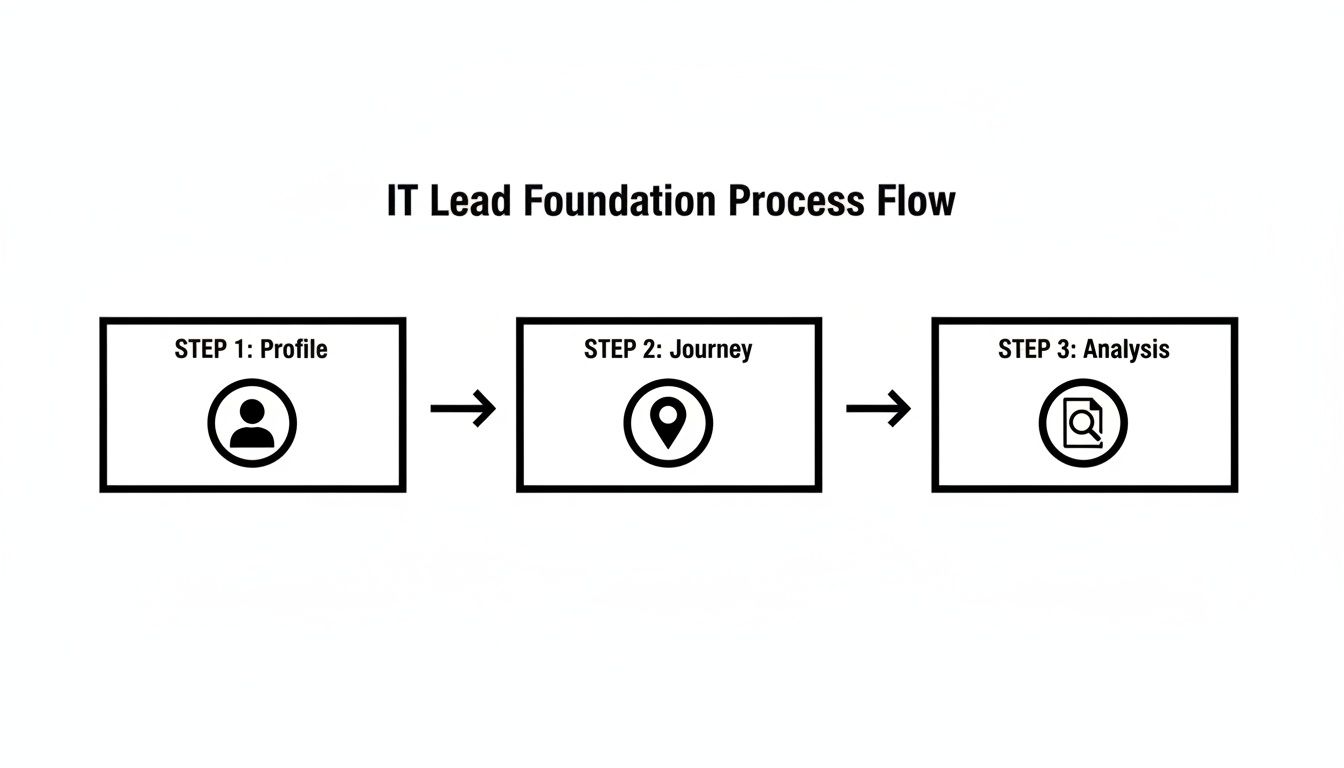
This process is your roadmap. It all starts with profiling your target, then moves to understanding their journey, and finishes with a deep analysis that shapes your entire content strategy.
To get on the radar of IT directors and CTOs, your content has to be substantial and actually helpful. They're searching for expertise and answers, not a sales pitch. Your aim is to create assets they’d want to save, share with their team, or use to build a business case for a new project.
From my experience, a few content formats consistently knock it out of the park for IT services lead gen:
This laser focus on creating genuinely valuable resources is a cornerstone of successful content marketing for agencies and service businesses. It builds rock-solid credibility long before you even think about a sales conversation.
Search Engine Optimisation (SEO) is the bit of magic that makes sure your amazing content actually gets found. For IT services, the game is all about capturing prospects who have a high intent to buy, which usually means going after long-tail keywords.
Instead of a broad, generic term like "IT support," a much smarter long-tail keyword would be something like "managed IT services for accounting firms in Sydney." That kind of specificity attracts a visitor who knows exactly what they're looking for, making them a much, much warmer lead.
To really nail the conversion of website visitors into qualified prospects, using chatbots for lead generation can be a game-changer for an IT business. A well-programmed chatbot can handle initial technical questions, qualify visitors based on their needs, and even schedule consultations 24/7. It basically turns your website into a lead capture machine that never switches off.
The real power of SEO in this space isn't just about traffic; it's about attracting the right traffic. A single lead from a highly specific search query is often worth more than a hundred visitors from a generic one.
A lead magnet is that specific piece of value you offer in exchange for a prospect's contact details. It’s the handshake that turns a passive reader into an active lead. The best ones are practical, interactive, and offer immediate value.
Here are a few powerful examples that work wonders in an IT services context:
These lead magnets need to live on dedicated, high-converting landing pages. A great landing page has one job and one job only: to get that conversion. It needs a crystal-clear headline, snappy bullet points outlining the benefits, a dead-simple form (just name and email, if you can), and a big, bold call-to-action button. Strip out all other distractions like the main site navigation to keep their eyes on the prize.
While a solid inbound engine is great for bringing warm prospects to your door, the really high-value IT contracts often demand a more direct approach. For those complex, long-cycle sales, you simply can't afford to sit back and wait for the right leads to find you. This is where proactive outbound and Account-Based Marketing (ABM) strategies become your secret weapon.
It’s really about flipping the funnel. Instead of casting a wide net and hoping for the best, you’re hand-picking your dream clients and going after them with highly personalised, relevant outreach. This shift from volume to value is a game-changer for any IT service provider looking to land those bigger, enterprise-level accounts. It takes precision, a bit of detective work, and a real commitment to building relationships, not just blasting out emails.
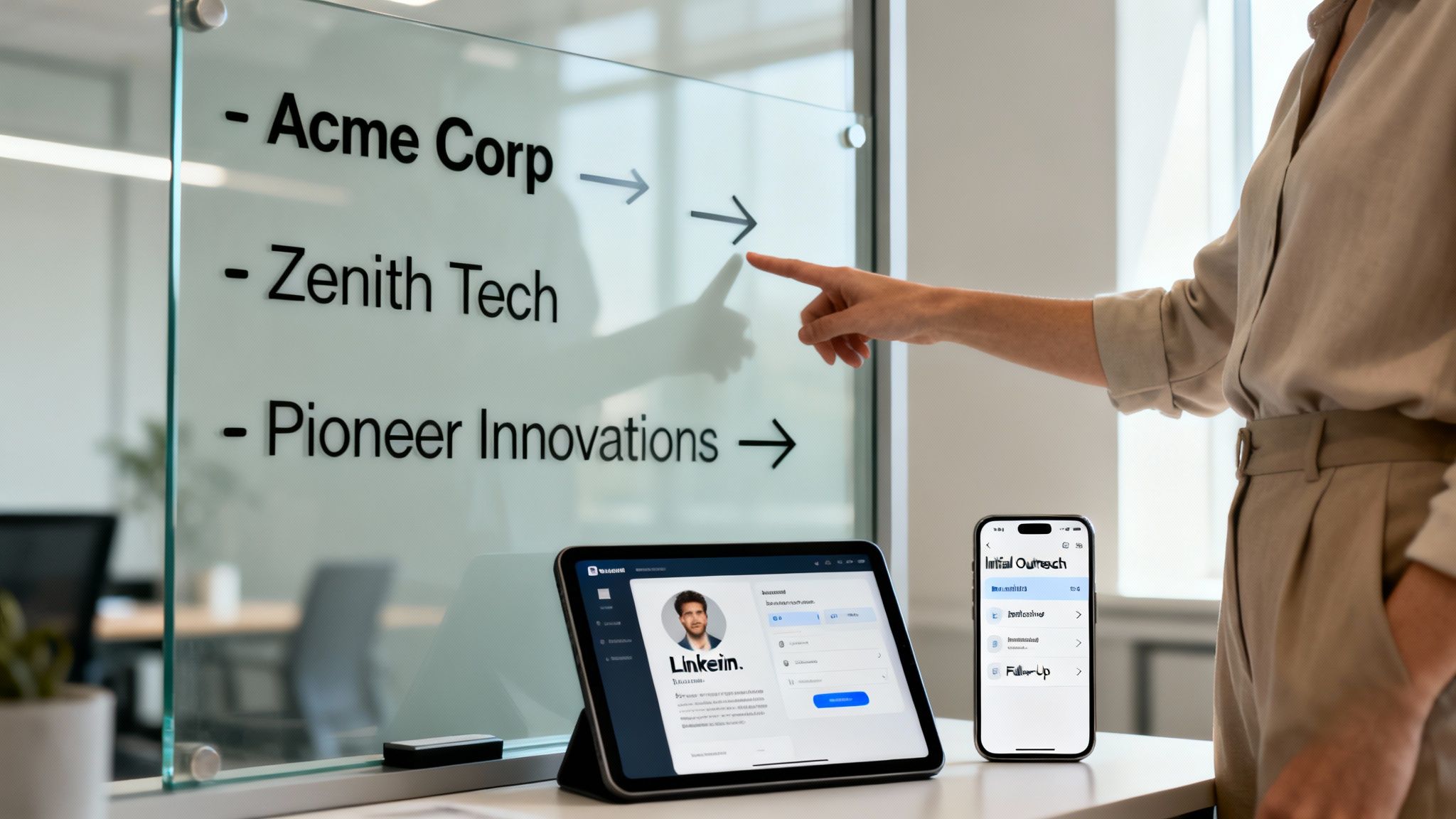
The first stop in any decent ABM campaign is figuring out exactly who you're going after. This goes a step beyond the buyer personas we talked about earlier; it’s about identifying entire companies that are a perfect match for your services. You're essentially building your "dream client" list.
So, what makes a company an ideal partner for you? Think about it. The characteristics might include:
Tools like LinkedIn Sales Navigator, industry databases, and even local business journals are absolute goldmines for this kind of information. The goal here is to create a tight, focused list of 25-50 target accounts that you can dedicate some serious, quality resources to.
Once your hit list is ready, generic outreach is going straight to the bin. The key is to map out a multi-touch sequence that feels personal and actually adds value at every single step. This isn't about spamming inboxes; it's a coordinated dance across multiple channels over a few weeks.
A sequence is just a pre-planned series of interactions designed to build familiarity and trust with the key decision-makers within your target companies. The idea is to pop up in different places with a consistent, helpful message.
Don't mistake activity for progress. A truly effective outreach sequence is built on quality, not quantity. One well-researched, personalised message is worth a hundred generic email blasts. This thoughtful approach dramatically improves your chances of cutting through the noise.
For instance, a typical sequence might mix different channels and messages over a 2-3 week period to get on the radar of a target CTO.
Example Multi-Touch Sequence for a Target Account:
| Touchpoint | Channel | Action |
|---|---|---|
| Day 1 | View the CTO's profile. Send a connection request with a personalised note referencing a recent company win or a shared connection. | |
| Day 3 | Send a short, sharp email that references a specific challenge common in their industry. Offer a link to a relevant case study. | |
| Day 7 | Find a recent post they shared and leave a thoughtful comment. No pitching, just genuine engagement. | |
| Day 10 | Follow up on the first email, this time offering a different piece of high-value content, like an industry benchmark report you put together. | |
| Day 15 | Phone Call | Make a brief, professional call. Reference your previous interactions and ask if now is a good time to briefly discuss how you've helped similar companies. |
This methodical approach ensures you're building a relationship, not just firing off a sales pitch. Every step is designed to show your expertise and genuine interest in their business, which makes the eventual request for a meeting feel natural and well-earned.
Let’s be honest, the fastest way to get a meeting with a key decision-maker is through a warm introduction. Nothing beats it. This approach taps into the trust that already exists in a mutual connection's relationship.
Before you even think about starting a cold outreach sequence, always check for a warmer path in. Map out your target accounts, identify the key people, and then jump on LinkedIn to see if you have any mutual connections—could be former colleagues, clients, or industry peers.
A simple message to your connection asking for an introduction can be incredibly powerful. Just be sure to frame your request by explaining the clear, specific value you believe you can offer their contact. This makes it easy for your connection to say yes and gives you instant credibility.
Once you have a crystal-clear picture of your ideal client, the next step is figuring out exactly where to find them. Throwing your marketing budget at every available platform is a fast track to disappointment and wasted cash. Getting leads for IT services demands a smart, multichannel approach that meets decision-makers where they already are.
Not every channel is created equal for high-value B2B tech. The places a Chief Technology Officer seeks information are vastly different from those of a small business owner. This is where your detailed buyer persona becomes your most valuable asset, guiding you toward the platforms that will actually deliver results.
The goal here isn't just to be on different platforms; it's to build a seamless journey for your prospects. Each touchpoint, whether it's a Google search, a LinkedIn post, or an industry event, should work together to guide them forward. It’s about being present and valuable in all the right places.
For IT services, a few core channels consistently punch above their weight. Instead of spreading yourself too thin, it pays to focus your initial efforts on mastering the platforms where technical and business leaders spend their time.
LinkedIn for Authority Building: This is the undisputed champion for B2B tech. Don't just use it to post company updates; use it to establish your expertise. Share in-depth articles, comment thoughtfully on industry news, and get active in relevant groups. This is how you build credibility with your target accounts long before they need you.
Google Ads for Capturing Intent: When a business has an urgent IT problem, their first stop is usually Google. Running targeted search campaigns for high-intent keywords like "managed cybersecurity provider Melbourne" or "cloud migration specialists" lets you capture prospects at the very moment they are actively looking for a solution.
Niche Industry Forums and Communities: Think about where your ideal clients hang out to solve problems. This could be a specific subreddit, a private Slack community for developers, or an industry-specific online forum. Becoming a helpful, respected voice in these communities can generate incredibly high-quality, word-of-mouth leads that money can't buy.
Focusing on a select few channels allows you to allocate your budget and resources much more effectively. You'll make a real impact rather than just making noise.
Relying on a single channel is a risky game in today's market. A prospect might discover you through a Google search, follow your company on LinkedIn to see your content, and then finally convert after attending one of your webinars. Each channel plays a distinct role in building trust and moving the conversation forward.
In fact, multichannel lead generation strategies have proven significantly more effective than single-channel approaches in the Australian market, particularly for technology sectors. Research shows that multichannel programs can achieve 24% higher engagement rates compared to single-channel efforts. For IT providers in a competitive market, this statistic highlights why a full-funnel approach is essential. You can discover more insights on why Australian telecom and tech marketing thrives on multiple channels.
A truly effective multichannel strategy isn't just about being active on different platforms. It's about creating a unified brand experience where the messaging is consistent and each channel complements the others. From the prospect's point of view, the journey should feel natural and connected.
Choosing where to invest your marketing dollars is a big decision. Not all channels are suited to every type of IT service or every business goal. Some are great for immediate, high-intent leads, while others are a slow burn, designed to build your brand authority over time. This table breaks down the top contenders to help you decide where to focus your efforts.
| Channel | Best For | Key Metric | Average Cost (AU) |
|---|---|---|---|
| Google Ads (PPC) | Capturing high-intent leads actively searching for solutions. | Cost Per Lead (CPL) | $40 – $120+ per click |
| SEO | Long-term, sustainable lead flow and brand authority. | Organic Traffic & Keyword Rankings | $2,000 – $10,000+ per month |
| Building authority, networking with decision-makers, ABM. | Engagement Rate & Profile Views | Varies (Organic + Paid) | |
| Content Marketing | Educating prospects, building trust, generating top-of-funnel leads. | Lead Magnet Downloads & Time on Page | $1,500 – $8,000+ per month |
| Referrals | High-quality, warm leads with built-in trust. | Number of Qualified Referrals | Low (Time & Relationship Investment) |
| Events/Webinars | Engaging a captive audience, generating MQLs. | Registrations & Attendance Rate | $500 – $15,000+ per event |
Ultimately, the best strategy often involves a mix of these channels. A strong SEO foundation brings in consistent organic traffic, Google Ads captures immediate demand, and LinkedIn helps you nurture relationships with key accounts. Use this comparison as a starting point to build a channel mix that aligns with your specific goals and budget.
Your specific service offering should heavily influence your channel mix. The strategy for a Managed Service Provider (MSP) targeting local businesses will look very different from that of a custom software development shop chasing enterprise clients.
Let's look at a couple of real-world scenarios.
Scenario A: The Local MSP
For an MSP, hyper-local SEO is king. Ranking in the Google Map Pack for "IT support near me" is invaluable. This should be paired with targeted LinkedIn ads aimed at business owners within a specific geographic radius and active participation in local business networking groups.
Scenario B: The Custom Software Firm
A software development firm needs a much broader reach. Their focus should be on creating deep-dive technical content like whitepapers and webinars, promoted through LinkedIn and targeted content syndication platforms. Account-Based Marketing (ABM), focusing on a select list of dream clients with highly personalised outreach, is also a critical component here.
By aligning your channels with your specific business goals and customer profile, you ensure that every marketing dollar is spent wisely, maximising your return on investment and filling your pipeline with genuinely qualified leads.
Getting a lead is the start of the race, not the finish line. What comes next—the careful process of nurturing that flicker of interest and making sure the handoff from marketing to sales is seamless—is where so many IT service providers drop the ball. A name and an email in your CRM are only as good as your plan to turn that initial curiosity into a genuine sales opportunity.
This is all about building trust and showing your expertise over time. The person who downloads your whitepaper today might not be ready for a sales call tomorrow. But with the right follow-up, they could become your biggest client in six months. The trick is to stay top-of-mind by being helpful, not pushy.

An automated email nurture sequence is your secret weapon for building relationships at scale. It’s a series of pre-written emails that get sent out automatically when a prospect does something specific, like downloading your cybersecurity checklist. Each email is designed to deliver a little more value and gently guide them deeper into their buying journey.
Forget the generic "Thanks for your download!" message. Instead, think about what would be most useful for them next. You can get the full rundown on setting these systems up in our detailed guide on what is marketing automation.
A solid nurture sequence for an IT services lead could look something like this:
This approach positions you as a helpful expert, not just another vendor trying to close a deal.
Let's be honest, not all leads are created equal. Someone who just subscribed to your newsletter is miles away from a CTO who’s downloaded three case studies and checked out your pricing page. Lead scoring is how you tell the difference. It’s a system for assigning points to leads based on who they are (demographics, company size) and what they do (website activity, email engagement).
This system automatically pushes the most promising opportunities to the top, so your sales team isn't wasting precious time chasing lukewarm leads. It's a simple but incredibly effective way to focus your effort where it counts.
A lead scoring model acts as a filter, ensuring that sales only engages when a prospect has shown clear signs of purchase intent. This single change can dramatically increase sales efficiency and conversion rates by focusing precious time on the opportunities most likely to close.
The IT lead generation landscape in Australia has exploded. Specialised agencies are now premium players, with top firms seeing huge revenue from organic traffic alone—some reporting sales of up to $469,000. The entry-level investment for professional services often starts at $5,000 or more, which shows you just how valuable this tech-focused targeting has become.
The biggest point of failure in most companies is the chasm between marketing and sales. Marketing generates leads, but sales complains they’re low quality. Sales needs more leads, but marketing feels like their hard work is being ignored. A Service Level Agreement (SLA) is the document that bridges this gap.
An SLA is a formal agreement that clearly outlines what marketing will deliver and what sales promises to do with those leads. No more finger-pointing.
Your SLA should nail down the specifics:
Getting this alignment right is the foundation of any effective lead generation machine. It creates accountability and makes sure no valuable lead ever falls through the cracks, finally turning your marketing spend into measurable revenue.
Getting your head around lead generation for IT services can throw up a lot of questions. The right moves really depend on your specific business model, who you're trying to reach, and your long-term goals.
We hear a lot of the same queries from IT providers, so we've tackled the most frequent ones here to give you some clear, straight-up answers and cut through the jargon.
For a Managed Service Provider (MSP), the winning combo is almost always hyper-local SEO paired with targeted content marketing. It's a powerful one-two punch.
Think about it: your ideal clients are often searching for immediate, local help. They're typing things like "IT support near me" into Google. Showing up for those high-intent searches is pure gold.
You then back this up with content that speaks directly to their business pains. We're talking blog posts on "5 signs your business has outgrown its IT infrastructure" or a handy "Cost of downtime calculator." This stuff builds your authority and establishes trust long before you ever get on a sales call. To really sharpen this inbound approach, add some targeted LinkedIn outreach to decision-makers in local businesses that fit your ideal client profile.
This is the big one, and the timeline really hinges on the strategy you pick. It's the classic trade-off between getting results quickly versus building something sustainable.
Patience is everything with inbound and SEO. While PPC gives you that quick hit, the compounding value of a strong organic presence delivers a more cost-effective and sustainable flow of leads over time. You're not just renting attention; you're building an asset.
It’s easy to get distracted by vanity metrics like website traffic or how many impressions your social media posts get. While they're nice to see, the Key Performance Indicators (KPIs) that truly matter are the ones tied directly to your bottom line.
To get a real sense of the health of your lead generation, you need to be all over these numbers:
Another crucial one for measuring how well your sales and marketing teams are working together is the Marketing Qualified Lead (MQL) to Sales Qualified Lead (SQL) conversion rate. These metrics tell you not just if you're getting leads, but if you're getting the right leads, profitably.
This comes up a lot. The best approach we've found is usually a hybrid model.
Leave your top-of-funnel content—things like blog posts and infographics—completely ungated. You want to maximise your reach, build brand awareness, and get your expertise out there.
But when it comes to your high-value, bottom-of-funnel content, that's when you put up a gate. We're talking about detailed whitepapers, ROI calculators, or webinar recordings. This strategy ensures you’re capturing contact details from prospects who are more serious and much further along in their buying journey. The rule of thumb is simple: the content's value must feel like a fair trade for their contact information.
Ready to build a lead generation engine that delivers consistent, high-quality prospects for your IT business? The expert team at Virtual Ad Agency specialises in full-funnel marketing solutions that drive real growth. Let's talk about your strategy today.

 previous