
Effective content marketing isn't about making noise; it's about building a strategic asset that pulls in high-value clients. This means moving beyond random blog posts to a deliberate system of defining your ideal client, understanding their challenges, and creating content that solves their problems. It’s how you position your agency as the definitive expert in your space.
Before a single word is written or an infographic is designed, you need a rock-solid foundation. Far too many agencies jump straight into content creation, thinking that sheer activity will somehow generate leads. This approach almost always leads to wasted time, money, and content that completely misses the mark.
Real success starts with a deliberate, strategic framework. This is where you get brutally honest about who you want to attract, what keeps them up at night, and how your agency can uniquely solve their problems.
First things first: you need absolute clarity on your ideal client. And I’m not talking about basic demographics like company size or industry. You need to get inside the head of the human on the other side of the screen—the Head of Marketing, the CEO, or the Brand Manager who will ultimately sign off on your proposal.
A detailed Ideal Client Profile (ICP) is non-negotiable. Ask yourself the hard questions:
Answering these questions allows you to create content that speaks directly to their pain points. It makes your agency feel like the perfect solution before they’ve even thought about getting in touch.
With a crystal-clear ICP, your next move is to see what your competitors are up to. A competitive content analysis isn't about copying what they’re doing; it’s about finding the gaps they’ve left wide open. Pick 3-5 of your closest competitors and really dig into their content.
Don't just glance at the topics your competitors cover. Look at how they cover them. Are their articles shallow and generic? Do they lack real-world examples and genuine insight? These gaps are your golden opportunities to create something ten times better.
This whole process is about defining what your agency will be known for, picking apart competitor strategies, and auditing your own assets to see where you can improve.
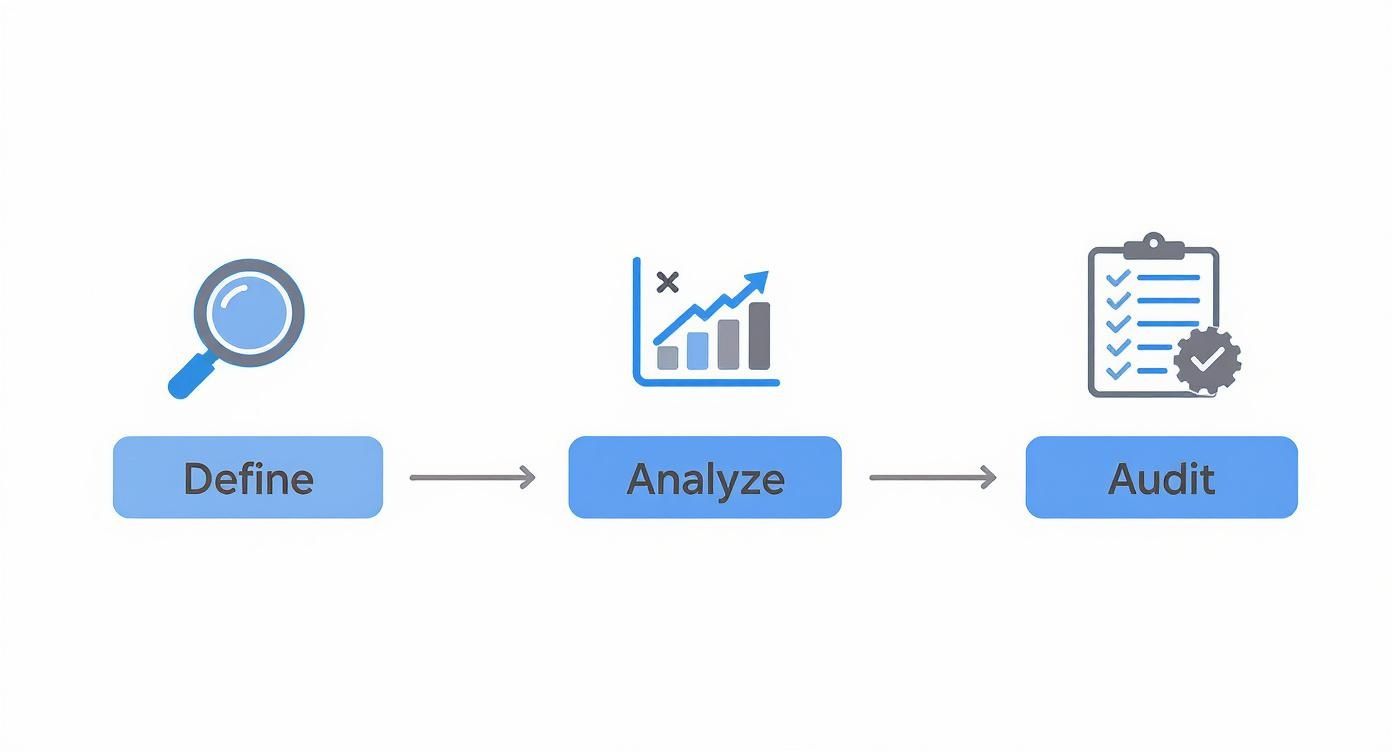
As you can see, a winning strategy always starts with deep definition and analysis, long before you start mapping out new content.
Finally, it’s time to look inward. A content audit helps you take stock of what you've already created. You might be sitting on a goldmine of outdated blog posts, old case studies, or webinar recordings that can be polished up and repurposed. The goal here is to identify what's working, what's not, and where the gaps are.
Go through your existing content and sort it into three simple buckets: Keep, Update, or Delete. An old blog post that still gets decent traffic might just need a data refresh and some new examples. A few thin, low-performing articles could be combined into a powerful, comprehensive pillar page.
This isn’t just busywork; it delivers real results. In Australia, 74% of businesses with a documented content strategy report significantly higher success rates. A methodical approach like this can deliver up to 3.2 times higher ROI compared to just winging it.
Understanding the nuts and bolts of how to develop a comprehensive content marketing strategy is essential before you get tactical. For personalised guidance on locking in this foundation, you can always book a content marketing consultation with our experts to map out your agency's path to success.
Consistent, high-quality content doesn’t just happen. It’s the result of a well-oiled machine. For any busy agency, this production engine is the difference between putting out sporadic content that misses the mark and having a reliable system that consistently brings in high-value clients. It’s how you turn strategic goals into tangible assets.
Building this engine all starts with your core content pillars. These aren't just random topics; they have to be directly tied to what your agency actually sells. If you specialise in SEO for e-commerce, your pillars might be things like "Technical SEO for Shopify," "E-commerce Link Building," and "Conversion Rate Optimisation."
Each pillar then acts as a central hub. Every blog post, case study, or webinar you create should radiate out from one of these hubs. This approach makes sure everything you publish reinforces your expertise exactly where you want to win new business.

With your pillars locked in, you need to map different types of content to the specific stages of a potential client's journey. A prospect who’s only just realising they have a problem needs something completely different from one who’s actively comparing you against two other agencies.
Think of it as a guided conversation. Early on, you’re looking to educate and build awareness. As they get closer to making a decision, your content needs to shift gear to build trust and show clear value.
Here’s a practical way to think about it:
A classic mistake I see agencies make is going all-in on top-of-funnel content while neglecting the crucial middle and bottom stages. A brilliant blog post is great for attracting visitors, but it's a compelling case study that usually convinces a prospect to actually book a call.
Once you have a clear map of what to create, the question is: who creates it? Agencies are always weighing up the pros and cons of keeping production in-house versus outsourcing to freelancers or specialised contractors. There’s no single right answer here—the best model really depends on your agency's size, budget, and internal skills.
| Resourcing Model | Pros | Cons |
|---|---|---|
| In-House Team | Deep brand and client knowledge, faster internal collaboration, builds long-term assets (team expertise). | Higher fixed overheads (salaries, benefits), can be a bottleneck if the team is small, may lack niche expertise. |
| Freelancers | Access to specialised skills (e.g., technical writers, video editors), flexible costs that scale with needs, brings fresh perspectives. | Onboarding can be time-consuming, potential for inconsistent voice or quality, less invested in your agency's big picture. |
Many agencies land on a hybrid model. They use a core in-house team for strategy and project management, then bring in a trusted stable of freelancers for specific creation tasks. This approach gives a nice balance of consistency and flexibility. To really get this system humming, looking into marketing automation for agencies can be a game-changer for managing workflows and nurturing those leads.
It doesn't matter who creates the content if the instructions are rubbish. A detailed brief is the single most important document in the entire production process. A weak brief just leads to endless revisions, missed deadlines, and content that completely misses the strategic goal.
A strong content brief leaves absolutely no room for guesswork. It's the blueprint that ensures the final piece is exactly what you had in mind.
Your briefs should always include these essentials:
This level of detail empowers your creators—whether they're down the hall or across the country—to deliver quality work on the first go, which dramatically speeds up your whole production engine.
Let's be honest. Anyone can churn out content. But creating content that makes a time-poor CMO sit up, take notice, and actually pick up the phone? That's a whole different game.
High-value clients aren't scrolling for generic listicles. They're looking for proof you understand their world—their specific business challenges, their industry, their pressures. They want to see genuine expertise and strategic thinking. Your content needs to deliver that, loud and clear.
This means you need to move beyond just blogging and start creating genuine assets that build trust and stamp your authority all over your niche. These are the kinds of resources that stop a decision-maker mid-scroll and make them think, "Finally. An agency that gets it."
The goal is to provide so much upfront value that getting on a call with you feels like the natural next step, not a cold pitch they have to endure.

While a consistent blog is non-negotiable for SEO and keeping your brand alive, it’s rarely the content that gets the big contracts signed. For agencies, the most powerful content formats are the ones that scream results and strategic depth.
These are the formats that genuinely connect with decision-makers:
These formats work because they don't just tell prospects you're good; they show them. You're giving them a tangible preview of the strategic thinking they’d get by hiring you. This is a vital piece of the puzzle when creating your marketing agency content strategy.
Even the most brilliant content is useless if your ideal clients never find it. That's why SEO can't be an afterthought—it has to be baked into your creative process from the very start. This is how you ensure those powerful, authority-building assets actually rank for the terms that decision-makers are typing into Google.
The digital advertising agency space in Australia is fierce, valued at around AUD 3.7 billion in 2025. With roughly 8,373 agencies competing for attention, standing out in search results isn't just a nice-to-have; it's essential for survival.
This means every single piece of content, from a success story to a research report, must be optimised with clear intent.
So many agencies fall into the trap of creating a brilliant asset and then trying to "sprinkle some SEO on top" at the end. It just doesn't work. Real content SEO begins with keyword research, shapes the content outline, and guides the entire writing and optimisation process.
On-page SEO is all about making it crystal clear to both people and search engines what your content is about. It's the technical foundation that gives your great ideas a fighting chance to be discovered.
Here’s a simple checklist to run through for every asset you publish:
When you combine high-value formats with a disciplined SEO process, your agency's content marketing stops being a cost centre. It transforms into a predictable engine for attracting and closing the clients you actually want.
Look, creating brilliant content is only half the battle. We’ve all been there – pouring hours into a compelling case study or an insightful playbook, only to see it gather dust. In a crowded digital space, even the best content can fall flat without a deliberate plan to get it in front of the right people.
This is where amplification comes in. It’s the engine that turns your content from a simple asset into a powerful client-attraction tool. For agencies, this isn't about just blasting links across social media. It demands a thoughtful, multi-channel strategy that cements your expertise and puts your work in front of key decision-makers.

LinkedIn is the ultimate playground for B2B agencies, but let's be honest, most are using it wrong. Simply posting a link to your latest blog post with a generic caption like "Check out our new article!" just won't cut it anymore.
The real power of LinkedIn lies in using your content to start meaningful conversations and position your agency's leaders as genuine industry authorities. It's about sparking a discussion, not just dropping a link.
Instead of the old "post and pray" method, try this:
This approach transforms your content from a broadcast into a conversation starter. You’re adding value directly within the LinkedIn feed, which is exactly what the platform's algorithm is designed to reward.
Organic reach is great, but paid amplification gives you control and precision. For agencies, this means targeting key decision-makers with surgical accuracy, ensuring your best content lands directly in front of the people who can actually hire you.
While platforms like Facebook have their place, LinkedIn Ads is often the most potent channel for agency client acquisition. The key is to be strategic. The Australian market is competitive, with brands allocating around AUD 4.26 billion to social media advertising in 2024. To make your spend count, you need to get granular.
With LinkedIn Ads, you can target users by their specific job title (like "Chief Marketing Officer"), company size, and industry. This means you can put your latest e-commerce case study directly in front of retail marketing heads. It’s that specific. For more local insights, it's worth checking out the latest social media statistics from Meltwater.
Your best-performing organic content is the perfect candidate for a paid boost. If a post is already getting great engagement, putting even a small budget behind it to reach a hyper-targeted audience can dramatically amplify its impact and generate high-quality leads.
Let’s be real: not everyone who downloads your playbook is ready to sign a contract today. That’s what email marketing is for. It's your tool for nurturing these relationships over time, keeping your agency top-of-mind by consistently delivering value.
Once a prospect is on your list, you can guide them with a curated flow of relevant content. Think about it this way:
This approach builds trust by helping before you sell. It positions you as a generous expert, not just another vendor. To really nail this, have a look at our detailed guide on email marketing for agencies for practical frameworks and templates.
To help you decide where to focus your efforts, here’s a quick comparison of the top channels for agencies.
Choosing the right channels is crucial for getting your content seen by potential clients. This table breaks down the primary options to help you align your distribution with your agency's goals.
| Channel | Primary Use Case | Best For Reaching… | Key Metric |
|---|---|---|---|
| LinkedIn (Organic) | Building thought leadership and starting conversations. | C-suite executives, Marketing Directors, specific industry professionals. | Engagement Rate (comments, shares) |
| LinkedIn Ads | Precise lead generation and driving high-value traffic. | Decision-makers by job title, company size, and industry. | Cost Per Lead (CPL), Conversion Rate |
| Email Marketing | Nurturing leads and building long-term relationships. | Prospects who have already shown interest (e.g., downloaded content). | Click-Through Rate (CTR), Open Rate |
| SEO & Backlinks | Driving long-term organic traffic and building authority. | Prospects actively searching for solutions to their problems. | Organic Traffic, Keyword Rankings, Referring Domains |
| Industry Publications | Gaining third-party validation and reaching new audiences. | Niche audiences and followers of respected industry voices. | Referral Traffic, Brand Mentions |
Ultimately, a blended approach works best. Use organic LinkedIn to test your messaging, then put a paid budget behind what works. Nurture those leads with email, and build your long-term SEO authority in the background.
Finally, a powerful piece of content can become a long-term SEO asset through backlinks. Earning links from respected industry sites not only drives valuable referral traffic but also gives your own website's authority a massive boost.
The trick is to create content that is genuinely link-worthy. Think original research, a comprehensive industry report, or a controversial opinion piece. Something other people will want to reference.
Once you have your "linkable asset," the next step is targeted outreach. Identify non-competing blogs, industry publications, and journalists who cover your niche. Craft a personalised email that explains exactly why your content would be valuable to their audience and suggest where it might fit. It’s a slow burn, for sure, but every high-quality backlink you earn turns your content into a more powerful and enduring engine for your agency's growth.
"If you can't measure it, you can't improve it."
It’s an old saying, but it’s the bedrock of any content program that actually works—especially in an agency. Every dollar has to pull its weight. Proving the return on your content isn't just a nice-to-have for the monthly report; it’s how you show your value, keep clients happy, and make smarter decisions next quarter.
The first step is to stop chasing vanity metrics. Sure, page views and social media likes feel good, but they don’t pay the bills. The real challenge, and where the magic happens, is drawing a straight line from your content efforts to things that really matter, like qualified leads and new client wins.
To show you’re making a real impact, your focus has to shift from the noisy, top-of-funnel metrics to the results that hit the bottom line. You need to build a clear line of sight from a blog post all the way to a signed contract. That means prioritising metrics that tell a story about business growth, not just website traffic.
Instead of getting bogged down in surface-level data, you need to zero in on the performance indicators your clients and bosses actually care about.
Here’s where your attention should be:
Connecting content to revenue isn't just about fancy attribution software. It’s a mindset. It means getting your content and sales teams talking, so you can track how leads interact with your content right through their journey, from the first click to the final proposal.
You don’t need a ridiculously complex or expensive analytics suite to start proving your worth. A simple, hard-hitting performance dashboard can be built with tools you’re probably already using, like Google Analytics 4 (GA4) and your CRM. The goal is to create one source of truth that’s clear, compelling, and easy for anyone to get their head around.
Your dashboard should be set up to give a full-funnel view of how your content is performing.
Top of Funnel (Awareness & Discovery)
Middle of Funnel (Consideration & Engagement)
Bottom of Funnel (Decision & Conversion)
The final piece of the puzzle is turning this data into a story that resonates with your stakeholders, whether that’s your agency’s leadership or your clients. A report packed with jargon and endless charts just creates confusion. Your job is to translate the numbers into a clear story about growth.
When you present your results, always lead with the bottom-line impact. Kick things off with the number of new clients won or the value of the sales pipeline you’ve generated. Then, use the mid- and top-funnel metrics to explain how you got there.
This approach completely reframes the conversation, shifting it from "How many page views did we get?" to "Here’s how our content directly helped the agency grow this quarter."
Running an agency means juggling a lot of moving parts, and figuring out where content marketing fits can bring up some tricky questions. We get it. Here are some of the most common queries we hear, along with some straight-talking answers based on our experience in the trenches.
This is the classic "how long is a piece of string?" question, but it doesn't have to be. We can definitely give you some solid benchmarks to work from. A good rule of thumb is to put aside 5% to 15% of your agency's total revenue for your marketing efforts, and a healthy chunk of that should be earmarked for content.
For a smaller agency that's serious about growth, a monthly budget of around $3,500 to $5,000 is a realistic place to start. That's enough to get some high-quality blog posts out the door each month, create social content to get eyeballs on them, and run a consistent email newsletter. It’s enough to build momentum without breaking the bank.
Once you move into that mid-sized bracket, you'll see agencies investing anywhere from $5,000 to $15,000 a month. With that extra firepower, you can really start to make an impact. This typically allows for:
Let's be upfront: content marketing is a long game, not a quick fix. You might see some encouraging signs early on—a bump in website traffic or more engagement on social media within the first few months—but the real, tangible ROI takes time to materialise.
Don't measure a six-month content strategy with a one-month ruler. Real authority and organic search rankings are built through consistency and quality over time, not overnight wins.
Generally, you should start to see a noticeable impact on your lead generation within 6 to 9 months of consistent, quality work. This is the point where your content often starts ranking for valuable keywords and your ideal clients begin to see you as a genuine authority.
To see the full effect, where content becomes a predictable and primary source of new business? That often takes 12 to 18 months of sticking with the plan.
There’s no one-size-fits-all answer here. The right move really depends on your agency's unique situation.
Bringing someone in-house gives you deep brand knowledge and total alignment, but it also comes with higher fixed costs and can easily become a production bottleneck if you're not careful.
On the other hand, outsourcing to freelancers or a specialised content agency offers incredible flexibility and access to a much wider skill set. It can be more cost-effective, particularly when you need something specialised like a technical whitepaper or professional video production.
Frankly, many agencies find a hybrid model is the sweet spot. They'll have an in-house strategist or marketing manager who steers the ship and manages a team of external creators. This approach gives you the best of both worlds: brand consistency combined with scalable production.
At Virtual Ad Agency, we build and run content strategies that drive real, measurable growth for agencies just like yours. If you’re ready to turn your content from a cost centre into a powerful client acquisition engine, let's have a chat. Find out how we can help your agency grow.

 previous