
When we talk about SEO for law firms, we're talking about the strategic process of getting your firm’s website to the top of search engine results. It's hands-down the most powerful way to attract high-value clients who are actively looking for a lawyer right now. This isn't just about tweaking your website; it's a careful mix of technical improvements, smart local search tactics, and creating content that speaks directly to your ideal client.
In Australia's fiercely competitive legal market, a strong online presence isn’t a nice-to-have anymore—it's absolutely essential. The days of relying solely on referrals and a Yellow Pages ad are long gone. Today, your next big client is almost certainly starting their search on Google.
A well-executed SEO for law firms strategy does more than just boost your rankings. It turns your website from a simple online brochure into a consistent, automated lead-generation machine. It’s about being there the moment a potential client needs you, positioning your firm as the clear, trusted choice. This isn't about chasing quick wins; it's about building a sustainable digital asset that delivers compounding returns over time.
To get this right, you can't just focus on one thing. A winning strategy is built on several key pillars that all work together. If you neglect one, the others will suffer. Think of it as building a house – you need a solid foundation before you can put up the walls and roof.
Here’s a look at the essential components we focus on when building out an SEO campaign for any law firm.
| Pillar | Focus Area | Primary Goal |
|---|---|---|
| Technical Foundation | Website speed, mobile-friendliness, security (HTTPS), and crawlability by search engines. | Create a flawless user experience and ensure Google can easily read and index your site. |
| Local & Practice SEO | Optimising Google Business Profile, targeting location-specific keywords, and building local citations. | Dominate search results for clients in your specific geographic area and for your services. |
| Content & Authority | Creating high-value blog posts, practice area pages, and attorney profiles that establish expertise. | Answer potential client questions, target high-intent keywords, and build trust. |
| Off-Page Signals | Earning high-quality backlinks from reputable sources, managing client reviews, and directory listings. | Build your firm's credibility and authority in the eyes of both users and search engines. |
Each pillar supports the next, creating a comprehensive structure that’s built to last.
This visual shows exactly how these pillars—Foundation, Local SEO, and Authority—build on each other to create a dominant online presence for your firm.
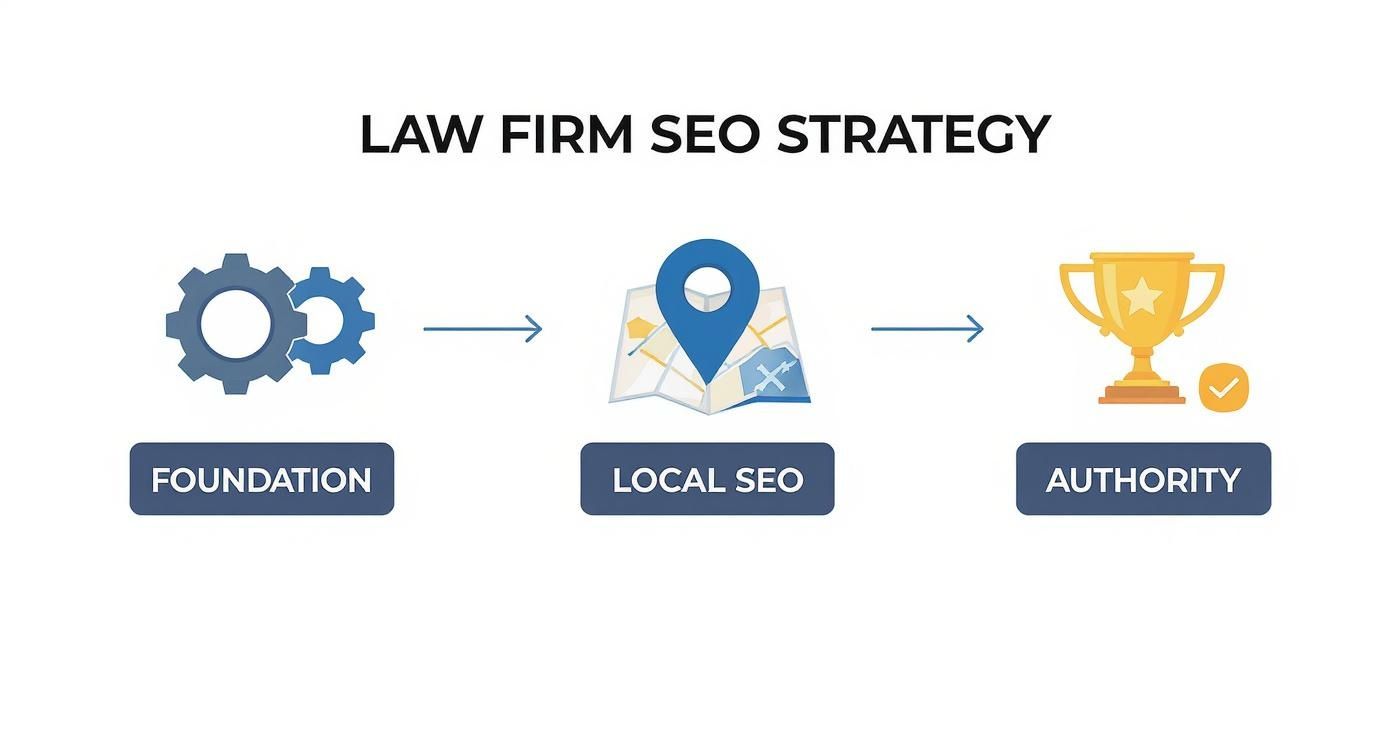
As the diagram shows, a rock-solid technical foundation is always the starting point. From there, you build up your local presence, and finally, you establish your firm as a leading authority in your practice areas. These aren't just legal-specific ideas; the journey of integrating SEO and small business operations nearly always follows this path from foundational work to market leadership. It’s a proven roadmap to outranking your competitors.
Key Takeaway: Effective law firm SEO isn't just one activity; it's a multi-faceted strategy. You need a holistic approach that blends technical excellence, a sharp local focus, and authority-building content to turn online searches into real, paying clients.
Before you even dream of ranking for competitive terms like “personal injury lawyer Sydney,” you have to get your website's technicals sorted. Think of it as the foundation of a building; if it's cracked or unstable, everything you build on top is at risk of collapsing. Technical SEO is all about making sure your site is fast, secure, and dead simple for search engines to understand.
I've seen so many firms get caught up in creating amazing content, completely unaware that their website's technical gremlins are holding them back. A slow-loading page or a confusing site structure can undo all that hard work in an instant. This is the bedrock. Get this right, and everything else you do has a fighting chance.
Let's be real: most of your potential clients will find you on their smartphone while they're on the go. In that context, speed isn’t a nice-to-have; it’s absolutely essential.
A slow website is a conversion killer. Pages that take more than a few seconds to load see a massive drop-off in visitors. This sends a loud and clear signal to Google that your site offers a poor user experience, and your rankings will suffer for it.
The mobile experience is just as critical. Google now overwhelmingly uses the mobile version of a website for indexing and ranking—what's known as mobile-first indexing. If your site is a nightmare to navigate on a phone, you're not just frustrating potential clients; you're actively telling Google you don't deserve to rank. For a solid grasp of this, it's worth Mastering Technical SEO Best Practices for Mobile-First Indexing.
Here’s how you can make an immediate impact:
The way your website is organised has a massive impact on both your visitors and your SEO. A logical site structure makes it incredibly easy for potential clients to find what they need, and it helps search engines understand the hierarchy and importance of your pages.
Put yourself in a client's shoes. They land on your homepage. Can they find your family law services in two clicks or less? Is your phone number impossible to miss? This kind of clarity is what turns visitors into leads.
A well-structured law firm website almost always follows this kind of pattern:
/personal-injury/parramatta/ are absolute gold for local search.Pro Tip: Your URL structure should be a clean reflection of your site's hierarchy. A URL like
yourfirm.com.au/services/family-law/divorce-lawyeris far more effective for both users and search engines than a messy one likeyourfirm.com.au/page-id-123.
Schema markup is a bit of code you add to your website that acts like a translator for search engines. It's like putting labels on your content, explicitly telling Google things like, "This is our firm's official name," "This is our address and phone number," or "This is an attorney's bar admission number."
For a law firm, this is an incredibly powerful tool. It's what helps your search results stand out with "rich snippets," like star ratings from client reviews or a list of your practice areas appearing directly under your name in the search results.
The key types of schema for any law firm are:
Getting these technical fundamentals right is non-negotiable. It ensures all your other content and local SEO efforts are built on solid ground. For a closer look at the on-page elements that build on this foundation, check out our guide to SEO optimisation best practices, which covers how to nail your titles, meta descriptions, and header tags.

This image nails it. The core of a locally-focused law firm website comes down to these key pages: practice areas, attorney bios, and your location. Get these right, and you're well on your way to owning the search results in your backyard.
For most Aussie law firms, the best clients aren't scattered across the country; they're right around the corner. That's why winning at SEO often means dominating your local area, making sure you’re the first name someone sees when they need legal help in their suburb.
This is where your strategy needs to get hyper-focused. Sure, national rankings are great for the ego, but it's the local rankings that pay the bills. The entire game is about showing up in that coveted "map pack" at the top of Google when someone searches for "family lawyer in Parramatta" or "conveyancer near me."
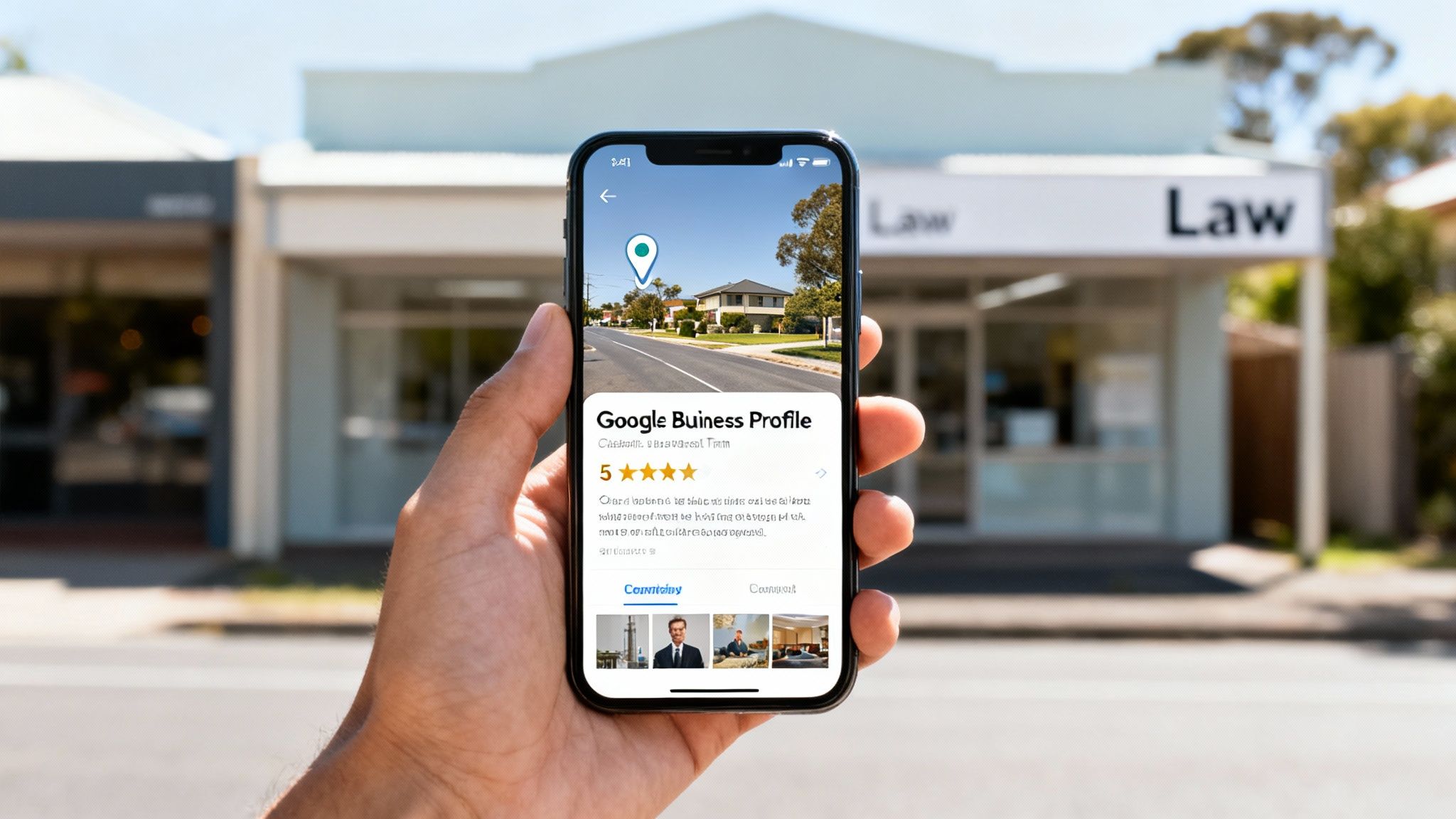
Think of your Google Business Profile (GBP) as your digital front door. It’s often the first interaction a potential client has with your firm online, and it's arguably the single most critical factor for local search rankings. An incomplete or neglected profile isn't just a missed opportunity; it's a gift to your competitors.
To turn your GBP into a client-generating machine, you have to treat it like a mini-website. That means optimising every single section you can get your hands on.
A basic profile is just the start. To truly get ahead, a comprehensive Google My Business optimization guide can walk you through the finer points of turning your listing into a local powerhouse.
In local SEO, consistency is everything. Your firm’s Name, Address, and Phone Number (NAP) must be absolutely identical across every single online platform where it appears. We're talking about your website, GBP, social media profiles, and every online directory.
Even a tiny variation—like using "St" on one site and "Street" on another—can create confusion for search engines and water down your local authority. It’s a small detail with a massive impact on how much Google trusts your location information.
A citation is simply any online mention of your firm’s NAP. The more high-quality, relevant citations you have, the more confident Google becomes that your business is legitimate and located exactly where you say it is.
For Australian law firms, you'll want to focus on getting listed in reputable directories:
Even if you only have one physical office, you can still pull in clients from surrounding suburbs. The trick is to create dedicated "location pages" on your website. For example, if your office is in Adelaide, you could create specific pages targeting clients in Glenelg, Norwood, and Prospect.
But here’s the key: each page needs to be unique and genuinely useful. Don't just find and replace the suburb name. Talk about local landmarks, mention your experience with cases in that specific area, and embed a map of the suburb. This shows both potential clients and search engines that you have a real connection to that community. The strategy behind building effective location pages is a core part of a broader approach, much like the tactics used in our guide on small business SEO, where local relevance is king.
A steady stream of positive client reviews is absolutely essential. Reviews are a major ranking factor for the local map pack and act as powerful social proof for potential clients who are on the fence.
Think about it: 81% of Australians search online for local services every week. This is a massive pool of potential clients, but they rarely look beyond the first few results. They trust the top three law firms that appear in the Google Map Pack for their suburb. Showing up there is make-or-break.
You need to develop a simple, repeatable process for asking satisfied clients for a review right after their matter is concluded. The more positive, recent reviews you have, the more you’ll stand out and build the trust needed to win that click.
If your technical and local SEO are the foundations of your digital presence, then content is the engine that actually drives it forward. You can have the slickest, fastest-loading website in the world, but without compelling content, it’s just an empty shell. The real goal isn't just to churn out articles; it's to create strategic assets that pull in the right kind of searcher and convince them your firm is the only choice to solve their problem.
This all starts with understanding that different pages on your site have different jobs. Your homepage is the handshake, but your practice area pages are where you close the deal with serious prospects. These pages are much more than a place to stuff keywords—they’re your digital sales pitch, showing you have the expertise and empathy to handle a client's situation.
Make no mistake: your practice area pages are the most valuable commercial real estate on your entire website. When a potential client searches for something like "criminal defence lawyer Melbourne," they have an urgent, specific need. They expect to land on a page that speaks directly to that need. A generic page just won’t get the job done.
A truly effective practice area page has to be a complete resource. It needs to anticipate and answer every single question a potential client might have, positioning your firm as the undeniable expert in that field.
Think about weaving these essential elements into your core practice area pages:
Most law firms treat their attorney bio pages like a dusty digital resume, listing qualifications and bar admissions. This is a massive missed opportunity. Your attorney bios are powerful tools for building trust and forging a personal connection before a client even picks up the phone.
Instead of a dry C.V., think of each bio as a storyteller. It's your chance to humanise your lawyers and showcase their unique passion and expertise. A great bio page should always include:
Key Insight: A potential client isn't just hiring a faceless law firm; they're hiring a specific person to guide them through a difficult time. A bio page that builds that human connection can be the single deciding factor that turns a website visitor into a paying client.
A blog is a fantastic tool for attracting people in the early research phase, but a truly effective content strategy for a law firm goes much deeper. Your content needs to serve every stage of the client's journey, from their first panicked Google search to the moment they decide to hire you.
This means creating a diverse range of content that establishes your authority and addresses very specific client pain points. For example, a detailed guide on "The Property Settlement Process in WA" is infinitely more valuable than another generic blog post about divorce.
To really get a competitive edge, think about developing these types of content:
The data from the Australian market is crystal clear on this. For law firms, online visibility is directly tied to lead generation. Firms on the first page of Google attribute around 60% of their new leads directly to their online presence.
Consider a high-value term like 'personal injury lawyer Sydney', which gets over 3,600 searches every month. Being visible for that term isn’t just a nice-to-have—it’s a financial necessity. You can discover more insights about the competitive Australian legal search market and see how these numbers break down further.

While the content on your website establishes your expertise, Google also hunts for external signals to really validate your firm's authority. This is where off-page SEO comes into play—it's all about building a portfolio of high-quality backlinks and a stellar online reputation.
Think of these elements as votes of confidence from across the web. A backlink from a reputable legal directory is like a referral from a respected colleague. A string of five-star reviews is like powerful word-of-mouth marketing, but at scale. Together, they create a compelling case for why Google should rank your firm at the top. This combination is a true cornerstone of any successful SEO for law firm strategy.
In the legal world, not all backlinks are created equal. You have to be discerning. A single link from the Law Society of NSW is worth infinitely more than a hundred from irrelevant, spammy blogs. Your focus has to be on quality and relevance, not just chasing numbers. The real goal is to build a natural link profile that reflects genuine authority, not one that’s just trying to game the system.
Here are some sustainable, high-impact strategies we see working for law firms in Australia right now:
A strong backlink portfolio is built, not bought. It's the result of genuine relationship-building, community engagement, and a commitment to sharing your firm's expertise beyond the confines of your own website.
Your firm’s online reputation is completely intertwined with its SEO performance. A consistent stream of positive client reviews on platforms like Google, LawConnect, and other legal directories is one of the most powerful ranking signals for local search, period.
Reviews build immense social proof, helping you stand out in a crowded market and directly influencing a potential client's decision to pick up the phone. But just hoping for good reviews isn’t a strategy. You need a proactive, systematic approach to reputation management.
When's the best time to ask for a review? Right at the successful conclusion of a matter, when the client's positive feelings are at their absolute peak. It’s crucial to make the process as easy and frictionless as possible for them.
Consider implementing a simple, automated system:
This approach not only boosts your review count but also helps you gather valuable feedback to improve your services. With 46% of all Google searches in Australia having local intent, dominating the map pack with a high star rating is critical. Being top-ranked can capture a huge portion of all clicks for local business searches, which just goes to show the immense value of a strong review profile. You can discover more insights about Australian local search effectiveness to see just how much these numbers impact client acquisition.
Navigating the world of SEO can bring up plenty of questions for managing partners and legal marketers. I get it. Below, I’ll tackle some of the most common queries with direct, actionable answers drawn from years of experience helping firms just like yours.
This is the big one, and the honest answer is that SEO is a long-term investment, not a quick fix.
While you might see minor improvements in the first few months, meaningful results from law firm SEO typically take 6 to 12 months to really materialise. The legal niche is one of the most competitive online spaces there is.
The initial months are all about laying the groundwork. This involves crucial tasks like:
You should expect to see noticeable increases in rankings and organic traffic around the 4 to 7-month mark, particularly for local keywords. More competitive, broader practice area terms will naturally take longer. The key is consistency; the effort you put in today builds compounding returns for years to come.
The most powerful strategy isn't choosing one over the other; it's using them together. SEO and Pay-Per-Click (PPC) advertising, like Google Ads, are two sides of the same coin and work best in tandem.
Think of it this way:
A smart approach is to use PPC data to fuel your SEO. The keyword data from your Google Ads campaigns can reveal which phrases convert into actual clients. You can then prioritise targeting those proven, high-intent keywords in your SEO content strategy, giving you a massive head start. In short, think of PPC as renting visibility and SEO as owning it.
Chasing rankings for vanity keywords is a common mistake. While seeing your firm at number one for a broad term feels good, it doesn't necessarily translate into new business. Instead, you need to focus on metrics that directly impact your firm's bottom line.
Here are the Key Performance Indicators (KPIs) that truly matter for any law firm:
At Virtual Ad Agency, we specialise in creating data-driven SEO strategies that focus on the metrics that matter most—generating qualified leads and growing your practice. We build comprehensive digital marketing plans that turn your online presence into your most valuable asset.
Discover how our tailored SEO services can deliver measurable results for your firm.

 previous