
When you hear the term search engine marketing agency, what comes to mind? Essentially, they’re specialists who help businesses get found on search engines like Google. They use a mix of paid ads and long-term organic strategies to put your brand right in front of people actively looking for what you sell.
Think of them as your expert guide to the digital marketplace.

Right now, your ideal customer is probably searching online. An SEM agency’s entire reason for being is to make sure that customer finds you, not your competition. This goes way beyond just running a few ads; it's about building a complete strategy to capture high-intent customers the moment they’re ready to buy.
This isn’t a one-trick pony. A solid SEM strategy relies on two powerful approaches working in sync:
A good agency knows these aren't separate channels. They’re two sides of the same coin. PPC can give you quick data on what keywords and messages work, which you can then feed into your SEO strategy. At the same time, strong organic rankings can actually help make your paid ads more effective and cheaper.
So, why go with a specialist? A dedicated search engine marketing agency brings a depth of knowledge that a generalist "do-it-all" firm just can't match. They live and breathe search engine algorithms, constantly tweaking and refining their methods to stay ahead of the curve.
This focused expertise is absolutely critical. The digital advertising agency industry in Australia has ballooned to a market size of $3.7 billion, growing at an average of 7.4% each year for the last five years. Within that, search engine marketing is the single biggest revenue driver, which shows just how vital it is for businesses. You can dig into more data on the digital advertising market in Australia to see the full picture.
A true SEM partner does more than just manage your ad spend. They translate your business goals into real, measurable digital outcomes. Their job is to make sure every dollar you invest in search contributes directly to your bottom line, turning clicks into customers.
The real magic happens when paid and organic search are woven together seamlessly. A smart agency creates a feedback loop where one strengthens the other. For example, by testing different headlines in a PPC campaign, you can quickly find out what messaging resonates most with your audience. You can then use that winning message in your website's SEO titles and descriptions to improve organic click-through rates.
This integrated approach helps you dominate the search results page. Imagine securing multiple spots—one in the paid ads section and another in the organic listings. This kind of visibility doesn't just drive more traffic; it hammers home your brand's credibility and authority, making potential customers much more likely to choose you. This synergy is what separates a basic ad campaign from a sophisticated, results-driven search marketing strategy.
Think of a search engine marketing agency as the architect and general contractor for your online storefront. They don't just put up a few ads and hope for the best; they build a complete system designed to attract the right people, pull them in, and turn them into customers. It’s a calculated process that blends data science with creative copywriting and technical skill. The whole point is to make sure every dollar you spend on search, from that first click to the final sale, is working as hard as it possibly can.
Let's break down the core services you should expect from any proficient SEM agency.
Paid search, or pay-per-click (PPC), is the fastest way to get your business in front of people who are actively looking for what you offer. It’s like renting the best billboard on the busiest highway in town—right at the top of Google's search results. An agency's job here is far more involved than just switching on a campaign. It's a constant cycle of testing, learning, and refining to squeeze every last drop of value out of your ad budget.
A huge part of this process involves looking over the fence at what your competitors are doing. Good agencies use sophisticated AI competitor analysis tools to spot gaps in the market and figure out where the opportunities lie. This intel feeds directly into every decision, from the keywords they target to the ad copy they write, giving you an edge. Our whole approach to building winning campaigns is detailed in our Google Ads management services.
The day-to-day work includes:
If you sell products online, Google Shopping is an absolute non-negotiable. Those slick, image-based ads you see at the top of the search results are a goldmine for e-commerce stores. An SEM agency takes control of these campaigns by meticulously optimising your product feed—the master spreadsheet that tells Google everything about what you sell.
This isn't a "set and forget" task. The agency will constantly tweak product titles, rewrite descriptions, and test different images to make your listings pop. They'll also structure your campaigns to push high-margin products or seasonal best-sellers, making sure your ad spend is laser-focused on what actually makes you money.
Ever browsed for a pair of shoes online, only to see ads for those exact shoes following you around the internet for the next week? That’s remarketing. It’s built on one simple, powerful truth: most people don't buy on their first visit.
A staggering 97% of first-time visitors will leave your website without making a purchase. Remarketing gives you a second, third, and fourth chance to connect with this huge audience, bringing them back when they're finally ready to pull the trigger.
An agency doesn’t just show the same ad to everyone. They build smart audience lists to deliver hyper-relevant messages. For instance, someone who abandoned a full shopping cart might see an ad offering a small discount, while a person who just browsed a product category might get shown your best-sellers from that range. It’s a subtle but incredibly effective way to stay top-of-mind.
Getting someone to click your ad is only half the battle. If they land on a page that’s slow, confusing, or untrustworthy, that click—and your money—is completely wasted. This is where Landing Page and Conversion Rate Optimisation (CRO) comes into play. It’s the art and science of fine-tuning your website to convince more visitors to take action, whether that’s buying a product or filling out a contact form.
A great SEM agency’s work doesn’t stop at Google Ads. They dig into your website analytics, run A/B tests on headlines and calls-to-action, and analyse heatmaps to see where users are getting stuck. This holistic view is critical because even tiny improvements in your conversion rate can lead to massive gains in revenue, all without spending a single extra dollar on advertising. This is more important than ever, with Australian businesses pouring a record $1.5 billion into their online presence, marking a 12% increase year-over-year as they wake up to the power of a fully optimised digital strategy.
Kicking off a search engine marketing campaign without the right metrics is like trying to navigate a ship in a storm without a compass. You’ll see plenty of action—waves of data, gusts of impressions—but you’ll have zero idea if you’re actually heading towards your destination. A sharp SEM agency knows how to cut through all that noise, focusing only on the Key Performance Indicators (KPIs) that signal real business impact.
It’s far too easy to get distracted by flashy numbers like impressions (how many times your ad was shown) or even total clicks. While they have their place, they don't tell you the whole story. An ad that a million people see is completely useless if none of them are your ideal customer, or if they click and then immediately leave.
Real success isn’t just about being seen; it’s about driving profitable action.
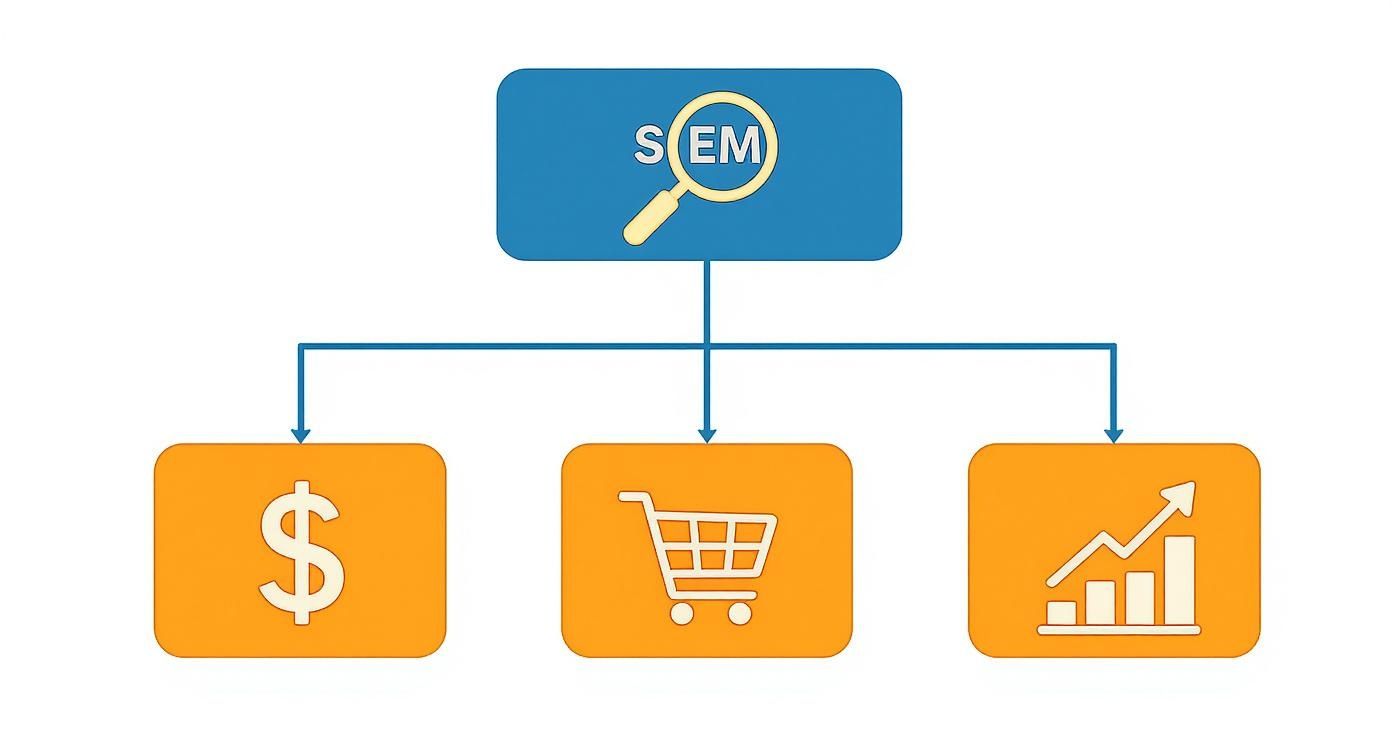
As you can see, every element works together in a bigger strategy. The goal is simple: turn search engine visibility into real financial returns and business growth.
To really get a feel for how your campaigns are performing, an agency will start with the foundational metrics before quickly shifting focus to the ones that reflect efficiency and, most importantly, profitability. This layered analysis is crucial for optimising every single step of the customer journey.
Let’s be clear: not all data is created equal. A good agency lives and breathes the numbers that truly matter. Here’s a rundown of the key metrics they’ll be watching like a hawk.
This table breaks down the essential KPIs. We’ll look at what each one measures and, more critically, why it’s a non-negotiable part of figuring out if your campaigns are actually working.
| Metric (KPI) | What It Measures | Why It's Important |
|---|---|---|
| Click-Through Rate (CTR) | The percentage of people who click your ad after seeing it. | A high CTR tells you the ad is hitting the mark—the message and targeting are resonating with your audience and compelling them to learn more. |
| Cost Per Click (CPC) | The exact price you pay every time someone clicks on your ad. | This is all about budget efficiency. The goal is to drive the CPC down while keeping lead quality high, making every dollar you spend work harder. |
| Conversion Rate | The percentage of clicks that lead to a desired action (e.g., a sale, a sign-up). | This is where the magic happens. A strong conversion rate means your landing page and offer are perfectly aligned with what the user wants. |
| Cost Per Acquisition (CPA) | The total cost to acquire a single new customer or lead. | This is a core business metric. Driving this number down means your customer acquisition is becoming more efficient and easier to scale. |
| Return On Ad Spend (ROAS) | The total revenue generated for every dollar you spend on advertising. | The ultimate bottom-line metric. It directly answers the question: "Is our advertising spend making us money?" A positive ROAS is the goal. |
These metrics provide the feedback loop needed to refine and improve your strategy over time, ensuring your investment is always directed towards what gets results.
For a deeper dive into how these and other metrics fit into the bigger picture, check out our detailed guide on the most important digital marketing performance metrics.
While KPIs like CTR and CPC are vital for day-to-day campaign management, the C-suite usually only cares about two numbers that hit the bottom line. These are the final word on whether your investment is truly paying off.
A great SEM agency knows their job isn’t just to manage clicks—it’s to generate a profitable return. They measure their own success by your business growth, tying every decision back to the financial health of your company.
The two top-tier KPIs that matter most are:
Ultimately, you should judge your partnership with an SEM agency on its ability to deliver a strong, predictable ROAS. By zeroing in on these business-centric KPIs, they go beyond simply managing ads and become a genuine growth partner, turning data into tangible, profitable results for your business.
One of the first questions on every business owner’s mind is, "So, what's this actually going to cost me?" It's a fair question, but there's no single price tag for partnering with a search engine marketing agency. The way you pay can take a few different shapes, and figuring out which one fits your business is crucial.
Think of it like this: you wouldn't use the same car for a quick trip to the shops as you would for a long-haul road trip. In the same way, there isn't a one-size-fits-all pricing plan for SEM. Agencies usually have a few core models, each with its own pros and cons, designed for different business goals and campaign sizes.
Let's pull back the curtain on the money side of things and break down the three most common pricing models you'll come across.
This is probably the most traditional model in the playbook, especially for campaigns with some serious budget behind them. The agency's management fee is simply a percentage of what you spend on ads each month. For instance, an agency might charge 15% of a $20,000 monthly ad spend, which puts their fee at $3,000.
This is a favourite for a reason. With a flat monthly retainer, you pay a fixed, predictable fee every single month, no matter how much you spend on ads. This fee covers the agency's brainpower, time, and all the services laid out in your agreement, like managing campaigns, building reports, and holding strategy sessions.
This model gives you total clarity over your budget. You know exactly what your management costs are, which makes financial planning a whole lot easier. It also ensures the agency is focused on getting you results efficiently, not just on spending more of your money. For a deeper dive into how management fees slot into the bigger picture, our guide on how much advertising on Google costs is a great read.
A flat retainer model shifts the focus from "How much can we spend?" to "How can we get the absolute best results from the current budget?" This alignment of goals is critical for building a long-term, trust-based relationship with your SEM agency.
If you're all about the bottom line, this model will catch your eye. Here, the agency's fee is tied directly to hitting specific, pre-agreed targets. You're not paying for time or ad spend; you're paying for real, tangible outcomes.
Common performance metrics include:
This model forces the agency to have skin in the game and holds them accountable for delivering genuine business value. The catch? It requires rock-solid tracking, crystal-clear attribution, and a firm agreement on what a "qualified" lead or sale actually is, making it the most complex model to set up correctly.
Picking a search engine marketing agency is a big deal. You’re not just handing off a task; you’re choosing a partner to help steer your business’s growth. The right agency works like an extension of your own team, one that's genuinely invested in seeing you win. But with so many agencies out there, how do you see past a slick sales pitch and find a partner who can actually deliver?
It’s all about a structured approach. You need to focus on tangible proof of their expertise, not just promises. This means digging into their track record, really understanding how they work, and making sure their style gels with yours. Don't rush this decision – it's a critical investment in your future.
Any agency can talk a good game. A top-tier partner, however, will have a clear and verifiable history of success. Your first job is to sift through this history and separate the real contenders from the pretenders. Vague assurances just don't cut it; you need to see hard evidence that they know their stuff and can do the same for you.
Start by asking for detailed case studies. I don't mean glossy, one-page summaries, either. You want in-depth stories that lay out:
Beyond case studies, check for official industry certifications. A Google Premier Partner badge, for instance, isn't just a shiny logo. It signifies that the agency is in the top 3% of partners in their country, meeting tough requirements for performance, ad spend, and certified staff. It's a powerful, third-party stamp of approval on their skills.
A partnership without clear communication is doomed from the start. Pay close attention to how the agency interacts with you from the very first conversation. Are they open and honest about their methods? Do they take the time to explain complex concepts in plain English, or do they hide behind a wall of technical jargon?
A great agency relationship is built on trust, and trust is impossible without transparency. You should never feel like you're in the dark about how your money is being spent or what results are being generated. Your agency should be an open book.
Before you sign on the dotted line, get crystal clear on expectations for communication and reporting. Some key questions to ask are:
Their answers will tell you a lot about their client service philosophy. A confident, organised agency will have solid, structured processes for all of this.
Finally, you need to be sure the agency is a good strategic and cultural fit for your business. A one-size-fits-all approach to SEM rarely gets the job done. A skilled search engine marketing agency will show genuine curiosity about your business, your industry, and your specific challenges. They should be asking you smart questions about your target audience, profit margins, and long-term goals.
Industry experience is a massive plus. An agency that has already worked in your market will get up to speed much faster and sidestep common pitfalls. If you’re really focused on paid search, this buyer's guide for finding the best Google Ads agency has some great insights to help you make an informed choice.
Ultimately, the goal is to find a partner who not only has the technical chops but also feels like a natural extension of your own team—someone who is as passionate about growing your business as you are.

Theory and metrics are all well and good, but the real test for any SEM agency is whether they can deliver tangible, bottom-line results. It’s one thing to talk about ROAS and CPA; it’s another thing entirely to see how a smart strategy can completely change a business's fortunes. The most compelling proof always comes from real-world stories of growth.
These stories go beyond numbers on a spreadsheet. They show the journey from a specific business challenge to a measurable, profitable outcome, giving you the social proof needed to feel confident in what expert SEM management can achieve.
Let's look at a couple of examples of how a strategic partnership can translate into genuine success.
Imagine a local plumbing company. They're highly skilled, but they’re struggling to stand out in a seriously crowded market. The phone isn’t ringing, and they’re constantly losing high-value emergency jobs to bigger competitors who own the top of Google’s search results. Their challenge was simple: they needed more qualified leads, and they needed them fast.
A targeted, local SEM strategy was the answer. The approach honed in on a few key areas:
The results were immediate and powerful. Within the first quarter, the company saw a 73% increase in qualified phone leads and a 45% reduction in their Cost Per Lead. This flood of new work meant they could hire two new plumbers just to keep up with demand. They went from being invisible to being a top local choice.
The right SEM strategy doesn't just find customers; it finds the right customers at the right time. For local service businesses, this precision is the difference between just surviving and genuinely thriving.
Now, let's picture an e-commerce brand selling boutique pet supplies. They had fantastic products but were being completely drowned out by massive online retailers. Their advertising efforts felt like shouting into the void, with a low Return On Ad Spend (ROAS) that made scaling feel like an impossible dream.
The challenge was clear: boost online sales, but do it profitably. A multi-layered approach was put in place, combining Google Shopping with intelligent remarketing to squeeze maximum value from every dollar of ad spend.
The strategy involved:
Within six months, the brand achieved a record-breaking 8:1 ROAS. This means for every $1 they spent on ads, they generated $8 in revenue. This profitable growth gave them the capital to expand their product range and cement their position as a key player in their niche.
Taking the leap and partnering with a search engine marketing agency is a big decision. It’s totally normal to have a few last-minute questions before you commit. To help you get all the clarity you need, we've pulled together some straight answers to the questions we hear most often from business owners.
Think of this as the final piece of the puzzle, designed to make sure you feel 100% confident about how an SEM partnership really works.
This is the big one, and the answer really comes in two parts. The beauty of SEM is that its Pay-Per-Click (PPC) side can start bringing in traffic and leads almost instantly. Seriously, once a campaign is live, you could see new visitors hitting your site within the first week.
But there’s another side to the coin: Search Engine Optimisation (SEO). SEO is a long game. It’s about building a rock-solid foundation for organic growth, and that takes time. You’re often looking at several months before you see significant, lasting movement in the rankings. A good agency masters both, using PPC for those quick wins while patiently building up your SEO for sustainable, long-term success.
Technically, yes, you can. But it’s rarely the most effective way to spend your time or money. A professional SEM agency brings a whole arsenal to the table: specialised knowledge, expensive industry tools, and years of hands-on experience. They live and breathe the tiny details of bidding strategies, algorithm updates, and conversion rate optimisation—things that are incredibly difficult for a non-specialist to get right.
Bringing an agency on board isn't just about saving yourself a headache. It's about tapping into deep expertise to get a much, much better return on your investment than you could likely get on your own. The cost of hiring a pro often pays for itself many times over through smarter campaigns and less wasted ad spend.
There's no one-size-fits-all price tag here. The cost really depends on how competitive your industry is, the size of your business, and what you’re trying to achieve. Generally, your total investment is split into two key areas:
Any decent agency will sit down with you to figure out a budget that actually makes sense for your goals and is geared towards delivering a positive return.
Ready to see how a dedicated SEM strategy can drive real growth for your business? The expert team at Virtual Ad Agency is here to build a customised plan that delivers results you can measure. Contact us today for a free consultation.

 previous