
Imagine your ideal customer is right now, phone in hand, searching for exactly what you offer. Will they find you? Or will your biggest competitor get the sale? This is where good SEO comes in. It’s the strategy that makes sure your business shows up, turning those online searches into real-world customers.

Think of the internet as a massive, sprawling city, and Google as its main map and directory. Without SEO, your business is like a shop tucked away in a quiet back alley with no sign. People actively looking for what you sell might never find you. Search Engine Optimisation (SEO) is all about putting up bright, clear signposts that guide potential customers right to your digital front door.
It's about tweaking your website to make it more attractive to search engines like Google, so they’re more likely to show your business to people searching for your kind of products or services. Unlike paid ads, which evaporate the moment you stop paying, SEO builds real, long-term value. It’s an investment in your digital property that keeps paying dividends over time.
One of the best things about a solid SEO strategy is its ability to level the playing field. A small local bakery with brilliant SEO can absolutely outrank a national chain in local search results. Google’s main goal is to give its users the most relevant, helpful answer to their question, not just show them the biggest company.
This gives small businesses a genuine fighting chance to compete for visibility based on quality and relevance. By focusing on specific local and niche keywords, you can pull in highly qualified leads who are pretty much ready to buy.
For savvy businesses, investing in SEO is fast becoming a standard operational cost. By 2025, it's expected that Australian small businesses will be investing around $1,350 per month in SEO. This isn't surprising when you see the clear link between online visibility and foot traffic, especially when a massive 46% of all Google searches have local intent.
Better yet, a whopping 78% of local searches on a mobile phone lead to a store visit within 24 hours.
SEO isn’t just about being found; it’s about being chosen. It builds trust and credibility. When your business consistently appears near the top of search results, it creates a perception of authority and reliability in the minds of your potential customers.
To really get the most out of SEO, it's a good idea to first get a clear handle on what search engine optimization is. This foundation helps you see how all the different pieces fit together to achieve one primary goal: driving sustainable growth for your business.
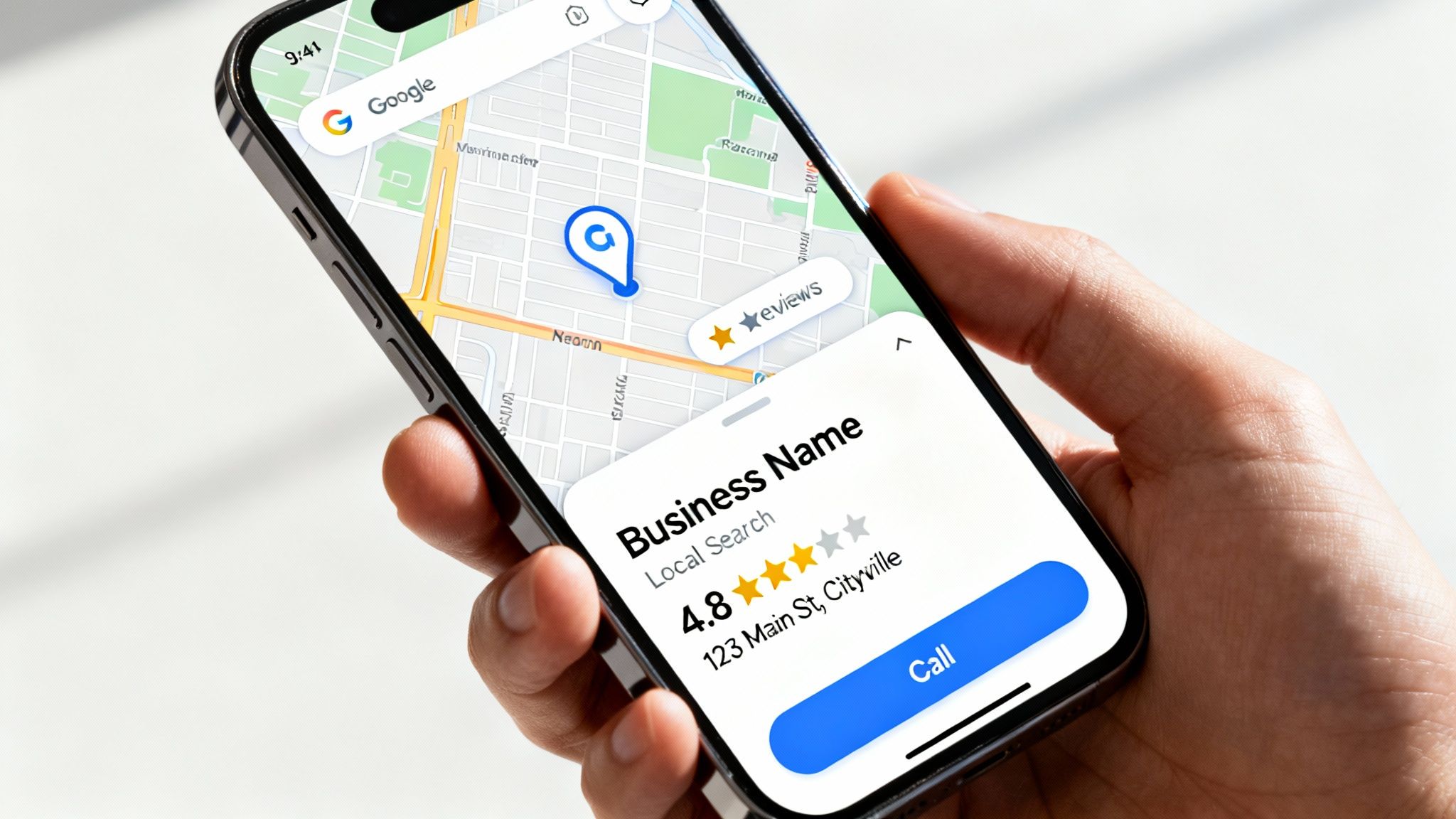
For any business with a physical shopfront or a specific service area, your most important customers are the ones right outside your door. While general SEO casts a wide net across the internet, local SEO is like putting up a giant, flashing neon sign in your suburb—one that’s only visible to people nearby who are actively searching for what you do.
Think of it this way: when someone searches for "cafe near me" or "plumber in Richmond," Google's first priority is to show them the best, most relevant local options. Mastering local SEO is how you convince Google that your business is that option. For driving foot traffic and local leads, it’s arguably the most powerful form of SEO for a small business.
The absolute cornerstone of this whole strategy is your Google Business Profile (GBP). This isn't just another online listing; it’s your digital storefront on Google Search and Google Maps.
Your Google Business Profile is a free tool that lets you manage how your business shows up. A neglected profile is a huge missed opportunity, but a fully fleshed-out one can quickly become your best lead-generation tool.
To make it really work for you, you need to get these areas right:
A well-maintained profile sends strong trust signals to both Google and your potential customers, making them much more likely to choose you over a competitor with a sparse or outdated listing.
Imagine giving a friend directions to a party but sending them three different addresses. They’d get confused, frustrated, and probably just give up. The exact same thing happens when search engines find conflicting information about your business online. This is where NAP consistency becomes absolutely vital.
NAP stands for Name, Address, and Phone number. These core details must be identical everywhere your business is mentioned online, from your own website to online directories like Yelp, TrueLocal, or other industry-specific sites. Even a tiny variation like "St." versus "Street" can create confusion for search engines.
Inconsistencies erode Google's confidence in your business data. The more consistent your NAP is across the web, the more Google trusts that you are a legitimate, established local entity. This trust directly boosts your local rankings.
This whole network of online mentions is known as your local citations. Performing a quick audit of your business listings every few months is a simple but incredibly effective local SEO task.
To help you get started, here's a quick checklist of the most impactful tasks to tackle first.
This table breaks down the most critical tasks that will give you the biggest bang for your buck right away.
| Priority Task | Why It Matters | Quick Win Action |
|---|---|---|
| Optimise Google Business Profile | It's your digital storefront. A complete profile is the #1 local ranking factor. | Fill out every single section. Add 10+ high-quality photos this week. |
| Ensure NAP Consistency | Inconsistent details confuse Google and erode trust, hurting your rankings. | Google your business name. Find 5 online directories and correct any inconsistencies. |
| Generate Customer Reviews | Reviews build social proof and are a massive signal of trust for Google and users. | Send a follow-up email to your last 3 happy customers asking for a review. |
| Target Local Keywords | This connects you directly with customers searching for services in your specific area. | Create a dedicated page on your website for your main service in your primary suburb (e.g., "Plumbing Services Richmond"). |
Focusing on these core areas will build a strong foundation for your local search presence.
To attract customers in your specific area, you have to speak their language. This means targeting city-specific or suburb-specific keywords. Instead of a broad term like "custom cakes," a far more effective keyword would be something like "custom birthday cakes Adelaide." If you’re a business that travels to customers, create individual pages on your website for each major suburb you serve.
This strategy can have a massive impact. For instance, a detailed Australian study found that businesses targeting multiple geographic locations drive an average of 557% more organic traffic than those focused on just one. It’s a clear demonstration of how expanding your digital footprint across different suburbs can seriously increase your visibility.
Finally, you need to actively encourage your happy customers to leave reviews. Positive reviews are one of the most powerful local ranking factors. They provide the social proof that builds immense trust with new customers. Just as importantly, make sure you respond to every single review—good or bad—to show you’re engaged and value what your customers have to say.
For businesses struggling to get traction in a competitive area, a professional SEO consultant in Adelaide can help devise a targeted strategy to build local authority and climb those local rankings.
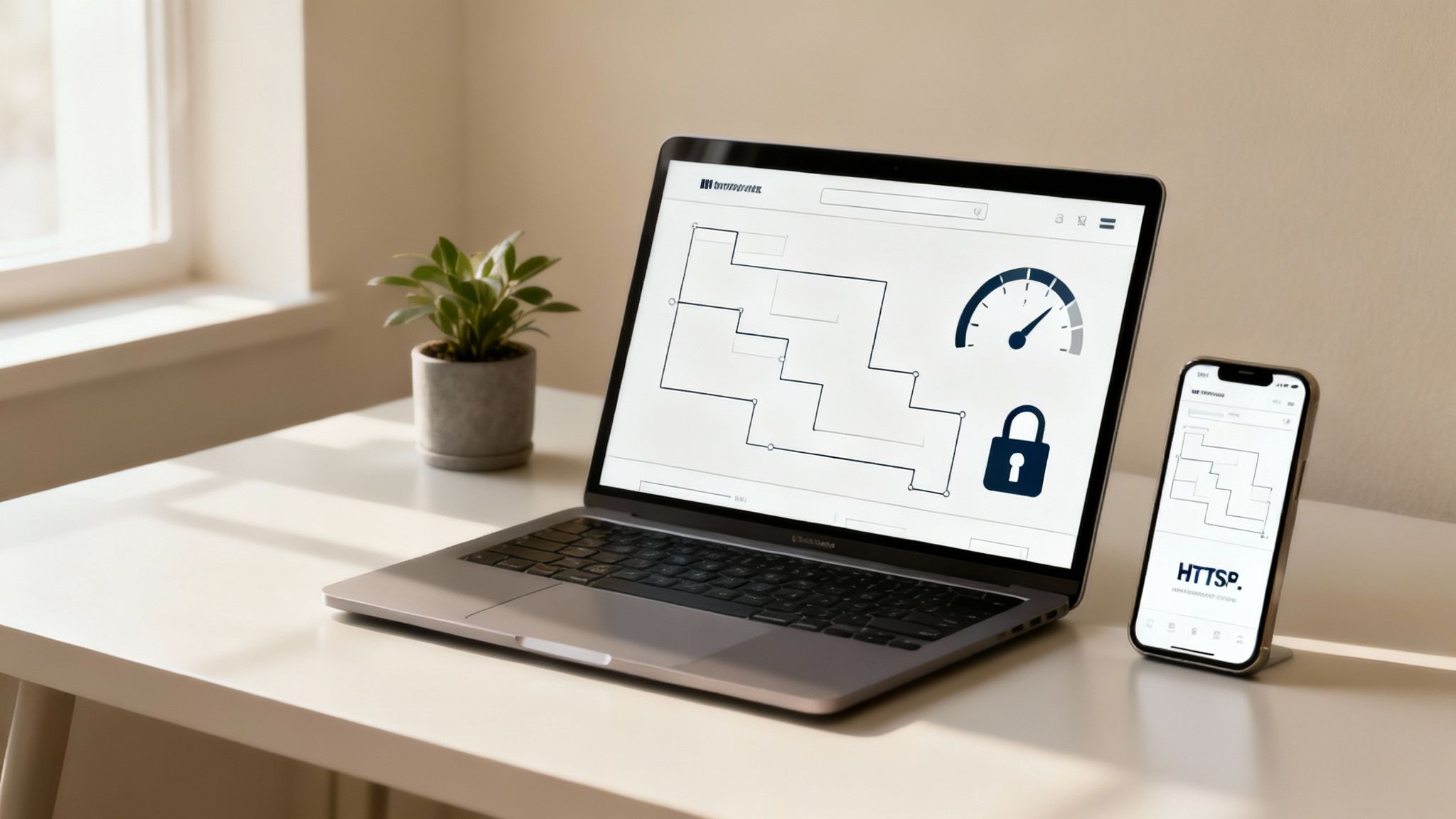
Think of your website like your actual shopfront. Long before you can wow customers with your products, you need to make sure the building itself is safe, loads quickly, and is a breeze to walk through. This is the nuts and bolts of technical SEO—getting your website’s structure right so that customers and search engines have a fantastic experience.
If you don't nail this foundation, even the most brilliant content and marketing can fall completely flat. A slow, confusing, or insecure site will just frustrate visitors and signal to Google that your digital shop isn't worth recommending. Getting these basics sorted is a non-negotiable step in any smart SEO for small business strategy.
These three pillars are the bedrock of your website's technical health and how users feel when they visit. Each one sends a powerful message to Google about the quality and trustworthiness of your site.
Site Speed: In today's world, nobody has time to wait. If your website takes more than a few seconds to load, potential customers are gone. Simple as that. A slow site is a one-way ticket to the bottom of the search results.
Mobile-Friendliness: Let's face it, most online searches now happen on a phone. Your website has to look and work perfectly on a small screen. If it doesn't, you're shutting the door on a massive chunk of your audience.
HTTPS Security: See that little padlock icon in the browser's address bar? That's not optional anymore. An HTTPS connection encrypts the data shared between your site and your visitors, protecting their info and building vital trust. Google actively favours secure websites.
A fast, secure, and mobile-friendly website is like a clean, well-lit, and accessible shop. It makes visitors feel comfortable and welcome, encouraging them to stay longer and explore what you have to offer.
Imagine walking into a massive store with no signs or logical aisles—it would be total chaos. A good website structure is your digital signposting. It organises your pages into clear categories so that visitors (and Google's crawlers) can easily find what they’re looking for.
For instance, a bakery's website might have a clear hierarchy: "Home" at the top, then main categories like "Cakes," "Pastries," and "Contact Us." Under "Cakes," you’d find specific pages for "Birthday Cakes" and "Wedding Cakes." This intuitive flow makes for a great user experience and helps Google understand how your pages relate to one another. If your current site is a bit of a maze, exploring a website redesign in Australia can give you a fresh start with a layout that just makes sense.
Once your site is nicely organised, you need to hand Google the map. This is where a couple of simple but essential tools come into play.
Once you've got your website's foundation sorted, you need to give people a good reason to show up. This is where content comes in. Think of it as the engine of your SEO strategy; it’s the fuel that gets you noticed, builds trust with potential customers, and ultimately, brings in sales. A website without great content is like a shop with empty shelves.
Good content is more than just words on a page. It answers the questions your customers are asking, solves the problems they're facing, and shows them you genuinely understand what they're going through. For any small business looking to make a real impact with SEO, creating helpful content isn't just an option—it’s the whole game.
This all starts with getting inside your customers' heads. You need to figure out the exact words and phrases they're typing into Google when they're looking for help.
The first step in this process is keyword research. It might sound a bit technical, but really, it's just about discovering the search terms your ideal customers use every day. Simple tools like Google Trends can be a fantastic starting point to see what's currently on people's minds.
Let's say you're a plumber in Bondi. Your keyword research will quickly show you two very different types of searches, each coming from a customer with a different need.
Commercial Keywords: These searches signal a clear intention to buy or hire someone. When a person searches for "emergency plumber Bondi" or "leaking pipe repair cost," they need help, and they need it now. These keywords are gold and should be the focus of your main service pages.
Informational Keywords: These searches show someone is trying to learn or fix something themselves. Think "how to fix a dripping tap" or "why is my hot water running out fast?" This person might not be ready to hire you this very second, but they have a problem you know how to solve.
A solid SEO for small business strategy needs to create content for both. Commercial keywords will bring in immediate leads, while informational content builds your reputation as the go-to local expert.
While blog posts are perfect for answering those informational "how-to" questions, they aren't your only option. For a small business, some of the most powerful content you can create is stuff that shows off your work and answers customer questions directly.
Here are a few practical ideas to build trust and nudge visitors towards making a call:
By creating a mix of content that serves customers at every stage—from their first Google search to the moment they're ready to buy—you build an incredibly powerful asset. Your website transforms from a simple online brochure into a trusted resource that doesn't just attract visitors, but consistently turns them into loyal customers.
This strategic approach effectively turns your website into a hardworking member of your team, generating leads for you 24/7.
With your website's technical foundation sorted and your content plan in motion, it’s time to add the finishing touches. This part of the process is called on-page SEO, and it’s all about sending clear, unmistakable signals to Google about what your pages are really about.
This is where you make sure all the hard work you’ve poured into your content actually gets seen.
Think of it this way: your great content is the premium product on the shelf. On-page SEO is the eye-catching packaging and clear labelling that tells a browsing customer exactly what’s inside and why they should care. Nailing this is a cornerstone of any effective SEO for small business strategy.
The most obvious place to start is with your title tags and meta descriptions. These are the first things people see in the search results, making them your digital first impression—your chance to earn that all-important click.
Your title tag is that blue, clickable headline in Google's search results. It’s arguably the single most important on-page factor. The meta description is the little blurb underneath that gives a sneak peek of the page's content.
Together, they're a mini-advertisement for your webpage. A winning combination will:
A lazy title like "Services Page" does absolutely nothing for you. But something like "Expert Gas Fitting & Plumbing in Adelaide | Call Us" instantly tells both Google and a potential customer what you do, where you are, and what the next step is. Tweaking these elements is a simple way to boost your click-through rate from search, a key part of the puzzle when it comes to conversions. To dig deeper, our guide on how to improve your conversion rate has more actionable advice.
To help you get started, here's a quick breakdown of the core on-page elements you'll be working with.
This table summarises the key elements, their job, and what a good example looks like in practice.
| Element | Purpose | Good Example |
|---|---|---|
| Title Tag | The main headline in search results. A major ranking factor. | `Local Bookkeeper for Tradies in Perth |
| Meta Description | The summary text below the title. Influences click-throughs. | Struggling with your books? We specialise in bookkeeping for Perth tradies. Get your BAS lodged on time, every time. Free consult! |
| Header Tags (H1, H2) | Structure content for readability and signal topic hierarchy to Google. | <h1>Perth Bookkeeping for Tradies</h1> <h2>Our BAS Lodgement Services</h2> |
| Image Alt Text | Describes an image for visually impaired users and search engines. | alt="Perth bookkeeper meeting with a client at their workshop" |
| URL Slug | The part of the URL after the ".com.au/". Should be short and keyword-rich. | yourwebsite.com.au/bookkeeping-for-tradies-perth |
Getting these basics right on every important page of your site is a huge step towards better visibility.
Okay, let's talk about trust. Online, one of the most powerful signs of trust and authority is a link from another website to yours. We call this a backlink, and the art of earning them is called link building.
A backlink is essentially a vote of confidence. When another site links to you, they're vouching for you, telling their audience—and, more importantly, Google—that your website is a valuable resource.
For a small business owner, "link building" can sound complicated and a bit daunting. But it really doesn’t have to be. The best way to approach it is to think of it as digital networking—an online version of the community engagement you’re likely already doing.
The best link building strategies for small businesses often look a lot like good old-fashioned community involvement. It’s about building real relationships, not just chasing links.
Forget about complex technical tactics. Instead, focus on simple, real-world opportunities that build your digital footprint and your local reputation at the same time.
Here are a few practical ideas to get you started:
Every one of these actions creates a relevant, local backlink that tells search engines you’re a legitimate and trusted part of the community.
Stepping into the world of SEO can feel a bit like learning a new language, with a whole dictionary of jargon and concepts to get your head around. It's totally normal to have questions. This guide is here to give you clear, straight-up answers to the things small business owners ask us most, so you can move forward feeling confident.
Think of this as your personal FAQ, designed to cut through the noise and give you real insights you can actually use for your business. We'll tackle the big questions about timelines, budgets, and what to focus on first, making sure you have a solid idea of what to expect.
This is probably the most common question we hear, and the answer is that SEO is a long game, not an overnight fix. While some high-impact changes, like properly setting up your Google Business Profile, can start showing results in a few weeks, the real foundational work takes time to build momentum.
Realistically, you should expect to see meaningful traction and a noticeable lift in traffic and leads within four to six months. This can change depending on things like how competitive your local market is, where you're starting from, and how consistent you are with your efforts.
Think of it like planting a garden. You've got the initial work of preparing the soil and planting the seeds, then the consistent watering and care. It takes a while to see the first sprouts, but the eventual harvest is a sustainable source of nourishment. SEO is the same; you're building an asset that generates 'free' traffic that compounds over time, unlike paid ads which disappear the second you stop paying.
Absolutely! A motivated business owner can definitely handle many of the fundamentals of SEO for a small business. You don't need to be a coding genius to get started and make a real impact.
The best place to begin is with the tasks that give you the most bang for your buck. These include:
That said, time is your most precious resource. If you find yourself getting stuck on the technical details or you just don't have the hours to dedicate, bringing in a professional can be a very smart move. The key is finding an agency or freelancer who is focused on business results—like more phone calls and contact form submissions—not just vanity metrics. Often, a hybrid approach works best, where you handle some bits and outsource the rest.
For a deeper dive, this comprehensive small business SEO guide is a fantastic resource to help you get found online.
If you run a local service or a retail shop, one thing stands head and shoulders above everything else for immediate impact: your Google Business Profile (GBP). It’s your digital shopfront, and it's often the very first interaction a potential customer will have with your brand on Google Search and Maps.
A well-optimised and active profile can drive a huge amount of business, sometimes even more than your website. It is the single highest-leverage thing you can do to improve your local visibility fast. Prioritising your GBP means focusing on accurate info, regular posts, a steady stream of new photos, and actively encouraging and replying to customer reviews.
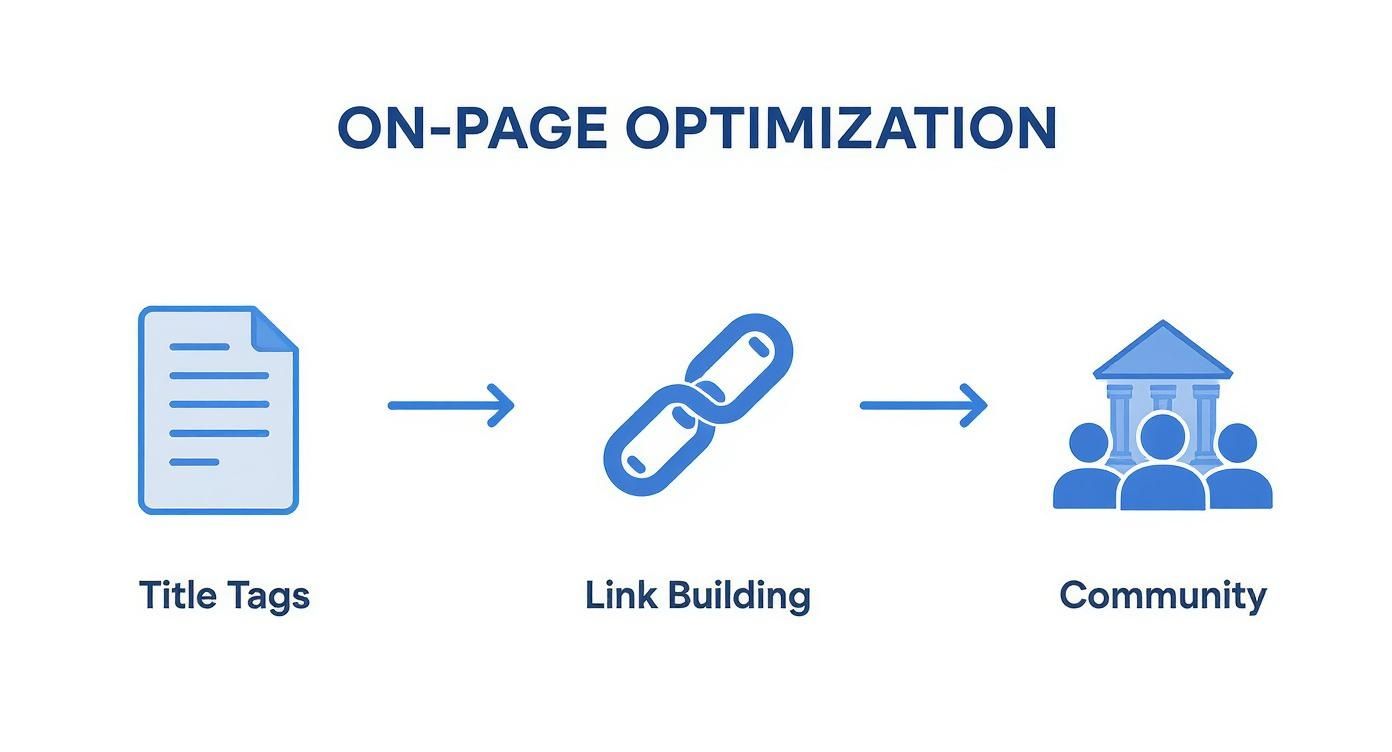
Each of these steps reinforces the others, creating a powerful signal to search engines that your website is a credible and relevant local resource.
SEO budgets can really vary. A completely DIY approach will cost you your time, plus maybe a small investment in a few tools. If you're looking to hire help in Australia, costs can range from $500 to over $2,500 per month for a local campaign, depending on the scope of work and who you partner with.
It's so important to see this as an investment, not an expense. A good SEO campaign should generate a positive return by bringing you new leads and customers. So, a better question isn't "how much does it cost?" but "what business results can I expect for this investment?" Start with a budget you're comfortable with, track your results carefully, and be ready to scale up your investment when you see a clear return.
At Virtual Ad Agency, we specialise in creating data-driven SEO strategies that deliver measurable growth for businesses. If you're ready to turn your website into a powerful lead generation engine, let's talk about how we can help. Discover our SEO services and get a custom strategy today.

 previous