
Here's the simple truth: performance marketing is an advertising strategy where you only pay when you get a measurable result.
Think of it less like buying a billboard and hoping for the best, and more like paying a sales team on commission. Instead of paying upfront for ad space, you pay when a specific, desired action—like a click, a lead, or a sale—actually happens.
Traditional advertising often feels like a bit of a gamble, doesn't it? You pour a significant budget into a TV commercial or a magazine spread, then cross your fingers and hope it reaches the right people and inspires them to act. The return on your investment is often vague and frustratingly difficult to measure.
Performance marketing flips this old model on its head. It’s a discipline driven by hard data, where every single dollar is held accountable. The entire strategy is built around tangible outcomes, making sure your marketing spend is directly tied to hitting specific business goals.
At its core, this approach operates on a brilliantly simple premise: no results, no fee. This completely shifts the risk from you, the advertiser, to the publisher or marketing partner. You're not just buying eyeballs or impressions; you're purchasing concrete actions that genuinely move your business forward.
It's this fundamental difference that explains why so many businesses are shifting their focus. The Australian digital ad market is a perfect example of this trend, with spend hitting AUD $16.4 billion in 2024—an 11.1% jump from the previous year—as businesses increasingly back strategies with clear, measurable returns. Digital channels now gobble up 73.1% of all ad spend in Australia, highlighting a massive shift towards accountable marketing.
This simple comparison shows the core idea of performance-based advertising, where investment is directly linked to outcomes, not just visibility.
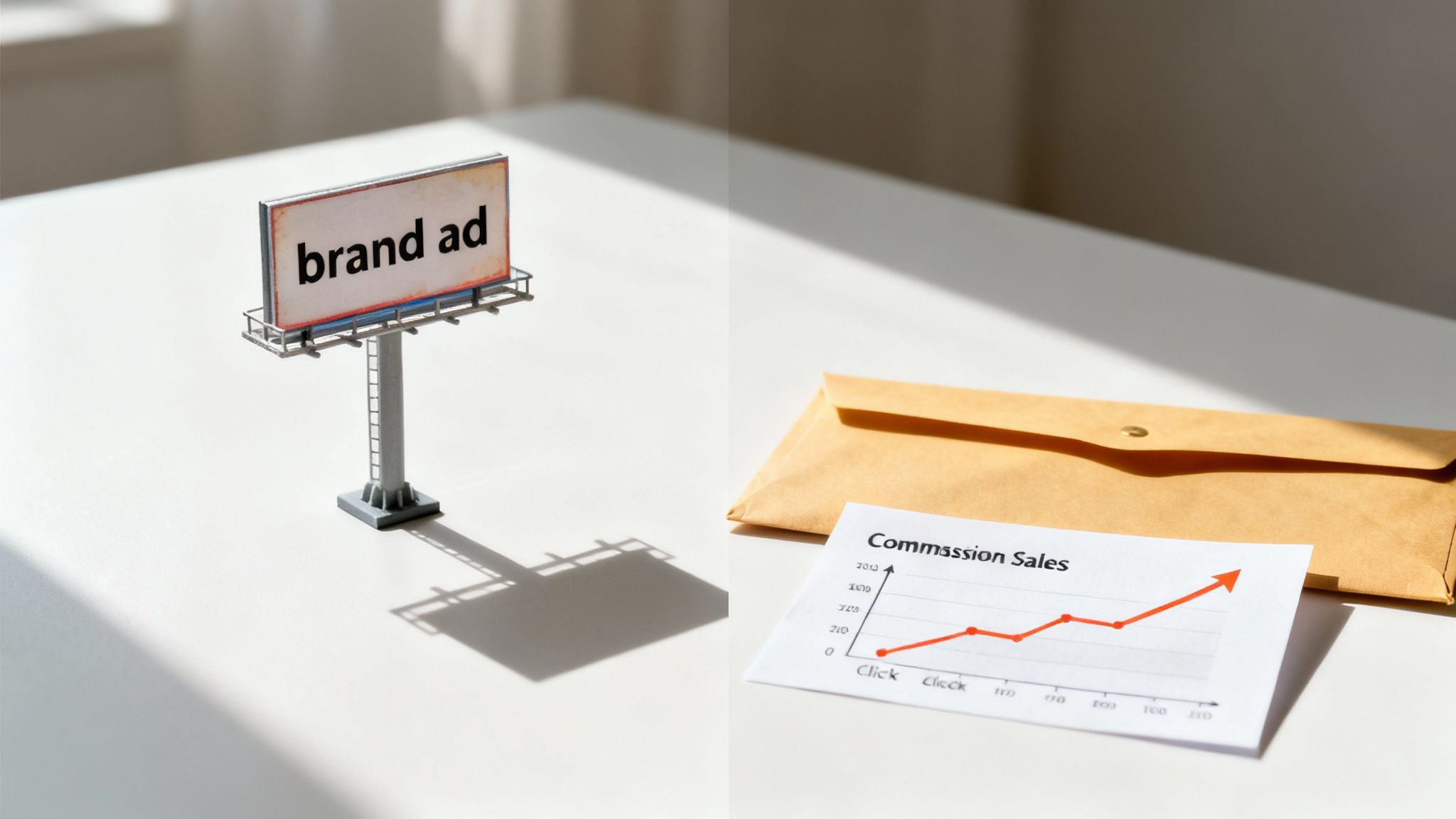
The image contrasts a generic brand ad with a clear graph showing sales growth, highlighting the focus on measurable performance over simple visibility.
So, what makes this model so effective? It’s not just about the payment structure; it’s about the entire ecosystem that supports it. A few key elements work together to deliver those results:
These components are all part of a bigger picture, often managed through sophisticated media buying that makes sure your ads reach the right audience at exactly the right time. At its heart, performance marketing thrives on the ability to turn insights into smart choices. To get a better handle on this foundational approach, it's worth exploring what defines successful data-driven decision-making.
Performance marketing is the strategic discipline that covers the planning, channel selection, execution, measurement, and optimisation of all performance advertising. It ensures every individual tactic works together to achieve the bigger business goals.
This results-first approach gives you a clear, transparent, and highly effective way to grow your business, turning your marketing budget from an expense into a direct driver of revenue.
Performance marketing isn’t a single tactic. It's a powerful ecosystem of different channels, all pulling in the same direction to deliver results you can actually measure. Think of it like a builder's toolkit. You wouldn't use a hammer for every single job, right? In the same way, different channels are designed to hit specific business goals.
Getting your head around these core channels is the key to building a strategy that really works. It lets you pick the right tools for the job—whether that's connecting with your audience, driving a specific action, or just growing your business in a predictable, cost-effective way.

Paid search, often called Pay-Per-Click (PPC), is one of the most direct forms of performance marketing you can find. It’s all about placing ads on search engine results pages, like Google, and paying a small fee only when someone actually clicks on your ad.
This channel is incredibly effective because it taps into high-intent users—people who are already actively looking for what you sell. Someone searching for "emergency plumber Adelaide," for example, isn't just browsing; they need help right now. A sharp PPC campaign puts your business right at the top of their results, making you the first and easiest solution. If you want a closer look at how this all works, our guide to Google Ads management dives deep into maximising your search presence.
While search is great at capturing existing demand, paid social media advertising is a master at creating it. Platforms like Facebook, Instagram, and LinkedIn hold a massive amount of user data, which allows for incredibly precise targeting based on demographics, interests, and online habits.
This is where the 'performance' part really kicks in. You pay for actions that actually line up with your campaign goals. That could be anything from a simple click (CPC) and generating a new lead (CPL), to driving a direct sale (CPA). A local gym, for instance, could run a laser-focused Facebook campaign offering a free trial pass, only paying when someone actually fills out the sign-up form.
The real power of social media in performance marketing lies in its ability to target users with surgical precision. You can reach audiences based on location, life events, job titles, and past purchasing behaviour, ensuring your ad spend is highly efficient.
Affiliate marketing is a classic pay-for-performance model. It's built on partnerships with third parties—known as affiliates or publishers—who promote your products or services to their own audiences. These partners could be anyone from bloggers and influencers to comparison websites.
The beauty of this channel is its low-risk nature. You only pay the affiliate a commission after they’ve successfully driven a sale or a qualified lead. This creates a powerful incentive for your partners to promote you effectively. Imagine a popular Australian travel blogger writing a glowing review of your hotel and earning a commission for every booking made through their unique tracking link. This model ties your marketing costs directly to your revenue.
Programmatic advertising uses automation and smart algorithms to buy and sell digital ad space in real-time. Instead of the old-school method of negotiating with individual website owners, this technology lets you bid on ad impressions across a massive network of websites, apps, and other digital properties.
It might sound complex, but the goal is simple: show the right ad, to the right person, at the right time, for the right price. The performance aspect is front and centre, as campaigns are constantly being optimised based on real-time data to achieve specific goals, like a target CPA or Return On Ad Spend (ROAS). For example, an online clothing retailer can use programmatic ads to retarget users who visited their site but left without buying anything, showing them the exact products they were looking at.
In performance marketing, data isn’t just a jumble of numbers on a spreadsheet. It’s the compass guiding every single decision you make. It's easy to get lost in a sea of available metrics, but real success comes from zeroing in on the Key Performance Indicators (KPIs) that actually reflect the health and profitability of your campaigns.
It’s time to move past vanity metrics like impressions or likes. Those don't pay the bills. True performance is measured by actions that directly pump cash into your bottom line. Getting a handle on these core metrics lets you see what’s working, what isn’t, and where your budget is getting you the biggest bang for your buck.
Think of these KPIs as the vital signs of your marketing efforts. Each one tells a specific story about your campaign's efficiency and impact, helping you diagnose problems and spot opportunities for growth. Three of the most critical metrics you'll live and breathe are CPA, ROAS, and CLV.
These aren't just fancy acronyms; they're the bedrock of profitability and long-term business health. A solid grasp of these figures is non-negotiable for anyone serious about performance marketing. For a deeper dive, you can explore more of the key digital marketing performance metrics in our detailed guide, which gives a much broader view of how to measure success.
Let's break down the most important ones:
Cost Per Acquisition (CPA): This is the bottom-line cost you pay to land one paying customer. You figure it out by dividing your total ad spend by the number of new customers you've brought in. A lower CPA is a good sign—it means your campaign is efficiently turning ad dollars into actual sales.
Return On Ad Spend (ROAS): This metric answers the ultimate question: for every dollar I put into ads, how much revenue am I getting back? A ROAS of 5:1 means you’re pulling in $5 in revenue for every $1 spent. It’s a direct measure of how profitable your campaign is. Performance marketing is all about measurable results, so a clear understanding of Return on Investment (ROI) and its close cousin, ROAS, is absolutely essential.
Customer Lifetime Value (CLV): This is a forward-looking metric. It predicts the total net profit you can expect from a single customer over their entire relationship with your business. A high CLV gives you permission to spend a bit more to acquire a customer (a higher CPA), because you know their long-term value makes the initial investment worthwhile.
Key Takeaway: While CPA tracks the immediate cost and ROAS measures short-term profitability, CLV gives you the long-term strategic view. The best performance marketers know how to balance all three to build sustainable, scalable growth.
And that brings us to the metrics that really matter for performance marketing. Let’s take a look at some of the most essential ones in a bit more detail.
This table breaks down the most important KPIs, giving you a quick-reference guide to what they mean and why you should be tracking them.
| KPI | What It Measures | Why It's Important |
|---|---|---|
| CPA (Cost Per Acquisition) | The total cost to acquire one new paying customer. | Shows how efficiently your ad spend is converting into customers. A lower CPA is generally better. |
| ROAS (Return On Ad Spend) | The gross revenue generated for every dollar spent on advertising. | Provides a direct measure of campaign profitability. Essential for understanding if your ads are making money. |
| CLV (Customer Lifetime Value) | The total net profit a business can expect from a single customer over their entire relationship. | Helps you make strategic decisions about acquisition costs and informs long-term growth and retention strategies. |
| CTR (Click-Through Rate) | The percentage of people who saw your ad and then clicked on it. | A key indicator of ad relevance and creative effectiveness. A high CTR suggests your message is resonating. |
| CVR (Conversion Rate) | The percentage of users who take a desired action (e.g., make a purchase) after clicking an ad. | Measures how effective your landing page and offer are at turning traffic into tangible business results. |
Tracking these KPIs is just the start. The real magic happens when you use these insights to refine your strategy, optimise your campaigns, and drive even better results over time.
So, what happens when a single sale involves multiple marketing channels? This is where attribution models come into play. They’re essentially the rulebook you use to give credit for a conversion to the various touchpoints in a customer's journey.
Think of a customer’s path to purchase like a game of footy. A player might click a Facebook ad (a pass from the midfielder), then a Google Search ad (an assist from the striker), and finally make a purchase. Who gets the credit for the goal?
Different attribution models answer that question differently:
Choosing the right attribution model is a huge deal. It directly shapes how you see the value of each channel and, as a result, where you decide to put your money for future campaigns.
https://www.youtube.com/embed/hbM3befCOv4
Moving from theory to action is where performance marketing really comes alive. Getting your first campaign out the door can feel like a huge task, but it’s actually a methodical process built on clear goals, smart choices, and precise tracking. This is your roadmap to getting a campaign off the ground and driving real results from day one.
The whole approach is designed to cut out the guesswork and pump up your returns. Unlike old-school advertising where you might wait months to see if anything happened, a well-built performance campaign gives you feedback almost instantly. This lets you learn on the fly, adapt your strategy, and scale up what’s actually working.
Before you spend a single dollar, you need to know exactly what a "win" looks like for your business. Vague goals like "increase sales" or "get more leads" just won't cut it. In the world of performance marketing, your goals must be specific, measurable, achievable, relevant, and time-bound (SMART).
A strong goal gives your whole campaign a laser focus. So, instead of a fuzzy objective, you need something concrete, like: "Generate 50 qualified sales leads per month at a target Cost Per Acquisition (CPA) of $50."
Getting this specific does two critical things:
Next up, you have to pinpoint exactly who you're trying to reach. The more you understand about your ideal customer, the better you can target them and the less money you'll waste. Go beyond the basic demographics and start building a detailed customer persona.
Think about things like:
A deep understanding of your audience lets you pick the right channels and craft messages that actually connect, making every ad dollar work harder for you.
With your goals locked in and your audience defined, you can now pick the best channels to reach them. If you’re trying to capture people actively searching for a solution right now, Paid Search (PPC) is a no-brainer. If you need to build awareness and target users based on their interests, Paid Social is probably your best bet.
Your budget should follow these choices. There isn't a magic number for a starting budget, but a practical way forward is to start small, test a couple of key channels, and see what the initial data tells you.
Pro Tip: Make sure your test budget is big enough to actually learn something. If your target CPA is $50, a $100 budget will barely give you any data to work with. Aim for a budget that lets you get at least 10-20 conversions so you can make decisions based on facts, not feelings.
Once you find a channel delivering a solid Return On Ad Spend (ROAS), you can scale up your investment with confidence.
Your ad is your first handshake. It needs to grab attention and speak directly to what your audience needs. A great ad has a clear value proposition, a strong call-to-action (CTA), and visuals that look and feel like your brand.
But the journey doesn't stop at the click. The landing page they arrive on must be a seamless continuation of the ad's promise. Make sure your landing page is:
This flowchart shows how key metrics flow together, tracking the journey from the initial cost to get a customer (CPA) all the way to their long-term value (CLV).
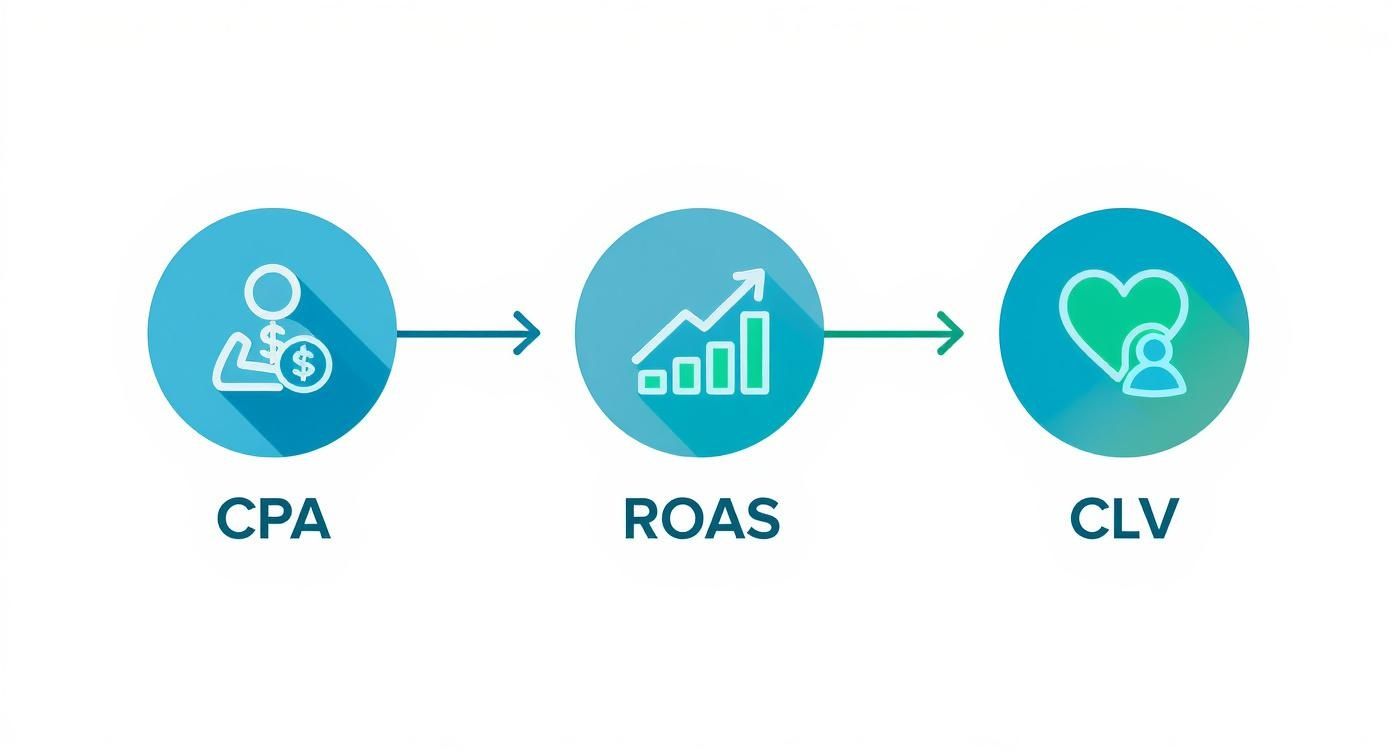
This shows how a successful campaign isn't just about getting a customer; it's about building a profitable, sustainable engine for growth.
This last step is the absolute foundation of everything. It's what puts the "performance" in performance marketing. Without accurate tracking, you're just guessing.
Here are the non-negotiables to set up before you go live:
With this foundation firmly in place, you’re ready to launch, start collecting data, and begin the endless—but rewarding—cycle of optimisation that makes performance marketing so powerful.
Theory gives you the playbook, but the real magic happens when you see the plays executed on the field. To make the power of performance marketing truly click, let's step away from the concepts and look at how actual businesses are using it to drive serious, measurable growth.
These mini case studies show how a results-first mindset can turn ad spend into a predictable revenue engine, no matter what industry you’re in. Each one zeroes in on a specific channel and a clear business goal, drawing a straight line between a smart action and a winning outcome.
Picture an Aussie online retailer selling sustainable activewear. Their goal was simple: crank up online sales and hit a minimum 4:1 Return On Ad Spend (ROAS) during the hectic spring season. Instead of just spraying their brand message everywhere, they got surgical with performance marketing on Instagram and Facebook.
They rolled out dynamic product ads, specifically retargeting people who had browsed their website but left without buying. By showing these users the exact items they’d already checked out, the ads felt less like an interruption and more like a helpful reminder.
This isn't a one-off success story; it taps into the social commerce boom happening right here in Australia. We know that personalised campaigns deliver 5.7 times higher engagement rates than generic ones. As more businesses pour their budgets into channels that deliver direct sales, this kind of sharp, focused approach is non-negotiable. You can dive deeper into what's working now in the latest Australian Marketing Trends Report.
Now, let's switch gears to a B2B software company. They sell complex project management tools to big enterprise clients, which means the sales cycle is long and considered. Their immediate goal wasn't to close a sale but to generate top-tier leads for their sales team to nurture. They knew their perfect customer was a project manager at a large construction firm.
LinkedIn was the obvious choice for its powerful professional targeting. They ran a campaign offering a free, downloadable whitepaper: "Improving Construction Project Efficiency."
The genius of their approach was leading with genuine value. By giving away a genuinely useful resource in exchange for contact details, they attracted people who were actively trying to solve the exact problem their software fixes.
These examples make it clear. Whether you're selling activewear or enterprise software, the core principles of what is performance marketing are the same: lock in your goal, pick the right channel, measure everything, and only pay for the results that actually move the needle.
Jumping into performance marketing is exciting, but let's be honest, it can feel a bit like staring at a complex new dashboard. The promise of paying only for results is a big one, but it brings up some very practical questions.
We get it. So, let's cut through the noise and tackle the most common queries we hear from businesses dipping their toes in the water for the first time. Our goal here is to give you clear, straight answers—no fluff—so you can start off on the right foot.
This is always the first question, and the most honest answer is: it depends. There's no magic number that works for everyone. The real key is budgeting enough to actually collect meaningful data. A budget that’s too small is like trying to map the ocean with a single fishing line; you won't learn much, even if you get lucky once or twice.
A better way to approach this is to think about your target Cost Per Acquisition (CPA). Let's say you figure it'll cost about $40 to get a new customer. A starting budget of $200 only gets you five conversions. That's simply not enough data to know if your campaign is a winner or just had a good week.
As a solid rule of thumb, your initial test budget should be big enough to aim for at least 10-20 conversions. This gives you a proper data set to make smart decisions about what’s working and where to double down.
For many small Aussie businesses, a realistic starting test budget often falls somewhere between $1,500 to $3,000 per month, usually focused on a single channel. This gives you enough room to gather data, see which ads resonate, and begin tweaking things for better performance.
While performance marketing delivers feedback much faster than old-school advertising, it isn't an instant success button. You can see initial data like clicks and impressions almost immediately, but the results that actually matter to your bottom line take a little more time to bake.
It’s best to think of it in a few phases:
You should see encouraging signs within the first month, but a clear picture of profitability usually comes into focus after the first 90 days of consistent effort.
So many well-intentioned campaigns trip over a few common, and totally avoidable, hurdles. Knowing about these from the get-go can save you a world of headaches (and cash).
Absolutely. The core principles of performance marketing—clear goals, targeted audiences, and measuring everything—are universal. The main differences are in the strategies, the channels you choose, and the metrics you focus on.
The tactics might look different, but the 'pay-for-results' philosophy is just as effective for an e-commerce store selling sneakers as it is for a software company selling to large enterprises.
Ready to stop guessing and start getting measurable results from your marketing? The team at Virtual Ad Agency specialises in building and scaling high-performance campaigns that drive real growth. Let's talk about a strategy for your business.

 previous