
Think of a digital marketing strategy template as the blueprint for all your online marketing. It’s the framework that ties everything together, ensuring every dollar spent and every piece of content created pushes you closer to your real business goals. It’s what stops you from just doing marketing and starts you on the path to strategic, goal-driven growth.
Trying to navigate Australia’s crowded digital marketplace without a plan is a bit like setting off from Sydney to Perth without a map. Sure, you might stay afloat for a bit, but you're not going to get where you want to go efficiently. A good template is that map. It gives your marketing purpose, direction, and a clear way to show a return on your investment, turning abstract ideas into solid, actionable steps.
This isn't just about getting organised; it's a core tool for survival and growth in this market. A well-built template forces you to get specific about what success actually looks like, who your Australian audience really is, and where to put your time and money for the biggest impact. That structured thinking is absolutely vital for getting ahead of local competitors and tapping into unique Aussie consumer habits. For a deeper dive into the mechanics, it's worth taking the time to Master the Digital Marketing Strategy Framework.

The Australian digital scene isn't just busy—it's booming. The market hit around USD 13.03 billion in 2025 and is on track to reach almost USD 25.39 billion by 2034. This explosion, fired up by the widespread adoption of channels like SEO and social media, means you’re fighting harder than ever for your audience's attention. A solid template ensures your strategy is strong enough to not just compete, but to win.
Without a documented plan, your team is left performing random acts of marketing. A template changes that. It connects every single action back to a specific business goal, whether that’s generating leads, driving sales, or just building a brand people recognise and trust. If building brand equity is on your radar, our guide on how to increase brand awareness is a great place to start.
A great strategy template doesn't just tell you what to do; it forces you to answer why you are doing it. This shift from activity to outcome-focused marketing is what separates thriving businesses from those just getting by.
To give you a clearer picture of what's ahead in this guide, we've broken down the core components of the strategy template. Think of this as the table of contents for your future success.
Core Components of Your Digital Marketing Strategy
| Component | Objective | Key Outcome |
|---|---|---|
| Objectives & KPIs | Define what success looks like in measurable terms. | Clear, quantifiable targets (e.g., increase leads by 20%). |
| Audience Personas | Understand who you're talking to on a deep level. | Targeted messaging that resonates with your ideal customer. |
| Channel Strategy | Identify where your audience spends their time online. | Efficient allocation of resources to the most impactful channels. |
| Content & Media Plan | Map out what you'll create and where you'll promote it. | A consistent flow of valuable content that attracts and converts. |
| Budget Allocation | Assign funds to channels and activities effectively. | A clear view of marketing spend and expected ROI. |
| Measurement | Track performance and analyse what's working (and what's not). | Data-driven insights to optimise and improve your strategy. |
Each of these pillars is crucial for building a plan that doesn't just sit on a shelf.
This guide will walk you through each of these elements, giving you the tools and know-how to build a plan that delivers tangible results. It’s time to move beyond guesswork and start making data-backed decisions that genuinely drive your business forward.
Every solid digital marketing strategy is built on two things: knowing what you want to achieve, and knowing who you’re talking to. Goals like "increase sales" or "get more traffic" are just wishful thinking. To get any real traction, you need sharp, specific goals that tie directly back to the business's bottom line.
This means getting serious and adopting the SMART goal framework. It's a simple acronym that forces you to make every objective Specific, Measurable, Achievable, Relevant, and Time-bound. This structure turns a vague idea into a clear target your whole team can rally behind.

Let’s see how this plays out in the real world for Aussie businesses. Take a Melbourne-based e-commerce store that sells sustainable fashion. A weak, unhelpful goal would be "sell more clothes". Pretty useless, right?
A SMART goal, on the other hand, sounds like this: "Increase online sales of our new autumn collection by 15% through paid social media and email marketing campaigns within the next three months (Q2)." It's specific, you can measure it, it's realistic, it's relevant to revenue, and it has a deadline.
Now, picture a B2B services firm in Sydney providing IT solutions. They're not chasing direct sales; they’re hunting for leads.
This objective gives the marketing team a clear benchmark for success. It allows them to track progress properly and actually justify their budget. The conversation shifts from just being 'busy' to creating measurable business impact.
The real power of a strategy template lies in its ability to force clarity. When you define a SMART goal, you're not just creating a metric; you're creating a clear destination for every marketing activity that follows.
Once your goals are locked in, you need to get inside the heads of the people who will help you hit them. That's where buyer personas come in. A buyer persona is a semi-fictional sketch of your ideal customer, pieced together from market research and hard data on your existing customers.
This isn't just about demographics like age or location. It’s about digging deep to uncover what makes your audience tick. What are their biggest professional headaches? What drives them to look for a solution like yours? Where do they hang out online to find information? For a full walkthrough, you can learn more about how to conduct market research and build personas that are actually useful.
To build personas that genuinely reflect the Australian consumer, you have to tap into local data. Ditch the generic assumptions and get your hands on the numbers.
For example, a Perth-based financial services company might find through GA4 that a huge chunk of their website traffic comes from fly-in-fly-out (FIFO) workers browsing on their phones during their off-weeks. That single insight could completely reshape their content strategy, inspiring them to create mobile-friendly budget calculators and articles specifically about managing money on a FIFO roster.
When you pair clear, measurable goals with a deep, data-driven understanding of your audience, you're setting the stage for a digital marketing strategy that doesn't just look good on paper—it delivers real, predictable results.
Knowing your audience is only half the battle. Now for the tricky part: figuring out where they spend their time online and what on earth you're going to say to them.
Choosing the right digital channels isn’t about being everywhere at once. That's a recipe for burnout. It’s about being in the right places—the places where your message can actually connect and make an impact.
For Australian businesses, this means moving beyond guesswork. The online habits of a Gen Z consumer in Brisbane are worlds away from those of a C-suite executive in Perth. A solid strategy ensures your budget goes into platforms that actually deliver a return, not just noise.

The need for a calculated channel strategy is amplified by just how connected Australia is. As of early 2025, the country’s internet penetration hit a staggering 97.1%, with 77.9% of the population active on social media. Your audience is definitely online, but they’re scattered everywhere, which makes a strategic choice essential.
Instead of a scattergun approach, you need to analyse your buyer personas and match them to the primary user base of each platform.
Once you've picked your channels, you need a plan for what to post. A chaotic content calendar just leads to inconsistent messaging and a stressed-out team. This is where the "Hero, Hub, Hygiene" model comes in—it’s a brilliant framework for organising your content and making sure you have a balanced mix of activity.
This model helps you think about content in three distinct layers. It's how you build long-term authority while still grabbing short-term attention.
The Hero, Hub, Hygiene model transforms your content from a series of random posts into a structured ecosystem. Each piece has a purpose, whether it's answering a common question or creating a major brand moment.
Let's break down each part with some real-world examples.
1. Hygiene Content (The "Always-On" Stuff)
This is your foundational content, the stuff that pulls people in. It's the SEO-driven material designed to answer the specific questions your audience is typing into search engines. Think of it as the bedrock of your entire content strategy.
2. Hub Content (The Regular Programming)
Hub content is what you "push" to your existing audience to keep them coming back. It’s your regular, scheduled programming that builds a loyal community around your brand. To get this right, it pays to stay on top of current content marketing best practices.
3. Hero Content (The Big Bang Campaigns)
Hero content represents your big moments. These are the major campaigns you pour time and budget into a few times a year to reach a massive audience and generate serious buzz. To dive deeper, check out our own detailed guide on content marketing best practices.
By combining these three types of content, you create a robust and sustainable plan. Your Hygiene content pulls in new organic traffic, your Hub content turns that audience into a community, and your Hero content delivers those big-impact moments that really accelerate growth.
Let's get down to the two elements that really make or break any marketing strategy: the money you spend and the results you get. A brilliant plan is just a nice document until you put some proper funding behind it, and you can't prove your wins without measuring what actually moves the needle.
This is where your marketing strategy stops being theoretical and starts becoming a well-oiled, accountable machine.
Setting a budget can feel like a bit of a guessing game, but there are solid ways to approach it. One of the most common methods I've seen work well is the percentage-of-revenue model. You simply dedicate a set percentage of your total business revenue to marketing. For a stable, mid-sized Australian business, this often lands somewhere between 7-12%. A high-growth company, on the other hand, might push that up to 15% or more to aggressively chase market share.
Once you’ve got your total marketing number, the real art is in slicing up the pie. Not every channel is created equal, and your budget should reflect the priorities you’ve already laid out. A classic mistake is to spread your funds too thin across too many platforms. Trust me, it’s much better to dominate one or two key channels than to be a faint whisper on ten.
This kind of strategic thinking is more important than ever. Consider this: in 2025, Australian businesses are expected to pour a massive $1.5 billion into SEO services alone, which is a 12% jump from 2024. This tells us there's a clear shift toward investing in sustainable, long-term channels that build genuine organic authority. Even smaller businesses are now regularly allocating around $1,200 a month to SEO. You can dig into more of this data on Australian content marketing and SEO spending from Local Digital.
So, what does this look like in practice? Here’s a quick look at a sample budget for a mid-sized Australian business.
This table shows how a company with a $300,000 annual marketing budget might break things down. Notice how each channel is tied directly to a hard business metric, not a fluffy vanity one.
| Channel/Activity | Percentage of Budget | Key Performance Indicator (KPI) |
|---|---|---|
| Google Ads (PPC) | 35% ($105,000) | Return on Ad Spend (ROAS) |
| SEO & Content Marketing | 30% ($90,000) | Organic Keyword Rankings, MQLs |
| Social Media (Organic & Paid) | 20% ($60,000) | Cost Per Lead (CPL), Engagement Rate |
| Email Marketing & Automation | 10% ($30,000) | Lead Nurturing Conversion Rate |
| Analytics & Tools | 5% ($15,000) | N/A |
This isn't a rigid formula, but it’s a solid starting point that prioritises channels with clear, measurable returns.
With your budget locked in, the spotlight turns to measurement. This is the part where you connect every dollar you spend back to those SMART goals you set at the start. The trick is to sidestep the vanity metrics—things like social media likes or impressions—and zero in on the numbers that signal real business health. These are the metrics your CEO and finance team actually want to talk about.
The goal of measurement isn't just to report on what happened; it's to create a feedback loop that makes your next move smarter. Every data point should answer the question, "What should we do differently next month?"
To build a measurement framework that has real teeth, you'll want to focus on these critical metrics:
By tracking these outcome-focused numbers, your digital marketing strategy becomes a living, breathing tool for growth. It gives you the confidence to double down on what’s working, pull back from what isn’t, and prove the immense value your marketing brings to the bottom line.
A brilliant strategy is just a nice document without a clear path to get things done. This is where the rubber hits the road, turning all those well-laid plans into a concrete action plan with timelines, tools, and clear ownership.
One of the biggest traps I see teams fall into is creating a massive annual plan that feels overwhelming from day one. It just sits there, gathering digital dust.
The secret is to break it all down. Instead of one giant project, think of your strategy as a series of focused sprints. Start with the big picture—your 12-month goals—and then slice it into manageable quarterly milestones. Each quarter should have a primary focus, which stops your team from getting pulled in a million different directions.
A good timeline doesn't just list dates; it provides clarity and builds momentum. You're aiming to create a rhythm for your marketing activities that ensures steady progress without burning everyone out.
Your annual plan sets the destination. For instance, a goal might be to increase organic lead generation by 40% by the end of the financial year. A great goal, but how do you actually get there?
That's where your quarterly milestones come in. You break it down like this:
Suddenly, a huge annual goal feels totally achievable. The team knows exactly what they need to deliver each quarter, and every action has a clear purpose.
A great action plan doesn't just list tasks; it builds momentum. By breaking down a year-long strategy into focused 90-day sprints, you create a cycle of planning, execution, and learning that drives continuous improvement.
Great execution relies on having the right tools in your corner. Your tech stack should make your life easier, not more complicated. For Australian businesses, a streamlined set of tools can make a huge difference to your team's workflow and efficiency.
There’s absolutely no need to overcomplicate it. A powerful, effective stack often comes down to just a few core platforms that play nicely together.
Here’s what a lean but mighty tech stack often looks like:
This process of allocating resources, measuring what works, and constantly improving is a cycle, not a straight line.
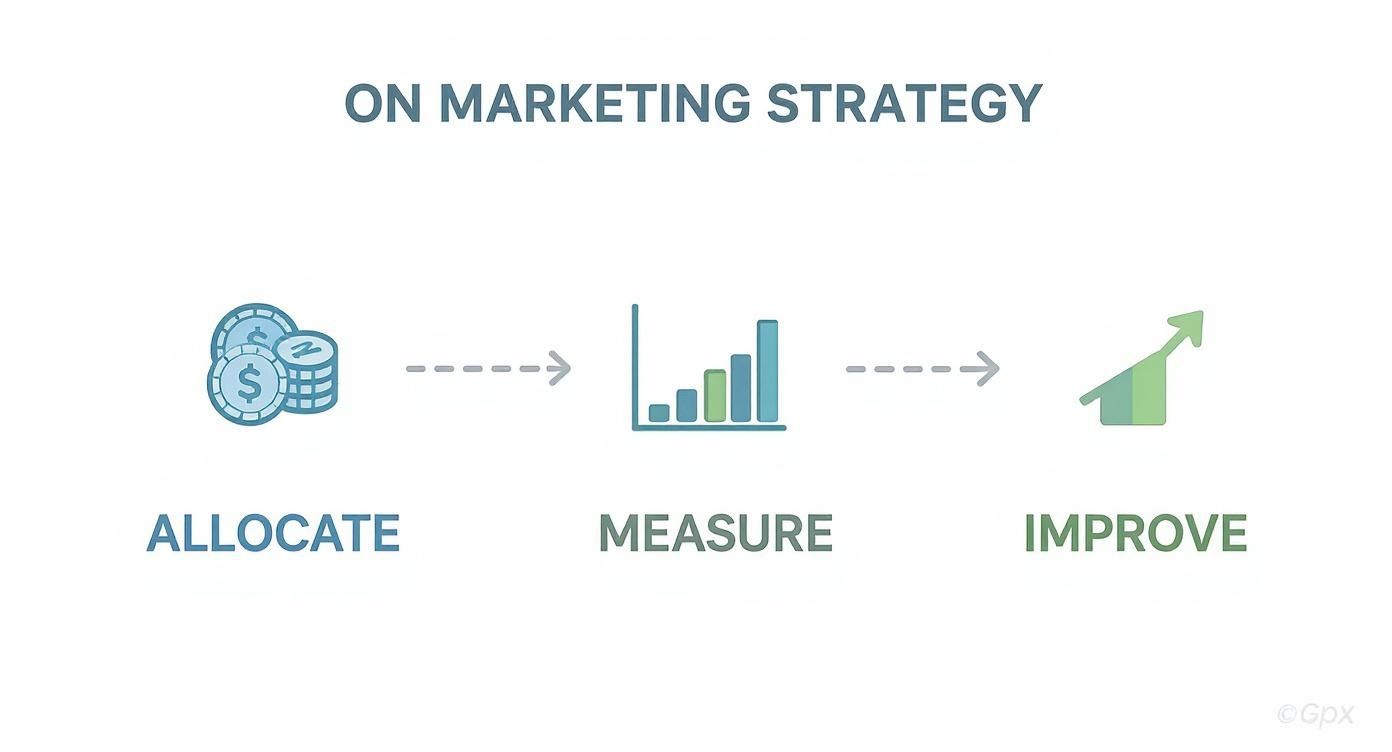
As the diagram shows, a successful strategy is a continuous loop. You operationalise your plan with clear timelines and the right tech, creating the structure you need to execute consistently, measure effectively, and adapt on the fly. This is how a template becomes a powerful engine for genuine business growth.
Once you start translating a digital marketing strategy template from a document into real-world action, questions inevitably pop up. It’s the gap between theory and execution where the real challenges live. We get it.
So, let's tackle some of the most frequent questions we hear from marketers and business owners. Think of this as your go-to FAQ for clearing common hurdles and getting your strategy off the ground with confidence.
This is a big one. The short answer? Your strategy should be a living document, not something you carve in stone and forget about. The market moves far too quickly for a "set and forget" approach.
We recommend a deep-dive annual review. This is where you zoom out, look at the big picture, analyse the previous year's performance, and align your marketing goals with the wider business objectives for the next 12 months.
But the real agility comes from quarterly check-ins. This is your chance to get tactical. Look at what's working and what’s not, and pivot based on hard data. For instance, maybe your Q1 paid social campaigns on Facebook blew your Return On Ad Spend (ROAS) forecast out of the water. Great! You might decide to double down and shift more budget there for Q2. Add in monthly performance huddles, and you've got a rhythm for making smart, timely tweaks.
Without a doubt, the biggest mistake is treating the template like a fill-in-the-blanks checklist. So many businesses just plug in generic info without thinking critically about who they're actually trying to reach or their unique spot in the market. It’s a fast track to a plan that looks impressive but delivers nothing.
A template might point you towards Instagram, but that's a total waste of time and money if your ideal customer is a CFO in the mining sector who lives on LinkedIn. The template is your framework, not a rulebook.
The most successful strategies come from teams that challenge the template, pull it apart, and rebuild it to fit their specific needs. Every single activity must tie back to a real business outcome, not just a fluffy marketing metric.
For a small team, a comprehensive strategy can look pretty daunting. But it's absolutely doable. The secret is ruthless prioritisation. You can't boil the ocean. You'll just burn out.
Here’s a simple way to approach it:
AI isn't some shiny add-on or a separate "AI strategy" you tack on at the end. It should be woven into the very fabric of your plan from the beginning. A modern template should explicitly call out where and how AI tools will be used to make your entire marketing engine smarter and more efficient.
Done right, AI-enabled campaigns can slash customer acquisition costs by up to 50%.
By integrating AI across these core areas, you transform your template from a static plan into a dynamic, intelligent system built for growth.
At Virtual Ad Agency, we specialise in transforming great strategies into measurable results. If you're ready to build and execute a digital marketing plan that delivers real growth for your business, we can help.
Learn more about our full-funnel marketing solutions at Virtual Ad Agency

 previous