
So, what exactly is digital marketing consulting?
It’s about bringing in an outside expert to look over your shoulder, figure out what’s working (and what’s not), and then draw you a map to get where you want to go. It’s not about just handing over tasks; it’s about hiring a strategic architect who builds a customised blueprint for your business's growth. The whole point is to make sure your marketing efforts are actually making you money.
Think of it like bringing in a master chef before a grand opening. They don't just rock up and start throwing ingredients in a pan. First, they’ll inspect the kitchen (your website and digital assets), check the quality of the ingredients (your content, data, and team), and get a feel for the diners they need to impress (your target audience). Only then do they create a menu designed to get people talking and coming back for more.
That’s what a great digital marketing consultant does. They aren't there to simply "run your ads" or "post on social media" for you. Their real job is to provide that high-level strategic direction, solve the tricky problems, and lay out a clear roadmap. This stops you from making expensive mistakes and ensures every dollar you spend on marketing is pulling its weight. They’re the ones who connect the dots between what you’re doing and what you want to achieve.
So many businesses fall into the trap of just doing marketing stuff. They’re writing blog posts, running a few ads, sending out emails… but it’s all a bit disconnected. There’s no big-picture strategy holding it all together, so it never really delivers the results it should. A consultant is the person who steps in to fix that.
A proper consulting engagement is all about answering the big questions:
A digital marketing consultant’s value isn’t in the number of tasks they do, but in the clarity and direction they bring. They build the strategic framework that makes everything else you do more powerful and profitable.
To help you visualise this shift from tasks to strategy, here’s a breakdown of the core functions a consultant really performs for your business.
| Consultant's Role | What It Means For Your Business | Key Outcome |
|---|---|---|
| The Diagnostician | An objective audit of your current marketing performance and assets. | Uncovers hidden problems and opportunities you're too close to see. |
| The Strategist | Develops a comprehensive, goal-oriented roadmap for your marketing. | A clear, actionable plan that aligns all marketing activities with revenue. |
| The Navigator | Guides your team through complex channels and new technologies. | Avoids costly trial-and-error and fast-tracks you to what works. |
| The Analyst | Translates raw data into meaningful business insights. | Decisions are based on solid evidence, not guesswork. |
| The Mentor | Upskills your internal team to improve their capabilities. | Builds long-term marketing self-sufficiency within your business. |
This table shows how a consultant's work isn't about taking over tasks, but about empowering your business with the strategy, insight, and skills needed to win.
And let’s be honest, getting that expert guidance is more important than ever. The Australian digital advertising sector is booming, estimated to hit AUD 3.7 billion in revenue in 2025. With the market growing at a compound annual rate of 7.4% over the past five years, the competition is fierce. You can dive deeper into these numbers with IBISWorld's detailed report on digital advertising agencies in Australia.
At the end of the day, a consultant is your objective, expert partner. They bring a fresh pair of eyes, free from internal politics or biases, and use their experience to carve out the most direct path to sustainable growth. It’s about making sure your business doesn’t just show up online, but actually competes—and wins. It’s an investment in clarity, efficiency, and your long-term success.
When you bring on a digital marketing consultant, you're not just buying a shopping list of services. You're investing in a coordinated system, a growth engine where every part works together to find, attract, and win over your ideal customers. It’s crucial to understand these core pillars to see how a consultant's work actually translates into real-world business results.
Think of it like this: your business is a high-performance vehicle. Some parts deliver raw power, others handle the steering, and some are there to make the journey smooth. The consultant is the master mechanic who tunes every single component so the whole machine moves faster and more efficiently towards its destination—more revenue and a bigger slice of the market.
This process isn't a one-off job; it's a continuous cycle of diagnosis, strategy, and growth, as you can see below.
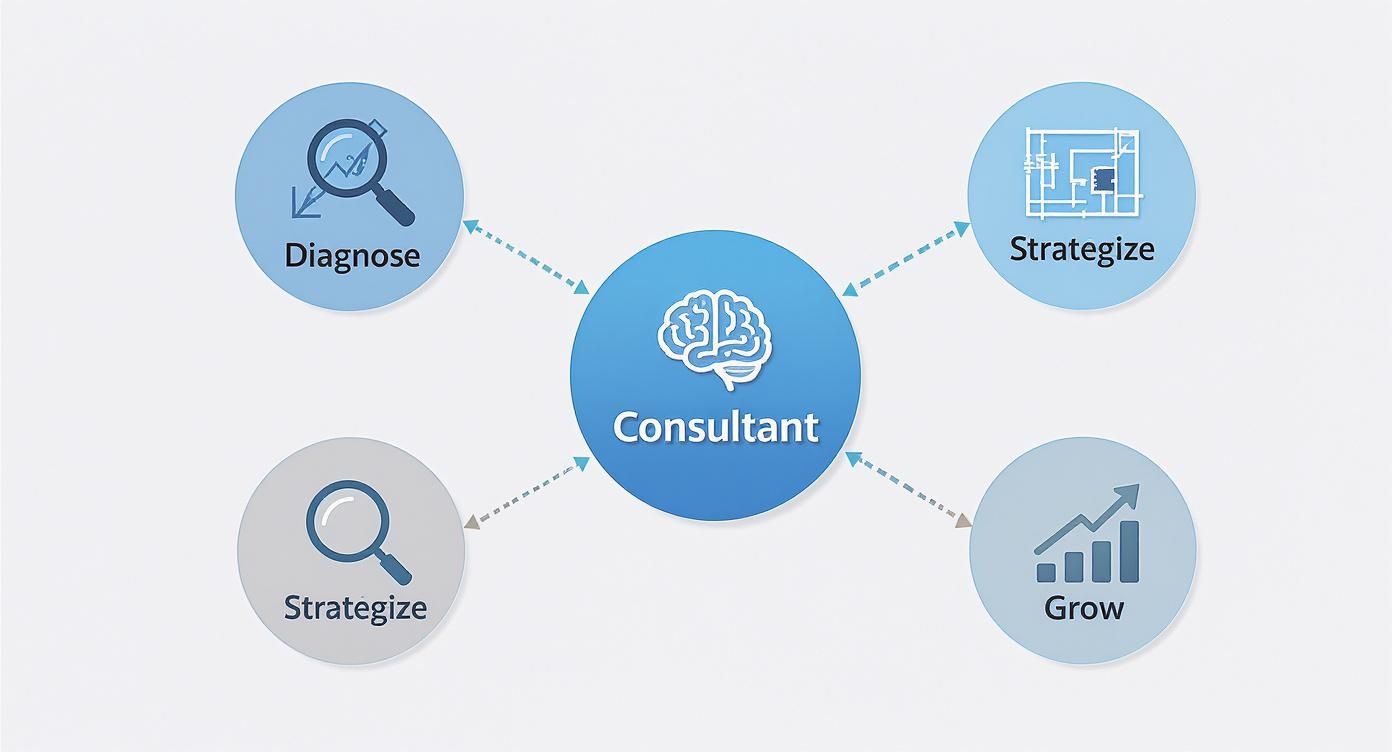
It all starts with a deep dive into where you are now. This analysis informs a custom-built strategy, which leads to measurable growth. That growth then provides fresh data, kicking off the next round of diagnosis and refinement.
Search Engine Optimisation (SEO) is the craft of making your business impossible to miss on search engines like Google. Forget about quick tricks or short-term hacks. A better way to think about SEO is like building a premium, permanent storefront on the busiest high street on the internet.
When people are actively looking for the exact solutions you offer, good SEO makes sure they find you, not your competition. It’s a process that involves a few key disciplines working in harmony:
A consultant doesn't just "do SEO." They build a long-term, sustainable asset that keeps generating organic traffic and leads for years. For smaller businesses, getting this right is non-negotiable. You can dive deeper into this with our guide on SEO for small business.
If SEO is your permanent storefront, then Paid Media is the supercharged speedboat that gets you in front of your ideal customers right now. Channels like Google Ads and paid social media (think Facebook, Instagram, and LinkedIn) let you place incredibly targeted messages directly where your audience spends their time.
A consultant's job here is to manage your ad budget like a seasoned portfolio manager. They pinpoint the most profitable platforms, create ads that demand attention, and constantly fine-tune campaigns to slash your Customer Acquisition Cost (CAC) while boosting your Return on Ad Spend (ROAS). It’s all about precision targeting, not just throwing money at the wall.
Getting people to your website is only half the job. Conversion Rate Optimisation (CRO) is the science of making your website more persuasive, transforming casual visitors into genuine leads and paying customers. In short, it’s about making it as easy as possible for people to do business with you.
CRO answers one simple but incredibly powerful question: "Why aren't more visitors taking the action we want them to take?" It's the difference between a website that just sits there and one that actively sells for you, 24/7.
Through A/B testing, analysing user behaviour, and making strategic design tweaks, a consultant can systematically lift your site’s performance. This could be as simple as rewriting a headline, changing a button colour, or streamlining your checkout process. These small, data-driven improvements can lead to massive revenue gains over time.
Behind all of these services are two elements that hold everything together: analytics and content. Data analytics is the feedback loop; it tells you what’s working, what’s not, and where your biggest opportunities are hiding. A consultant’s real skill is turning that raw data into clear, actionable business intelligence.
Content is the fuel for the entire engine. It gives your SEO efforts something to rank, provides your paid ads with a compelling message, and builds the trust you need to make conversions happen. High-quality content is also the backbone of effective email marketing, and knowing which of the top email outreach tools to use can make or break a campaign.
The demand for this kind of strategic expertise is booming. In 2025, the Australian digital marketing consulting and SEO services industry is forecast to hit a market value of around AUD 1.5 billion, growing at an impressive 12% year-over-year. This just goes to show how critical strategic online guidance has become for Aussie businesses wanting to stay competitive.

When you hire a digital marketing consultant, it all boils down to one simple question: where's the return on my investment? It’s a perfectly fair question. The goal isn’t just to get busy with marketing; it's to see real, tangible growth in your revenue, profit, and market share.
A great consultant immediately steers the conversation away from superficial "vanity metrics" like website traffic, social media likes, or impressions. Sure, those numbers show activity, but they don't pay the bills. The real value is in turning strategy and action into financial outcomes that directly fatten your bottom line.
This means getting obsessed with the numbers that truly matter. A consultant’s success isn't measured by how many blog posts they write, but by how much your customer acquisition cost drops or your sales pipeline grows because of their work.
True ROI lives in the metrics that tie marketing directly to the financial health of your business. A seasoned consultant builds a strategy designed to move the needle on these key performance indicators (KPIs), transforming marketing from a cost centre into a predictable revenue machine.
Their work revolves around improving core business metrics like:
By making these metrics the North Star for every decision, a consultant ensures that every dollar spent is purposeful and financially accountable. It provides a clear, data-backed justification for your entire marketing budget.
So, what does this look like in practice? A consultant’s first job is to establish a clear baseline. They dive into your historical data to understand your current performance—what's your average CAC right now? What's your typical conversion rate? This baseline becomes the starting line from which all future growth is measured.
Without this initial benchmark, it's impossible to prove value. Once that's set, the consultant works with you to set ambitious yet realistic targets. For instance, the goal might be to reduce CAC by 15% in the next six months or increase qualified leads from organic search by 25% within a year.
The essence of effective digital marketing consulting is turning abstract goals like "grow the business" into specific, trackable outcomes. It's a methodical process of establishing a starting point, setting a clear destination, and using data to navigate the path between them.
This systematic approach demystifies marketing. It gives you a clear framework for results-driven conversations with any consultant, making sure everyone is aligned on what success looks like and how it will be measured. For a deeper dive, exploring the right digital marketing performance metrics is a crucial next step for any business leader.
A consultant’s job doesn't stop after the strategy is set. It involves continuous analysis and reporting. They don't just launch a campaign and hope for the best; they track progress relentlessly, making data-driven tweaks to get better results.
This might involve a rigorous analysis of specific channels. For example, a key task could be evaluating LinkedIn costs and ROI to ensure the budget you’re putting into that platform is actually delivering qualified leads efficiently.
This transparent, evidence-based approach builds trust and demonstrates real value. It proves that investing in a digital marketing consultant isn't an expense, but a strategic move that delivers a clear, positive, and measurable return for your business.
Picking the right digital marketing consultant is probably the single most important decision you'll make in this whole process. This isn’t about hiring a vendor to just tick off tasks on a list; it’s about finding a strategic partner who’s genuinely invested in your company's growth. The right fit can put you on the fast track, while the wrong one can burn through your precious time and budget with little to show for it.
Think of it like choosing a co-pilot for a long-haul flight. You need someone with proven experience, a calm head under pressure, and a clear plan to navigate any turbulence. You wouldn’t just hire the person with the shiniest uniform; you’d want to see their flight log, check their references, and make sure you can actually communicate effectively in the cockpit.
This is your playbook for making that call with confidence. By asking the right questions and knowing what to look for, you can see past the flashy sales pitches and find a true partner to help steer your business towards its goals.
A consultant's track record is their most valuable asset. While every business is unique, you absolutely need to see concrete proof that they can deliver tangible results. Don't settle for vague promises of "more traffic" or "better engagement."
You need to dig deeper into their past work with a critical eye. When you're looking at their case studies, ask specific questions that get to the substance behind the story:
A great case study isn’t just a success story; it’s a transparent breakdown of a problem, a strategy, and a measurable solution. If a consultant can’t provide this level of detail, it’s a significant red flag.
Technical skill is only half the battle. A great consulting relationship is built on trust, transparency, and clear communication. If your styles clash or you get the feeling they aren't really listening, the partnership is doomed to fail, no matter how much of an expert they are.
Establish a communication rhythm right from the start. Will you have weekly calls? Monthly reports? A shared dashboard you can check anytime? Having a clear structure for communication prevents misunderstandings and makes sure you always know how your investment is performing. For more detailed insights, understanding what to look for in a top-tier digital marketing consultant can provide a comprehensive checklist.
Finally, think about cultural fit. Do they seem to share your business's values and work ethic? A consultant should feel like a natural extension of your team—someone who challenges your thinking but ultimately shares your vision for success. This alignment is the real foundation of a productive, long-term partnership that drives genuine business growth.
Figuring out the cost of a digital marketing consultant is the first step to making a confident investment. You need to know what you’re paying for and why. Thankfully, most consultants stick to one of three common pricing models, each suited to different business needs and goals.
Understanding these structures helps you line up your budget with what you want to achieve, making sure there are no nasty surprises down the track. This sort of transparency is the bedrock of a good partnership, as it sets clear expectations from day one about the value you're getting. Let's break down how these models actually work.
The project-based model is the most straightforward of the bunch. You agree on a fixed price for a specific, well-defined project with a clear start and finish line. This is the perfect choice when you need a tangible result rather than continuous support.
Think of it like getting a builder to put in a new deck. You both agree on the design, materials, and final price before a single nail is hammered. You know exactly what you’ll get and what it will cost.
Common projects that fit this model include:
This model gives you fantastic cost certainty, which is ideal for businesses with a specific problem to solve and a fixed budget to work with.
For businesses that need ongoing strategic guidance and hands-on management, a monthly retainer is the go-to model. You pay a fixed fee each month for an agreed-upon scope of work, tapping into the consultant's time and expertise.
This is like having a specialist doctor on call for your business's health. They’re not just there for a one-off procedure; they’re constantly monitoring your vital signs, providing preventative care, and tweaking the treatment plan to ensure you stay healthy and grow in the long run.
A monthly retainer turns a consultant from a temporary problem-solver into a long-term strategic partner. It creates a rhythm of collaboration focused on sustained, incremental growth rather than just a single outcome.
This structure works best for complex, long-term initiatives like ongoing SEO management, continuous conversion rate optimisation, or full-funnel content marketing. It lets the consultant get properly embedded in your business, adapt to market shifts, and drive consistent progress over time.
Finally, some consultants offer hourly rates. This model gives you the most flexibility, as you only pay for the time you actually use. It's a great option for ad-hoc tasks, one-off strategy sessions, or when the scope of work is a bit unpredictable.
But while it’s flexible, this approach can lead to unpredictable costs if you don't keep a close eye on it. It’s best suited for short-term needs, like getting an expert to review a campaign for a few hours or doing some quick troubleshooting on a technical glitch. For bigger, more involved work, a project-based or retainer model usually offers better value and budget predictability.

Staying competitive today is really about preparing for tomorrow. Digital marketing moves at a dizzying pace, and the tactics that deliver results right now could easily be old news in a year. A smart digital marketing consulting partnership isn't just about nailing today's best practices; it's about making your business resilient for the future.
This means looking beyond the current campaign cycle to see the big shifts coming over the horizon. The real goal is to build a strategy that’s not just effective, but flexible—ready to jump on new channels, technologies, and customer behaviours as soon as they appear. It's about turning tomorrow's challenges into your next big advantage.
Artificial intelligence (AI) isn't science fiction anymore. It's a hands-on tool that’s fundamentally changing how businesses connect with their customers. For a consultant, AI is like having a thousand data analysts working 24/7, spotting patterns and predicting outcomes in a way that was impossible just a few years ago.
For your business, this is a game-changer:
A consultant’s job here is to find and plug in the right AI tools that turn your data from a dusty record of the past into a powerful predictor of the future.
The social media world is also in the middle of a massive shake-up. The old days of just chasing follower counts and blasting out generic messages are well and truly over. The future is about building genuine communities and creating authentic connections, which requires a much smarter approach.
Great consulting is about anticipating the next curve. It's not about mastering the rules of today's game, but preparing your business to win the game that will be played tomorrow.
You can see this strategic shift in the spending trends. In 2025, Australian businesses are projected to spend a whopping AUD 7.5 billion on social media advertising. At the same time, influencer marketing is on track to hit around AUD 929 million, a clear signal that businesses are investing heavily in authentic, creator-led partnerships. You can dig into more of these marketing statistics for Australia to see just how big this change is.
This means a consultant’s focus is moving towards:
Ultimately, the future of digital marketing consulting is all about this forward-looking mindset. It’s about being a partner who not only solves today’s problems but also gives your business the foresight and agility it needs to win for years to come.
When you're thinking about bringing in a digital marketing consultant, a few practical questions always come up. How long will it take? What's the real difference between a consultant and an agency? Can my small business actually afford this? Getting straight answers is key before you sign on the dotted line.
Let's dive into the most common questions we hear from business owners.
This is the big one, and the only honest answer is: it all depends on the strategy. The time it takes to see a real return on your investment can be wildly different depending on where you're putting your marketing dollars.
A good consultant will be upfront about these timelines from day one, so you know exactly what to expect from each channel.
Choosing between an independent consultant and a full-blown agency is a major fork in the road. Neither one is automatically better—the right choice hinges on what you need, your budget, and how you like to work.
An independent consultant is like calling in a specialist surgeon. They’re an expert who diagnoses a very specific problem and prescribes a precise, focused solution. An agency is more like checking into a hospital—you get an entire team of specialists all working together under one roof.
Here’s a simple way to look at it:
| Aspect | Independent Consultant | Digital Agency |
|---|---|---|
| Focus | Deep-dive expertise in 1-2 key areas (like SEO or PPC). | A broad menu of services across many channels. |
| Involvement | Very hands-on, direct, and strategic relationship. | Usually managed through an account manager. |
| Cost | Often a more cost-effective option for specialised help. | Higher overheads mean a typically larger investment. |
| Best For | Businesses needing top-level strategy or expert help in one area. | Companies ready to outsource their entire marketing execution. |
Yes, absolutely. One of the best things about digital marketing consulting is how scalable it is. It's a world away from hiring a full-time, in-house marketing director with a hefty salary and all the associated costs. Consulting gives you access to that same top-tier strategic thinking for a fraction of the price.
Consultants often offer flexible ways to work, from a one-off project fee to tackle a specific goal to a modest monthly retainer for ongoing advice. This puts expert guidance within reach, helping small businesses make smarter, more impactful marketing moves without draining their bank account. In many cases, it's the most cost-effective way to get high-level strategy working for you.
At Virtual Ad Agency, we bring the strategic clarity you need to really grow. Our consulting is all about delivering results you can measure, whether you're after a comprehensive audit or an ongoing strategic partner to guide your next steps. Explore our digital marketing consulting services to build your growth roadmap today.

 previous