
When we talk about measuring brand awareness, we're really asking: how familiar is our target audience with our brand? This isn't just one number. It's a blend of direct feedback, like what you get from surveys, and a whole lot of indirect digital signals, such as branded search volume, website traffic, and the chatter on social media.

Knowing your brand's footprint in the market is the absolute first step towards any kind of meaningful growth. This goes way beyond just being 'known'. It's about connecting that awareness to tangible business results, like customer loyalty and, of course, revenue.
Let's be blunt: if you don't have a clear picture of who knows you and what they think, your marketing efforts are just a shot in the dark.
It’s the difference between shouting into a void and having a real conversation. Proper measurement tells you which messages are hitting home, which channels are actually working, and where your best opportunities are. For many Australian businesses, this is the key to unlocking a smarter, more impactful marketing game.
Gauging your brand's presence isn't just a box-ticking exercise for a report; it’s a powerful strategic tool. When you know how to measure brand awareness properly, you can see how you stack up against competitors, figure out if your campaigns are actually effective, and justify your marketing spend with cold, hard data.
This whole process allows you to answer some pretty critical questions:
Answering these questions turns your brand from a fuzzy concept into a measurable asset. It gives you the solid ground you need to make smarter, data-driven decisions that push your business forward. For instance, if you notice a spike in direct website traffic right after a radio campaign, you’ve got confirmation that your offline efforts are successfully driving people online.
By consistently tracking awareness, you shift from reactive marketing to a proactive strategy. You can spot growth opportunities in untapped markets, strengthen your brand's positioning, and build the kind of trust that fosters long-term customer relationships.
At the end of the day, you want to draw a clear line from your brand's visibility to your business's bottom line. It’s a simple progression: more awareness should lead to stronger consideration, which in turn leads to higher purchase intent. A potential customer is always more likely to choose a brand they recognise and trust over one they've never heard of.
Think of this guide as your playbook for turning the abstract idea of 'awareness' into a concrete, strategic advantage. We’ll walk through both the qualitative side of things, like surveys and focus groups, and the quantitative methods, like digging into digital metrics from Google Analytics and social media platforms.
By mixing these approaches, you get a complete view of your market presence. This allows you to pinpoint what’s working and, just as importantly, where to focus your energy for the biggest impact.
While digital metrics are fantastic for telling you what’s happening, they often fall short on the why. For that, you’ve got to go straight to the source and ask people what they genuinely think about your brand.
This is where direct feedback methods like surveys and focus groups come in. They move you beyond assumptions and analytics, letting you hear from your target market in their own words. This is how you uncover the sentiments and perceptions that raw data simply can't capture.
Surveys are your most scalable tool for getting this direct feedback. Done right, they can quantify awareness with surprising accuracy. But a poorly designed survey is just a waste of everyone's time, so it's vital to have solid strategies for gathering customer feedback effectively.
The real art lies in asking the right questions, which means understanding the two core types of brand awareness:
Getting a handle on both is crucial. High unaided recall means you’re a go-to brand in your space. Strong aided recognition tells you your marketing is at least cutting through the noise and making your name known.
To put this into practice, here’s a look at how you might structure these questions for an Australian audience. The goal is to see if people think of you on their own versus just recognising you when prompted.
| Question Type | Objective | Example Question |
|---|---|---|
| Unaided Recall | To assess top-of-mind brand awareness within a specific category. | "When you think of women's activewear brands in Australia, which names come to mind first?" |
| Aided Recognition | To determine if your brand is familiar to the audience when prompted. | "Which of the following brands have you heard of? (Select all that apply): Lorna Jane, Lululemon, PE Nation, Cotton On Body." |
This approach isn't just for small businesses. It's how the big players measure brand value. Take the Kantar BrandZ report on the Top 40 Most Valuable Australian Brands—it's built on survey responses from over 45,500 people across 965 unique brands. It’s a powerful, statistically sound way to connect brand awareness directly to financial performance.
When you’re writing your survey, keep it simple. Your questions need to be clear, concise, and unbiased to avoid accidentally leading people to an answer. You also need to think about your sample size and who you're sending it to, ensuring the results actually reflect your target market. If you need a more detailed framework, our guide on how to conduct market research is a great place to start.
Once your survey is ready, how do you get it in front of people?
The goal isn't just to collect data, but to collect the right data. A small, highly targeted survey will almost always give you more useful insights than a massive, unfocused one.
While surveys tell you what people think, focus groups are where you find out why. These moderated, small-group discussions let you dive deep into the feelings, opinions, and motivations that shape how people see your brand.
In a focus group, you might discover that while people recognise your name (aided awareness), they have a completely wrong idea about what you actually do. That's an invaluable insight you'd probably miss with a multiple-choice survey question.
By combining the scale of surveys with the depth of focus groups, you build a complete, nuanced picture of where your brand truly stands. This is the human-centric data you need to make smarter marketing decisions that actually connect with people.
While asking people directly tells you what they think, your digital footprint reveals what they actually do. These are the quantitative, indirect metrics that act as powerful proxies for brand awareness, reflecting real-world behaviour without you ever needing to run a survey. They show you just how effectively your brand is cutting through the digital noise.
Think of it this way: if your offline advertising is working, you should see a tangible ripple effect online. A sudden spike in direct website visits right after your radio ad airs is a brilliant sign that your message didn't just reach people—it stuck with them enough to make them type your name into their browser. This is where you connect the dots between your marketing spend and genuine brand recall.
Connecting these dots is crucial for a complete picture. You can explore a whole range of digital marketing performance metrics to get a handle on the full impact of your campaigns.
Your website is a goldmine of awareness data, and Google Analytics 4 (GA4) is the key to unlocking it. Don't get lost in a sea of reports; just focus on a few key indicators that scream "brand recall".
Direct Traffic is your number one signal here. These are the people who typed your website URL straight into their browser. They didn't stumble across you from a search or a social post; they already knew exactly who you were. A steady climb in direct traffic over time is a fantastic sign of growing top-of-mind awareness.
Next up is Branded Search. Jump into Google Search Console to see how many people are specifically looking for your brand name or variations of it. If someone searches for "Virtual Ad Agency" instead of "marketing agency Adelaide," it means your brand identity is strong enough for them to seek you out by name.
Finally, keep an eye on New Users coming from these direct or branded search channels. This tells you your awareness efforts aren't just hitting your existing audience but are successfully pulling in new people who have heard about you for the first time.
Social media is so much more than a place for likes and comments; it's a vital arena for measuring your brand’s presence and perception. The analytics tools built into these platforms offer a treasure trove of awareness insights.
The Australian market really drives this point home. Recent data shows Australia's social media ad spend hit a massive US$4.73 billion (AU$7.5 billion). With 60% of Aussie internet users on Instagram and 33.6% using social media for brand discovery, you simply can't afford to ignore it. You can dig into more details in this in-depth analysis of social media trends in Australia.
Here are the core social metrics to get started with:
Think of social media metrics as a conversation. Reach and impressions tell you how many people are in the room, while share of voice tells you how much of the conversation you actually own.
Raw numbers are a great starting point, but social listening tools like Brandwatch or Sprout Social give them crucial context. These platforms scan social media, blogs, and forums for mentions of your brand, competitors, and industry keywords, letting you go way beyond simple mention counts.
For instance, a spike in mentions after a campaign launch is great, but is the chatter positive or negative? Are people excited or frustrated?
Social listening helps you answer these questions, turning a simple awareness metric into deep qualitative insight. It shows you not just that people know your brand, but what they associate with it, giving you a real-time pulse on public perception.
Knowing people have heard of you is one thing. But real brand power isn’t just about recognition; it’s about building the kind of trust that gets people to act. The ultimate goal is to close the gap between someone simply knowing your name and someone trusting you enough to pull out their wallet.
This is where measuring your brand's impact gets a little more sophisticated. We need to shift our focus from "Do they know us?" to a much more critical question: "Do they trust us enough to buy?". It means looking beyond simple reach and impression numbers to connect your brand-building work directly to customer behaviours that signal they're ready to make a move.
The first step in bridging this gap is getting a handle on brand sentiment. What's the tone of the conversation around your brand? Is it positive, negative, or just neutral? Simply counting up your brand mentions won't cut it; you need to understand the feeling behind them to get a true read on your reputation.
This is where social listening tools really shine. They can automatically analyse the tone of online reviews, social media comments, and forum chatter. A steady stream of positive sentiment is a massive clue that your awareness efforts are building the trust and goodwill needed to pave the way for a sale.
Imagine a local café launches a new coffee blend. They might see a big jump in Instagram tags (that's the awareness), but a sentiment analysis will show if people are raving about the flavour (positive sentiment) or complaining about the price (negative sentiment). That context is what turns a vanity metric into a genuine, actionable insight.
The real test of brand strength is its power to turn awareness into consideration. It's not just about being known, but about being known for the right things. That foundation of trust is what ultimately drives people to buy.
Here in Australia, the link between trust and what we buy is incredibly strong. Roy Morgan’s quarterly survey consistently highlights the country’s most trusted brands, with familiar names like Bunnings often leading the pack.
Similarly, data from YouGov evaluates brands on their ability to turn awareness into purchase intent. They even identify 'Awareness Advancers' and 'Consideration Closers' as key performance indicators. By bringing this kind of trust and intent data into your analysis, you get a much richer picture of how familiar and compelling your brand truly is. You can dig into these brand persuasion rankings and findings here.
Beyond sentiment, you can track specific user actions that are clear signals of an intention to buy. These are the little micro-conversions along the customer journey that show a user is moving from passive awareness to actively considering a purchase.
Think about the things people do when they're getting serious:
Using analytics tools like Google Analytics 4, you can track all these events. Even better, you can attribute them back to your brand-building campaigns. For instance, if you run a brand awareness campaign on YouTube and then see a spike in demo requests from people who first found your site through that campaign, you've got a clear, measurable link. That's how you prove the real-world value of building a strong, trusted brand.
Scattered data is just noise. When your metrics are spread thin across Google Analytics 4, social media insights, and survey results, it's almost impossible to get a clear picture of your brand's health. The only real solution is to bring everything together into a single, powerful brand awareness dashboard.
This isn't just about making pretty charts; it's about creating a single source of truth. A good dashboard turns all those disconnected data points into a cohesive story, showing you how your efforts in one area, like a new social media campaign, are actually influencing another, like your direct website traffic.
Before you even think about building the dashboard itself, you need to decide what you're going to measure. A classic mistake is to cram every metric you can find onto one screen. All that does is create analysis paralysis. You're far better off focusing on a hand-picked set of Key Performance Indicators (KPIs), neatly organised by channel.
Here’s a practical way to break it down:
This flowchart shows how brand trust is built, moving from simple awareness to active purchase intent—a journey your dashboard should aim to map out.
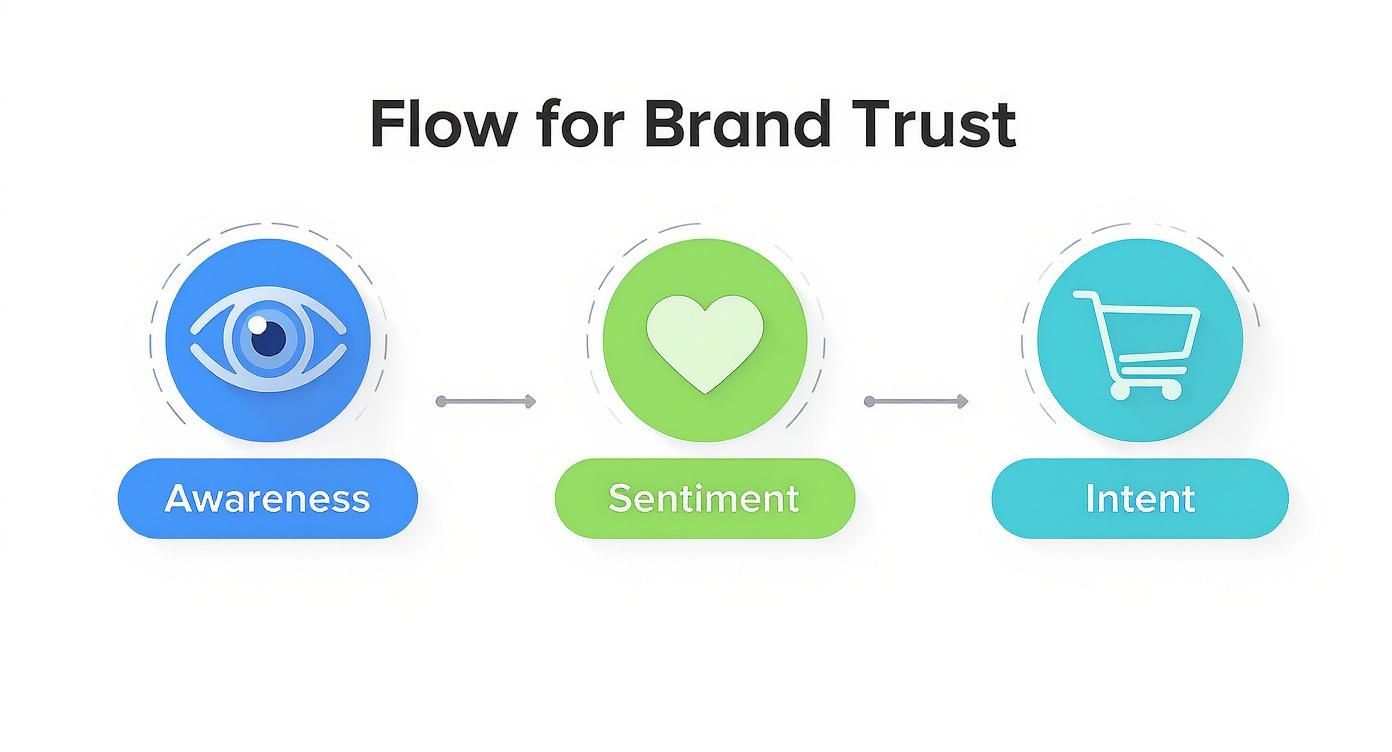
This visual flow—from the eye (Awareness) to the heart (Sentiment) and finally the shopping cart (Intent)—is a great reminder that effective brand building guides customers along a very specific path.
With your KPIs sorted, it’s time to build. Tools like Google Looker Studio (what used to be Data Studio) are fantastic because they're free and connect seamlessly with other Google products like GA4 and Search Console. You can also pull in data from social platforms and survey tools using third-party connectors. For those who operate heavily within the Salesforce ecosystem, a practical guide on how to create dashboards in Salesforce offers some valuable, platform-specific advice.
A logical layout is everything. Don't just dump charts onto the page. You need to structure your dashboard to tell that story we talked about earlier.
A great dashboard moves from high-level awareness metrics at the top down to more granular engagement and sentiment metrics below. This lets stakeholders get a quick overview or dive deeper if they need to.
Consider laying it out something like this:
To give you a clearer idea, here's a quick summary of the essential metrics you'll want to include.
| Metric Category | KPI Example | Tool for Measurement |
|---|---|---|
| Website & SEO | Branded Search Volume | Google Search Console |
| Website & SEO | Direct Traffic | Google Analytics 4 |
| Social Media | Impressions & Reach | Native social media analytics (e.g., Meta Business Suite) |
| Social Media | Share of Voice (SOV) | Social listening tools (e.g., Brandwatch, Sprinklr) |
| Direct Feedback | Aided/Unaided Awareness | Survey platforms (e.g., SurveyMonkey, Attest) |
| Direct Feedback | Brand Sentiment | Social listening tools |
Pulling these KPIs together provides a comprehensive, at-a-glance view of how your brand is perceived and discovered across the board.
A dashboard is only useful if it actually helps you make better decisions. To turn it into a real strategic asset, you need to add context and segmentation.
Don't just show the numbers; show what they mean. Use scorecards to highlight month-on-month or year-on-year changes. A 15% increase in direct traffic feels much more significant when it's presented that way.
Even better, segment your data to uncover deeper insights. Break down your website traffic by demographic or geographic location. Which city is showing the most brand interest? Are your latest campaigns resonating more with a specific age group? Connecting this data back to the customer journey can reveal some incredibly powerful opportunities for optimisation. For a deeper dive, using effective customer journey mapping tools can help you visualise these pathways.
Finally, set realistic goals and benchmarks directly within your dashboard. If your goal is to increase unaided awareness by 10% this quarter, your dashboard should clearly track your progress towards that target. This simple step transforms your dashboard from a backwards-looking reporting tool into a command centre for your entire brand strategy. It allows you to spot trends, benchmark performance, and, most importantly, clearly communicate your impact to stakeholders.
Getting your head around brand metrics can feel like wading through fog, especially when you're trying to put a formal process in place for the first time. Let's clear the air and tackle some of the most common questions we hear from businesses, giving you some straightforward answers to get you moving.
If you're starting from a blank slate, the worst thing you can do is try to measure everything all at once. The trick is to establish a simple, free baseline using tools you probably already have.
Kick things off with Google Analytics 4 (GA4) and Google Search Console. You're looking for just two numbers to begin with:
Just track those two metrics for a month. That’s it. That's your starting line. From there, you could launch a simple one-question poll on social media asking, "Have you heard of [Your Brand Name]?" to get your first taste of direct feedback.
Your initial goal isn’t perfection; it’s about building momentum. Get a baseline with data that’s easy to grab, and you’ll have a foundation to build on and compare against down the track.
This is the million-dollar question, isn't it? Brand awareness is a long game, not an overnight sensation. It’s completely different from a direct response campaign where you can see sales roll in within hours. The impact of brand-building efforts reveals itself much more slowly.
As a general rule, you should be looking for meaningful shifts over quarters, not weeks. For a solid, sustained marketing campaign, you might spot some early signs like a lift in social media reach within the first month. But for a noticeable jump in core metrics like unaided recall or direct traffic, you're likely looking at six months to a year of consistent, focused effort. Patience is your best friend here.
Honestly, neither is more important—they're two sides of the same coin. Believing you have to pick one over the other is a trap many businesses fall into.
Seeing a spike in direct traffic (the 'what') is fantastic news. But a survey revealing that customers are visiting because they heard a glowing review from a mate (the 'why') gives you a much richer, more powerful insight you can actually act on. You should always aim to pair your analytics with genuine human feedback to get the full picture.
At Virtual Ad Agency, we specialise in helping Australian businesses translate abstract brand metrics into a clear roadmap for real growth. If you’re ready to build a measurement framework that ties awareness directly to your bottom line, take a look at our full-funnel marketing solutions. Learn more about our services.

 previous